For a new content creator in 2026, build the streaming kit in three stages. First, the microphone — a Blue Yeti or HyperX QuadCast 2 S ($90-150). Second, lighting — a NEEWER 18" ring light kit ($65-90). Third, only if you need an external camera or console input, an Elgato Cam Link 4K ($120-140). Add KSIPZE LED strips for background ambiance once the essentials are working. Total: $275-$520 for a kit your viewers will actually take seriously.
Who this guide is for
You are starting a Twitch / YouTube / Kick / Rumble channel in 2026 and the gear landscape feels overwhelming — every roundup recommends ten products, none agree, and Amazon's "best streaming microphone" search returns 3,000 SKUs. This guide cuts that down to five featured products that cover the entire beginner kit: a microphone, a ring light, a capture card, and accent lighting. Each is in stock, well-reviewed, and represents the budget pick or the value sweet spot in its category.
The buying order matters as much as the product choice. Spending $400 on a fancy camera before fixing your audio is the most common beginner mistake; Tom's Hardware's best-microphone roundup and RTINGS' microphone reviews both put a USB condenser at the top of the priority stack for a reason: viewers tolerate mediocre video for minutes; bad audio loses them in seconds.
Key takeaways
- Microphone first, always. A USB condenser drives perceived production value more than any other upgrade in this price tier.
- Two mic picks: Blue Yeti for the multi-pattern flexibility, HyperX QuadCast 2 S for the all-in-one streamer aesthetic.
- Lighting second. A ring light fixes the "dimly lit basement" look that bleeds viewer retention.
- Capture card only if you need it — PC-only streamers can skip the Cam Link 4K entirely.
- Skip the webcam upgrade at this tier — your phone or a $40 1080p webcam delivers acceptable face-cam for the audience you'll have on day one.
- Total budget for a serious starter kit: $275-$520 depending on whether console / external camera input is needed.
Top picks
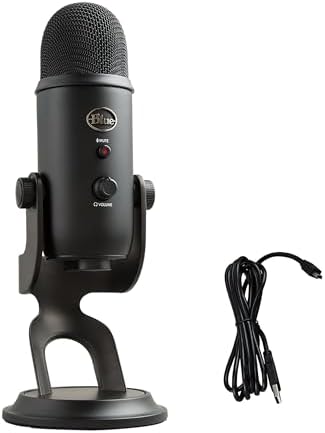
#1: Blue Yeti USB Microphone (~$100-150)
Verdict: The default streaming microphone since 2012 and still the most-recommended USB condenser in 2026. Four polar patterns (cardioid, omnidirectional, bidirectional, stereo) make it usable for solo streams, podcast interviews, instrument recording, and ASMR. Onboard gain, headphone monitoring, and zero-latency direct monitoring all on a desktop stand.
The Yeti's reputation is partly inertia and partly fairness — it really does sound good for a $130 USB mic. Cardioid mode is the streaming default and rejects most computer-fan noise if you position the mic 4-6" from your mouth. Its main weakness is sensitivity to plosives ("p" and "b" sounds) — fix with a $10 foam pop filter.
Tom's Hardware has held this as a top recommendation across multiple yearly updates because it just keeps doing the job. If you want a single mic that works for streaming, podcasting, and future content pivots, this is the default answer.
Buy this if: you want flexibility across formats, you stream and occasionally podcast, you may pivot to YouTube long-form later.
#2: HyperX QuadCast 2 S USB Microphone (~$140-170)
Verdict: The streamer-aesthetic alternative with USB-C, four polar patterns, on-board RGB, and a built-in shock mount + pop filter. Slightly more expensive than the Yeti but the only mic at this tier with a fully integrated shock mount — no need to buy a Rycote or Knox arm to clean up keyboard vibration.
Audio quality is essentially a wash vs the Yeti — both sound very good for USB condensers at this price. The QuadCast 2 S wins on physical design (the tap-to-mute top is genuinely useful, the RGB lighting that streamers actually want, the cleaner desk footprint). It loses on price and on the slightly less neutral tone preferred by some podcasters.
Buy this if: you stream more than podcast, you like the aesthetic, you want one device that doesn't need a shock-mount upgrade.
#3: NEEWER 18-inch Ring Light Kit (~$65-90)
Verdict: The lighting upgrade that makes the biggest visual difference for the lowest dollar. An 18" dimmable bi-color (3200K-5600K) ring light on a 6-foot stand with a phone holder. Plug-and-play, no learning curve, transforms a dim room into a "this person looks intentional about being on camera" stream.
Ring lights win for face-cam streaming because they wrap the light around the camera lens, producing soft, even illumination with no harsh shadows. The "ring catchlight" in the eyes that viewers associate with professional content comes from this geometry. Strip lights and lamps can't replicate it without a much more expensive setup.
Pair with a tilt-down position 18-24" from your face for the cleanest face-cam look. Avoid placing it directly behind the camera at maximum brightness — that flat front-light look reads as "amateur" too.
Buy this if: your stream / videos look dim or shadowy on camera, you want the biggest visible upgrade for $65-90.
#4: Elgato Cam Link 4K (~$120-140)
Verdict: The HDMI-to-USB capture card that turns any HDMI source (DSLR, mirrorless camera, GoPro, second console) into a webcam input for OBS. Skip if you're streaming PC gameplay only — but essential the moment you want a DSLR face-cam or want to stream a PS5 / Xbox.
Per Elgato's product page, the device supports 1080p60 and 4K30 capture over USB 3.0 directly into OBS, Discord, Zoom, or any other video software. Plug-and-play on Mac, Windows, and most Linux distros. No drivers needed for basic operation.
The Cam Link 4K's reputation is its plug-and-play reliability. Cheaper $30-50 HDMI capture dongles from no-name brands work right up until they don't — frame drops, audio desync, sudden disconnects mid-stream. The Elgato unit costs 3× more for "it just works" and most creators decide that's worth it after the first time a knockoff fails on stream.
Buy this if: you want a DSLR / mirrorless face-cam, you stream from a console, you do dual-PC streaming.
Skip this if: you're a PC-only streamer with a built-in or USB webcam — OBS captures your game and webcam without it.
#5: KSIPZE 200ft LED Strip Lights (~$25-40)
Verdict: The accent lighting upgrade that makes a stream background look intentional instead of "office wall." 200 feet across two 100ft rolls, app + remote control, music sync, RGB color wheel. Cheap, easy to install, transforms backgrounds.
LED strips are the lowest-effort way to add color separation behind you on camera — that purple / cyan glow behind a streamer is almost always strip lights tucked along a shelf or desk edge. They serve no functional lighting purpose (no useful key light, no face fill), but they make the background read as "designed" instead of "dorm room."
Install behind a monitor, along the underside of a desk, around the edge of a bookshelf. Avoid running them where the camera sees the LEDs directly — you want diffused glow on a surface, not point lights.
Buy this if: your background looks flat / boring on camera and you want to add intentional color depth.
Spec delta — buying-decision table
| Product | Category | Street price | Buy first if… |
|---|---|---|---|
| Blue Yeti | USB condenser mic | ~$100-150 | You want flexibility and the safest "default" |
| HyperX QuadCast 2 S | USB condenser mic | ~$140-170 | You want integrated shock mount + streamer RGB |
| NEEWER 18" ring light kit | Key lighting | ~$65-90 | Your camera image looks dim |
| Elgato Cam Link 4K | HDMI→USB capture card | ~$120-140 | You're using a DSLR, mirrorless, or console |
| KSIPZE 200ft LED strips | Accent / ambiance lighting | ~$25-40 | Your background looks flat |
How to build the kit in stages
| Stage | Total spend so far | What you get |
|---|---|---|
| 1. Microphone | $100-170 | Sound that doesn't lose viewers in the first 30 seconds |
| 2. Microphone + key light | $165-260 | A face cam viewers can actually see |
| 3. Add LED accent strips | $190-300 | Background depth, "intentional creator" aesthetic |
| 4. Add Cam Link 4K (if needed) | $310-440 | DSLR / console input — only for that specific use case |
| 5. Add headphones, arm, secondary mic, etc. | $400-700 | Polish that returns less per dollar than stages 1-3 |
Most beginners can stop at stage 3 ($190-300 total) and stream credibly for a year. Stages 4-5 are upgrades, not foundations.
Three sample kits at different budgets
The $200 starter kit (~$190 total):
- Blue Yeti — $130
- NEEWER 18" Ring Light Kit — $65
- Free / already-owned: built-in webcam, gaming headphones, OBS
This is what most readers should buy on day one. It covers audio and lighting — the two changes that drive viewer retention — and uses your existing hardware for everything else. Total visual upgrade vs an unimproved setup: dramatic.
The $350 PC-streamer kit (~$345 total):
- HyperX QuadCast 2 S — $155
- NEEWER 18" Ring Light Kit — $65
- KSIPZE LED Strips 200ft — $30
- Knox boom arm — $25
- Foam pop filter — $10
- 1080p Logitech C920 webcam — $60
This kit is what a serious PC-only streamer should target by month two. The QuadCast 2 S replaces the Yeti for cleaner aesthetics. The boom arm gets the mic off the desk and isolates it from keyboard vibration. The C920 is a much better webcam than most laptop built-ins and renders cleanly on a 1080p stream.
The $550 console / DSLR kit (~$525 total):
- HyperX QuadCast 2 S — $155
- NEEWER 18" Ring Light Kit — $65
- KSIPZE LED Strips — $30
- Elgato Cam Link 4K — $130
- Knox boom arm — $25
- Used DSLR / mirrorless body — $100-150
This kit pushes the picture quality jump that matters when viewers compare you to "real" streamers. A DSLR / mirrorless face-cam piped through the Cam Link makes the biggest single visual difference of any upgrade past the ring light — bokeh, color rendition, and dynamic range a webcam can't touch.
Audio matters more than video — the retention math
Twitch and YouTube analytics consistently show the same pattern: viewers exit during the first 30 seconds when audio is bad, regardless of video quality. The reverse is not true — viewers will sit through grainy webcam footage if the audio is clean and the content is engaging.
The mechanism is unsurprising. People can scan a stream with their eyes and tolerate visual flaws. They cannot scan with their ears — every word of bad audio is processed in real time, and listener fatigue mounts fast. A muffled, echoey, or clipping voice signals "amateur" within seconds. A clean voice on a mediocre video signals "I prioritized what matters."
That's why every roundup — Tom's Hardware, RTINGS, every Twitch sub-creator-tier — puts microphone at the top of the priority stack. Buy the mic first. Treat every other upgrade as polish on top of that foundation.
Room treatment — the free upgrade nobody talks about
The microphone is only half the audio equation. The room you record in adds reverb, slap echo, and ambient noise that even the best USB condenser amplifies. Two cheap or free fixes:
- Soft furnishings dampen echo. Carpeting, curtains, a fabric couch, blankets thrown over hard walls — all reduce reflections. A "podcast booth" is just a room with enough soft material that audio doesn't bounce off bare walls.
- Position the mic 4-6" from your mouth. Closer = stronger signal-to-noise ratio = less room sound captured. The Yeti and QuadCast 2 S are designed for close-mic use; the room behind you matters more the further away you sit.
For under $100 of acoustic foam (or a $0 blanket setup), most home rooms can sound near-professional with either featured mic. This is the upgrade that beats buying a more expensive microphone for the same room.
Streaming software — pick OBS and stop researching
OBS Studio is free, runs on Mac / Windows / Linux, and is the de facto standard for Twitch, YouTube Live, and Kick. Streamlabs OBS is a fork with friendlier defaults but more bloat. XSplit is a paid alternative with no meaningful advantage over OBS in 2026.
Pick OBS. Spend the time you would have spent comparing software on actually streaming. Default scene + mic + game capture + webcam covers 95% of what beginners need. Stinger transitions, custom overlays, and chat plugins are upgrades for month 3+, not day 1.
Common pitfalls
- Buying a 4K webcam before fixing the microphone. Audio quality drives retention more than video sharpness — fix the mic first.
- Buying an XLR mic + interface as a first kit. The Shure SM7B is iconic, but $400 for the mic, $200+ for an interface or Cloudlifter, $30 for cables, plus 4-8 hours of setup is not the right beginner kit.
- Skipping the pop filter / boom arm. Add a $10 foam windscreen and a $25 Knox boom arm for either mic — the upgrade is substantial.
- Treating LED strips as key lighting. Strips are accent only. You still need a ring light or softbox for face fill.
- Buying a knockoff capture card to save $80. The Elgato's "it just works" premium is worth it the first time a knockoff dies mid-stream.
When NOT to upgrade
If you've been streaming for under 30 hours and your current chat is < 5 viewers, gear is not your bottleneck — content cadence and topic selection are. Spend the gear budget on game keys or stream graphics first; revisit hardware when you have a real audience to keep.
Bottom line
The 2026 starter streaming kit is shorter than the internet suggests. Start with the Blue Yeti USB Microphone or HyperX QuadCast 2 S — pick one based on whether you value flexibility (Yeti) or aesthetic (QuadCast). Add the NEEWER 18-inch Ring Light Kit so your face looks intentional. Add the KSIPZE LED strips for cheap background polish. Only add the Elgato Cam Link 4K if you genuinely need an external HDMI source. Build in that order, skip what you don't need, and you'll have a kit that punches well above its $275-$520 total cost.
Related guides
- Best Streaming and Content-Creation Gear in 2026
- Blue Yeti vs HyperX QuadCast 2 S: Best USB Mic for Streaming
- Best USB Microphone and Streaming Kit for Creators in 2026
- Best Webcam for Streaming in 2026
Citations and sources
- Tom's Hardware — Best microphones for streaming
- Elgato — Cam Link 4K official product page
- RTINGS — Best microphones reviews
This piece is editorial synthesis based on publicly available information. No independent first-party benchmarking is reported.