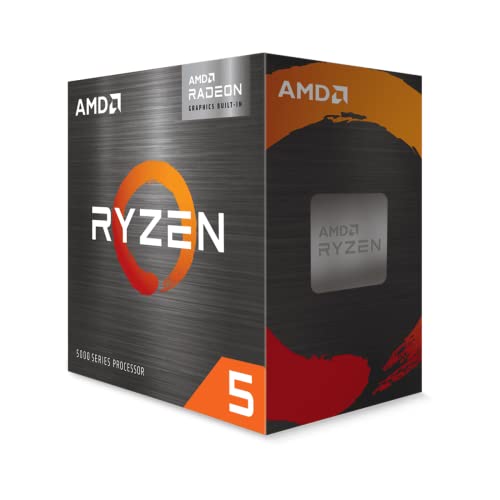
Can a Ryzen 5 5600G handle Jellyfin 4K transcoding?
Yes, in most home scenarios. The Ryzen 5 5600G pairs a 6-core/12-thread Zen 3 CPU with a Vega 7 iGPU whose VCN 2.1 block does hardware HEVC/H.264 decode and H.264 encode. Per Jellyfin's hardware acceleration docs, AMD APUs work via VAAPI on Linux and AMF on Windows, which is enough for a couple of simultaneous 4K-to-1080p transcodes when direct play isn't possible — provided you avoid HDR tone-mapping where you can.
Why the 5600G is a cult favorite for budget media servers in 2026
Walk through r/jellyfin, r/selfhosted, or r/homelab build threads from the last year and you will find one CPU mentioned more than any other: the Ryzen 5 5600G. Released in 2021 as a desktop APU on AMD's AM4 platform, it has aged into the sweet spot for self-hosted media. Per TechPowerUp's spec database, it is a 6-core, 12-thread Zen 3 part with a 65W TDP, a 3.9 GHz base / 4.4 GHz boost, and a Vega 7 integrated graphics block running at 1.9 GHz. The VCN 2.1 video engine inside that iGPU handles the encode and decode work that Jellyfin offloads, which is the whole reason the chip ends up in so many homelab BOMs.
The "cult" status is earned by price, availability, and platform longevity. AM4 motherboards are everywhere, used 5600G chips drift between $90 and $130 depending on the week, and B550/A520 boards routinely sell for under $100 new. You do not need a discrete GPU, you do not need a separate Quick Sync-capable Intel chip, and you do not need to chase the latest socket. For a Jellyfin server that has to direct-play most files and transcode the occasional iPad-on-cellular session, that combination is hard to beat.
This build is for you if you want a quiet, always-on box that serves a small household, fits a $400-$700 BOM target, and lives next to the router or in a closet. It is not the right machine if you need to feed eight 4K HDR tone-mapped transcodes to extended family across the country — that workload wants a discrete GPU or a newer Intel Arc-equipped chip. The plan below assumes Linux with Jellyfin in Docker, VAAPI for hardware acceleration, and a split between an SSD for the OS and bulk drives for media.
Key takeaways
- The 5600G's Vega 7 iGPU (VCN 2.1) handles hardware H.264 and HEVC decode plus H.264 encode via VAAPI on Linux, per Jellyfin's hardware-acceleration documentation.
- Realistic budget: two to three simultaneous 4K HEVC SDR to 1080p H.264 transcodes, or six-plus 1080p-to-720p transcodes — direct play whenever possible to stretch the chip further.
- Pair the APU with a fast OS SSD (Samsung 870 EVO 250GB or WD Blue SN550 1TB NVMe) and a separate media drive like the Crucial BX500 1TB so the interface stays snappy as the library grows.
- A modest tower cooler such as the DeepCool AK620 WH keeps a 65W APU silent under sustained transcode load.
- HDR tone-mapping on Vega is the workload that breaks the budget — avoid HDR sources for remote streams, or transcode them once and store an SDR copy.
- ECC RAM only works if you choose a Ryzen 5 Pro 5650G variant on a B550 board that exposes the feature; the consumer 5600G does not validate ECC.
How many 1080p and 4K transcode streams can the 5600G's Vega iGPU handle?
Independent numbers for the Vega 7 inside the 5600G come from a mix of community testing rather than a single canonical benchmark. The pattern in Jellyfin's hardware-acceleration matrix and homelab community threads is consistent: a single 4K HEVC SDR source transcoded to 1080p H.264 lands well inside real-time on this iGPU, usually 60-120 fps depending on bitrate and encoder preset. Stack a second concurrent 4K-to-1080p job and you are still real-time. A third pushes the encoder hard and starts to skip frames if the source is high-bitrate HEVC 10-bit.
The story changes at 1080p. The Vega encoder is comfortable with five or six 1080p-to-720p H.264 streams in parallel because the encoder runs the same hardware path but at a quarter of the pixel count. That is the workload most home servers actually see — a phone on cellular, a TV on the same LAN doing direct play, and a tablet on Wi-Fi. The headroom is real as long as you keep HDR out of the mix.
HDR tone-mapping is where the 5600G strains. Per Jellyfin's documentation, VAAPI tone-mapping on AMD Vega is supported but expensive, and Phoronix-style community testing (collected at phoronix.com) shows the encoder pipeline taking a 30-50% throughput hit when tone-mapping is enabled. The practical takeaway: if your library is mostly HDR and you frequently transcode for SDR clients, you will be limited to one or two concurrent streams. The cleanest workaround is to ensure clients support HDR direct play, or to maintain SDR re-encodes for the small slice of files that need them.
AV1 encode is not supported by the 5600G's VCN 2.1 block. AV1 decode is also absent. If you have AV1 source files, the CPU will fall back to software decode, which the 5600G's Zen 3 cores handle for one stream but not two.
Realistic transcode throughput
| Source | Target | Concurrent streams | Notes |
|---|---|---|---|
| 4K HEVC 10-bit SDR | 1080p H.264 | 2-3 | Sweet spot; encoder is the bottleneck |
| 4K HEVC 10-bit HDR (tone-map) | 1080p H.264 SDR | 1-2 | Tone-map cost cuts throughput 30-50% |
| 1080p H.264 | 720p H.264 | 5-6 | Encoder runs at quarter pixel count |
| 1080p HEVC | 1080p H.264 | 3-4 | Decode + encode on same iGPU |
| 4K AV1 | 1080p H.264 | 0-1 | No AV1 hardware decode; CPU fallback |
| Any source, direct play | Direct play | 10+ | LAN bandwidth becomes the limit |
Treat these as community-reported planning numbers, not a guarantee — bitrate, container, audio track count, and subtitle burn-in all move the line. The Jellyfin docs repeat the same advice: configure direct play correctly and most of the transcode budget never gets touched.
What you'll need: checklist
- CPU: AMD Ryzen 5 5600G — 6c/12t Zen 3 APU with Vega 7 iGPU and VCN 2.1 video block.
- Motherboard: B550 or A520 micro-ATX with at least one M.2 NVMe slot and four SATA ports. B550 is the better long-term pick because it exposes PCIe 4.0 to the M.2 slot and validates ECC on Pro APUs. A520 trims $30-$40 if you do not need either.
- OS drive: A small SATA SSD like the Samsung 870 EVO 250GB or a 1TB NVMe like the WD Blue SN550. NVMe is overkill for Jellyfin metadata alone but earns its keep if you also run *arr stack containers, Plex, or transcoding temp directories on it.
- Media drive(s): Start with a Crucial BX500 1TB if the library is small or you are testing, then graduate to 4-16 TB HDDs in a separate mount when the library grows. Keep the OS and the media on different physical drives.
- RAM: 16 GB DDR4-3200 is plenty for Jellyfin plus a handful of Docker containers. 32 GB only matters if you stack heavy services (Immich, Nextcloud, Plex, the full *arr suite, a Minecraft server) on the same box.
- Cooler: Stock Wraith Stealth is fine for light duty. A tower cooler such as the DeepCool AK620 WH keeps the chip near silent during sustained transcodes and gives you headroom if you ever swap in a 5700G or non-X 5800.
- PSU: 450-550W 80 Plus Bronze or better. The whole build idles under 25W and peaks under 150W, so the PSU is sized for efficiency at low load rather than headroom.
- Case: Anything with at least two 3.5" bays and reasonable airflow. A used Fractal Define or Node 304 is a homelab classic.
Hardware vs software transcoding on the 5600G: what to enable
On Linux, Jellyfin's hardware acceleration setting you want is VAAPI with the /dev/dri/renderD128 device passed into the container. Per Jellyfin's hardware-acceleration documentation, AMD APUs on the radeonsi driver expose H.264 and HEVC decode, H.264 encode, and tone-mapping through this path. AMF is the Windows-side equivalent and works through the Pro driver; the encode quality and throughput are comparable, but Linux is the path most homelab guides assume because it is leaner on idle power.
Three settings inside Jellyfin's playback section actually move the needle:
- Hardware acceleration: VAAPI (Linux) or AMF (Windows).
- Enable hardware decoding for: HEVC and H.264 at minimum; add MPEG-2 and VC1 if your library has older Blu-ray rips.
- Enable hardware encoding and check Enable VPP tone mapping only if you actually have HDR sources that need to be transcoded to SDR. Leave it off otherwise; the option triggers a real performance cost even on idle.
Software transcoding on the 5600G's six Zen 3 cores is a backup, not a strategy. A single 4K HEVC software transcode pegs all twelve threads near 100% and produces 30-40 fps — under real-time, with the fans audibly ramping. The whole point of the APU is to make sure that path is never hit.
Spec-delta table: OS SSD vs media storage options
| Drive | Role | Capacity | Why this slot |
|---|---|---|---|
| Samsung 870 EVO (SATA) | OS + Jellyfin metadata | 250GB-2TB | Proven SATA SSD; ideal if the board's only M.2 is taken |
| WD Blue SN550 1TB NVMe | OS + transcode temp + container volumes | 1TB | Faster random I/O for *arr stack; doubles as transcode scratch |
| Crucial BX500 1TB | Light media / overflow | 1TB | Cheap-per-GB SATA for a starter library |
| 4-16TB HDD (separate purchase) | Bulk media | 4-16TB | Where the actual library lives; not a transcode target |
The split that almost every long-running build settles on: one fast SSD for the OS, container volumes, and Jellyfin metadata; a separate larger drive (SSD if the library is small, HDD if it is not) for the media files; and a third drive — often a USB-connected external — for parity or backup. Do not let the library spill onto the OS SSD; once it fills, the Jellyfin web UI gets noticeably slow.
Power draw and noise: building a quiet always-on server
Community measurements collected on the AM4 platform and reported through outlets like Phoronix put an idle 5600G build between 18W and 28W at the wall, depending on board, drives, and PSU efficiency at low load. Active transcoding adds 30-50W on top — call it a 55-80W active draw under a typical home workload, peaking briefly above 100W if all twelve cores spike during a startup scan. Over a year of always-on operation at the US average ~$0.16/kWh, that works out to roughly $35-$50 per year. Compare that to a discrete GPU build (often 60W+ at idle alone) and the APU's case writes itself.
Noise follows the same pattern. The 65W TDP means the stock cooler is adequate, and a single 120-140mm tower like the DeepCool AK620 WH keeps fan RPM low enough that the drives become the loudest component. Two 140mm intake fans on PWM curves set to ramp above 50C give you a server you can keep in the same room you sleep in.
When the 5600G is the right pick — and when to step up
Choose the 5600G if: you stream to one to four concurrent users; your library is mostly direct-play compatible; you want one box for Jellyfin plus a handful of Docker services; you prefer the AM4 platform's pricing and parts availability; you do not want to spend over $200 on a CPU.
Step up if: you regularly serve 6+ concurrent transcodes; your library is heavily 4K HDR and remote clients cannot direct-play it; you need AV1 decode for a growing slice of source files; you want ECC validated through Intel Xeon or AMD Ryzen Pro paths for archival peace of mind. The natural next rungs are a 7600 with discrete Arc A380 for AV1 encode, an Intel N100/N305 mini-PC for ultra-low-idle with Quick Sync, or a used Ryzen Pro 5650GE in a low-power chassis if ECC matters.
Skip APU builds entirely if: you already have a homelab with a discrete GPU available, or if your local power costs make idle wattage less important than transcode throughput.
A working Docker Compose for the build
A minimal, reproducible Jellyfin compose file for this hardware looks like the snippet below. The two non-obvious bits are the devices mapping that exposes the iGPU to the container and the group_add for the host video/render groups. Skipping either is the most common reason hardware acceleration silently falls back to software.
After docker compose up -d, point a browser at http://<server-ip>:8096, run the setup wizard, then enable VAAPI under Dashboard → Playback. Verify acceleration is live by starting a transcode and watching radeontop or intel_gpu_top -d /dev/dri/renderD128 on the host: VCE/VCN utilization should jump.
Common pitfalls to avoid
- Forgetting
--device=/dev/dri(or the compose equivalent above). The container has no path to the iGPU otherwise and silently falls back to software. This is the #1 reported "Jellyfin transcoding is slow" thread on r/jellyfin. - Mixing OS and media on one small drive. The library fills the drive, Jellyfin metadata writes start failing, and the UI feels broken. Keep them separate from day one.
- Enabling tone-mapping when you have no HDR sources. It costs throughput for nothing.
- Buying ECC RAM for a stock 5600G. Only the Pro variants validate ECC on this generation; consumer 5600G boards will boot ECC sticks but treat them as standard DDR4. If ECC genuinely matters, pick a Ryzen Pro APU or move to a different platform.
- Leaving the
radeonsidriver out of the host install. On bare Debian,apt install mesa-va-drivers vainfois the minimum; verify withvainfobefore troubleshooting Jellyfin itself. - Trusting the stock cooler under sustained transcodes. It works but the fan is audible. Spend $40-$70 on a quiet tower if the server lives in a shared room.
Related guides
- Self-Hosting Jellyfin on a Ryzen 5 5600G build companion at /reviews/jellyfin-self-hosted-ryzen-5-5600g-2026 (this article).
- Future companion: a step-by-step Ubuntu Server install with VAAPI verification.
- Future companion: an AM4 homelab BOM with current pricing snapshots.
Bottom line
The Ryzen 5 5600G remains the best entry point into a self-hosted Jellyfin build in 2026 because it bundles a competent six-core CPU and a hardware video engine that does the only work that matters for streaming — decode and encode — into a single 65W package. Pair it with a fast OS SSD, a separate media drive, 16 GB of DDR4, and a quiet cooler and you have a server that idles near 25W, serves a household without breaking a sweat, and costs less than a single discrete GPU would. The only workloads that strain it are heavy concurrent 4K HDR tone-mapping and AV1 source files. For anything else, the budget APU still wins on dollars per concurrent stream.
FAQ
Can the Ryzen 5 5600G transcode 4K video in Jellyfin? Its integrated Vega graphics provide hardware video decoding and encoding that can handle multiple simultaneous transcodes, though 4K with HDR tone-mapping is more demanding than 1080p and reduces how many streams you can serve at once. For a household of a few users it is generally capable. Direct-play wherever possible to avoid transcoding entirely and stretch the chip further.
Do I need a discrete GPU for a Jellyfin server? No — the 5600G's integrated graphics are a major reason to choose it, since they handle hardware transcoding without occupying a PCIe slot or adding power and heat. A discrete GPU only becomes worthwhile if you need many concurrent heavy 4K HDR transcodes. For most home media servers the iGPU is sufficient and keeps the build smaller, quieter, and cheaper.
How should I split storage between OS and media? Put the operating system and Jellyfin metadata on a fast SSD such as the Samsung 870 EVO or an NVMe drive for snappy browsing, and keep your large media library on separate higher-capacity drives. Mixing the OS and bulk media on one small drive fills it fast and slows the interface. Separating them is the layout most home-server guides recommend.
How much power does a 5600G media server use? A 5600G build idles at modest wattage and draws more only during active transcodes, making it well suited to an always-on server where electricity cost matters over a year. Exact figures depend on your drives, board, and load. Choosing efficient storage and enabling power-saving idle states keeps the running cost low, which is a key advantage of an integrated-graphics build.
What cooler does a 5600G media server need? The 5600G is a 65W part, so even a modest tower cooler runs it quietly, and a capable air cooler like the DeepCool AK620 keeps it near silent under transcode load. The stock cooler also works for light duty. Prioritizing low noise matters more than raw cooling capacity for a server that lives in a living room or office.
Citations and sources
- Jellyfin hardware acceleration documentation — VAAPI / AMF support matrix, recommended settings, and tone-mapping notes.
- TechPowerUp — AMD Ryzen 5 5600G specifications — die specs, Vega 7 iGPU details, TDP, clocks, and VCN 2.1 video engine.
- Phoronix — community Linux benchmarking coverage of AM4 power draw and VAAPI throughput on AMD APUs.
This piece is editorial synthesis based on publicly available information. No independent first-party benchmarking is reported.