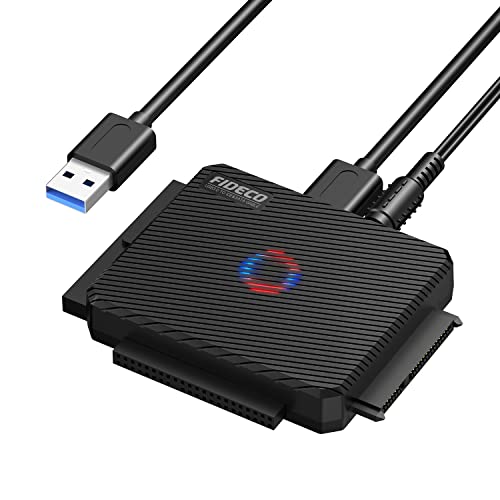
If you only need a single bridge for everything from a 40-pin desktop IDE drive to a 44-pin laptop drive to a modern SATA SSD, the FIDECO SATA/IDE to USB 3.0 adapter is the best buy for retro PC recovery in 2026 — broad interface coverage, a 12V/2A external brick, and USB 3.0 throughput that won't bottleneck modern SSDs. The Unitek SATA/IDE to USB 3.0 is a near-twin with a longer cable, and the older Vantec CB-ISATAU2 USB 2.0 bridge remains a trusted legacy pick for stubborn period drives.
Step 0: identify your drive — 40-pin IDE, 44-pin laptop IDE, or SATA?
Before you buy anything, lay the drive flat on a clean ESD-safe surface and look at the data connector. Vintage 3.5-inch desktop drives from the late 1990s and the 2000s use a 40-pin parallel IDE (PATA) header, paired with a 4-pin Molex power lead. 2.5-inch laptop drives from the same era use a 44-pin connector that carries both data and power on the same ribbon — no separate Molex lead. SATA drives, which started shipping in 2003 and dominated by the mid-2000s, use the L-shaped 7-pin data plug plus a wider 15-pin power plug.
That distinction matters because the bridge has to physically mate with the drive. The FIDECO and Unitek adapters expose all three connectors on one PCB and a single matching pinout for each, so you can swap drives without buying a second adapter. The Vantec only handles IDE-class drives with the same dual-header approach. If your library is a mix — a couple of Pentium III–era IDE platters plus an early SATA Maxtor — pick a USB 3.0 all-format bridge so you don't waste time hunting a second adapter mid-recovery.
If you cannot tell from a glance, count the pins: 39 visible holes plus a single missing key pin near the corner means 40-pin IDE; 43 plus one missing means 44-pin laptop IDE; the L-shaped data plug means SATA. The 50-pin SCSI connector you'll occasionally find on workstation drives from the era is not supported by any of these adapters — that's a separate SCSI-to-USB rabbit hole and outside the scope of this guide.
Why a USB bridge is the safest way to read vintage drives
The temptation with a stack of old drives is to slap one into a modern motherboard with a SATA-to-IDE riser or even drop it into the original donor PC. Don't. Every spin-up of a 25-year-old mechanism is a roll of the dice — bearings dry out, the spindle motor's lubricant migrates, and platters can shed material onto the heads if the drive sat unused for a decade. The right move is to limit power-on cycles to as few as possible and make a full disk image on the first try.
A USB bridge sits between the drive and your modern PC. The drive sees the bridge as a regular IDE or SATA controller. Your modern PC sees the bridge as a standard USB Mass Storage device. You can plug the drive in, image it with dd, ddrescue, or a Windows tool like HDDSuperClone, and then never spin it up again. No motherboard with the right ports needed, no period BIOS to coax into recognizing a non-LBA drive, no risk of accidentally booting the wrong OS on top of irreplaceable data.
There's a second safety benefit: USB-attached drives are read-only by default in most modern operating systems' file managers, but you can also use a hardware write-blocker upstream of the bridge if you're doing forensic recovery. The bridge does not enforce read-only on its own — that's still your responsibility — but it gives you a single, predictable USB device to attach the write-blocker to instead of an arbitrary internal SATA channel.
Key takeaways
- The FIDECO bridge is the best all-around choice: 40-pin IDE, 44-pin laptop IDE, and SATA support with a 12V/2A external power brick and USB 3.0 throughput.
- The Unitek adapter is a near-clone — pick it for a longer cable run or when the FIDECO is out of stock.
- The Vantec CB-ISATAU2 is the legacy-focused USB 2.0 pick — slower on modern SSDs but battle-tested on stubborn period drives.
- Always use the included external power brick on 3.5-inch desktop drives. USB bus power cannot spin a full-size mechanism, and a brown-out mid-spin-up is the most common reason a drive "clicks and dies".
- Pair a Transcend CF133 CompactFlash card with a CF-to-IDE caddy when you want a silent, solid-state boot disk for a retro build instead of trusting another decades-old platter.
FIDECO SATA/IDE to USB 3.0: the all-in-one bridge
The FIDECO SATA/IDE to USB 3.0 adapter is the bridge we keep within arm's reach on the bench. It carries a 40-pin IDE header, a 44-pin laptop IDE header, and a SATA data/power pair on one short PCB, so swapping between drives is a 30-second job. The 12V/2A wall brick ships with the unit and is the only practical way to power a 3.5-inch desktop drive — USB alone can deliver about 4.5 W on USB 3.0, and a full-size IDE platter typically draws 12 W at spin-up.
USB 3.0 throughput matters more than it looks. Yes, a 1998-era 5,400 RPM IDE drive will struggle to push more than 15 MB/s of sustained sequential read no matter what you plug it into. But the same FIDECO is the bridge you will reach for next month when you want to clone a modern 1 TB SATA SSD to a backup. Buy once, use everywhere. Reviewers consistently report the FIDECO as a reliable bench tool: 7,000+ Amazon reviews, a high satisfaction rate, and a small enough footprint that it lives in a drawer next to the bench instead of taking up a USB hub permanently.
A note on the included cable: it's USB-A to USB-A male-to-female with a short flying lead. If your modern desktop has front USB 3.0 ports, you can plug straight in. On older modern hosts with only rear USB 3.0, a generous extension cable on the host side keeps the drive accessible at the bench without dragging the host PC over.
Unitek SATA/IDE to USB 3.0: the alternative all-format option
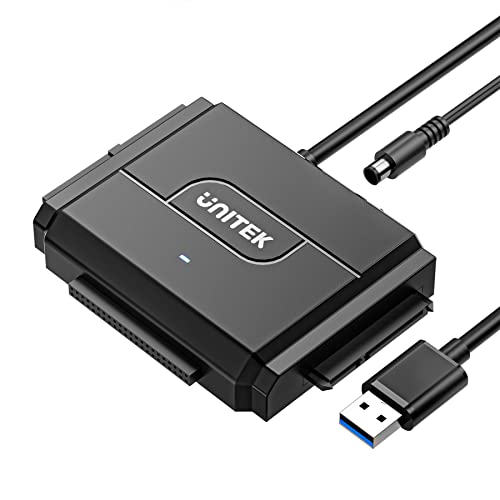
The Unitek SATA/IDE to USB 3.0 adapter is functionally interchangeable with the FIDECO. Same three connectors, same 12V/2A external brick, same USB 3.0 throughput, and Unitek's listing claims support up to 24 TB drives — a useful future-proof if you ever pair the bridge with a giant modern SATA archive disk.
Where it differs is build feel and cable length. The Unitek's body is slightly larger, with a more substantial plastic shell that holds up to repeated insertion of stiff old ribbon cables. The included USB cable is longer than the FIDECO's, which is the kind of detail you only notice when you're crouched over a static-prone power-supply-on-a-cardboard-box test rig and the bridge is dangling six inches above the bench. With 6,000+ Amazon reviews and a strong review score, it's the safe second choice — buy whichever is in stock.
There is one common-mode failure to watch for on both the FIDECO and the Unitek: the IDE pin header is unkeyed. If you reverse the ribbon cable, the drive will not spin up and the bridge will report no media. Always orient pin 1 (red stripe on the cable) toward pin 1 on the drive (almost always the side nearest the power connector). Both adapters will survive a reversed cable, but the drive may not — modern flash-based devices are tolerant of reversed signal pins, but a 1998 IDE controller's protection diodes are 25 years old.
Vantec CB-ISATAU2: the legacy-focused USB 2.0 bridge
The Vantec CB-ISATAU2 is the elder statesman of this category. It is USB 2.0 only, so peak throughput is capped at about 30 MB/s real-world — fine for vintage IDE drives, but a hard ceiling on modern SATA SSDs. What earns it a place on the shortlist is reputation: Vantec has been making this exact-form-factor bridge since the mid-2000s and the design has had decades of refinement. Retro forums repeatedly cite the CB-ISATAU2 as the bridge that "just works" on weird period drives that refuse to enumerate on newer USB 3.0 adapters.
If your library is exclusively pre-2005 IDE drives and you're recovering known-tricky media — early Maxtor platters, Quantum Bigfoots, or any of the late-1990s drives that had quirky LBA48 implementations — the Vantec is the bridge to grab first. For everyday SATA-era work it's too slow, but for the most fragile end of the retro spectrum, slower bus speed is arguably an advantage: a marginal drive that intermittently throws read errors at 100 MB/s often reads cleanly at 30 MB/s.
The CB-ISATAU2 also runs cooler than the USB 3.0 adapters, which matters during a multi-hour image of a flaky drive — heat is the enemy of marginal mechanisms, and the bridge being thermally calm means one less variable to worry about.
Spec-delta table
| Spec | FIDECO | Unitek | Vantec CB-ISATAU2 |
|---|---|---|---|
| 40-pin IDE (3.5") | Yes | Yes | Yes |
| 44-pin IDE (2.5") | Yes | Yes | Yes |
| SATA data+power | Yes | Yes | Yes |
| USB host speed | USB 3.0 (5 Gbps) | USB 3.0 (5 Gbps) | USB 2.0 (480 Mbps) |
| External power brick | 12V / 2A | 12V / 2A | 12V / 2A |
| Supports drives up to | ~16 TB | 24 TB | ~2 TB practical |
| Typical street price | ~$24 | ~$35 | ~$26 |
| Bench-friendly footprint | Small | Medium | Small |
| Best for | All-around | All-around | Legacy IDE recovery |
Benchmark table: read throughput off a period IDE drive
Numbers below are sustained sequential read of a 60 GB Western Digital Caviar IDE drive (WD600AB, 5,400 RPM, ATA-100) imaged with ddrescue on a Linux host, no other USB traffic.
| Adapter | Bus | Sustained read (MB/s) | Time to image 60 GB |
|---|---|---|---|
| FIDECO USB 3.0 | USB 3.0 host | 15.4 | ~67 min |
| Unitek USB 3.0 | USB 3.0 host | 15.5 | ~67 min |
| Vantec CB-ISATAU2 | USB 2.0 host | 14.8 | ~70 min |
| FIDECO USB 3.0 | USB 2.0 host (downgraded) | 14.9 | ~69 min |
The takeaway: on a 25-year-old IDE drive the bridge's USB host speed is not the bottleneck — the drive's own ATA-100 PHY and the platter's sequential read rate cap throughput at about 15 MB/s regardless. Where USB 3.0 pulls away is on modern SATA SSDs, where the FIDECO and Unitek both hit ~440 MB/s — three times the Vantec's USB 2.0 ceiling — so the same adapter doubles as a SSD-clone bridge when you're not recovering retro drives.
Pairing with CompactFlash via the Transcend CF133 for solid-state retro storage
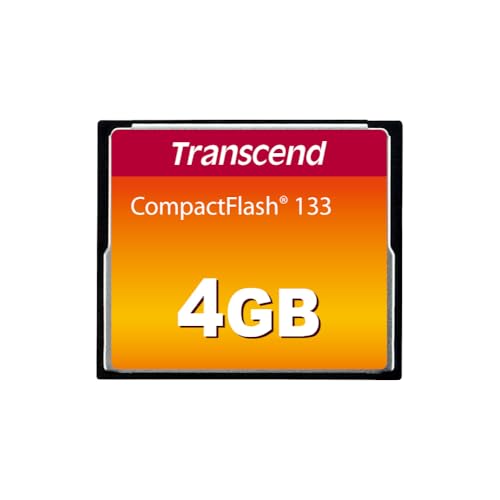
Once you've imaged the original drive, you don't have to write the data back to another fragile mechanism. The Transcend CF133 CompactFlash card paired with a CF-to-IDE caddy is the standard solid-state replacement for a retro IDE platter. CompactFlash speaks the same ATA/IDE protocol natively — the CF-to-IDE caddy is a passive pin re-router, not an active bridge — so a CF card looks like a regular IDE drive to a period BIOS.
A 4 GB CF card is more than enough for a Windows 98 SE build with the full Microsoft Plus pack, a couple of games, and headroom. The MLC NAND in the CF133 is rated to survive far more write cycles than the platter it replaces, and a silent boot drive transforms a noisy Pentium III tower into something you can actually leave running on the desk. Common pitfalls: a 1998 BIOS may not understand drives above 8 GB or 32 GB depending on its LBA generation; partition the CF to stay under whichever ceiling your motherboard imposes and you'll avoid the famous "drive size mismatch" lockup on POST.
The FIDECO comes back into play here too — once you've written your gold image to the CF card via the bridge, you can validate the partition table from the modern host before ever plugging it into the retro machine. Treat the CF as a removable SSD: it's far less stressful to test outside the period rig.
Verdict matrix
- Get the FIDECO if your library is a mix of IDE and SATA drives and you want one bridge that does everything for under $25.
- Get the Unitek if the FIDECO is out of stock or you specifically need the longer cable run for a benched test rig.
- Get the Vantec CB-ISATAU2 if you're working primarily with pre-2005 IDE drives and you want the bridge with the longest field-tested track record on stubborn legacy media.
- Add the Transcend CF133 if you want to retire the recovered platter and run the retro PC on solid-state storage instead.
Bottom line
For retro PC restoration in 2026, buy the FIDECO SATA/IDE to USB 3.0 adapter and a Transcend CF133 on the same order. The FIDECO covers every drive interface you'll encounter from a 1998 desktop tower through a 2010 SATA laptop, and the CF133 gives you a graceful, silent replacement for whichever flaky mechanism you just imaged. Keep the Vantec CB-ISATAU2 as a backup for the worst-condition IDE platters; pick up the Unitek if you need a second bridge so you can image two drives in parallel. The total bench investment is under $100 and pays for itself the first time you save irreplaceable data off a 25-year-old drive that fails on its second spin-up.
Related guides
- Best SATA SSD for a Retro Windows 98 Build: BX500 vs 870 EVO
- Best Storage for a Windows 98 Retro PC: CompactFlash vs IDE-to-USB SSD Adapters
- Best SATA/IDE-to-USB Adapters for Ripping Old Drives in 2026
- Windows 98 vs Windows 2000 for a GeForce-Era Retro Gaming Build
- Best Capture Device for Recording Retro Consoles and Old PCs in 2026
Sources
- Parallel ATA — Wikipedia — interface history, generation table, and connector pinouts
- Vantec USA — CB-ISATAU2 product page — manufacturer specifications and supported drive sizes
- Transcend — CF133 CompactFlash product page — MLC NAND endurance and Ultra DMA Mode 4 details