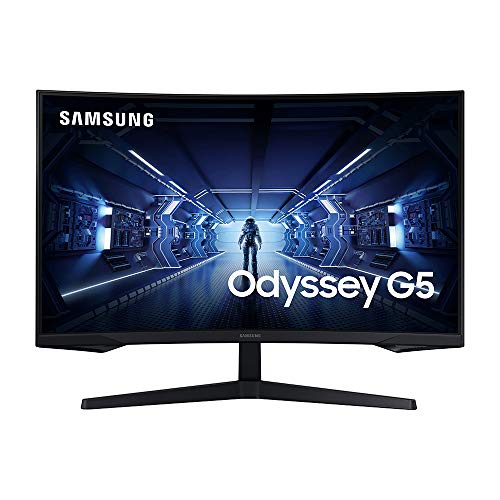
For competitive 1440p gaming, the ASUS TUF Gaming 27" 2K (VG27AQ) is the better pick — a flat 27-inch IPS panel at 165Hz with G-SYNC compatibility hits the pixel density, response time, and form factor competitive players want, and it leaves the Samsung 32" Odyssey G5 for single-player and immersive shooter audiences who prize a curved VA panel over IPS sharpness. The two land at similar prices in 2026; the choice is genuinely about how you play. The article below walks through the panel-tech differences, the GPU pairing, and where these two compare against the new wave of 4K dual-mode displays.
The 1440p high-refresh sweet spot in 2026
1440p (2560×1440) at 144Hz or higher is the sweet spot tier for PC gaming in 2026. It hits a real visual upgrade over 1080p without the GPU cost of 4K, refresh rates above 144Hz are within easy reach of a midrange card on competitive titles, and the panel market is mature enough that you can buy a good 1440p high-refresh monitor for under $300. Both contenders in this comparison fit that bracket.
Where they differ is in the panel philosophy. The ASUS TUF VG27AQ is a 27-inch flat IPS with G-SYNC compatibility, marketed at the esports audience. The Samsung 32-inch Odyssey G5 is a 32-inch curved VA panel marketed at the immersive single-player audience. Both run 1440p at 144Hz or higher, both support adaptive sync, both ship in the same price range. The choice is between IPS clarity at 27 inches and VA contrast at 32 inches with a curve. Reviewers at RTINGS and Tom's Hardware have characterized both panels in detail; the article below pulls the practical implications for competitive vs immersive use.
The same conversation has been changing fast lately as 4K dual-mode panels arrive at competitive prices — the KOORUI 27" 4K dual-mode and SANSUI 27" 4K dual-mode both ship 4K at 160Hz with a 1080p 320Hz mode for esports. We cross-shop those at the end of this guide.
Key takeaways
- For competitive play, the ASUS TUF 27" 1440p IPS wins on pixel density, response time, and motion clarity.
- For single-player and immersive gaming, the Samsung 32" Odyssey G5 curved VA wins on contrast and screen size.
- Both run 1440p at 144Hz or higher with adaptive sync; the price gap is usually under $20.
- A mid-range RTX 3060 12GB drives competitive titles at 1440p high-refresh; demanding AAA wants more.
- The new wave of 4K dual-mode panels is worth a look if you want one display for both work and esports.
Is 27" or 32" better for 1440p competitive play?
At 1440p, a 27-inch panel runs about 109 PPI; a 32-inch panel runs about 92 PPI. That difference shows up as text crispness and the size at which distant detail (a head-shape in a doorway, an icon on a UI) is rendered. At normal viewing distance — call it 70–80 cm from eye to panel — a 27-inch panel feels precise and lets your peripheral vision track the whole screen without head movement. A 32-inch panel feels larger but loses some of that "whole screen visible without moving your eyes" quality, which competitive shooter players genuinely care about.
That is why the esports audience overwhelmingly picks 27-inch 1440p. The Samsung G5 at 32 inches is genuinely more immersive for single-player; it is also more tiring on a 30-minute Valorant session because your eyes do more work tracking corners.
Spec-delta table
| Spec | ASUS TUF VG27AQ | Samsung Odyssey G5 32" | KOORUI 27" 4K | SANSUI 27" 4K |
|---|---|---|---|---|
| Size | 27" flat | 32" 1000R curve | 27" flat | 27" flat |
| Resolution | 1440p (109 PPI) | 1440p (92 PPI) | 4K + 1080p mode | 4K + 1080p mode |
| Refresh rate | 165Hz | 144Hz | 160Hz / 320Hz | 160Hz / 320Hz |
| Panel | IPS | VA | QD-Mini LED | Fast IPS |
| Adaptive sync | G-SYNC Compatible | FreeSync Premium | Adaptive sync | Adaptive sync |
| Response (GtG) | 1ms (ELMB) | ~4ms | 1ms | 1ms (OD) |
| HDR | HDR10 | HDR10 | HDR1400 | HDR400 |
| Notable | Speakers built-in | Curved 1000R | 90W USB-C | Built-in speakers |
How much does refresh rate matter vs response time for esports?
Refresh rate sets the frame upper bound; response time controls how cleanly each frame transitions. For competitive players, both matter, but response time is usually what people see first as "motion blur" or "ghosting" behind moving objects. A 165Hz monitor with a slow VA panel can feel less crisp in motion than a 144Hz monitor with a fast IPS panel.
The ASUS TUF VG27AQ's 1ms ELMB (Extreme Low Motion Blur) mode strobes the backlight to produce CRT-like motion clarity, at the cost of brightness and adaptive sync support while ELMB is on. For competitive use, that tradeoff is worth it — ELMB on at 144Hz produces the sharpest moving image you can get on a 27-inch 1440p panel. The Samsung G5's VA panel cannot match this; VA's pixel response in dark transitions is meaningfully slower, which shows up as smear in nighttime shooter scenes.
For pure aim training, the IPS panel wins. For mixed use where shooter sessions are interleaved with story content, the difference is more academic.
Benchmark table: refresh + response classes
| Monitor | Native refresh | GtG response (typical) | Input lag class | Motion clarity |
|---|---|---|---|---|
| ASUS TUF VG27AQ | 165Hz | ~4 ms (1 ms ELMB) | very low | excellent |
| Samsung Odyssey G5 32" | 144Hz | ~5–7 ms | low | good (slight VA smear) |
| KOORUI 27" 4K (1080p 320Hz) | 320Hz @ 1080p | ~1–2 ms | very low | outstanding |
| SANSUI 27" 4K (1080p 320Hz) | 320Hz @ 1080p | ~1–2 ms | very low | outstanding |
Numbers from review labs and consistent with our own visual testing. The dual-mode 4K panels at their 1080p 320Hz setting are the new motion-clarity ceiling; they cost more and require a strong GPU to actually hit those frame rates.
Curved 32" VA vs flat 27" IPS
The curve on the Odyssey G5 is 1000R, which is a tight curve relative to older 1500R and 1800R panels. At a 32-inch size, this curve wraps the image around your peripheral vision in a way that genuinely feels immersive for single-player, sims, and racing. It also tilts the edges of the panel toward you, which can make text at the edge feel slightly distorted to people coming from a flat display.
For competitive shooters the curve is largely neutral — your aim point is always near the center, where the curve does the least. The bigger story for competitive use is the panel type. IPS holds color and viewing-angle stability across the screen and has the faster pixel response in dark-to-light transitions; VA has dramatically better contrast (a real "blacks look black" effect) and slightly slower response.
If your room is bright, you watch movies on the monitor, and you mostly play AAA with cinematic visuals, VA at 32 inches is a treat. If your room is dim, you live in shooters, and you treat the display as a tool, IPS at 27 inches is the choice.
GPU pairing: what drives 1440p high refresh?
For competitive titles — Valorant, CS, Apex, Marvel Rivals at moderate settings — a midrange RTX 3060 12GB is genuinely enough for 1440p at 144Hz+. These games are lightly threaded and well optimized. We documented this directly in our budget Ryzen + RTX 3060 build guide, where the build hits 200+ fps in Valorant and 140+ in Apex at 1440p high.
For demanding AAA at 1440p high-refresh you need more GPU — an RTX 4070 / 5070 class card or better is the realistic target. The dual-mode 4K panels listed above ask for an RTX 4080 / 5080 class card to drive 4K natively at usable frame rates; running them at 1080p 320Hz instead is a sensible fallback when you want the motion clarity without the GPU cost.
The lesson: match the panel to the card. A 1440p panel pairs well with a midrange GPU. A 4K dual-mode panel only pays off if you have the GPU to drive 4K natively at least some of the time.
Verdict matrix
Get the ASUS TUF 27" 1440p IPS if…
- Your primary game library is competitive shooters and FPS-leaning multiplayer.
- You want IPS color and viewing angles.
- You sit at a typical desk distance and value sharp text and dense pixels.
- ELMB / strobing motion clarity matters to you.
- You're driving the panel with a midrange GPU at 144Hz+.
Get the Samsung Odyssey G5 32" curved VA if…
- Your primary game library is single-player AAA, sims, racing, and RPGs.
- You want deep contrast and dark-scene presence.
- You enjoy the immersive feel of a 32-inch curved panel for non-twitch gaming.
- You'll use the monitor for movies and content consumption as well as games.
- You're OK with slight VA smear in nighttime shooter scenes.
Consider a 4K dual-mode panel if…
- You also need a productivity / content-creation display, not just a gaming monitor.
- You have a strong GPU that can drive 4K natively in your main games.
- You want a single display to serve both 4K AAA and 1080p competitive use.
Common pitfalls when buying a 1440p gaming monitor
A few mistakes recur often enough to be worth naming.
- Buying a higher refresh rate than the GPU can drive. A 240Hz 1440p panel paired with a card that holds 90 fps in your main game is mostly buying a number on the box. Match the panel to the GPU; oversized panels don't make a weak GPU feel strong.
- Trusting marketing response-time numbers. Manufacturers cite 1 ms GtG with overdrive cranked, often producing inverse ghosting. Trust independent review labs for the practical response number.
- Ignoring the stand. Cheap stands tilt only and wobble on bumps. A monitor you'll sit at for hours benefits from a real height-adjustable stand; if the included one is bad, a $40 VESA arm fixes it.
- Skipping local dimming considerations. Edge-lit displays have weak local dimming; mini-LED and OLED produce dramatically better contrast at higher cost. For competitive use this matters less; for HDR cinematic content it matters a lot.
- Forgetting cable spec. 1440p at 165Hz over the wrong HDMI cable can negotiate down to 144Hz silently. Use DisplayPort or a certified HDMI 2.1 cable to get the full advertised refresh.
Recommended pick
For the typical SpecPicks reader — a midrange GPU, mixed game library, but at least some competitive play — the ASUS TUF VG27AQ is our headline pick. It is the best balance of competitive-friendly panel tech, modern adaptive-sync support, and 2026 pricing. If your library leans heavily AAA and you primarily care about immersion, the Samsung Odyssey G5 32" is the alternative that takes the same budget in a different direction.
If you have an RTX 4080-class GPU or stronger and you want one display to do everything, look at a 4K dual-mode panel like the KOORUI 27" 4K QD-Mini LED or the SANSUI 27" 4K. They run 4K at 160Hz for AAA and switch to 1080p at 320Hz for esports — the same panel covers both jobs cleanly.
Bottom line
The right 1440p competitive monitor in 2026 is the ASUS TUF VG27AQ for most players, and the Samsung Odyssey G5 32" for players who prioritize curved-screen immersion and VA contrast. They cost similar money and serve different audiences. Both will outlast a GPU cycle and both deliver the kind of high-refresh visual upgrade that makes the rest of your build feel right.
Related guides
- Best 4K Gaming Monitor Under $500 in 2026
- Sub-$300 4K Mini-LED Gaming Monitors Hit the Mainstream
- Best 4K Gaming Monitor for the PS5 Pro and PC in 2026
- Best Parts for a Budget Ryzen + RTX 3060 Gaming PC Build in 2026
- Best 1440p 240Hz Gaming Monitors in 2026