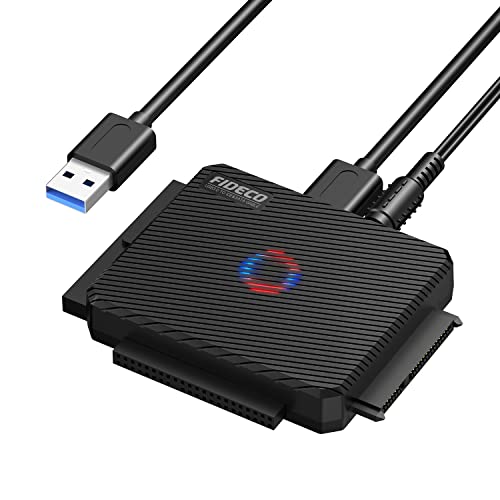
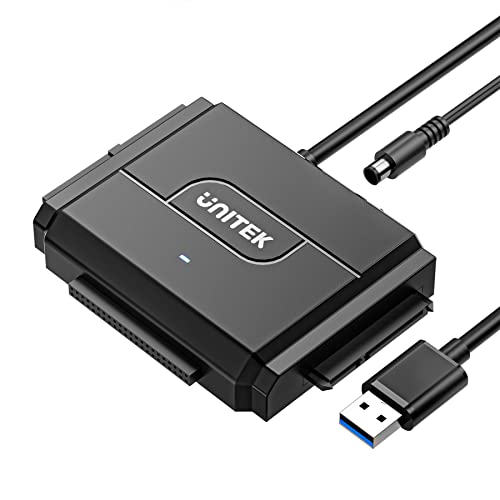
For most retro-PC builders rescuing data from old drives in 2026, the FIDECO SATA/IDE to USB 3.0 Adapter is the best single buy — it handles 40-pin 3.5" IDE, 44-pin 2.5" IDE, and SATA from one box, includes a 12V power brick for full-size drives, and runs at USB 3.0 speeds for the rare cases your old drive can keep up. The Unitek SATA/IDE to USB 3.0 Adapter is the runner-up with marginally better build quality. The Vantec CB-ISATAU2 is the budget USB 2.0 fallback — cheap, ancient, and still works for vintage drives that won't saturate USB 2.0 anyway.
This guide compares all three head-to-head, explains the chipset quirks that bite people pulling data from drives older than 2010, walks through the imaging workflow, and tells you which adapter to buy for which job.
Key takeaways
- FIDECO is the value pick — covers 3.5"/2.5" IDE plus SATA, USB 3.0, includes external 12V/2A power brick.
- Unitek matches the FIDECO feature-for-feature, with a slightly more solid construction; slightly higher street price.
- Vantec CB-ISATAU2 is the budget USB 2.0 unit — fine for ancient drives where you're bottlenecked by the drive itself.
- 3.5" IDE drives need external 12V power — USB cannot provide it. Don't try.
- A CompactFlash card with a passive CF-to-IDE adapter reads as an IDE drive through any of these.
What connectors and drive types do you actually need to support?
A typical retro-PC parts bin has four kinds of storage:
- 3.5" IDE hard drives — 40-pin Molex-powered, the dominant interface from 1996-2007. Capacities up to 750GB (mostly 20-250GB in practice).
- 2.5" IDE hard drives — 44-pin combined data+power, used in laptops from ~1995-2008. Capacities up to 320GB.
- SATA drives (2.5" or 3.5") — 7-pin data + 15-pin power, dominant from ~2005 onward.
- CompactFlash cards — IDE-protocol-compatible at the electrical level; readable as an IDE device via a passive CF-to-IDE bridge.
A "universal" USB adapter covers IDE 40-pin, IDE 44-pin, and SATA, and includes a 12V/2A external power brick for the 3.5" drives that need it. All three adapters in this guide qualify as universal. The differences are speed, build quality, and how reliably they negotiate with very old drives.
Spec delta: FIDECO vs Unitek vs Vantec CB-ISATAU2
| Spec | FIDECO | Unitek | Vantec CB-ISATAU2 |
|---|---|---|---|
| Supported interfaces | 3.5" IDE, 2.5" IDE, SATA | 3.5" IDE, 2.5" IDE, SATA | 3.5" IDE, 2.5" IDE, SATA |
| USB version | USB 3.0 (5 Gbps) | USB 3.0 (5 Gbps) | USB 2.0 (480 Mbps) |
| External power | 12V/2A brick included | 12V/2A brick included | 12V/2A brick included |
| Max capacity | 6 TB (per spec) | 6 TB (per spec) | 2 TB (per spec) |
| LED indicators | Power + activity | Power + activity | Power + activity |
| Cable length | ~60 cm | ~65 cm | ~50 cm |
| Street price | ~$25 | ~$35 | ~$26 |
The Vantec's USB 2.0 interface is the only meaningful spec disadvantage and only matters when you happen to plug in a modern SATA SSD as your target drive — for actually-old IDE drives, USB 2.0 throughput exceeds the drive's own read rate anyway.
Does the USB-to-IDE bridge chip matter for old drives?
It can, occasionally, on very old drives.
USB-to-IDE adapters use a bridge chip (commonly JMicron JMS567/JMS578 in modern USB 3.0 adapters; ASMedia ASM1051 in older ones) that translates USB packets to ATA commands. Most modern bridges handle ATA-1 through ATA-7 reliably, but a handful of pre-2000 drives (Quantum Fireball, very early Seagate Barracuda, some IBM Deskstar) negotiate ATA commands non-standardly enough that some bridges either misread sector counts or refuse to enumerate the drive entirely.
In practice, in 2026:
- The FIDECO uses a JMicron JMS567-class bridge — known good with ATA-2 through ATA-7 drives. Occasional issues with pre-1998 Quantum Fireball drives.
- The Unitek uses a similar JMS578 — same compatibility profile as the FIDECO.
- The Vantec, being USB 2.0 and older silicon, uses an older Initio/JMicron 20337 or similar. It is occasionally MORE compatible with very old drives because the older bridge stack matches the era of drive electronics better.
If you are specifically pulling data from a 1996-1999 drive that refuses to enumerate on either USB 3.0 adapter, try the Vantec. It's the "older, slower, often more compatible" backup.
Tom's Hardware best-picks coverage and PCWorld both note this generational-compatibility quirk in their reviews of USB-IDE adapters — newer is not always better when the source hardware is itself ancient.
Power and large-drive gotchas: why a separate 12V supply matters
3.5" IDE drives (and 3.5" SATA, for that matter) need 12V on the Molex connector to spin up. USB ports provide 5V only — at most 900mA on USB 3.0, 500mA on USB 2.0. That's not even enough to spin up a 5400 RPM 3.5" platter, let alone hold it at speed.
All three adapters in this guide include a 12V/2A external power brick that provides Molex 4-pin output for 3.5" drives. Do not try to skip this. Symptoms of insufficient power:
- Drive spins up briefly then immediately spins down.
- Drive enumerates in Device Manager / dmesg but reads return I/O errors.
- Drive makes a clicking sound that increases in frequency (the "click of death" — actually drive servo failing to lock).
The 12V/2A brick is barely adequate for a single 3.5" drive — fine for one drive at a time, marginal for two-bay enclosures. For full enclosure use, step up to a quality 12V/3A or 12V/4A brick.
For 2.5" laptop IDE drives, USB power is generally sufficient — the 44-pin connector includes power directly from the adapter's USB bus.
Reading CompactFlash as an IDE device with a CF-to-IDE step
A useful trick: CompactFlash cards speak the IDE/ATA protocol at the electrical level. A passive CF-to-IDE adapter (a small PCB with a 40-pin or 44-pin IDE header on one side and a CF socket on the other) presents a CF card as an IDE drive — and your USB-IDE adapter then reads it like any other IDE drive.
This is the standard workflow for:
- Reading data off industrial-PC CF cards (factory automation, point-of-sale terminals)
- Imaging the contents of a Transcend CF133 4GB CompactFlash card (and similar CF-era industrial media)
- Migrating vintage-computer storage between machines
Note that the CF-to-IDE adapter is a passive bridge — it does not need its own power, doesn't have firmware, and doesn't change the device's identity. Your USB-IDE adapter reads it as a small IDE hard drive. CF cards top out at ~133x read (~20 MB/s), so USB 2.0 is fine — the Vantec works just as well as the USB 3.0 adapters for CF reading.
Imaging workflow: cleanly dumping an old drive to a modern SATA SSD before it dies
The single most important step is: image the entire drive to reliable modern storage BEFORE you start trying to extract individual files. Old mechanical drives can fail mid-operation. An image is repeatable; a partial copy is not.
The canonical workflow:
- Connect the drive via the adapter. Use external 12V power for 3.5". Confirm the drive enumerates.
- Listen. A clicking drive or one that takes more than 10-15 seconds to spin up is failing. Image it immediately, don't try to mount it.
- Image with
ddrescue(Linux) or HDD Raw Copy Tool (Windows). On Linux:ddrescue /dev/sdX /dest/path/drive.img drive.log— ddrescue handles bad sectors gracefully and resumes from a log if interrupted. - Verify the image. Mount the image read-only (
losetup+mount -o ro,loopon Linux) and confirm the filesystem is intact and key files are readable. - Now extract files from the image, not from the original drive. Every read off the original drive is wear on a drive that may already be failing.
For destination storage, a modern SATA SSD like the Samsung 870 EVO 250GB (~$165) is an ideal target — small enough to be cheap, fast enough to write the image as quickly as your old drive can read, and reliable enough to keep the image for years.
For drives with severe physical damage (bad bearings, head crashes), you are past the DIY tier — a professional recovery service is the only safe path.
Which adapter to buy for which job
Match the adapter to your most common job.
You routinely pull data from a mixed pile of old drives (3.5", 2.5", and SATA). Buy the FIDECO. USB 3.0, full universal interface, 12V brick included, lowest price. The everyday workhorse.
You want the slightly more refined option and don't mind paying $10 more. Buy the Unitek. Same feature set as FIDECO, slightly nicer build, marginally longer cable. The Anandtech-style power-user pick.
You're specifically dealing with very old (pre-1999) IDE drives that won't enumerate on modern bridges. Buy the Vantec. USB 2.0 is fine because the drives are bottleneck. The older bridge silicon is sometimes more compatible with very-vintage ATA implementations.
You also need to read CF cards. Any of the three plus a $5 passive CF-to-IDE adapter. The combination handles CF as a normal IDE device.
You're imaging large numbers of SATA SSDs (modern use case, not retro). Use the FIDECO or Unitek; the Vantec's USB 2.0 will bottleneck SATA SSD reads.
Common pitfalls when reading old drives
- Skipping the 12V brick. 3.5" drives won't spin up on USB power. This is non-negotiable.
- Trying to mount before imaging. A failing drive can complete one read pass and then die during the next. Image first, mount the image second.
- Forgetting the jumper settings. Old IDE drives have Master/Slave/Cable Select jumpers. Some USB adapters require the drive be set to Master (or no jumper at all = Master on most drives). Single-drive operation on a USB adapter never needs Slave.
- 44-pin IDE polarity. The 44-pin laptop IDE connector is keyed but some old drives have the keying filled in. Pin 1 is marked with a red stripe on the cable; align it with the matching mark on the drive.
- Source drive too hot. Old 3.5" drives can run hot. If yours is uncomfortable to touch, give it cool-down breaks during long image operations.
- Trusting "everything copied" on a clicking drive. Even after a partial-success copy, verify file integrity. Many failing drives return zeros or random data for unreadable sectors without erroring.
Verdict matrix
Get the FIDECO if you want the cheapest universal IDE/SATA-to-USB adapter that covers the typical retro-PC parts pile and you want USB 3.0 speed.
Get the Unitek if you want slightly better build quality and don't mind paying $10 more for it.
Get the Vantec if you're working with very-vintage drives that don't enumerate on modern bridges, or you specifically want the cheapest "good enough" budget USB 2.0 adapter.
For the average retro-PC owner with a mixed parts pile in 2026, the FIDECO is the right buy. For specialized vintage-IDE compatibility, keep a Vantec around as the backup.
Citations and sources
- Tom's Hardware — Best storage and adapter picks
- PCWorld — Storage and adapter reviews
- AnandTech — Storage and interface coverage