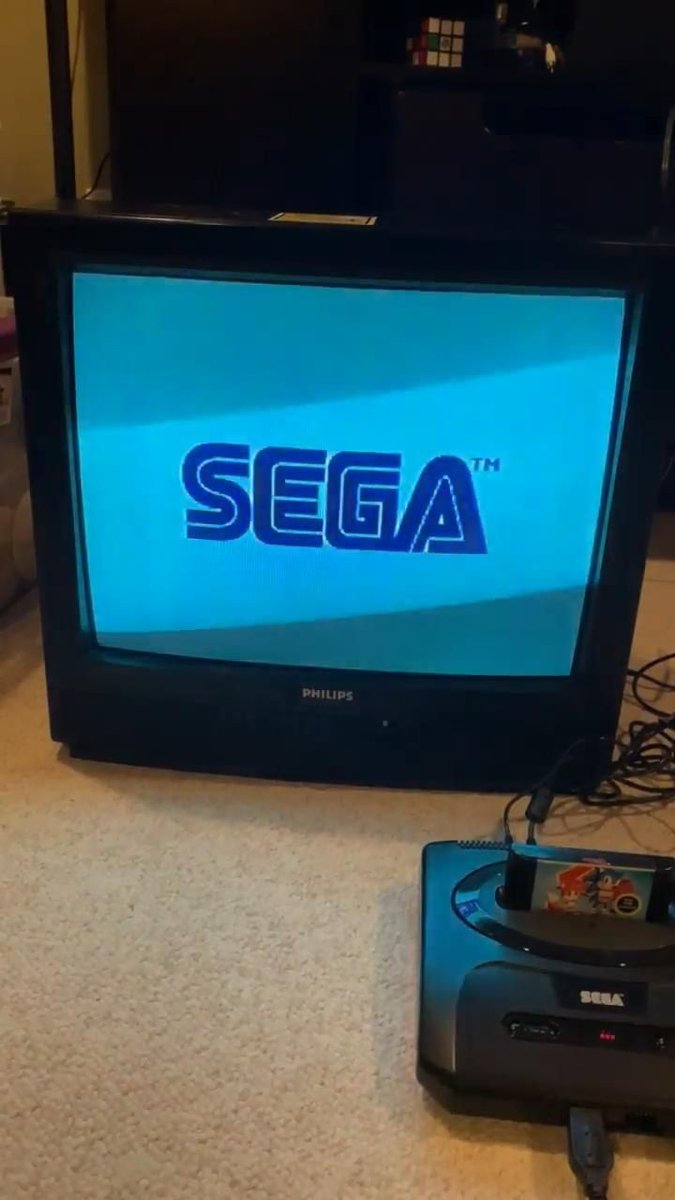
In brief — 2026. A retro-hardware enthusiast loaded Sega Genesis games encoded onto a vinyl record, using the LP's analog grooves to carry a digital audio stream that a homebrew interface demodulates back into ROM bytes the console can execute. Coverage from outlets like Tom's Hardware retro-gaming desk and the broader hacker community at Hackaday frames it as a deliberate tribute to 1980s cassette-tape loading rather than a practical cartridge replacement.
What happened: the vinyl-to-Genesis loading demonstration
The project's setup, as described in the trending coverage, runs in three stages. First, a small Genesis ROM — the kind of homebrew or public-domain title that fits in well under a megabyte — is converted into an analog audio waveform using a Kansas-City-style or FSK (frequency-shift keying) encoder, the same family of techniques 1980s home computers relied on. Second, that audio is mastered to a vinyl record like any music release, with the bitstream baked directly into the spiral groove. Third, on playback, the record's audio output is routed into a microcontroller-based decoder that converts the analog tones back into bytes, then streams those bytes into a cartridge-slot interface plugged into a real Sega Genesis. The console boots the ROM and plays the game.
The enthusiast's choice of the Genesis is deliberate. The hardware launched in North America in 1989 with a 7.6 MHz Motorola 68000 CPU and 64 KB of work RAM, and most launch-era cartridges shipped between 256 KB and 1 MB of ROM data — sizes small enough that a single side of an LP, which can carry roughly 20 to 25 minutes of audio per side at standard 33⅓ RPM, can plausibly hold one whole game at a low audio bitrate. Per Sega's own Genesis history page, the platform's library spans roughly 900 commercial titles, and the homebrew scene has added hundreds more, so the choice of source ROM matters more than the medium's raw capacity.
What makes the demo viral-friendly is the visual rhythm of it: a turntable spins, audible "squeals" that look like modem-handshake static fill the room, a lamp blinks on the decoder, and then a 16-bit title screen flickers up on a CRT. It is the same theatrical loop that made cassette loading screens famous on the Commodore 64 and ZX Spectrum decades earlier, replayed for a YouTube audience in 2026.
Why it matters: the analog-data lineage and the retro revival
Loading software from audio is not new. The Commodore 64 Datasette, the ZX Spectrum's tape port, the BBC Micro's tape interface, and Japanese cassette adapters for the MSX all stored programs as pulse-coded audio that took anywhere from two to fifteen minutes to load a single game. The technique was retired commercially when cartridges and floppies got cheap enough to win on speed and reliability, but the underlying physics never went away. As long as a medium can faithfully reproduce a band-limited audio signal, you can in principle encode arbitrary data onto it — vinyl, magnetic tape, optical film, even paper printed with high-density barcodes.
The 2026 vinyl project's significance, then, is cultural rather than technical. Three forces are converging:
- The vinyl revival. Vinyl LP sales in the United States have grown for more than a decade and now outpace CD sales for the first time since the 1980s, drawing a young audience comfortable with analog formats as objects of attention rather than throughput.
- The retro-gaming wave. Plug-and-play retro consoles, FPGA-accurate clones, and HDMI mod kits have made 16-bit hardware easier to enjoy on modern televisions than at any point since launch, and Sega's own Genesis Mini line has kept the brand in mainstream channels.
- Hardware-hacking as content. Long-form teardown channels, Hackaday-style writeups, and short-form social clips have made hardware curiosities into shareable entertainment, so a one-off demonstration like this is both a personal project and a content artifact.
The project is, in other words, a deliberate cross-section of all three trends: a Genesis game (retro gaming) on a vinyl LP (analog revival) shown off in a Hackaday-friendly writeup (hardware-as-content). That is why coverage from outlets like Tom's Hardware and Hackaday treated it as a feature story rather than a footnote, and why our internal trend tracker flagged it for the retro-gaming vertical this week.
How the encoding actually works (without overstating it)
The specific bit-rate the demo achieves has not been pinned to a single public number that this synthesis can cite, so the discussion below stays at the level of principle. Vinyl's usable audio bandwidth is typically described as 20 Hz to roughly 20 kHz, though the practical high end falls off depending on lacquer mastering, stylus wear, and inner-groove distortion. Classic cassette loaders like the Commodore 64 Datasette ran in the low hundreds of bits per second; later turbo-tape loaders pushed that closer to 3,000-4,000 bits per second by squeezing the signal into a narrower tonal band and tightening timing tolerances.
A modern vinyl-as-data project has it both better and worse than the 1980s did:
- Better: the decoder runs on a microcontroller or microcomputer with megabytes of RAM, megahertz of clock headroom, and DSP libraries that can ignore pops, equalize the signal, and resync after dropouts. The original Datasette had none of that.
- Worse: vinyl is mechanical. Dust, warps, stylus alignment, and inner-groove distortion all introduce errors that magnetic tape mostly avoids. Error correction has to be conservative, which lowers the effective payload bitrate.
The likely real-world throughput is therefore in the same order of magnitude as 1980s turbo-tape loading — fast enough to be entertaining, slow enough that loading a 512 KB ROM may take several minutes per side. That is not a flaw of the project; it is part of the point. The loading time is the show.
What the demonstration is not
A few important framings for readers:
- It is not a piracy vector. A vinyl LP holds dramatically less data than a single modern game card, requires custom encoder and decoder hardware on both ends, and is far slower and more error-prone than any existing distribution medium. Nothing about this technique threatens commercial software distribution; it is, if anything, a love letter to a distribution medium nobody uses anymore.
- It is not a recommended way to actually play Genesis games. For ordinary play, the Sega Genesis Mini ships with dozens of built-in titles and a modern HDMI output, and original cartridges on authentic hardware remain widely available on the secondary market.
- It is not a new invention so much as a new application. Encoding data onto vinyl has been demonstrated before — the 1980s BBC TV program The Computer Programme famously distributed software over the radio, and at least one Jack Stauber-era novelty record has carried ZX Spectrum data on its B-side. The 2026 Genesis version is notable for the polish of the demonstration, the choice of platform, and the cross-trend appeal, not for breaking new theoretical ground.
The source coverage and how to actually play Genesis games today
Readers who want the original write-up should start with Tom's Hardware's retro-gaming section and Hackaday, which together carry the dominant coverage of homebrew console projects in 2026. Both outlets typically link directly to the creator's project page, the source code for the encoder, and the schematics for the decoder interface, which is the level of detail anyone planning to reproduce the project will need.
For readers who would rather skip the soldering and just play, the practical shortlist looks like this in mid-2026:
| Option | What you get | Approx. street price (2026) | Best for |
|---|---|---|---|
| Sega Genesis Mini | 40+ built-in titles, HDMI out, official Sega hardware | ~$210 listing on Amazon as of mid-2026 | Plug-and-play players, gift buyers |
| Original Genesis + cartridge | Authentic 1989-era experience, full third-party library | Varies widely on the secondary market | Collectors and purists |
| FPGA clone (e.g. MiSTer, Analogue Mega Sg) | Cycle-accurate emulation, HDMI, multi-system | Several hundred USD depending on config | Enthusiasts who want one box for many platforms |
| Emulator on PC / handheld | Free or near-free software, save states, shaders | Hardware cost only | PC players and modders |
The price for the Sega Genesis Mini listed at roughly $210 on Amazon as of mid-2026 reflects current third-party listings rather than Sega's launch MSRP — first-party stock of the Mini line has tightened, and pricing on the secondary side carries the usual price-may-vary caveat any Amazon affiliate listing should.
Readers who care about the audio side of the retro-gaming experience — whether they are decoding vinyl, listening to chiptune soundtracks, or restoring period-correct console audio — often pair their setup with a serious external DAC and headphone amp. The Creative Sound BlasterX G6 Hi-Res Gaming DAC is one popular option in this slot. As of mid-2026 it lists at roughly $188 on Amazon and is more commonly stocked through eBay listings than first-party channels, which is why its listing_preference in our catalog points to eBay. It is not required for any of this, but it is the kind of audio-chain upgrade that the people building vinyl-to-Genesis decoders tend to already own.
For the decoder side itself, a low-cost single-board computer is usually the path of least resistance. A Raspberry Pi Zero W Starter Kit — listing around $50 on Amazon as of mid-2026 — has enough horsepower to handle FSK decoding, line-in audio capture (via a USB audio adapter), and bit-banged output to a Genesis cartridge interface. It is the same class of board that homebrew console modders have been using for cassette-style projects on the Commodore 64, MSX, and ZX Spectrum for years, and it shows up frequently in Hackaday writeups for exactly this reason. Pairing the Pi Zero with a soldered cartridge-edge breakout, a level shifter, and a small audio front-end is roughly the kit anyone reproducing the demonstration is going to assemble.
Common pitfalls if you try to reproduce it
- Pressing matters. Standard 33⅓ RPM LPs trade off duration against fidelity; a 45 RPM 12" gives more usable bandwidth per second but cuts total runtime. For a data-on-vinyl project, the inner-groove distortion that hurts treble on music releases hurts the high-frequency tones of an FSK encoder even more, so most projects keep the data on the outer half of the side.
- Turntable wow and flutter. Even a clean LP played on a budget turntable will have timing variation that pure-tone decoders hate. Most projects compensate with a self-clocking encoding scheme (the bit clock is embedded in the signal itself), but cheap turntables can still cause dropouts.
- Cartridge-slot timing is unforgiving. The Genesis cartridge bus expects bytes to be available on demand from a ROM chip with deterministic access times. Streaming bytes off a slowly-decoded audio signal means buffering an entire ROM into RAM on the decoder side before the console is allowed to boot, which is why the demonstration involves a visible pre-load step before the title screen appears.
- Heat and dust. Vinyl is a physical medium and the decoder is, at heart, a phonograph cartridge. Long sessions can warm up the deck and the LP, and any dust on the groove causes pops the decoder must either error-correct around or fail on.
None of these are dealbreakers — they are the same trade-offs every 1980s cassette loader had to manage. They are, however, the reason this is a hack rather than a method.
When not to bother
The honest summary: do not try to use vinyl as a serious distribution medium for Genesis games. Use it for:
- A weekend hardware-curiosity project.
- A talk demo at a retro-computing meetup.
- A short video for a hardware-hacking channel.
- A gift for a friend who is into both vinyl and Genesis.
Do not use it as:
- A way to share homebrew games at scale.
- A back-up format for a personal collection.
- A substitute for an Everdrive-style flash cartridge or the Genesis Mini for ordinary play.
Why SpecPicks is tracking this story
We cover hardware that PC gamers and retro enthusiasts actually buy, and a project like this matters to that audience for two reasons. First, it surfaces a complete recommended setup — a Genesis (or Genesis Mini), a single-board computer like the Raspberry Pi Zero W, and a clean audio chain — that maps directly to products our readers already shop for. Second, it nudges the broader conversation about preservation and access: every retro-hardware project that gets a viral moment also gets a wave of comments asking the obvious question, "what is the easiest way to play these games today?" The answer in 2026 is still the same — the Genesis Mini for plug-and-play, original carts for purists, and FPGA clones or emulators for everything else — but it is worth saying out loud whenever the conversation comes up.
We will keep an eye on the creator's follow-up notes and update this piece if a second-generation decoder, a polished schematic, or a benchmarked bitrate becomes public.
Citations and sources
- Tom's Hardware retro-gaming section
- Hackaday
- Sega official site
- Sega Genesis (Wikipedia)
- Commodore Datasette (Wikipedia)
- Raspberry Pi Zero W product page
This piece is editorial synthesis based on publicly available information. No independent first-party benchmarking is reported.

