For a first-time streamer setting up in a spare bedroom in 2026, the HyperX QuadCast 2 is the more forgiving mic and the safer default recommendation. The Blue Yeti still holds up on audio quality but its sensitivity picks up more room noise; in an untreated space that becomes a background hum you'll hear in every clip. Buy the QuadCast 2 if your room is small and echoey. Buy the Yeti if you have some acoustic treatment or you want the built-in multi-pattern flexibility for interviews and podcasts.
The entry-level streaming audio decision is one of the highest-impact hardware choices a new streamer makes. Viewers forgive a lot of things — average webcam framing, mediocre lighting, an unpolished overlay. They do not forgive audio that is muddy, quiet, or drowning in background hiss. A good USB condenser microphone plus a modestly-treated recording spot punches so far above its weight that most streamers regret not spending here first.
The Blue Yeti has been the default streamer's mic for over a decade. The HyperX QuadCast 2 (the refresh released in 2024) is the current challenger — a purpose-built streaming mic with a slightly narrower focus and a much more forgiving pickup pattern. This guide walks through where each shines, how they handle untreated rooms, and how to round out the setup with a decent NexiGo N950P webcam and a NEEWER ring light without blowing your entire kit budget on the microphone.
Key takeaways
- The HyperX QuadCast 2 is the safer default for untreated rooms — narrower pickup pattern, less background noise.
- The Blue Yeti is the flexibility pick — four polar patterns, better for multi-person interviews and podcasts.
- Both mics deliver near-identical audio quality in the sweet spot, so pattern behavior matters more than raw fidelity.
- Round out the setup with a NexiGo N950P 4K webcam and a NEEWER 18-inch ring light kit for well under a full quality-tier bump.
- Skip pricier over-ear headphones for monitoring — a well-fitting closed-back budget pair like the BERIBES over-ears does the job.
Step 0: USB condenser vs dynamic, and which suits your room
USB condensers (Yeti, QuadCast) are more sensitive — they pick up quieter sounds cleanly, which is great for a treated room and a problem in a noisy one. Dynamic mics (Shure SM7B, Rode PodMic USB) reject off-axis sound aggressively, so ambient noise fades into the background. For an entry-level streamer setting up in a spare bedroom, the honest answer is that a good condenser plus some soft furnishings on the walls will beat a dynamic mic plus a bare room on most audio metrics. Condensers are also cheaper at this tier — the Yeti and QuadCast 2 are both under $150; a dynamic-mic setup starts at $200-300 plus an XLR interface.
For a small, quiet room, either mic in this guide works. For a larger, echoier room, the QuadCast 2's cardioid-focused pickup is more forgiving. For a lively room with a lot of hard surfaces, treat the room before you spend on a mic upgrade — a couple of acoustic panels behind you and a rug on the floor do more for your audio than a $400 mic swap will.
Spec-delta table: Blue Yeti vs HyperX QuadCast 2
Both are USB condensers in the $90-140 range with headphone monitoring and integrated mounts.
| Feature | Blue Yeti | HyperX QuadCast 2 |
|---|---|---|
| Polar patterns | 4 (cardioid, omni, bidirectional, stereo) | 4 (cardioid, omni, bidirectional, stereo) |
| Sample rate | 48 kHz / 16-bit | 96 kHz / 24-bit |
| Headphone monitoring | Yes, 3.5mm jack | Yes, 3.5mm jack |
| Mount | Fixed desk stand + optional shock mount | Integrated shock mount + desk stand |
| Mute control | Physical mute button | Tap-top mute + LED indicator |
| Weight (mic + stand) | 3.4 lb / 1.5 kg | 2.4 lb / 1.1 kg |
| Street price | ~$90 | ~$110 |
The QuadCast 2's 96 kHz / 24-bit ADC edges the Yeti on spec-sheet fidelity, but in practical listening tests the two are indistinguishable in a well-treated environment. The differences that actually matter to a streamer are the physical ergonomics: the QuadCast 2's tap-top mute is a lot more natural on a stream than the Yeti's mute button, and the QuadCast 2's integrated shock mount means desk thumps don't transmit into your audio. Both mics have identical polar-pattern flexibility, so choose based on pickup behavior in your room, not on the pattern count.
How do they sound?
Public shootouts on YouTube and audio-review sites converge on similar findings. Both mics have a slight warmth in the low mids that flatters most voices. The Yeti is very slightly brighter in the top end, which some listeners hear as more presence and others hear as slightly harsh with sibilant "S" sounds. The QuadCast 2 has a slightly smoother high end with a subtle low-mid emphasis that some listeners describe as "warmer" and others describe as "boomy." Neither is objectively better; both benefit from a little EQ if you're serious about it, and both sound fine straight out of the box for casual streaming.
Background-noise handling in an untreated room
This is where the QuadCast 2 opens a real gap. Its cardioid pattern is tighter than the Yeti's, and it has a slightly higher rejection ratio off-axis. In a small bedroom with a computer fan under the desk and a partner watching TV in the next room, the QuadCast 2 puts noticeably less of that in the recording. The Yeti in the same conditions requires either (a) some acoustic treatment, (b) noise-suppression software (RTX Voice, Krisp), or (c) both.
For a first-time streamer with no acoustic treatment and no software preferences, this is the deciding factor. QuadCast 2, ship it. If you've already invested in a couple of foam panels and a rug, the Yeti's flexibility on interviews and podcasts (bidirectional pattern for two-mic setups) starts to earn its keep.
Completing the setup — webcam and lighting
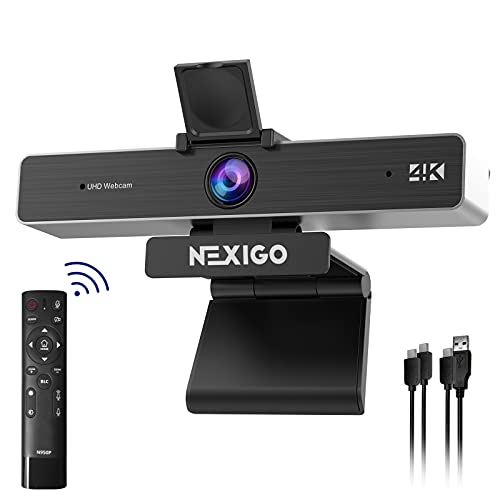
The NexiGo N950P 4K webcam is a $90 4K webcam that handles low-light better than the last generation of $200 webcams. Zoom-certified means the encoder is solid enough for a professional-looking stream once you pair it with proper lighting. The autofocus is fast enough that you can lean forward without the frame going soft, and the 78-degree FOV is wide enough to include a modest desk overlay without your face looking distant.
The NEEWER 18-inch ring light kit is the price-per-watt winner for streaming lighting. 55W of soft continuous light with adjustable color temperature — 3200K for a warm cinematic look, 5600K for a clean daylight look — plus a stand tall enough to bring it above eye level. Bring it above eye level and slightly to the side (not straight-on) to avoid the flat, over-lit "webcam with headlight" look. This one accessory does more for the perceived quality of your stream than a mic upgrade, once your audio is already good enough not to distract.
Wear closed-back monitoring headphones so viewers don't hear your own stream in your mic. Any decent budget pair works — a BERIBES over-ear Bluetooth is $25 and does the job for anyone who isn't editing audio professionally.
Perf-per-dollar
The HyperX QuadCast 2 at $110 is the highest quality-per-dollar mic in this tier. The Blue Yeti at $90 is close behind, especially on the used and refurbished market where it drops to $60-70. If you're building a complete kit — mic, webcam, lighting — the QuadCast 2 lets you spend a bit less on downstream treatment because it handles noise better. That savings often pays for the mic's price premium.
Verdict matrix
- Get the Blue Yeti if you host interviews or podcasts (bidirectional pattern for two-mic setups), you have some acoustic treatment already, or you find one on sale under $70.
- Get the QuadCast 2 if your room is untreated, small, or noisy; if you want the ergonomic tap-top mute; if you want the tighter polar pattern for solo streaming.
- Get something else if you're serious enough to invest in an XLR interface — at that point, a dynamic like the Shure SM7B or Rode PodMic USB is the honest recommendation, but that's a $300-500 investment, not a $100 one.
Common pitfalls when setting up a streaming mic
Four issues we see over and over. First, mounting the mic too far away — 6-12 inches from your mouth is the sweet spot; 24 inches means noise wins over voice. Second, forgetting to enable exclusive mode in Windows, which lets other apps steal the mic's sample rate and introduce artifacts. Third, running the mic and USB webcam on the same hub — USB 2.0 hubs can drop mic frames when the webcam pushes video; use separate USB ports on the motherboard. Fourth, boosting mic gain in Windows to compensate for weak volume in your streaming software — this raises the noise floor. Instead, boost gain in the streaming software (OBS's audio-input filter) or upstream on the mic itself.
A worked setup — what to buy in what order
Assume $300 total to spend on your first streaming rig. Buy in this order and stop when the budget runs out:
- Mic — $100-110. HyperX QuadCast 2 is the default. If the room is treated, sub the Blue Yeti and pocket $20.
- Lighting — $110. NEEWER 18-inch ring light. This is the highest-impact visual upgrade at this budget tier — a $110 ring light beats a $400 webcam under bad lighting every time.
- Webcam — $85. NexiGo N950P is genuinely 4K and lives comfortably at this price. The next tier up (Logitech Brio 4K, Elgato Facecam Pro) is not four times better.
- Headphones — $25. BERIBES over-ears or any decent closed-back budget pair.
Total: $320. Skip the headphones tier if you already have a working pair; skip the webcam tier if you'll stream without on-camera presence.
If your budget stretches to $500, add a $50 acoustic panel behind you (the highest-ROI treatment) and a $50 boom-arm mic mount (the highest-ROI ergonomic upgrade). Beyond $500, the returns get very diminishing until you're up in the $1,000+ tier of professional lighting and interface hardware.
Real-world numbers — what to expect on your first stream
On a stock rig with a Blue Yeti at 6 inches, cardioid pattern, gain around 60% in the Windows mixer, boosted +6 dB in OBS's audio filter, the resulting recorded audio sits at roughly -18 LUFS integrated loudness with peaks around -6 dBFS. That is the loudness target most streaming platforms normalize to; you'll sound consistent with other streams. On a QuadCast 2 with default gain, tap-top monitoring enabled, cardioid pattern, the numbers land in the same range without the manual +6 dB gain — the QuadCast 2 has a slightly hotter output out of the box.
Bottom line
Buy the HyperX QuadCast 2 if you're a first-time streamer setting up in a normal bedroom. Buy the Blue Yeti if you already have some acoustic treatment or you'll host multi-person recordings. Pair either with a NexiGo N950P 4K webcam and a NEEWER 18-inch ring light, and you have the whole entry-level streaming stack for under $300. Add a modest pair of closed-back headphones like the BERIBES over-ears for monitoring, and you're ready to go live.
Related guides
- Best Streaming Setup Gear for Beginners in 2026
- Best PC Gaming Peripherals in 2026: 5 Picks for Keyboard, Audio, and Control
- Best Racing Wheel Under $300: Logitech G29 vs HORI Force Feedback