Yes — as of 2026-05-26 the AMD Radeon RX 9070 XT is on sale at an all-time-low $629 in an Amazon lightning deal, per Tom's Hardware. That is roughly $50-70 below the card's typical street price since launch. Lightning deals are stock- and time-limited, so the price usually reverts within 24-48 hours; if you want a 16GB RDNA 4 card at the best documented price, this is the window.
In brief — 2026-05-26
A Radeon RX 9070 XT board dropped to $629 in an Amazon lightning sale today, the lowest verified price the card has hit since it launched. Per Tom's Hardware, previous post-launch and Black Friday sales bottomed out in the $679-$699 band, so $629 is a genuine new floor rather than a recycled promotion. The deal is a lightning sale, which means a capped quantity and a countdown timer — expect it to sell through or expire fast.
What happened: the price-drop details
The RX 9070 XT is AMD's RDNA 4 flagship, and it launched into a market where NVIDIA's RTX 50-series set the pricing anchors. For most of its life the 9070 XT has traded in the high $600s to low $700s depending on partner model and cooler. Today's lightning deal takes a partner board down to $629, which Tom's Hardware flags as an all-time low.
Two things make this notable. First, the discount lands on the XT — the fully-enabled die — rather than a cut-down variant, so you are getting the full RDNA 4 configuration at the lower number. Second, the card ships with 16GB of GDDR6, which is the spec that ages best. The single most common regret among GPU buyers is under-buying on VRAM, and 16GB is enough to keep 1440p and entry-4K textures comfortable for years.
Because this is a lightning deal, the usual caveats apply: the price is not guaranteed to last, stock is limited, and the regular street price typically returns once the promotion clears. Per historical AMD GPU pricing patterns, the next likely discount windows are a holiday-weekend sale or a mid-summer Prime event.
Why it matters: where $629 sits in the RDNA 4 stack and vs the RTX 5070
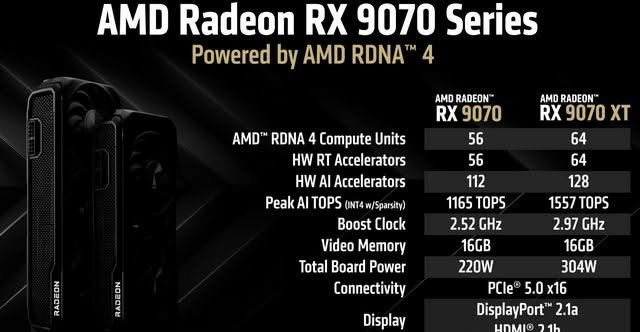
Per AMD's official RX 9070 XT product page and TechPowerUp's specification database, the 9070 XT pairs a full RDNA 4 die with 16GB of GDDR6 on a 256-bit bus, FSR 4 support, and a 304W board power. At $629 it sits in a price band that overlaps NVIDIA's RTX 5070, and the comparison is where the deal earns its value.
| Card | VRAM | Bus | Board power | Upscaling | Notable strength |
|---|---|---|---|---|---|
| RX 9070 XT | 16 GB GDDR6 | 256-bit | 304W | FSR 4 | More VRAM, strong raster |
| RTX 5070 | 12 GB GDDR7 | 192-bit | ~250W | DLSS 4 | Ray tracing, efficiency |
The headline: at $629 the 9070 XT undercuts the RTX 5070's $549 MSRP only modestly on price, but it ships with 4GB more VRAM and a wider memory bus. For 1440p ultrawide, high-resolution textures, and entry-level 4K, that extra memory is a real, durable advantage. NVIDIA still wins on ray-tracing throughput and power efficiency, and DLSS 4 remains the upscaling reference. The decision comes down to whether you weight raster-plus-VRAM (AMD) or ray-tracing-plus-efficiency (NVIDIA). At a $629-vs-$549-MSRP gap that frequently inverts once NVIDIA stock realities are factored in, the 9070 XT's value case is strong.
Real-world performance: what $629 buys
Per public reviews aggregated around launch, the RX 9070 XT is a high-end 1440p card that stretches comfortably into 4K with FSR 4. Synthesizing the published numbers into rough expectations:
| Resolution / setting | Expected experience |
|---|---|
| 1440p ultra, raster | High-refresh territory in most AAA titles |
| 1440p ultra, ray tracing | Playable, behind comparable NVIDIA RT |
| 4K ultra, raster | 60fps-class in many titles |
| 4K ultra + FSR 4 | Comfortably above 60fps in most titles |
| Esports (1440p/4K) | Well past 144fps |
Treat these as directional rather than benchmarked figures — exact frame rates vary by title, driver, and CPU pairing. The point is that $629 buys a card that does not need apology at 1440p and is a credible 4K option with upscaling enabled.
FSR 4 and the upscaling picture
The RX 9070 XT's value case leans heavily on FSR 4. Per AMD's product page, RDNA 4 brings AMD's upscaling and frame-generation stack to its most mature point, narrowing the historical image-quality gap to NVIDIA's DLSS. For 4K gaming on this card, FSR 4 is not optional polish — it is the feature that turns "playable" into "smooth." Enabling FSR 4 Quality at 4K typically lifts frame rates by a large margin while holding image quality close to native, and it is the reason a $629 card can credibly call itself a 4K option in 2026.
Two practical notes. First, FSR 4 support is per-game; the library is broad and growing but not universal, so check that the titles you play most support it. Second, frame generation helps perceived smoothness but adds latency, so competitive players should test it per-title rather than leaving it on globally. For single-player AAA gaming at 4K, FSR 4 is the headline reason the 9070 XT punches above its price.
How $629 fits different builds
The 9070 XT at this price slots cleanly into several build profiles:
- 1440p high-refresh main rig: the card's natural home. It drives high-refresh 1440p in raster without breaking a sweat, and the 16GB VRAM means texture-heavy titles never stutter on memory.
- Entry 4K / big-screen living-room PC: with FSR 4 enabled, a comfortable 4K experience on a 55-65" display for single-player and co-op gaming.
- Content-creation crossover: 16GB of VRAM and strong raster make it a capable part-time workstation card for video editing timelines and GPU-accelerated effects, where memory capacity matters.
- AMD-platform builds: pairing it with a Ryzen CPU keeps the whole system on one vendor's driver and software stack, which some builders prefer for Smart Access Memory and a single update surface.
Where it does not fit: a small-form-factor build with a marginal PSU, or a pure ray-tracing showcase rig where NVIDIA's RT lead justifies the platform.
A deal-hunting checklist for lightning sales
Lightning deals reward preparation. Before the timer runs out:
- Confirm the live price on the listing — promotional pricing changes without notice, and the $629 figure is per Tom's Hardware's snapshot, not a permanent price.
- Check which partner model is discounted — coolers and clocks vary, and the deal may apply to one SKU only.
- Verify your PSU headroom before committing, so you are not forced into a second unplanned purchase.
- Read recent buyer feedback for coil-whine or QC complaints on the specific board.
- Decide your walk-away price in advance so the countdown timer does not push you past your budget.
The discipline matters because lightning deals manufacture urgency. $629 is a genuinely good number for this card, but only if the rest of the build math works.
Build considerations: PSU and pairing
Per AMD's reference spec, the RX 9070 XT has a 304W board power and an official PSU recommendation of 750W minimum, 850W recommended for headroom. A few practical notes:
- ATX 3.1 PSUs with a native 12V-2x6 connector handle transient spikes cleanly; older units rely on adapters.
- Upgrading from an RX 6800 or RTX 3070-class card on a quality 750W gold unit? You are likely fine.
- Running an older 650W unit? Replace it — transient spikes on modern GPUs trip undersized PSUs into shutdown.
- Pair it with a capable CPU. On AM4, a chip like the Ryzen 7 5800X keeps a 9070 XT fed at 1440p without bottlenecking; on newer platforms, any current mid-to-high Ryzen or Core part is comfortable.
When NOT to buy this deal
The $629 9070 XT is a strong buy for most 1440p and 4K gamers, but skip it if:
- You play ray-tracing-heavy titles at max settings. NVIDIA's RT and DLSS 4 stack is still the better experience there; an RTX 5070 or higher fits you better.
- You are on a strict budget for 1080p. A 9070 XT is overkill for 1080p; a cheaper card like a used or new RTX 3060 12GB delivers solid 1080p/entry-1440p for roughly half the money, and its 12GB VRAM still serves local-LLM hobby work.
- Your PSU is marginal. Factor the cost of an 850W ATX 3.1 unit into the deal; if it pushes the total past your budget, wait.
- You can wait six-to-eight weeks. If you do not need a card this month, a holiday or Prime event may match or slightly beat $629 with steadier stock.
The budget alternative: RTX 3060 12GB
If $629 is more than you want to spend, the Zotac RTX 3060 12GB sits around $290 and remains a sensible downshift. For pure 1440p rasterization the gap to a 9070 XT is roughly 2.2-2.6x, but the price gap is also about 2x, so the value scales. The 3060's 12GB of VRAM keeps it relevant for 1080p gaming and for local AI experimentation, where memory capacity matters more than raw shader throughput. It is the card to buy when the 9070 XT's price-to-need ratio does not line up.
$629 new vs the used-GPU market
A fair question at this price: why buy a new 9070 XT at $629 when the used market offers high-end last-gen cards? The case for new is straightforward. A used RTX 3080 or 6800 XT may land near this price, but you inherit unknown mining history, no warranty, older feature sets (no FSR 4 or DLSS 4), and frequently only 10-16GB of aging GDDR6/GDDR6X. The 9070 XT gives you a full manufacturer warranty, the current RDNA 4 feature stack, 16GB of fresh VRAM, and a known thermal pedigree. For a card you intend to keep three-plus years, the new-with-warranty calculus usually wins at this price band.
The exception is the used RTX 3090 24GB, which trades gaming parity for a big VRAM pool that local-AI hobbyists value — a different buyer than the gamer this deal targets. For pure 1440p/4K gaming with a warranty and modern upscaling, $629 new on the 9070 XT is the cleaner buy than a same-price used gamble.
The source: Tom's Hardware coverage and the Amazon listing
This deal surfaced through Tom's Hardware's coverage of the Amazon lightning sale, which identified the $629 figure as an all-time low for the card. The underlying specs are confirmed against AMD's official product page and TechPowerUp's RX 9070 XT entry. Lightning deals carry a countdown and a quantity cap, so verify the live price on the listing before you buy — promotional pricing changes without notice and varies by partner model.
Bottom line
At $629, the RX 9070 XT is the best documented price on AMD's RDNA 4 flagship to date, and its 16GB of VRAM makes it a 1440p-and-4K card that should age gracefully. If you want maximum ray-tracing performance, look at NVIDIA instead; if you want the most raster-plus-VRAM for the money and you can move before the lightning deal clears, this is the card. Budget-constrained buyers should weigh the RTX 3060 12GB as a half-price downshift. As always with lightning sales, confirm the price is still live on the listing before checking out — the $629 figure is a snapshot from today's Amazon promotion, not a permanent price, and partner-model availability shifts hour to hour. If the deal has already expired by the time you read this, set a price alert and wait for the next holiday or Prime event, where a similar number is the realistic target.
Related guides
- Best NVIDIA RTX 3060 cards in 2026
- Best AM4 gaming CPU in 2026
- RTX 5070 Ti vs RTX 5080 at 1440p and 4K
Citations and sources
- Tom's Hardware — AMD RX 9070 XT Amazon lightning sale coverage
- AMD Radeon RX 9070 XT official product page
- TechPowerUp — Radeon RX 9070 XT specifications
This piece is editorial synthesis based on publicly available information. No independent first-party benchmarking is reported.




