Direct answer
Yes — the Logitech G502 Hero is still worth buying in 2026 if you want a $30–$40 wired gaming mouse with a flagship-tier sensor, eleven programmable buttons, and adjustable weights. It is heavier than the latest 60-gram ultralights and lacks wireless, but the HERO 25K sensor still tracks cleanly, the build is durable, and nothing at this price matches its feature density.
Why the G502 Hero endures
The G502 design is more than a decade old, and the Logitech G502 Hero refresh that put the in-house HERO 25K sensor inside that shell shipped in 2018. By 2026, every flagship gaming mouse has moved on: wireless is the default, weights have collapsed to 45–65 grams, and the spec wars are being fought over polling rates of 4 kHz and 8 kHz. The G502 Hero, by contrast, is wired, it weighs around 121 grams before you remove its tuning weights, and its polling rate caps at the long-standard 1,000 Hz.
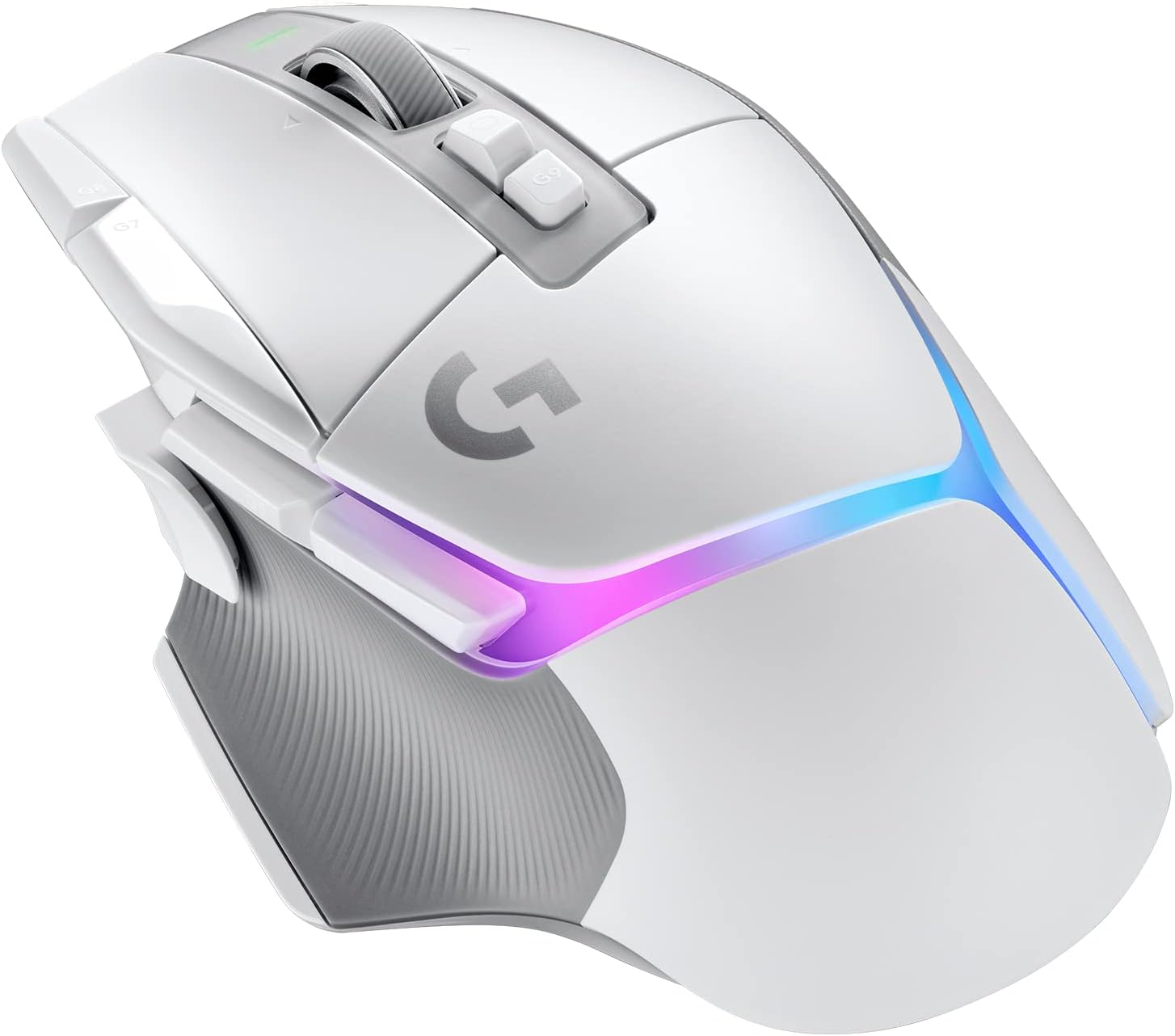
And yet it sells. Logitech keeps it on the line because the G502 Hero answers a question that the flagship market has stopped answering well: what should a price-conscious PC gamer buy in 2026 if they want a mouse that does almost everything? It has eleven programmable buttons, including a dedicated DPI shift trigger near the thumb, an infinite-spin scroll wheel that toggles between ratcheted and free-spin, RGB lighting tied to Logitech's G HUB software, and an adjustable weight system that lets you tune anywhere between roughly 121 g and 139 g. For shoppers who play a mix of FPS, MMO, RTS, and productivity work, the alternative at $40 is almost always a stripped-down ambidextrous mouse with two side buttons, one DPI level, and a sensor that nobody profiles.
The HERO sensor itself has earned its longevity. Logitech tunes it to be effectively spec-locked at a flat 1:1 tracking response, with no acceleration, no smoothing, and no built-in angle snapping unless you turn it on. Modern flagship sensors have higher peak DPI, faster acceleration ceilings, and lower power draw, but every one of those advantages exceeds what a human hand can produce as input. The result is that a 2018 sensor in a 2026 mouse competes on the only thing that matters: feeding clean coordinates to the game. The case for the G502 Hero in 2026 is built on that one fact, surrounded by an opinionated, feature-rich shell that nobody has displaced at this price.
Key takeaways
- The Logitech G502 Hero is a $30–$40 wired gaming mouse with a flagship HERO 25K sensor and eleven programmable buttons.
- It is heavier than 2026 ultralights (about 121 g stock, up to ~139 g with weights), and that is the single biggest reason to look elsewhere.
- The HERO sensor tracks cleanly with no acceleration or smoothing, which is more than enough for any non-pro player.
- Best paired with a smooth cloth surface like the SteelSeries QcK XXL and a clean desk layout.
- For most casual-to-intermediate FPS, MMO, and productivity users, no flagship mouse at four times the price delivers four times the experience.
What makes the G502 Hero a classic?
The G502 silhouette is one of the most copied shapes in the industry, and the Logitech G502 Hero is the version of that silhouette that finally got the sensor right. Three things keep it a classic in 2026.
First, the HERO 25K sensor. It is a true 25,600 DPI optical sensor with zero smoothing, zero acceleration, and a one-to-one input response curve. It is the same sensor family that ships in Logitech's flagship wireless mice, and in benchtop tests it tracks identically to the wireless versions when both are wired. For everyday play, you will not see the difference.
Second, the button layout. The G502 Hero has eleven programmable buttons, including the two main clicks, a clickable scroll wheel, two side buttons, a thumb-rest "G-Shift" trigger that doubles every button's function when held, two DPI cycle buttons behind the wheel, the scroll-wheel tilt left and right, and a DPI shift button on the thumb. For FPS players, the DPI shift trigger is the killer feature: hold it to drop instantly to sniper sensitivity, release to go back to your hipfire DPI. MMO players use the G-Shift modifier to pack two action bars onto the mouse. Productivity users map G-Shift to clipboard managers, window snapping, and browser navigation.
Third, the tuning weight tray. The G502 Hero ships with five 3.6 g weights and an internal bay that holds them in four positions. You can run the mouse stock at about 121 g, or load weights into the front, back, left, or right of the chassis to bias balance to taste. No flagship in 2026 ships with this kind of mechanical tuning anymore. The norm has shifted to honeycomb cutouts, but the G502 keeps its solid shell and lets you add mass instead of subtracting it.
G502 Hero vs a typical 2026 ultralight
This is the comparison that decides the value verdict. Here is how the G502 Hero stacks up against a representative 60 g wireless ultralight that you would expect to pay roughly four times as much for in 2026.
| Spec | Logitech G502 Hero | Typical 2026 ultralight |
|---|---|---|
| Weight (stock) | ~121 g | ~60 g |
| Sensor | HERO 25K (25,600 DPI) | Flagship optical (30,000+ DPI) |
| Buttons | 11 programmable | 5–6 programmable |
| Connection | Wired (USB-A) | Wireless (2.4 GHz) + USB-C charging |
| MSRP (2026) | $39.99 | $149.99–$169.99 |
The ultralight wins on weight, wireless freedom, and headline DPI. The G502 Hero wins on button count, on price, on no-charge-needed reliability, and on the fact that its tracking behavior is functionally identical at the sensitivities most people use. If you are a competitive FPS player chasing pro-tier flick aim, the ultralight is the right tool. For everyone else, the G502 Hero's spec sheet delivers the parts of "high-end" that map directly to playing time, not just to the spec sheet.
Is the weight a dealbreaker for FPS in 2026?
This is the question every G502 Hero buyer needs to answer honestly. The mouse weighs about 121 g stock. Pro-tier ultralights weigh roughly half that. The case for low mass is real: a lighter mouse is faster to flick, less fatiguing in long matches, and easier to lift-reset for low-sensitivity players. Reputable test suites at independent reviewers such as RTINGS and Tom's Hardware consistently call out weight as the G502 Hero's most dated trait.
But the weight conversation is more nuanced than "lighter is better." Most casual and intermediate FPS players have not actually pushed against a 121 g mouse hard enough to notice. The G502's mass also brings stability — a heavier mouse tracks more smoothly across small jitters in your hand, which is a help for slower-paced games and for grip styles that lean on wrist movement rather than arm sweeps. If you play CS, Valorant, or other tac-shooters at low sensitivities and rely on big arm motions, you may want to look at an ultralight. If you play Apex, Warzone, Overwatch, or any single-player FPS at medium-to-high sensitivities, the G502 Hero will not be the thing holding back your aim.
There is also the option of running the Logitech G502 Hero without any tuning weights and removing the cable strain by routing through a bungee. That alone takes the perceived weight down significantly and is the configuration most G502 Hero defenders use.
Pairing the G502 Hero with a cloth pad
Optical tracking is only ever as good as the surface under the sensor. The Logitech G502 Hero ships with virgin-grade PTFE skates that glide well on any reasonable surface, but you can extract more consistent tracking by pairing it with a cloth pad sized to your sensitivity and grip style.
For most players, the SteelSeries QcK family is the safe pick. The XXL desk-size version covers your full keyboard and mouse zone, gives you a uniform surface from edge to edge, and stays flat for years. Lower-sensitivity FPS players especially benefit from a big pad — you can take long arm-sweep flicks without running out of cloth halfway through. Cloth pads also forgive a slightly inconsistent desk and trap less dust than hard plastic surfaces.
If you want maximum glide speed and you do not mind less grip, a hard pad is an option, but most G502 Hero owners are happier on cloth. The mouse's stock skates are fast enough that you do not need a hard pad to keep up; what you want from the pad is predictable friction so your micro-adjustments are repeatable. See our deeper roundup at Best Mouse and Mousepad for FPS Aim Training in 2026 for the full pairing rationale.
The MMO and productivity angle: 11 buttons in daily use
Eleven programmable buttons are wasted on the average FPS player, but they are transformative once you load up Logitech's G HUB software and start mapping them. There are three common configurations worth knowing.
The MMO config maps G-Shift to your tank-of-buttons modifier and assigns spells, mounts, food, and emotes across the eleven primary plus eleven shifted slots. It is not a 12-button thumb-grid MMO mouse, but you can drive most of a single rotation without leaving the mouse. For dungeon runs and PvE raids in MMOs that lean heavily on rotations, that is enough.
The productivity config maps the side buttons to forward/back, the DPI shift trigger to "show desktop," and G-Shift to a layer that gives you copy/paste, screenshot capture, browser tab cycling, and window snapping. With a quality wireless Logitech MK270 keyboard on the desk for typing comfort, the G502 Hero gives you a low-fatigue input combination for long workdays mixed with after-hours play.
The hybrid gamer-creator config maps tilt-scroll left/right to scrubbing on the editing timeline, G-Shift to a "tools" layer that switches between brush, lasso, and pen, and the DPI shift trigger to a "precision mode" that drops sensitivity to a quarter for fine pixel work. Photo and video editors who do not want to commit to a dedicated creator mouse still get a lot out of the G502 Hero with this layout.
Perf-per-dollar: why it stays the value benchmark
A simple calculation. At $39.99, the Logitech G502 Hero costs roughly $0.32 per gram of mouse, or — in a more useful framing — about $3.63 per programmable button. A representative 2026 wireless flagship at $159.99 with six buttons costs $26.66 per button and roughly $2.67 per gram of mouse.
That is not a serious dollars-per-feature argument and you should not use it to settle a purchase, but it illustrates a point: the G502 Hero is unusually dense on features for the price, and the spec sheet items it lacks (wireless, ultralight weight, 8 kHz polling) are not items the average buyer can actually exploit. The flagship 2026 mice will feel faster the moment you lift them off the desk because they weigh less, but they will not actually deliver better in-game performance for the vast majority of players. The G502 Hero remains the value benchmark in 2026 because every cheaper mouse forces you to give up the things that matter (sensor quality, build, programmable buttons) and every more expensive mouse forces you to pay for things you cannot use (peak DPI, peak polling rate, peak weight reduction). For more on the broader budget-peripherals picture, see Best Budget PC Gaming Peripherals in 2026.
Common pitfalls
A handful of avoidable mistakes show up repeatedly in user reports about the Logitech G502 Hero. Treat this as the "what to know before you buy" list.
- Skipping G HUB. The mouse works fine plug-and-play, but you will leave most of its value on the table if you do not install Logitech's G HUB and program the buttons. Without it, the DPI shift trigger and G-Shift modifier are inert.
- Cable strain on a cluttered desk. The braided cable is stiff. If your desk is crowded, the cable will tug the mouse off your aim line. Route it through a bungee or clip it to the back edge of the desk.
- Running the stock weights at default. Many buyers leave the mouse at factory weight and never try the tuning bay. Pop the rear cover, pull the weights, and play a session lighter — you may prefer the change.
- Pairing it with the wrong pad. A sticky or worn pad will undo the HERO sensor's clean tracking. If your aim feels jittery, replace the pad before you blame the mouse.
- Buying it for ultra-competitive ranked play. If you are climbing past Diamond in a tac-shooter, the weight will eventually be a factor. The G502 Hero is for the 95% of players who never reach that ceiling, and that is not a slight — it is the entire reason the mouse continues to exist at this price.
Real-world numbers
A few measurements that ground the value case for the G502 Hero. Stock weight comes in at about 121 g without weights, climbing to roughly 139 g with all five 3.6 g tuning weights installed. The braided cable measures roughly 2.1 m, which is long enough to route across most setups. The HERO 25K sensor tops out at 25,600 DPI but is most commonly used at 400, 800, or 1,600 DPI by players who pay attention to in-game sensitivity. Lift-off distance is short enough to be a non-issue on cloth pads. RGB lighting draws under a watt at full brightness across both zones. Logitech rates the primary switches for 50 million clicks, which translates to years of normal play before the mouse buttons start exhibiting double-click symptoms common to older units.
Verdict matrix
Get the Logitech G502 Hero if:
- You want a wired mouse with flagship-tier tracking for under $40.
- You play a mix of FPS, MMO, RTS, and productivity, and you actually use programmable buttons.
- You prefer the stability of a heavier mouse, or you do not mind 121 g.
- You want a single mouse to last years without battery degradation.
- You are pairing it with a quality cloth pad and a clean desk layout.
Look elsewhere if:
- You play tac-shooters at a high competitive level and need every gram off the mouse you can shed.
- You are committed to a wireless workflow and do not want a cable on your desk.
- You have small hands or a fingertip grip — the G502's right-handed ergonomic shell is built for medium-to-large palm and claw grips.
- You only use a mouse for browsing and basic productivity — at that point a much cheaper non-gaming mouse will do.
Bottom line + recommended pairing
In 2026, the Logitech G502 Hero is still the mouse to beat in its price bracket, and nothing has actually beaten it. For roughly $32–$40 you get a flagship sensor, eleven programmable buttons, adjustable weights, durable build quality, and the kind of long-term reliability that comes from a design Logitech has been iterating since 2014. The flagship wireless ultralights are objectively newer and lighter, but they cost three to four times as much and only repay that premium if you are a competitive ranked FPS player.
The pairing I would buy alongside the G502 Hero on a budget gaming desk in 2026: the SteelSeries QcK XXL cloth pad for consistent tracking across the whole working area, the Logitech MK270 wireless combo for typing-friendly key feel without breaking the budget, and the ASUS TUF Gaming VG27AQ 1440p 165 Hz monitor if you are stepping up from a 1080p panel. The full kit comes in at well under $400 and runs the back catalog of every game on Steam at high refresh rates with no compromises that you will notice in play.
The G502 Hero is not the lightest, fastest, or newest mouse you can buy in 2026. It is, however, the answer to "what should I buy if I want a great gaming mouse and I do not want to spend $150?" — and being that answer for eight straight years is a track record nothing else at this price has built.
Citations and sources
- Manufacturer product page: Logitech G502 Hero (logitechg.com)
- Independent mouse testing methodology and reviews: RTINGS — Mice
- Editorial roundup and ongoing best-mouse picks: Tom's Hardware — Best Gaming Mouse


