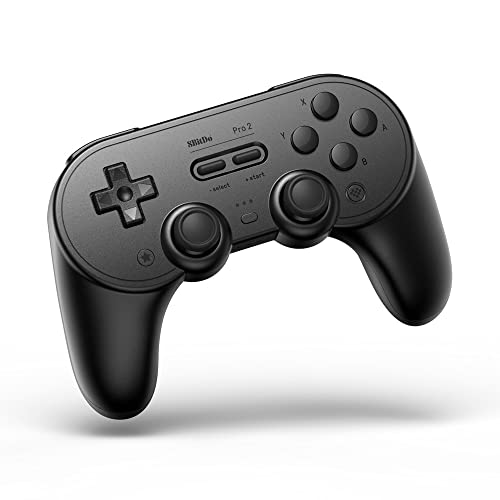
For most PC gamers in 2026, the PlayStation DualSense is the best all-rounder, the 8BitDo Pro 2 is the best for emulation and fighting games, and the GameSir G7 SE is the best wired-only pick for competitive play. The right choice depends entirely on what you play and how — there is no single winner across all three use cases. If you need one controller that does AAA single-player well and you have $74 to spend, the DualSense wins. If you split time between modern games and retro emulation, the Pro 2 is the unique choice. If you play competitively and want the cheapest, lowest-latency wired option, the G7 SE is the answer at $45.
Why we're picking these three (and what changed in 2026)
Choosing a PC controller used to be simple: Xbox-shaped pad, plug it in, done. In 2026 the market has fragmented in genuinely useful ways. The DualSense smuggled adaptive triggers and per-pixel haptic feedback into a price tier that used to deliver only basic rumble. 8BitDo took its retro-friendly form factors mainstream and added back buttons, profile switching, and meaningful customization software. A wave of budget brands — GameSir among them, alongside Flydigi and BIGBIG WON — pushed wired controller pricing below $50 while delivering hall-effect sticks and competitive-grade build quality. The result is that "best PC controller" is no longer a single answer.
For this head-to-head we picked three controllers that explicitly serve different jobs. The DualSense at $74 is the AAA pad, with the broadest feature support across Steam's library. The 8BitDo Pro 2 at $60 is the emulation and retro pad, with a layout and software story tuned to that audience. The GameSir G7 SE at $45 is the competitive-wired pad, the cheapest credible option on this list. We pulled the HORI HORIPAD Pro Controller into the discussion as the "comfortable conventional pad" reference point, even though it's a Switch-first controller — it's a useful sanity check on how much value you actually get from the premium picks.
Key takeaways
- DualSense wins for AAA single-player on PC — it has the broadest game support for its premium features.
- 8BitDo Pro 2 wins for fighting games, emulation, and anyone who prefers a SNES-style layout.
- GameSir G7 SE wins for competitive games on a tight budget — wired, low-latency, hall-effect sticks.
- Most "best of all three" picks are wired DualSenses, which Sony doesn't actually sell.
- Steam Input handles 90% of what each controller can do without manufacturer software.
- For under $60, the value-tier wired controllers are now genuinely competitive on build quality.
Spec-delta: the three at a glance
| Spec | DualSense | 8BitDo Pro 2 | GameSir G7 SE |
|---|---|---|---|
| Connection | USB-C wired + Bluetooth | USB-C wired + Bluetooth + 2.4GHz | Wired only (USB-C) |
| Layout | PS-style symmetric sticks | SNES-style + dual sticks | Xbox-style offset sticks |
| Hall-effect sticks | No (rev varies) | Yes on Hall edition | Yes |
| Back buttons | No | 2, fully remappable | 2, fully remappable |
| Battery life | ~12 hours | ~20 hours | N/A (wired) |
| Adaptive triggers | Yes (game-dependent) | No | No |
| Built-in software | None on PC | 8BitDo Ultimate | GameSir Nexus |
| Native Steam support | Excellent | Excellent | Excellent (Xbox-mode) |
| Approx. price | $74 | $60 | $45 |
A few read-aheads. The DualSense is the most premium of the three on paper, with adaptive triggers and HD haptics that no other controller in this lineup matches. The Pro 2's hall-effect sticks (on the newer revision) make it the most drift-resistant of the three. The G7 SE is wired-only by design — that's a feature, not a limitation, for competitive players. All three work with Steam Input out of the box and don't require manufacturer software for basic use.
Which controller feels best for AAA single-player on PC?
The DualSense, by a real margin. The two features that justify its premium — adaptive triggers and HD haptics — are properly implemented in a growing list of PC titles, including Returnal, Death Stranding Director's Cut, Forspoken, Star Wars Jedi: Survivor, Spider-Man Remastered, Resident Evil 4 Remake, and a handful of others. The list is not as long as on PlayStation 5, but it's long enough that anyone who plays current-gen AAA titles on PC will hit a supported game regularly.
Outside of supported games, the DualSense still wins on physical feel for many genres. The shape is comfortable for long sessions, the sticks are accurate, the triggers and bumpers have a satisfying click, and the build is solid. The two real downsides are battery life (about 12 hours, less than most competitors) and the fact that wireless mode requires you to manually disable Bluetooth when you want lowest-latency wired play — a small workflow friction but a real one.
The Pro 2 and G7 SE work fine for single-player AAA but lack the special features. If your AAA library is the dominant use case and you don't mind paying $14 more than the Pro 2, the DualSense is the right pick.
Which is best for fighting games and retro/emulation?
The 8BitDo Pro 2, with no real competitor in this lineup. Fighting games are the genre most allergic to D-pad compromises, and the Pro 2's D-pad is one of the best on any modern pad — comfortably above the DualSense's and well above the G7 SE's. For Street Fighter 6, GranBlue Fantasy Versus Rising, or anything in the Capcom or Arcsys catalog, the Pro 2's D-pad is genuinely playable in a way the others struggle to match.
For emulation, the same D-pad quality matters, and the Pro 2 layers on the platform breadth that emulator users actually exploit. It pairs cleanly with retro setups including the Switch Lite for handheld emulation use cases, RetroPie boxes, and the various Anbernic and Powkiddy handhelds that have become a category in their own right. The 8BitDo Ultimate software lets you set per-platform profiles and switch between them with a button combo, which is exactly what you want when one pad has to drive an N64 in one session and a PS1 in the next.
The DualSense and G7 SE are usable for these workloads but not optimized for them. The DualSense's D-pad, in particular, is a notable weak spot.
Which has the best wired latency for competitive play?
The GameSir G7 SE, full stop. There are two reasons. First, it's wired-only — there's no Bluetooth or 2.4GHz stack to add variability, no battery to maintain, no pairing dance before a match. Second, its hall-effect sticks are genuinely competitive-grade and avoid the drift that traditional potentiometer sticks develop with heavy use.
The practical latency difference between wired and wireless on a modern controller is small — a few milliseconds in most cases — but the consistency difference is what competitive players notice. A wired controller's latency is the same every frame; a wireless controller's latency can spike when the link gets stepped on. For Tekken, Street Fighter, Smash Bros, or any timing-sensitive multiplayer, that consistency is the win.
The DualSense and Pro 2 both work wired, but the DualSense's wired mode is awkward (the controller wants to be wireless), and the Pro 2's main strength is the layout, not the latency. For competitive play on a budget, the G7 SE is the cheapest credible option.
How does Steam Input support differ across the three?
Steam Input is the great equalizer for PC controllers. It exposes the controller's full input space (sticks, triggers, gyro, touchpad, motion) to games that explicitly support it, and it provides a remapping layer for games that don't.
The DualSense gets the best Steam Input treatment. Its gyro, touchpad, and motion sensors are all exposed cleanly, and Valve has invested specific work in supporting DualSense's signature features. For games that don't natively understand the DualSense, Steam can pretend it's an Xbox controller with extras, which gives you the best of both worlds.
The Pro 2 also has excellent Steam Input support. Its back buttons can be mapped through 8BitDo's software or through Steam Input directly, and its gyro is exposed for use in motion-control aiming setups (Splatoon-style) for shooters that support gyro on PC.
The G7 SE works in Xbox-controller mode by default, which is the most universally compatible profile across PC games and Steam Input. It lacks gyro or touchpad inputs to expose, so the Steam Input integration is simpler — but everything it does have works cleanly.
How does Steam Input change the buying calculus?
Steam Input bridges the gap between Xbox-native PC games and non-Xbox controllers, but it can't add hardware features that aren't present. A DualSense without working adaptive triggers in a given title is still a great pad — just not the showcase experience. A G7 SE will never have gyro because it doesn't have a gyro sensor. The right way to think about Steam Input is "this gets you 90% of the way to controller-vendor parity in software" — but the remaining 10% is the hardware story, which is exactly where these three pads differ from each other.
Verdict matrix
Get the DualSense if... You play AAA single-player games on PC and want the best premium experience. You're willing to pay $74 for adaptive triggers and HD haptics in supported titles. You want a controller that doubles for a PS5 if you ever own one. You're fine with mid-pack battery life.
Get the 8BitDo Pro 2 if... You play fighting games regularly. You do meaningful retro emulation. You like the SNES-style layout for nostalgia or ergonomic reasons. You want fully remappable back buttons. You want long battery life. You care about platform breadth (PC + Switch + mobile + Android TV) on one controller.
Get the GameSir G7 SE if... You play competitive multiplayer and want the lowest-friction wired controller. Your budget is under $50. You want hall-effect sticks for drift resistance. You don't need wireless, gyro, or special features. You want an Xbox-shaped layout.
Recommended pick: the practical answer
If you can only pick one and your needs are evenly mixed, the DualSense is the safest bet at $74. It does everything well, it has the broadest software support of the three, and it ages gracefully — when its haptic features hit a game, they're a meaningful upgrade. It is not the cheapest, the most competitive-friendly, or the best for fighting games. It is the most generally good.
If your needs are specific — you play fighters, you emulate, you grind competitive multiplayer on a budget — the Pro 2 or G7 SE will serve you better than the DualSense and at a lower price. The best PC controller is the one that matches your library, not the one with the most features on its spec sheet.
For households where multiple people game, the cheap option is to buy two of the three: a DualSense and a G7 SE covers single-player and competitive simultaneously for $119, less than two DualSenses. A DualSense and a Pro 2 covers single-player and emulation for $134. Mix and match to your library rather than buying duplicates of a single model.
Common pitfalls when buying a PC controller in 2026
- Not checking the stick revision. The Pro 2 has had multiple hardware revisions; hall-effect sticks are on the newer ones. Confirm the listing.
- Buying a DualSense for a non-Steam game and expecting adaptive triggers. Many launcher-exclusive titles (Epic, GOG, Battle.net) have inconsistent support.
- Assuming Bluetooth wireless is good enough for competitive play. It is for casual, but a wired controller is the right call for ranked multiplayer.
- Ignoring the D-pad. If you play any fighting game seriously, the D-pad is the most important input on the controller, not the sticks.
- Skipping firmware updates. 8BitDo and GameSir both ship meaningful firmware updates that change controller behavior — check before you blame the hardware.
When NOT to buy any of these
Buy nothing if you already own an Xbox Series X|S controller and it's working fine. The Xbox pad remains the canonical PC controller — every game supports it natively, Steam Input handles the edge cases, and it's perfectly good for almost everything except the specific use cases above. The reason to upgrade is a specific need (DualSense for AAA features, Pro 2 for layout, G7 SE for wired competitive), not "I want a better generic pad."
If you primarily play on Switch and only occasionally on PC, the HORI HORIPAD Pro Controller is a sensible cross-platform buy that gives you Switch-first ergonomics and works on PC via Steam Input.
Bottom line
There is no single best PC controller in 2026 — there are three of them, each best at a specific job. The DualSense is the AAA single-player pad. The Pro 2 is the fighting-game and emulation pad. The G7 SE is the budget competitive pad. Pick by use case, not by spec-sheet superiority, and you'll be happier with the controller you end up holding for hundreds of hours.
Related guides
- Best Controller for Raspberry Pi Retro Emulation in 2026
- Best Game Controllers for PC and Emulation in 2026
- Best Sim-Racing Wheel and Shifter Setup for Beginners in 2026
- Build a Pi Zero W Handheld Retro Emulator in 2026