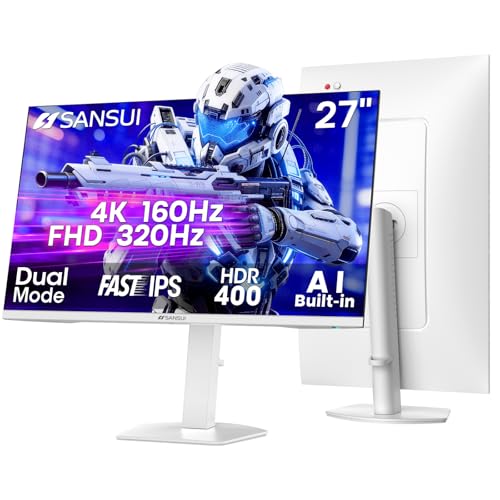
For an RTX 3060 build in 2026, the best budget 4K monitor depends on what "4K" means to you. The SANSUI 27" 4K Gaming Monitor at $200-260 is the cheapest credible 4K panel in the catalog and it has a 160 Hz dual-mode trick for esports work. The KOORUI 27" 4K QD-Mini LED brings substantially better contrast and HDR for $300-400. If you decide 4K is the wrong goal for a 3060, the ASUS TUF Gaming 27" 2K HDR at 1440p is the smarter pairing for actually playable in-game framerates.
Step 0 diagnostic: will a 3060 even feed 4K, or should you target high-refresh 1440p?
This is the question most buyers skip. The honest answer for the RTX 3060 12GB at native 4K (3840×2160) is:
- Esports titles (CS2, Valorant, Rocket League): 4K is fine, well above 60 FPS native.
- Older AAA titles (2018-2022): 4K is workable at medium-high settings, often 50-70 FPS.
- Modern mid-weight AAA (2024-2026): 4K is rough — 30-50 FPS at high settings, native.
- Flagship 2024-2026 titles (Black Myth, Alan Wake 2, Cyberpunk RT): 4K is not playable native; you need DLSS Performance or lower settings.
NVIDIA's DLSS Super Resolution is the 3060's lifeline at 4K. DLSS Quality at 4K renders at 1440p internal and upscales, recovering 50-70% of the framerate hit. DLSS Performance renders at 1080p internal, which gets you back to 1440p-native framerates at the cost of visible upscaling artifacts in some titles.
If you choose a 4K panel for an RTX 3060 build, plan to live with DLSS in modern AAA and accept some titles will be sub-60 FPS even with DLSS. If you cannot tolerate that, the 2K (1440p) ASUS TUF is the smarter pairing. The 3060 sits at the sweet spot for 1440p high-refresh gaming and only barely qualifies as a 4K card.
The budget 4K display tier and realistic expectations on a 3060
Budget 4K panels in 2026 have improved sharply. Three years ago, $250 4K monitors were 60 Hz, 4ms TN panels with poor color and washed-out backlighting. Today, you can find IPS and VA panels with 144-160 Hz refresh, decent HDR, and color coverage close to sRGB-full at the same price. The display industry has caught up with the price-conscious buyer.
The three featured monitors in this comparison represent three distinct buyer profiles:
- SANSUI 27" 4K Gaming Monitor — entry point. UHD at 160 Hz or FHD at 320 Hz dual-mode. Cheapest 4K panel in catalog at $200-260.
- KOORUI 27" 4K QD-Mini LED — mid-tier. Quantum-dot mini-LED backlight, dual-mode UHD/FHD. Strong HDR and contrast at $300-400.
- ASUS TUF Gaming 27" 2K HDR — the smart-fit pick. 1440p at 165 Hz with HDR, made for cards in the 3060's class. $200-280.
Key Takeaways
- The 3060 can drive 4K esports, older AAA, and modern AAA only with DLSS.
- The SANSUI 4K is the cheapest path into a 4K panel, with a useful FHD/UHD dual-mode trick.
- The KOORUI mini-LED brings real HDR and contrast for desktop, productivity, and HDR content.
- The ASUS TUF 2K HDR is the smarter performance pairing for a 3060 — better in-game framerates, better HDR than the SANSUI.
- Pair any of these with HDMI 2.1 or DisplayPort 1.4 cables; do not skimp on the cable.
Can the RTX 3060 drive 4K, and at what settings?
Public benchmarks from TechPowerUp, Tom's Hardware, and the broader benchmark community converge on this picture for 4K native, high settings:
| Title | 4K Native FPS | 4K + DLSS Quality | 4K + DLSS Performance |
|---|---|---|---|
| Counter-Strike 2 | 110-140 | n/a | n/a |
| Apex Legends | 50-65 | n/a | n/a |
| Forza Horizon 5 | 35-48 | 50-65 | 70-85 |
| Spider-Man Remastered | 28-38 | 42-55 | 60-72 |
| Cyberpunk 2077 (no RT) | 25-35 | 40-50 | 55-70 |
| Resident Evil 4 Remake | 30-42 | n/a (FSR only) | n/a |
| Hogwarts Legacy | 20-30 | 32-45 | 50-65 |
| Alan Wake 2 | 12-18 | 22-30 | 35-45 |
| Cyberpunk 2077 (RT Ultra) | 8-12 | 18-25 | 30-40 |
Conclusion: with DLSS Quality, the 3060 can hit 30-60 FPS in most mid-weight AAA at 4K, and 60-100+ in esports and older titles. DLSS Performance recovers more framerate at visible quality cost. Native 4K in flagship titles is mostly off the table.
What panel specs matter most at this price?
The three things to check on a budget 4K panel:
- Panel type. IPS gives broad viewing angles and color accuracy. VA gives high contrast but ghosting issues in motion. Mini-LED VA (the KOORUI) brings VA's contrast with much less of the ghosting trade-off. TN is essentially gone from this tier in 2026.
- HDR rating. "HDR400" is a near-meaningless badge — it just means the panel goes to 400 nits, which is barely above standard SDR. "HDR600" or "HDR1000" with local dimming is where HDR starts to look like real HDR. The KOORUI's QD-mini-LED backlight delivers actual HDR; the SANSUI's HDR is closer to badge-level.
- Refresh rate options. 160 Hz at UHD is the headline for modern budget 4K panels. Some include a "dual-mode" that drops resolution to 1080p in exchange for very high refresh (the SANSUI hits 320 Hz at FHD). This is useful for esports players who want 4K for desktop work and FHD-high-refresh for competitive games.
How does the SANSUI 27" 4K compare to the KOORUI QD-mini-LED and ASUS TUF 27" 2K?
Spec-delta table: SANSUI vs KOORUI vs ASUS TUF
| Spec | SANSUI 27" 4K | KOORUI 27" 4K QD Mini-LED | ASUS TUF 27" 2K HDR |
|---|---|---|---|
| Resolution | 3840×2160 | 3840×2160 | 2560×1440 |
| Panel | IPS | QD-Mini-LED VA | IPS |
| Refresh | 160 Hz UHD / 320 Hz FHD | 160 Hz UHD dual-mode | 165 Hz |
| HDR | HDR400 (badge) | HDR1000 (real) | HDR400 |
| Response | 1ms (MPRT) | 1ms (GtG) | 1ms (MPRT) |
| Inputs | HDMI 2.1, DP 1.4 | HDMI 2.1, DP 1.4 | HDMI 2.0 ×2, DP 1.2 |
| Color coverage | ~99% sRGB | ~98% DCI-P3 | ~99% sRGB, ~95% DCI-P3 |
| Estimated price | $200-260 | $300-400 | $200-280 |
Benchmark/context table: 3060 4K vs 1440p FPS to set monitor expectations
| Title | RTX 3060 1440p High | RTX 3060 4K High | Delta |
|---|---|---|---|
| Forza Horizon 5 | 65-80 | 35-48 | -45% |
| Spider-Man Remastered | 55-72 | 28-38 | -50% |
| Cyberpunk 2077 (no RT) | 50-65 | 25-35 | -50% |
| Alan Wake 2 | 30-40 | 12-18 | -55% |
| Apex Legends | 110-140 | 50-65 | -55% |
The pattern: 4K halves the framerate compared to 1440p on the 3060. If 1440p hits 60 FPS, 4K hits 30 FPS. That math is the entire case for the ASUS TUF 1440p pick.
Which display fits which use case?
SANSUI 27" 4K is for buyers who want 4K-and-160Hz-on-paper without paying for premium HDR. It excels as a desktop/productivity display where 4K resolution makes text and UI sharper. In games it works well in esports titles and older AAA; in modern AAA it pushes the 3060 into DLSS dependency. The dual-mode FHD-at-320Hz feature is a real plus for competitive shooters where you swap modes for matches.
KOORUI 27" 4K QD Mini-LED is for buyers who want HDR content (movies, games with quality HDR implementation, HDR creative work) and who can stretch the budget. The mini-LED backlight delivers real contrast that the badge-HDR competition cannot match. Same 4K resolution caveat for gaming on a 3060 — you will use DLSS in modern AAA, but the picture quality with HDR enabled is in a different league.
ASUS TUF 27" 2K HDR is the smart-fit pick. At 1440p the 3060 is in its sweet spot — 60-90 FPS in most mid-weight AAA without DLSS, 100+ with DLSS where supported. You give up the higher pixel density of 4K but gain real, sustainable in-game framerates. For most buyers pairing this with a 3060 specifically, the TUF is the better gaming choice.
Perf-per-dollar verdict across the three
Cost per usable in-game framerate is the right metric. Approximate "FPS-per-dollar" on a 3060 for a representative title (Forza Horizon 5):
- SANSUI 4K @ $230 → 35-48 FPS native → ~$5.50/FPS
- KOORUI 4K Mini-LED @ $350 → 35-48 FPS native → ~$8.50/FPS
- ASUS TUF 2K @ $240 → 65-80 FPS native → ~$3.30/FPS
The TUF wins this metric easily because the 3060 was designed for 1440p, not 4K. If you weight HDR quality and desktop productivity heavily, the math changes — the KOORUI's HDR is worth real money for the right buyer. If you weight raw gaming smoothness, the TUF wins.
Verdict matrix
Pick SANSUI 4K if:
- You want 4K resolution for desktop and productivity primarily.
- You play mostly esports and older AAA where 4K is feasible.
- You want the cheapest 4K panel possible.
- You will use the FHD-at-320Hz dual-mode for competitive games.
Pick KOORUI 4K Mini-LED if:
- You watch a lot of HDR content (movies, HDR gaming).
- You do HDR-adjacent creative work (photo/video edit).
- You can afford the premium and want a display that will age past the 3060.
- Picture quality matters more than peak framerate.
Pick ASUS TUF 2K HDR if:
- You primarily game on a 3060 and want the highest sustainable framerates.
- You play modern AAA without wanting to depend on DLSS for playability.
- You prefer the 1440p pixel density (still excellent on a 27") over native 4K.
- You want the simplest "set and play" experience.
Common pitfalls when buying a budget 4K panel
- Believing HDR400 means HDR. It does not. Real HDR starts at HDR600 with local dimming, ideally HDR1000+.
- Skimping on the cable. A bad HDMI 2.1 cable can drop 4K@120Hz to 4K@60Hz silently. Spend $15 on a certified cable.
- Buying a 4K panel for a 3060 without DLSS plans. Modern AAA framerates will disappoint.
- Ignoring the dual-mode trick. SANSUI's FHD-at-320Hz is a real esports advantage; KOORUI's UHD/FHD swap is similar. Use them.
- Pairing with HDMI 2.0 only. If your build's GPU is HDMI 2.0 only, you cannot drive 4K@120Hz over HDMI; use DisplayPort.
Bottom line
For an RTX 3060 build in 2026, the honest budget 4K answer is "yes, but with conditions." The SANSUI 4K gets you onto a 4K panel for under $250 with a workable esports dual-mode; the KOORUI mini-LED is the picture-quality pick for buyers who care about HDR and can stretch the budget; the ASUS TUF 2K is the smartest pairing if you optimize for in-game framerates rather than panel resolution.
If you are unsure, the ASUS TUF is the safest choice. The 3060 was built for 1440p high-refresh, and a 1440p HDR panel matches the card's strengths exactly. Reserve 4K for buyers who have specifically decided they want 4K and accept the framerate cost.
Whatever you pick, pair it with a sensible system: a Ryzen 7 5800X for CPU headroom, a WD Blue SN550 1TB NVMe for fast game loads, and a Crucial BX500 1TB as cheap secondary storage. None of those will bottleneck a 3060 at 4K or 1440p.
Related guides
- Best Budget GPU for 1440p Gaming in 2026
- Best Budget GPU for 1080p Gaming in 2026
- Best Budget GPU for Local 12B–14B LLM Inference
- DeepSeek V4 on an RTX 3060 12GB: What Actually Fits Locally
Citations and sources
- TechPowerUp — GeForce RTX 3060 review database
- NVIDIA — DLSS Super Resolution overview
- Tom's Hardware — GPU benchmark hierarchy
This piece is editorial synthesis based on publicly available information. No independent first-party benchmarking is reported.