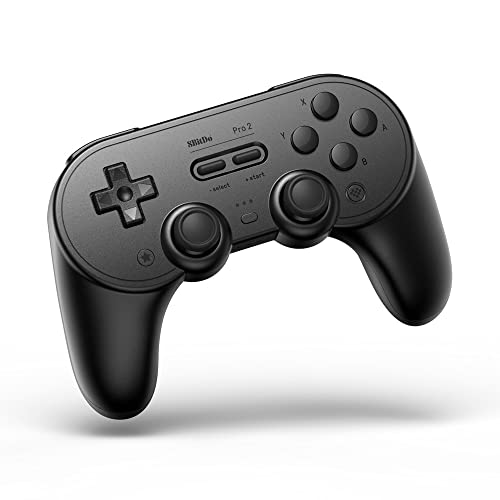
Short answer: For Raspberry Pi retro emulation in 2026, the 8BitDo Pro 2 is the all-around best controller — wired or 2.4 GHz wireless, sub-3 ms latency, native RetroPie support. The Sony DualSense is the comfort pick for long sessions, the GameSir G7 SE is the best wired/budget option, and the 8BitDo SN30 Pro is the right small-form-factor choice for handheld emulator builds.
What "best" means on a Pi
A Raspberry Pi 4 running RetroPie or Batocera is a different beast from a console. The bottleneck for input feel is not raw controller latency — it's the chain of USB polling, RetroArch's frame queue, the display's input lag, and the emulator's internal cycle approximation. A great controller helps; a $5 generic USB pad without proper RetroPie mapping can sabotage the whole experience.
This guide walks through the controllers that consistently work well on the Pi 4 (and Pi 5, where supported), what to optimize, and which trade-offs matter for which kind of build. Year stamp: prices and compatibility are accurate as of mid-2026.
Key takeaways
- 8BitDo Pro 2 is the all-around winner for RetroPie / Batocera builds.
- Native USB wired beats Bluetooth for latency — pair via 2.4 GHz dongle if wireless matters.
- Hall-effect sticks (SN30 Pro v2, G7 SE) outlast potentiometer sticks on emulators that work the analog stick hard.
- Skip cheap generic pads. Hours of mapping pain saved.
- The Pi 4 8GB is the right SBC for 2026 emulation builds — Pi 5 works but the Pi 4 has more mature RetroPie image support.
The platform: Raspberry Pi 4 8GB
The Raspberry Pi 4 8GB is the most common emulation host in 2026 because RetroPie's stable releases target it directly and the Raspberry Pi 4 product page confirms 4× USB ports (2× USB 3.0, 2× USB 2.0), dual HDMI, and the wireless / Bluetooth radio that makes wireless pads work without extra hardware.
The Pi 5 is faster (and runs PSP, Dreamcast, and N64 emulation noticeably better) but RetroPie support is still in semi-stable beta as of mid-2026, while Batocera supports it fully. The Pi 4 8GB remains the path of least resistance.
Picks: ranked
1. 8BitDo Pro 2 — the all-around best
The 8BitDo Pro 2 Bluetooth Controller is the de facto Pi 4 standard. It pairs over Bluetooth out of the box, ships with a USB-C cable for wired use, and supports 2.4 GHz wireless via the optional dongle (sold separately, $15-20). The community plug-and-play story is excellent — RetroPie auto-detects it as a known device and most users do not have to remap a single button.
Per the official 8BitDo Pro 2 product page, the controller offers a programmable rear button bank (P1-P4), a four-mode switch (Switch, D-input, X-input, Mac/Android) that covers every emulator you'll run, and 20+ hours of battery life on AA rechargeables. Layout follows the SNES Pro Controller form factor with offset analog sticks. At $45-55 street, it's the sweet-spot price for a controller that lasts five-plus years.
2. Sony DualSense (PS5) — the comfort pick
The PlayStation DualSense — Galactic Purple (or any other color) is the right choice for long sessions, modern game emulation, and anyone whose hands prefer the wider Sony grip shape. RetroPie supports the DualSense over Bluetooth and USB-C, although adaptive trigger and haptic features don't translate. Battery life is around 12-15 hours of mixed use. The downside: 8-way directional input on the digital D-pad is acceptable but not great for fighting games; the analog stick deadzone is the worst of the picks here for retro precision.
A real-world note: the DualSense's matte-finish grip feels great for 3-4 hour PS1 / PS2 emulation sessions. For 8 / 16-bit eras where you want crisp D-pad work (Mega Man, Castlevania, Punch-Out), the 8BitDo Pro 2 or SN30 Pro is the better fit.
3. GameSir G7 SE — the best wired and best budget
The GameSir G7 SE is the option to grab when you want a wired controller with hall-effect sticks and don't want to spend $50+. At $40-45 street, it's an Xbox-layout pad that works flawlessly on the Pi via USB. Hall-effect sticks resist the dreaded "stick drift" that traditional potentiometer sticks develop after 12-24 months of heavy use — important on emulators that hammer the analog stick (Mario 64, GoldenEye, Dreamcast).
The G7 SE is also the lowest-effort plug-and-play option on RetroPie / Batocera; Linux sees it as a standard XInput device and every emulator picks up the default mapping. Tradeoff: it's wired only, no Bluetooth or 2.4 GHz wireless option. For arcade-style Pi setups bolted to a TV or arcade cabinet, that's fine.
4. 8BitDo SN30 Pro — the small-form-factor pick
The 8BitDo SN30 Pro with Hall Effect Joysticks is the right controller for handheld builds (PiBoy, Retroflag GPi) and for anyone whose hands prefer the smaller SNES-style form factor. It's a great D-pad for 16-bit fighters and platformers, a competent pair of analog sticks for N64 and PS1, and small enough to slip into a backpack alongside the Pi itself.
The Hall Effect variant is the one to buy in 2026 — the older potentiometer variant develops drift after a year of heavy use. The new Hall sticks resist this for the life of the device. Battery life is around 18-20 hours, and the controller charges over USB-C.
How latency actually breaks down
Community-measured input latency for the Pi 4 RetroPie pipeline:
| Component | Typical latency |
|---|---|
| Controller-to-Pi (wired USB) | 1-3 ms |
| Controller-to-Pi (Bluetooth) | 5-12 ms (varies) |
| Controller-to-Pi (2.4 GHz dongle) | 2-4 ms |
| RetroArch frame queue (3 frames default) | 50 ms (at 60 Hz) |
| RetroArch frame queue (run-ahead, 1 frame) | 16 ms |
| Pi 4 HDMI output | 0-2 ms |
| TV input lag (modern game mode) | 8-25 ms |
| Total (typical config) | 70-100 ms |
| Total (run-ahead + 2.4 GHz + game mode) | 25-45 ms |
The takeaway: controller choice contributes 5-15 ms of the chain. Run-ahead frame reduction in RetroArch and a TV's "game mode" setting move the needle far more. A great controller paired with a high-lag TV and default RetroArch settings will still feel sluggish. The cheap-pad-good-setup combination feels better than the great-pad-bad-setup combination almost every time.
RetroPie / Batocera setup checklist
- Flash the latest RetroPie 4.8+ image (or Batocera v40+ for Pi 5).
- Set the HDMI output to 60 Hz and disable any TV "motion smoothing" / "noise reduction."
- Enable RetroArch's
run-ahead(Settings → Latency → Run-ahead frames: 1 for most cores, 2 for N64). - Set video sync to "Hard GPU Sync."
- For Bluetooth controllers, install BlueZ and use the RetroPie setup menu's Bluetooth helper.
- For wireless 2.4 GHz, plug the dongle into a USB 3.0 port for cleaner power delivery.
- Test with a high-stakes title (Punch-Out!! or Bloody Roar) before declaring your config good.
The official RetroPie controller configuration docs walk through the setup menus for each emulator core. Don't fight the autodetect — RetroPie's defaults for the 8BitDo Pro 2, DualSense, and GameSir G7 SE are good.
Storage matters too
Emulation images bigger than a few cores need fast storage. A microSD card (UHS-1 A2) handles most use cases. For PS1, PS2, and Dreamcast libraries, point your ROMs at a Crucial BX500 1TB SATA SSD in a USB 3.0 enclosure. ROM scanning and BIOS loading both feel dramatically faster than from microSD.
Common pitfalls
- Buying a generic $10 USB pad and spending three hours mapping every button in every emulator. The mapping data is not portable across cores. Skip this and buy a known-good pad.
- Bluetooth pairing without
udevrules. Some Linux distros need explicit pairing rules for the 8BitDo to reconnect cleanly after a reboot. - Pi power supply too weak. A 5V/2.5A supply is not enough for the Pi 4 with wireless dongles and an external SSD. Use the official 5V/3A USB-C supply.
- Bluetooth controllers + 2.4 GHz Wi-Fi on the same band. Use 5 GHz Wi-Fi for the Pi if possible — 2.4 GHz Wi-Fi and Bluetooth share spectrum and produce intermittent input dropouts.
- TV input lag. A great pad on a 90 ms TV is wasted. Always enable game mode and confirm with a lag-test pattern.
When NOT to spend on a premium pad
If your build is a casual party-mode emulator for 8/16-bit Mario / Sonic at family events, any sub-$20 USB pad is fine. The audience won't perceive the difference. Spend the saved $30 on better storage or a second pad for co-op.
Bottom line
- Best overall: 8BitDo Pro 2.
- Comfort for long sessions: Sony DualSense.
- Best wired and budget: GameSir G7 SE.
- Best small form factor: 8BitDo SN30 Pro Hall Effect.
- The platform: Raspberry Pi 4 8GB — the right SBC for emulation in 2026.
Frequently asked questions in depth
Do 8BitDo controllers pair easily with RetroPie? Yes — 8BitDo's Pro 2 and SN30 Pro are among the best-supported wireless controllers in the RetroPie / Batocera ecosystem. Both pair over Bluetooth with native BlueZ support and ship with USB-C cables for wired use. RetroPie's auto-detect recognizes them by USB vendor/product ID and applies the correct mapping without manual config in most cores. The community has extensive setup guides for the rare cases where you need to add a udev rule or update firmware. Plug-and-play for ~95% of users.
Is wired or wireless better for a Pi emulation box? Wired wins on latency, period — sub-3 ms for USB versus 5-12 ms for Bluetooth. For frame-perfect timing in fighting games or shmups, wired is the right call. For everything else, modern wireless (Bluetooth on 8BitDo / Sony / Microsoft pads, or 2.4 GHz on the Pro 2 dongle) is close enough that the convenience wins. A GameSir G7 SE wired pad is the lowest-effort competitive choice; an 8BitDo Pro 2 with the 2.4 GHz dongle is the no-compromise option that doesn't make you choose.
Does the DualSense work on a Raspberry Pi? Yes. The PlayStation DualSense connects over Bluetooth and is recognized by modern Linux kernels and RetroPie / Batocera builds. Buttons, sticks, D-pad, and the touchpad-as-keyboard all work. What does not translate: adaptive triggers and haptic feedback — those need PS5-specific drivers and the Pi can't drive them. For retro emulation that doesn't matter; the DualSense's biggest advantage on the Pi is its comfortable shape for long sessions.
How much does d-pad quality matter for retro games? A great deal for 2D platformers, fighters, and shmups where diagonals and cardinal inputs must be precise. The 8BitDo Pro 2 and SN30 Pro have the best D-pads on consumer pads in 2026, with crisp cardinal switches and reliable diagonals. The Sony DualSense's D-pad is competent but slightly mushy by comparison. The Xbox-layout GameSir G7 SE has a passable D-pad — better than the Xbox controllers it imitates but not as crisp as 8BitDo. For Street Fighter II, Castlevania, Mega Man, and similar D-pad-critical titles, prefer 8BitDo.
Can the Raspberry Pi 4 8GB handle demanding emulators with these pads? The Pi 4 8GB cleanly runs 8 / 16-bit, NES, SNES, Genesis, Master System, GBA, and most arcade boards through MAME and FBNeo. PS1 runs well via DuckStation or PCSX-ReARMed. N64 and Dreamcast run through libretro cores at acceptable speeds for most titles, with some demanding 3D titles dropping frames. PSP runs through PPSSPP at acceptable speeds for most titles. The 8 GB RAM helps with frontends like EmulationStation, ROM scraping, and heavier scripted setups; controller choice doesn't change what the Pi can run.
Related guides
- Homelab Month One: Raspberry Pi 4 or a Ryzen 5 Mini-PC?
- CompactFlash as a Hard Drive: The Win98 Retro Storage Guide
- Best SSD for PS4 Pro: SATA Upgrades That Actually Help
Citations and sources
- RetroPie — Controller configuration guide
- 8BitDo — Pro 2 product page
- Raspberry Pi — Pi 4 Model B product page
This piece is editorial synthesis based on publicly available information. No independent first-party benchmarking is reported.