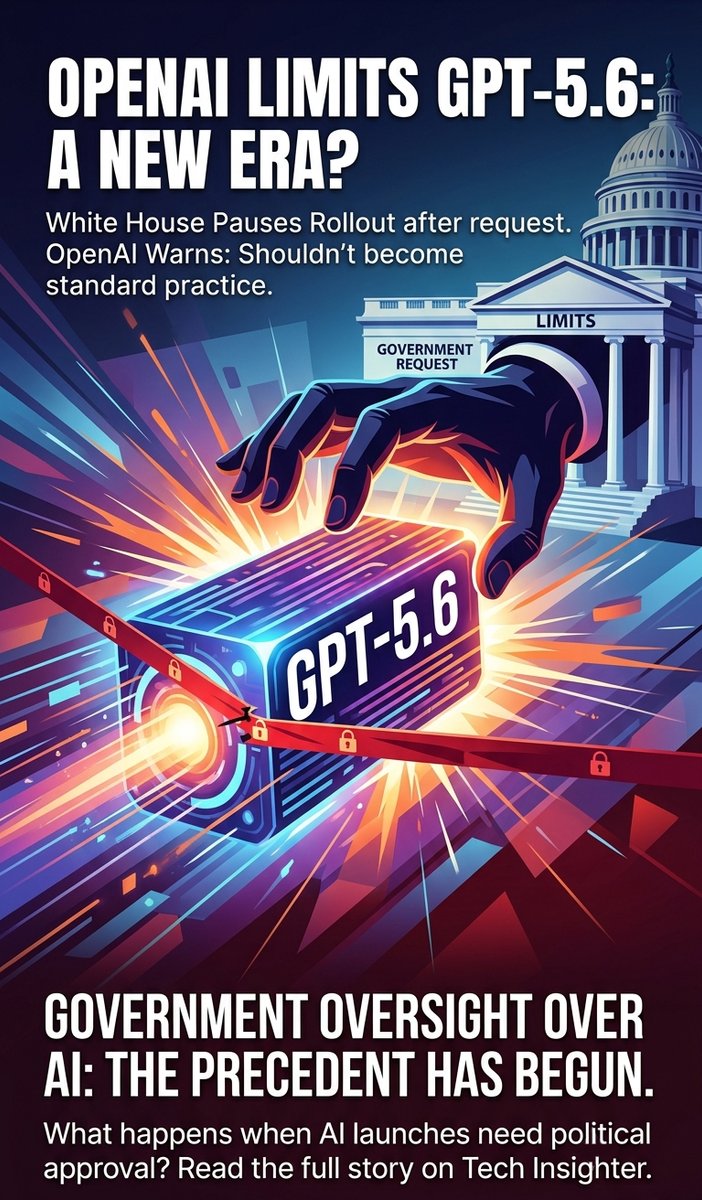
In brief (2026): OpenAI's GPT-5.6 rollout now requires US government sign-off on a customer-by-customer basis before new commercial access is granted, according to public reporting on the release. For builders who can't wait or don't want their AI workflow gated on a federal review queue, the practical fallback is running open-weights models locally on a 12GB card like the MSI RTX 3060 Ventus 2X.
What happened
According to reporting from the-decoder, OpenAI's GPT-5.6 general availability rollout is being staged behind a US government approval workflow that applies to each new customer individually rather than as a blanket program-wide sign-off. The mechanism, as reported, sits atop the standard commercial onboarding pipeline: applicants for GPT-5.6 access route through a review that requires federal clearance before commercial provisioning proceeds.
The precise legal authority under which this review is being conducted is not fully public. It is broadly consistent with the tightening posture around frontier-model export and deployment controls that has been building in US regulatory guidance across late 2025 and early 2026. The scope — which customer types, which industries, which jurisdictions — is defined by OpenAI's policy pages and by whatever the reviewing agency has published; both should be considered authoritative in ways this news brief is not.
We are not privy to the internal criteria used during review. We are summarizing what public reporting states as of the publication date of this piece. If you are a prospective GPT-5.6 customer, confirm the current terms directly with OpenAI before making procurement decisions.
Why it matters
Frontier-model access has always been a soft bottleneck for builders — waitlists, rate limits, terms-of-service opacity — but a per-customer government sign-off is a new class of friction. Two consequences are already visible in developer forums.
First, timelines slip. Even a well-run federal review can add weeks between "I have a use case" and "I have API keys," and builders working against a product deadline don't have that runway. That pushes teams to hedge, either by locking in access on older GPT-5.x models that don't carry the new requirement or by keeping a self-hosted fallback ready.
Second, the ceiling for what "self-hosted" can achieve keeps rising. Open-weights releases in 2026 — most notably GLM-5.2 and refreshed Llama and Qwen checkpoints — are close enough in capability on many tasks that they clear the bar for a lot of production work. A 12GB RTX 3060 is enough for smaller open-weights variants at usable speeds; a ZOTAC Twin Edge in the same tier does the job for the same money.
Third — and this is the part the policy conversation often glosses — the review requirement doesn't just constrain who can use GPT-5.6 today. It changes how founders and CTOs plan for the next 12 months. If your product roadmap depends on a specific model with a specific timeline, and that timeline now includes a federal review, you're either accepting model-lock risk or you're spending engineering hours on abstraction layers that make the underlying model swappable. That's real work.
What we do and don't know
Public reporting has answered some questions and left others open. Here's the state of the picture.
What is reported:
- New commercial customers of GPT-5.6 face a per-customer approval step.
- The approval mechanism involves a US government sign-off.
- Existing customers on earlier GPT-5.x models are not, as of reporting, retroactively subject to the same requirement.
What is not clearly public:
- The specific agency running the review.
- The turnaround time for a typical approval.
- The criteria used to accept or reject a customer.
- The scope of covered use cases (research, enterprise, government, foreign entities).
Because this is a policy story and policy shifts fast, we treat the "what is reported" list as a snapshot of the moment we published, not a durable statement about how the rollout works six months from now. If you are relying on GPT-5.6 for a business decision, confirm current terms directly with OpenAI and with the reviewing authority.
What builders are doing right now
Three patterns dominate the response so far.
1. Provisional self-hosted floor
Teams that were on the fence about a local-LLM rig are pulling the trigger. The pattern is a single 12GB RTX 3060 in a mid-tower with a Ryzen 7 5800X-class CPU and 64GB DDR4. That gets you comfortable interactive throughput on 7–9B parameter open-weights models at q4, enough to keep a product's AI features running while the API paperwork works itself out.
For most single-user or small-team workflows this rig costs less than a month of enterprise API contract for a comparable-quality workload, and it removes the vendor dependency entirely.
2. Multi-vendor abstraction
Teams already at scale are decoupling their code from any single provider. LiteLLM, LangChain routing, and homegrown provider abstractions have all seen more attention in the last 60 days than in the prior six months. The pattern is not about switching provider per request; it is about being able to switch if you have to, without a rewrite.
Once you have that abstraction in place, mixing hosted and self-hosted becomes trivial: send the sensitive or gated queries to a local rig, send the rest to whichever hosted API has the best price-quality ratio for the workload.
3. Deferred procurement
The quieter response: some builders are choosing to wait. If your product roadmap depends on GPT-5.6 specifically and the review timeline is uncertain, one option is to keep working on the current GPT-5.x model, ship what you can, and revisit when the rollout stabilizes. That's a real answer, especially for teams without spare engineering hours.
The self-hosting alternative — what it actually gets you
Self-hosting an open-weights model on a consumer GPU is not equivalent to using GPT-5.6. It is a real fallback for a subset of tasks, and understanding that subset matters more than picking a card.
Where local wins: privacy-sensitive workflows (medical, legal, internal HR content), high-volume batch processing (summarization pipelines, RAG rerank, embedding generation), and always-on integrations where API rate limits would otherwise interfere. On a 12GB RTX 3060 running a 7–9B open-weights model, you can push tens of thousands of tokens through per hour and pay only for electricity.
Where local loses: frontier reasoning, coding on unfamiliar frameworks, and the long tail of tasks where a smaller model's quality gap versus a frontier model is the difference between shipping and not shipping. GPT-5.6 is a frontier model; open-weights 7–13B checkpoints are not.
The realistic hybrid: use GPT-5.6 (or whatever hosted frontier model you can access) for the high-stakes tasks that need frontier capability, and route the everyday tasks to a local rig. If federal review gates your access to the frontier tier, the everyday tier at least keeps shipping.
Hardware floor for a self-hosted fallback
If you're building a fallback rig, the checklist is short.
- GPU: 12GB minimum for real workloads. The MSI RTX 3060 Ventus 2X 12G is the value floor as of Q2 2026. If you can stretch to 16GB or 24GB you gain material headroom for bigger models.
- CPU: 8-core Zen 3 or newer. The Ryzen 7 5800X still hits the sweet spot on used-market AM4 boards.
- RAM: 64GB DDR4. Partial-offload throughput improves markedly with more system RAM.
- Storage: A 1TB NVMe SSD holds model weights for a rotation of ~10 quantized 7–13B variants comfortably.
- PSU: 750W 80+ Gold. Enough headroom for the card plus future upgrades.
Total build cost in Q2 2026 sits around $900–$1,200 depending on used-market pricing. That is trivial compared to the opportunity cost of not being able to ship because access to a hosted model is gated.
Do you actually need to react to this?
Honest answer: probably not, unless you are already a commercial GPT-5.6 customer or planning to become one imminently. For most builders shipping today, GPT-5.5 and Claude, Gemini, and open-weights alternatives are all still available on ordinary commercial terms. The policy story matters for procurement planning and for how you architect your provider abstraction — it does not require you to rearrange your stack this week.
Where it does matter: if your product has any customer commitment tied to GPT-5.6 specifically ("we use OpenAI's newest model"), be ready to explain the review process, or renegotiate the commitment.
How this compares to past frontier-model gating
Access friction on frontier language models is not new. The original GPT-4 launch used invite-only research previews. Anthropic's Claude 3 Opus rolled out to enterprise before hitting general API access. Google Gemini Advanced gated the largest tier behind a paid consumer tier for months. Each of those was a commercial-side gate — the vendor chose who got in, on what terms, on what timeline.
What is different about the reported GPT-5.6 mechanism is that the gatekeeper is not the vendor. A federal review inserts a party into the provisioning decision that has its own criteria, its own pace, and its own opacity, from the customer's perspective. The vendor cannot promise you a timeline because the vendor does not fully control it.
That distinction changes what mitigations make sense. When the vendor is the bottleneck, ordinary contract terms — SLAs, minimum-commit deals, priority queues — apply. When a federal reviewer is in the loop, contract mitigations do not help; only architectural mitigations do. That is why the abstraction-layer and self-hosted-fallback responses are being taken seriously by teams that used to shrug off provider-lock as a theoretical risk.
Historically the pattern that emerged from tight AI-export controls in adjacent industries — advanced semiconductors, high-end networking gear — was that regulated access accelerated open alternatives. The pattern here rhymes. Every week that GPT-5.6 rollout is gated is a week of engineering hours going into making a stack robust to a specific model being unavailable, which structurally reduces the price you're willing to pay for any single hosted frontier model.
What we're watching next
Three signals will tell us how consequential this rollout mechanism ends up being:
- Average approval time. If typical review takes days to a couple of weeks, most builders will absorb it. If it stretches to months, the abstraction and self-hosted responses become mandatory rather than optional.
- Scope creep. If the requirement stays confined to GPT-5.6 and equivalents, it's a manageable exception. If it extends to earlier GPT-5.x models or to competing frontier providers, the whole frontier-tier procurement conversation changes.
- Open-weights closing the gap. If GLM-6, Llama 4, or a peer release lands with capability close enough to gated frontier models on the tasks that matter, the friction stops mattering because the demand curve moves.
We'll update this brief if any of these move meaningfully. For now, treat this as one more input into how you architect access to AI models — not a five-alarm fire.
The source
Reporting for this brief comes primarily from the-decoder, whose write-up describes the per-customer approval mechanism. OpenAI's own policies pages are the authoritative reference for current commercial terms; if there is a discrepancy between our summary here and the current policy documentation, defer to the primary source.
Bottom line
GPT-5.6 access is now gated on a per-customer US government approval as of the reported rollout terms. It is not the end of frontier-model access for US builders, but it is a new class of friction that materially affects timelines and provider-lock risk. The two responses that make sense in almost every case: keep your code portable across providers, and have a self-hosted floor on a 12GB RTX 3060 or Twin Edge ready to catch the workload if you need it.
Related guides
- GLM-5.2 review — is it the best open-weights model?
- Ollama vs llama.cpp on the RTX 3060 12GB
- Match your GPU to the model: a per-LLM hardware guide
- MSI RTX 3060 Ventus 2X 12G — SpecPicks pick
Citations and sources
- the-decoder — AI industry news coverage — primary reporting on the GPT-5.6 rollout requirement
- OpenAI policies — authoritative commercial and usage terms
- TechPowerUp — GeForce RTX 3060 specification sheet — hardware reference for the self-hosted fallback recommendation



