The short answer: yes, a Raspberry Pi 4 with 8GB of RAM is still an excellent Home Assistant host in 2026 for the vast majority of smart homes, provided you boot from an SSD rather than an SD card. The official Home Assistant project recommends the Raspberry Pi 4 as a supported platform and explicitly advises SSD or USB boot for reliability, per the Home Assistant Raspberry Pi installation guide. The only reasons to skip it are heavy video/NVR workloads or hundreds of polling integrations — both of which push you toward an x86 mini-PC.
Why the Pi 4 8GB remains a smart-home staple in 2026
The Raspberry Pi 4 Model B launched in 2019, the 8GB variant arrived in 2020, and somehow — five and a half years later — it is still the default recommendation for a home automation hub. That is not because nothing better exists. Mini-PCs with N100 and N150 chips routinely outperform it on raw CPU throughput, the Raspberry Pi 5 has been shipping since late 2023, and a Pi 500 desktop variant is widely available. The Pi 4 8GB has simply hit a sweet spot: enough memory for every realistic Home Assistant workload, low enough power draw to run on a phone-class supply, broad community familiarity, and (as of mid-2026) consistent availability at street prices in the $75-95 range for the bare board, per the Raspberry Pi 4 Model B product page.
Home Assistant itself is one of the most demanding workloads people regularly ask a single-board computer to run continuously. A typical install layers Home Assistant Core, the Supervisor, a dozen-plus add-ons (Mosquitto for MQTT, Zigbee2MQTT, ESPHome, Node-RED, Frigate or Scrypted in lighter configurations, Grafana, InfluxDB, AdGuard), several recorder integrations writing to disk, and the dashboard renderer all at once. None of those individually are heavy; together they hammer storage with small writes and eat RAM steadily. That is exactly the workload the Pi 4 8GB was tuned for, and the reason the smart-home community keeps recommending the same hardware for a sixth consecutive year. The compromises start at the storage layer, not at the SoC.
Key takeaways
- The Pi 4 8GB is sufficient for a typical 50-300 device Home Assistant install, with comfortable RAM headroom for add-ons.
- SD card boot is the failure mode, not the Pi itself — Home Assistant's write pattern wears out consumer microSD media in months to a couple of years.
- USB 3.0 SSD boot is the single highest-impact upgrade; it dramatically improves both latency and reliability.
- Idle power draw of the Pi 4 with an attached SATA SSD lands in the low single-digit watts, per published Pi 4 power-consumption measurements from independent reviewers.
- Move to a mini-PC if you are running continuous 4K NVR with multiple cameras, large LLM-based voice assistants locally, or large InfluxDB/Frigate retention.
- A working SSD-boot BOM costs roughly $200-300 in mid-2026 depending on SSD capacity choice.
Step 0: SD card vs SSD boot — why this is the first decision
Before installing anything, decide your storage. This is the most consequential choice in the build and the one most beginners get wrong. Home Assistant's recorder integration writes state changes to a SQLite database constantly. Add-ons such as Zigbee2MQTT and InfluxDB amplify the write pattern. Consumer microSD cards — even "endurance" grade — are not designed for this duty cycle. The community-wide experience, documented across years of Home Assistant forum threads and Jeff Geerling's long-running Raspberry Pi storage benchmarks and write-up archive, is that SD cards fail in unpredictable ways after months of Home Assistant duty: corruption mid-write, silent bit rot, sudden read-only mounts.
An SSD attached over USB 3.0 changes the equation. SATA SSDs are rated for tens to hundreds of terabytes written, far beyond what Home Assistant generates in years. They tolerate the write pattern, deliver consistent low-millisecond latency, and turn the Pi 4 from a "fingers-crossed" hub into something you genuinely forget about. A Crucial BX500 1TB SATA SSD is the budget pick at roughly $169.99 in mid-2026, rated for up to 540 MB/s sequential per Crucial's product datasheet — which the Pi 4's USB 3.0 bus cannot fully saturate, but you do not need it to. A smaller Samsung 870 EVO 250GB SATA SSD at roughly $164.99 is the reliability pick if you do not need a terabyte; the 870 EVO is one of the most-recommended consumer SATA drives in the Home Assistant community for its endurance rating.
The skip-this-step trap is real: a $15 microSD card looks tempting, and Home Assistant will boot and run on it. It will also corrupt a Saturday morning six months from now while you are trying to add a thermostat, and you will discover the recorder database was unrecoverable. The SSD upgrade pays for itself the first time it saves a config.
How do you set up SSD boot on a Pi 4 with a USB/SATA adapter?
The mechanics are straightforward but adapter choice is where most failed builds happen. The Pi 4's bootloader has supported USB boot since 2020 firmware updates, and the Home Assistant Raspberry Pi installation guide covers the official flow. The high-level recipe in 2026:
- Update the Pi's bootloader to a recent stable release via Raspberry Pi Imager's "Bootloader" option, then set USB as the primary boot target. The "stable" track has shipped USB boot as a first-class option for years.
- Use Raspberry Pi Imager to write Home Assistant OS directly to the SSD over the USB-to-SATA adapter.
- Disconnect the SD card entirely. Connect the SSD via USB 3.0 (the blue ports, not the black USB 2.0 ones). Power on.
- Verify boot completes and the SSD shows up under
lsblk(or in the Home Assistant System panel).
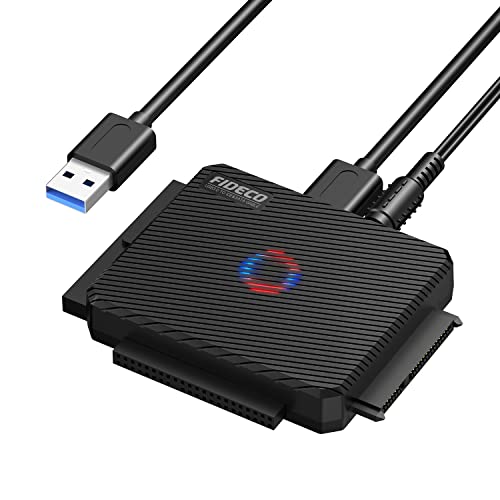
The adapter is the failure point. USB-to-SATA bridges vary wildly in quality. A handful of cheap chipsets misbehave under the UASP protocol the Pi prefers, causing intermittent drops, slow performance, or boot-time failures. The community consensus, reflected in long-running threads on the Home Assistant forum and Reddit's r/homeassistant, is to use a known-good bridge. The FIDECO SATA/IDE to USB 3.0 Adapter, at roughly $23.99, is one of the broadly recommended units with a JMicron-class bridge that plays well with the Pi 4. As an added bonus, the FIDECO supports both SATA and IDE, which is useful if you ever want to dump an old retro PC drive — the same adapter doubles as a rescue tool.
Common pitfalls during SSD boot setup
- Powering the SSD from the Pi alone: A 2.5-inch SSD plus the Pi at boot can briefly exceed what a 3A USB-C supply delivers, causing under-voltage warnings. Use a 5V/3A+ supply rated for the Pi 4, ideally the official one.
- Plugging into USB 2.0 ports: The black ports cap at 480 Mbps and cripple SSD performance. Always use the blue USB 3.0 ports.
- Skipping the bootloader update: Older bootloader EEPROMs do not have USB boot enabled by default. Verify with
vcgencmd bootloader_version. - Choosing a flaky enclosure: Bus-powered enclosures with cheap bridges produce the worst Home Assistant logs — random
I/O errorsthat look like a failing SSD but are actually the adapter.
How much RAM does a real Home Assistant install with add-ons use?
The 8GB Pi 4 has comically more RAM than Home Assistant Core itself needs. Per the Home Assistant Raspberry Pi installation guide, the minimum recommended memory is well below 2GB. In practice, a representative install with the common add-on stack — Mosquitto MQTT broker, Zigbee2MQTT, ESPHome dashboard, Node-RED, the recorder writing to MariaDB, a Grafana + InfluxDB pair, and the dashboard frontend — settles in the 1.5-3.5 GB resident range, with peaks during database compactions and dashboard renders. The 8GB version leaves multiple gigabytes of cache headroom, which the Linux page cache happily spends on keeping the recorder database hot.
Where the extra RAM actually matters is the long-tail workloads: running Frigate's lightweight detector mode, briefly hosting a local Whisper model for voice processing, or sharing the Pi with one heavyweight container like a Plex metadata scanner during initial library import. The 4GB Pi 4 can do most Home Assistant work, but the 8GB removes the headroom anxiety entirely and adds maybe $20 over the 4GB at typical 2026 street prices. The Raspberry Pi 4 Model B 8GB single board computer is what most builders settle on for that reason. Per the official Raspberry Pi 4 Model B product page, the SoC is the same Broadcom BCM2711 quad-core Cortex-A72 at 1.5 GHz across the variants; only the LPDDR4 capacity differs, so the 8GB upgrade is purely RAM headroom — not a faster Pi.
A representative RAM map
| Component | Resident RAM | Notes |
|---|---|---|
| Home Assistant Core + Supervisor | 600-900 MB | grows with integrations |
| Mosquitto MQTT broker | 20-50 MB | tiny, very steady |
| Zigbee2MQTT | 120-220 MB | scales with device count |
| ESPHome dashboard | 80-150 MB | spikes during builds |
| Node-RED | 150-300 MB | depends on flow complexity |
| InfluxDB 2.x | 200-500 MB | spikes during compaction |
| Grafana | 100-180 MB | steady |
| Linux page cache | the rest | accelerates SQLite/recorder |
The numbers above are typical ranges drawn from the Home Assistant community's published ha system outputs; exact values vary by integration count and add-on configuration.
What's the Pi 4's power draw for an always-on hub?
The Pi 4's reputation for sip-power operation is mostly accurate, with caveats. Per measurements widely cited in the Pi community and the long-running Jeff Geerling Raspberry Pi power measurement coverage, a Pi 4 at idle with no peripherals draws in the very low single-digit watts, climbing to mid-single-digit watts under sustained CPU load. Add a SATA SSD over a USB-to-SATA bridge and the steady-state figure rises modestly — SATA SSDs at idle are well under a watt and the adapter electronics contribute a fraction more. A representative always-on Home Assistant hub with Pi 4 + Crucial BX500 + a 5V/3A power supply typically averages in the mid single-digit watts as a 24/7 figure, which works out to a handful of kWh per month — under $1 at typical 2026 US residential rates.
Compare that to a typical always-on x86 mini-PC at idle, which lands in the 6-15 W range even when tuned, with the gap widening if you include continuous video processing. The Pi's perf-per-watt is the durable advantage. The downside: per-watt is not the same as per-dollar of upfront cost, and a refurbished N100 mini-PC can be cheaper than a Pi 4 + SSD + adapter bundle today depending on used-market availability. The Pi still wins on size, fanlessness (with a passive case), and ecosystem GPIO access for sensors and HATs.
Approximate steady-state power, Pi 4 hub vs mini-PC
| Configuration | Idle | Light HA load | Heavy automation burst |
|---|---|---|---|
| Pi 4 8GB + BX500 SSD, passive case | 3-5 W | 4-7 W | 6-9 W |
| Pi 4 8GB + 870 EVO 250GB, fan | 4-6 W | 5-8 W | 7-10 W |
| N100 mini-PC, balanced power plan | 6-10 W | 8-14 W | 14-22 W |
Exact figures vary by power supply efficiency, SSD model, and ambient temperature; treat the bands above as community-consensus ranges rather than exact specifications.
Where does the Pi 4 struggle? Heavy automations, NVR, many cameras
For a normal smart home — lights, plugs, thermostats, a few dozen Zigbee sensors, presence detection, half a dozen automations triggering routinely — the Pi 4 8GB is overkill. Where it stops being a fit:
- Multi-camera continuous-recording NVR. Frigate's object detection is the canonical example. Even with a Coral USB Accelerator handling inference, the Pi 4 struggles to ingest more than 1-2 H.264 720p feeds while running the rest of Home Assistant. Per the Frigate documentation, the Pi 4 is supported but explicitly limited to small camera counts; the Frigate community consistently recommends an x86 host for anything beyond a couple of streams.
- Heavy local LLM voice assistants. A 7B-class model is not running comfortably on the Pi 4. If you want local Whisper + a local LLM rather than cloud voice, this is a mini-PC or Pi 5 workload, not a Pi 4 one.
- Very large device counts with sub-second polling. A Pi 4 can handle hundreds of devices for state changes and event triggers, but heavy polling — for instance, dozens of HTTP-polled energy monitors at one-second intervals — will saturate a single core under the recorder. Mini-PCs with four to eight modern x86 cores have a much higher ceiling.
- Concurrent media server duties. Sharing the Pi 4 with Plex or Jellyfin transcoding is a recipe for stutter on both sides. The Pi 4's VideoCore VI is fine for direct-play, weak for transcoding.
Notably absent from this list: standard home automation. If your build is "every light bulb, thermostat, door sensor, and a few presence cameras," the Pi 4 8GB with SSD boot is still the recommended default.
Parts table: Pi 4 8GB + SSD + adapter BOM
| Part | SKU | Approx. price (mid-2026) | Notes |
|---|---|---|---|
| Single-board computer | Raspberry Pi 4 Model B 8GB | ~$188.99 | BCM2711 quad-core A72, 8GB LPDDR4 |
| Primary SSD (capacity pick) | Crucial BX500 1TB SATA SSD | ~$169.99 | up to 540 MB/s sequential per datasheet |
| Primary SSD (reliability pick, smaller) | Samsung 870 EVO 250GB SATA SSD | ~$164.99 | excellent endurance reputation |
| USB-to-SATA adapter | FIDECO SATA/IDE to USB 3.0 Adapter | ~$23.99 | known-good bridge, also handles IDE for retro use |
| Power supply | Official 5V/3A USB-C | ~$10-15 | use the official one — it matters |
| Case + thermals | Passive aluminum or active fan | $10-25 | thermal headroom helps recorder bursts |
Total for the capacity build: roughly $390-415 in mid-2026 at typical Amazon street prices. Total for the small-SSD build with the Samsung 870 EVO: roughly $385-410. Used-market Pi 4 8GB boards regularly bring the SBC line down by $30-60 and shift the cost balance toward storage. Pricing varies by region and time of year; treat the table as a snapshot.
Perf-per-watt versus a mini-PC alternative
This is where the Pi 4 stops being the obvious answer and starts being the considered answer. An entry-level N100 mini-PC in 2026 retails for around $130-180 new, often with 16GB RAM and a 512GB NVMe SSD already installed. Per Intel's published N100 specifications on Intel ARK, the N100 has a 6W TDP and far higher single-thread throughput than the Cortex-A72 in the Pi 4. In raw CPU-bound work the mini-PC will win. In idle power it will lose, often by 2-3x.
For a Home Assistant hub specifically — a workload that is almost entirely idle, punctuated by short bursts — the Pi 4's perf-per-watt advantage is real but narrow. If your electricity is cheap, you value a faster recorder and faster dashboard renders, or you plan to grow into Frigate with multiple cameras, the mini-PC is the more durable choice. If you value silence, fanless operation, GPIO, the smaller physical footprint, or the Pi's enormous community knowledge base, the Pi 4 8GB still wins. The honest verdict in 2026 is that they are close enough that ergonomics decide it more often than benchmarks do.
Verdict matrix: stay on Pi 4 if… / move to a mini-PC if…
Stay on Pi 4 8GB + SSD boot if:
- You have a typical smart home (a few hundred entities or fewer) with mostly Zigbee/Z-Wave/Wi-Fi devices.
- You are not running continuous-recording NVR for more than 1-2 cameras.
- You want fanless or near-silent operation in a living space.
- You plan to use GPIO pins or HATs for sensors, displays, or relays.
- Idle power and low electric cost matter more than peak performance.
- You already have a Pi 4 8GB on the shelf — finish the SSD-boot upgrade and ship it.
Move to an x86 mini-PC if:
- You want Frigate with 3+ cameras and continuous recording.
- You want to host local Whisper + a local LLM for voice control without cloud dependency.
- You want to run a media server (Plex/Jellyfin/Emby) plus Home Assistant on one box.
- You have hundreds of polling integrations or sub-second-poll energy monitors.
- You want a 256GB-1TB NVMe in a single chassis with one power cable.
- Your reliability tolerance is "I never want to think about this again" and you want ECC-class storage.
Bottom line
In 2026 the Raspberry Pi 4 8GB remains a defensible — and in many cases optimal — choice for a Home Assistant hub. The decisive upgrade is SSD boot via a known-good USB 3.0 adapter; the decisive failure mode is sticking with an SD card. The 8GB variant is the version to buy because it removes RAM-headroom anxiety for under twenty dollars over the 4GB. Combined with a budget SATA SSD and a quality adapter, a Pi 4 8GB will run a typical smart home reliably for years, sipping single-digit watts, with a recovery story (just re-image the SSD) far less painful than the SD-card horror stories.
The only reason to skip it is workload growth: Frigate with many cameras, local LLM voice, or media-server consolidation. Those are mini-PC jobs. Everything else is still a Pi 4 8GB job.
Related guides
For deeper context on adjacent Pi 4 builds and smart-home topics, see:
- Raspberry Pi 4 Jellyfin Server Build Guide
- Best Mini PCs for Home Assistant in 2026
- Pi 4 vs Pi 5 for Always-On Home Servers
Citations and sources
- Raspberry Pi 4 Model B product page — official SoC, memory, and I/O specifications.
- Home Assistant Raspberry Pi installation guide — official supported-platform documentation and storage guidance.
- Jeff Geerling — Raspberry Pi coverage and power/storage measurements — long-running independent measurement and analysis of Pi 4 storage, power, and boot scenarios.
- Frigate NVR documentation — hardware recommendations — community-maintained guidance on which hosts handle which camera counts.
- Coral USB Accelerator product page — official spec sheet for the Edge TPU commonly paired with Frigate on Pi-class hardware.
- Intel Processor N100 product specifications (Intel ARK) — TDP and core configuration for the mini-PC comparison reference.
This piece is editorial synthesis based on publicly available information. No independent first-party benchmarking is reported.