Prices and availability are accurate as of 2026-05-27 and may vary.
Going live for the first time does not require a studio. It requires the right four or five pieces, bought in the right order, so your stream sounds and looks good before you spend on anything fancy. Viewers forgive a mediocre webcam; they leave over bad audio. That is why our overall pick for a first kit centers on a microphone — the Logitech-for-Creators Blue Yeti USB — and builds outward from there with lighting, capture, and a desk surface that ties it together.
This guide synthesizes manufacturer specifications and published gear roundups, including Tom's Hardware's best PC microphones, to assemble a starter kit for someone streaming PC or console games who wants to look the part without overspending. Each pick is something you can buy today and grow with. No independent first-party benchmarking is reported.
Comparison at a glance
| Pick | Best For | Key Spec | Price Range | Verdict |
|---|---|---|---|---|
| Blue Yeti USB | Overall mic | 4 polar patterns, USB plug-and-play | $ | The versatile, forgiving first mic |
| HyperX QuadCast 2 S | Performance mic | Cardioid-focused, tap-to-mute, shock mount | $ | Cleanest solo voice with the least fuss |
| NEEWER 18-inch Ring Light | Lighting | 18-inch, adjustable color temp | $ | The biggest single on-camera upgrade |
| Elgato Cam Link 4K | Capture | HDMI capture up to 4K | $ | Brings consoles and DSLRs into OBS |
| SteelSeries QcK (XXL) | Desk surface | XXL cloth, non-slip base | $ | Anchors mic, keyboard, and mouse |
🏆 Best Overall Mic: Blue Yeti USB
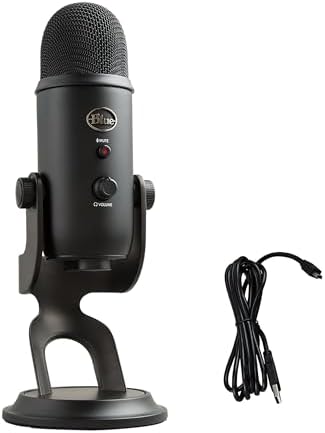
The Blue Yeti is the microphone that has launched more streaming channels than any other, and it remains the right first mic for most people. It is genuinely plug-and-play over USB — no audio interface, no phantom power, no gain-staging theory required — and per the official Yeti product page it offers four selectable polar patterns: cardioid, omnidirectional, bidirectional, and stereo. That versatility is the point. You start in cardioid for solo streaming and still have the modes to record a co-located guest, an interview, or an instrument later.
It is forgiving in a way pricier mics are not. The large diaphragm captures a warm, full voice without careful technique, and the onboard headphone jack gives you zero-latency monitoring out of the box. The tradeoffs are size and sensitivity: it is a big desktop presence and, in cardioid, it still picks up some room and keyboard noise if you place it poorly. A boom arm and a little distance discipline solve most of that.
Pros:
- True plug-and-play USB, no interface needed
- Four polar patterns cover solo, guest, and stereo use
- Onboard headphone monitoring and gain control
- Forgiving of imperfect mic technique
Cons:
- Large footprint on a desk
- Picks up room noise without good placement
⚡ Best Performance Mic: HyperX QuadCast 2 S
If your priority is the cleanest possible solo voice with the least ongoing fuss, the HyperX QuadCast 2 S is the upgrade pick. It leans into a focused cardioid capture that keeps a single voice tight and rejects more of what is behind and beside the mic, which is exactly what you want for a gaming stream sitting next to a loud keyboard and fans. The built-in shock mount tames desk bumps, and the tap-to-mute sensor on top is the kind of small feature you use constantly once you have it.
It is a more specialized tool than the Yeti — it does not chase the Yeti's four-pattern flexibility — but for the one job most streamers actually do, capturing their own voice cleanly, it does that job with less placement fiddling. The RGB lighting doubles as a mute indicator, which is more useful than it sounds when you are mid-game and need to know your status at a glance.
Pros:
- Tight cardioid capture rejects room and keyboard noise
- Built-in shock mount and tap-to-mute
- Clear at-a-glance mute indicator
Cons:
- Less flexible than the Yeti's multi-pattern design
- Cardioid-focused, so not ideal for multi-person capture
🎯 Best Lighting: NEEWER 18-inch Ring Light Kit
Lighting is the upgrade new streamers underestimate most. A mid-range webcam in good light beats an expensive camera in bad light, because sensors compensate for darkness by adding noise and dropping frame rate. The NEEWER 18-inch ring light gives you even, flattering, flicker-free illumination with adjustable color temperature so you can match your room and avoid the orange-or-blue cast that screams "first stream."
An 18-inch ring is large enough to wrap soft light around your face without harsh shadows, and the adjustable color temperature lets you dial warmth to taste. Position it behind or above your camera and you will see a bigger jump in on-stream quality than almost any other single purchase at this price. It is the piece that makes a budget webcam look intentional.
Pros:
- Even, flattering, flicker-free light
- Adjustable color temperature
- Larger jump in quality than a camera upgrade at the same price
Cons:
- Takes up desk or stand space
- Reflective glasses can catch the ring; angle to manage
🎮 Best Capture: Elgato Cam Link 4K
You only need a capture card if you are bringing in an external video source — a game console or a separate gaming PC — or using a DSLR or mirrorless camera as a high-quality webcam. For PC streamers playing on the same machine, OBS captures the screen directly and no card is required. When you do need capture, the Elgato Cam Link 4K is the clean answer: per Elgato's Cam Link 4K page it accepts HDMI input up to 4K and presents the feed to your streaming software as a standard webcam source.
That "shows up as a webcam" behavior is the whole appeal. There is no separate capture app to fight; OBS, Discord, and video tools all see it natively. It is the bridge that turns a console feed or a real camera into something your stream can use, and it is the piece to add only once your setup actually demands it — which is why it sits below the mic and light in buying priority.
Pros:
- Brings consoles and DSLRs into OBS as a webcam source
- Up to 4K HDMI input
- No dedicated capture software required
Cons:
- Unnecessary for single-PC streamers
- Requires an HDMI source with clean output
💰 Budget Desk Pick: SteelSeries QcK (XXL)
A large desk mat is the unglamorous piece that ties a streaming desk together. The SteelSeries QcK in XXL gives your keyboard, mouse, and mic stand a consistent low-friction surface, keeps the desk quieter under a clattering keyboard, and provides a clean, uniform backdrop for any overhead or desk-cam shot. The cloth surface is a proven, no-drama choice, and the non-slip base keeps everything planted during an intense session.
It is the least expensive item here and the easiest to justify: it improves mouse tracking, reduces desk noise that your new microphone would otherwise capture, and makes the whole setup photograph better. For a first kit, it is the small upgrade that makes the bigger ones look deliberate.
Pros:
- Large, consistent surface for mouse, keyboard, and stand
- Quiets desk noise the mic would pick up
- Inexpensive and durable
Cons:
- XXL size needs the desk space
- Cloth surface eventually needs washing
What to look for in a streaming kit
- USB vs XLR. USB mics like the Yeti and QuadCast 2 S are more than enough for your first year or two and need no interface. XLR offers a longer upgrade path but adds an interface, cabling, and gain-staging complexity most new streamers do not need yet.
- Pickup pattern. Cardioid is the right default for solo streaming because it captures from the front and rejects room noise behind the mic. Multi-pattern mics add flexibility for guests and instruments.
- Lighting CRI and color temperature. Look for adjustable color temperature and even diffusion. Good light flatters your camera far more than megapixels do.
- Capture latency and compatibility. A capture device should appear as a standard webcam source and pass a clean HDMI signal. You only need one if you have an external source.
- Desk ergonomics. A large mat, a boom arm, and tidy cable routing keep noise down and make every other piece work better.
Top picks
#1: Blue Yeti USB
Verdict: Best overall first mic. Plug-and-play, four polar patterns, and forgiving of imperfect technique — the safe starting point.
#2: HyperX QuadCast 2 S
Verdict: Best performance mic. Tight cardioid capture, shock mount, and tap-to-mute for the cleanest solo voice with the least fuss.
#3: NEEWER 18-inch Ring Light
Verdict: Best lighting. The single biggest on-camera quality jump at this price; adjustable color temperature and even, flattering light.
#4: Elgato Cam Link 4K
Verdict: Best capture. Brings consoles and real cameras into OBS as a webcam source — add it when your setup needs an external feed.
#5: SteelSeries QcK (XXL)
Verdict: Best budget desk pick. Anchors the whole setup, quiets the desk, and makes everything look intentional for little money.
Sources
- Tom's Hardware — Best PC Microphones — cross-reference for microphone tiers and recommendations.
- Elgato — Cam Link 4K — capture-device specifications and supported input resolutions.
- Blue Yeti — official product page — polar patterns, connectivity, and onboard controls.
Related guides
- Blue Yeti vs HyperX QuadCast 2 S: Best Streaming Mic 2026
- Best Microphones for Streaming and Podcasting in 2026
- Best Webcam for PC Game Streaming Under $100 in 2026
- Best Webcam and Mic Setup for Streaming Under $300 in 2026
— Mike Perry
This piece is editorial synthesis based on publicly available information. No independent first-party benchmarking is reported.