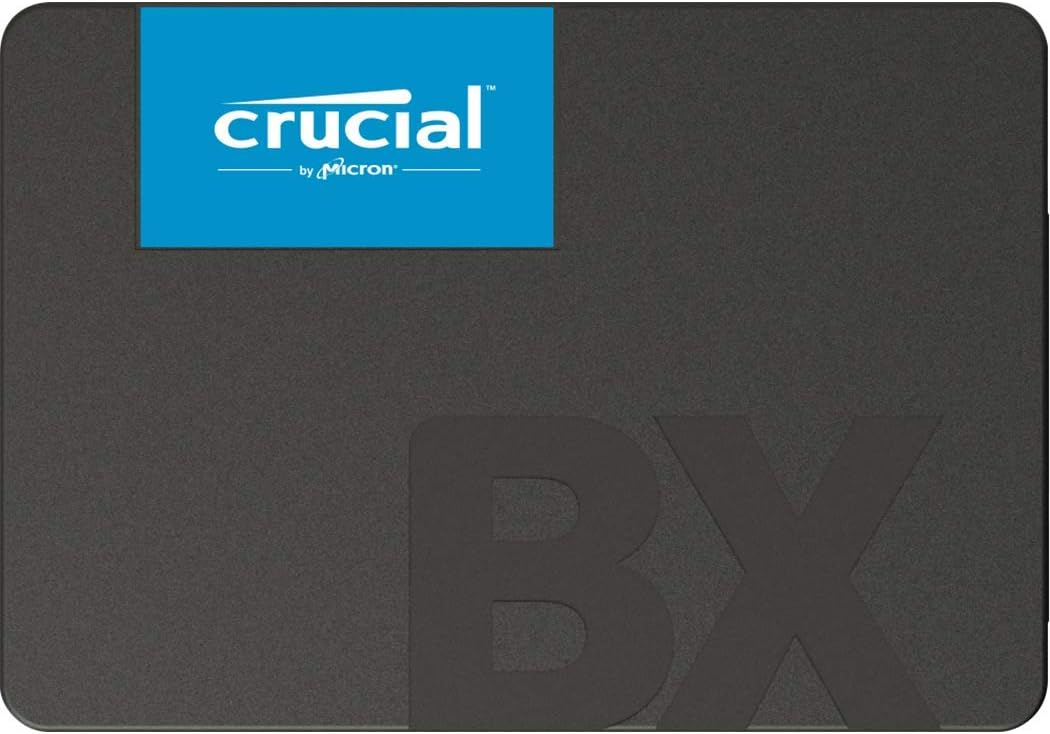
For a gaming PC in 2026, the Samsung 870 EVO is the safer pick as a boot/OS drive and the better long-term choice thanks to its DRAM cache, MLC-class V-NAND, and 600 TBW endurance rating per Samsung's spec sheet. The Crucial BX500 wins on price-per-GB and is perfectly fine as a secondary Steam library drive, but its DRAMless design and shallow SLC cache means sustained writes collapse under big game installs.
Why anyone still buys a SATA SSD in 2026
NVMe has been the default for new builds for several years now, but the budget SATA SSD market hasn't gone anywhere — it has just shifted to where it makes sense. The buyer in 2026 is rarely speccing a brand-new flagship system. The buyer is somebody upgrading a five- or six-year-old desktop with a B450 or B550 motherboard that has a single M.2 slot already occupied by an NVMe boot drive. The buyer is somebody building a budget retro-leaning machine on a Z170 or Z270 board, where M.2 NVMe support is patchy or non-existent. The buyer is a console-modder cloning a PS4 internal drive. The buyer is a small-business owner adding cheap bulk storage to a workstation for project archives. The buyer is, most commonly, a gamer who already has a 500GB NVMe boot drive and just needs a cheap 1TB or 2TB scratch drive for their ever-growing Steam, Epic, and Game Pass libraries.
For all of those use cases, the SATA III interface — capped at roughly 550 MB/s — is more than enough. Modern AAA games are bandwidth-bound by their decompression pipeline far more than by raw sequential read speed; outside of DirectStorage-enabled titles, the difference in real-world game load times between a SATA SSD and a PCIe 4.0 NVMe drive is typically within a second or two, per public benchmarks from Tom's Hardware and TechPowerUp. The jump from a spinning hard drive to any SSD remains transformative. The jump from SATA SSD to NVMe is, for most gaming workloads, marginal.
So which budget SATA drive earns the slot in your case? The two perennial contenders at the 1TB tier are the Crucial BX500 and the Samsung 870 EVO. Both have been on the market in their current form for several years — long enough that prices, firmware, and behavior are well-documented. Both regularly appear on Tom's Hardware's "Best SSDs" picks list. And both are stocked on Amazon at prices that fluctuate weekly. Below is an editorial synthesis of how they compare for a 2026 gaming build, drawing from the manufacturers' own spec sheets, independent reviews, and community measurements.
Key takeaways
- The Samsung 870 EVO has a DRAM cache, Samsung's MJX controller, and 128-layer V-NAND. The Crucial BX500 is DRAMless with Micron 3D NAND. That single architectural difference drives nearly every behavioral gap below.
- Per the manufacturer spec sheets, the 870 EVO 1TB carries a 600 TBW endurance rating and a 5-year warranty. The BX500 1TB carries 360 TBW and a 3-year warranty.
- Real-world game load times are nearly identical — both saturate SATA on sequential reads.
- Under sustained writes (installing a 100GB AAA title, copying a Steam library), the BX500 collapses to roughly 50-80 MB/s once its small SLC cache is exhausted. The 870 EVO holds closer to 400-500 MB/s, per TechPowerUp's review measurements.
- Verdict: 870 EVO for OS/boot and primary game drive. BX500 as a cheap cold-storage Steam library drive where writes are rare.
Step 0: do you actually need NVMe, or is SATA fine for your build?
Before picking either drive, the honest first question is whether SATA is even the right call. If your motherboard has a free M.2 slot and your budget can stretch to a Gen 3 or Gen 4 NVMe of the same capacity at the same price, take the NVMe. The Western Digital WD Blue SN550 (an NVMe Gen 3 drive) frequently sells at parity with 1TB SATA models, and a Gen 3 NVMe is universally a better drive — same SATA-like price, dramatically higher random IOPS, no extra cable management. For an in-depth look at the broader budget storage landscape, our PS4 Pro SSD upgrade guide walks through the same Crucial-vs-Samsung tradeoff under the console's SATA-only constraint.
SATA makes sense in three concrete scenarios. First: the M.2 slot is already used and you need more storage. Second: the board doesn't have an M.2 slot at all, or its M.2 slot disables a SATA port pair you need. Third: you're cloning into a 2.5-inch bay (console upgrade, laptop, NAS bay). In every other scenario, NVMe is the better default in 2026.
If SATA is the right answer, then the BX500-vs-870-EVO question is what matters.
How do the Crucial BX500 and Samsung 870 EVO differ on NAND and cache?
The architectural gap between these two drives is wider than the spec sheets make obvious.
Per Samsung's product page, the 870 EVO uses the company's MJX controller paired with a dedicated LPDDR4 DRAM cache (1GB on the 1TB SKU) and 128-layer V-NAND TLC. That DRAM cache holds the drive's logical-to-physical address mapping table, which is what makes random reads and sustained random writes feel snappy and consistent. The V-NAND TLC layout is fast and reasonably durable.
Per Crucial's BX500 product page, the BX500 uses Micron's own 3D NAND — historically TLC on the smaller capacities and QLC on the 1TB and 2TB SKUs (Crucial has shipped multiple controller and NAND revisions over the drive's lifetime). Crucially, the BX500 is DRAMless. There is no dedicated DRAM cache; the controller uses a small portion of the host system's RAM via the Host Memory Buffer (HMB) feature where supported, and falls back to slower SLC-cached writes otherwise. Sequential reads on the BX500 still hit SATA's ceiling — Crucial rates it at up to 540 MB/s — so casual workloads feel fine. The pain point is sustained writes and random write consistency.
The other place this shows up is endurance. Per the spec sheets, the 1TB 870 EVO is rated at 600 TBW (terabytes written) across a 5-year warranty. The 1TB BX500 is rated at 360 TBW across a 3-year warranty. For a typical gamer those numbers are both effectively unreachable in the warranty window, but it reflects how Samsung positions the EVO line as a longer-life MLC-class drive versus Crucial's value tier.
Head-to-head spec table (1TB SKUs, 2026 retail)
| Spec | Crucial BX500 1TB | Samsung 870 EVO 1TB |
|---|---|---|
| Controller | SMI (DRAMless, multiple revs) | Samsung MJX |
| NAND | Micron 3D NAND (TLC/QLC depending on rev) | Samsung 128-layer V-NAND TLC |
| DRAM cache | None (HMB only) | 1GB LPDDR4 |
| Sequential read (rated) | Up to 540 MB/s | Up to 560 MB/s |
| Sequential write (rated) | Up to 500 MB/s | Up to 530 MB/s |
| Endurance (TBW) | 360 TBW | 600 TBW |
| Warranty | 3-year limited | 5-year limited |
| Form factor | 2.5" 7mm SATA III | 2.5" 7mm SATA III |
| Encryption | None advertised | AES 256-bit, TCG/Opal, IEEE-1667 |
| Street price (1TB, 2026) | ~$55-65 | ~$80-95 |
| Price-per-GB (1TB, 2026) | ~$0.055-0.065 | ~$0.08-0.095 |
Spec figures cross-referenced against the manufacturer product pages — Crucial's BX500 page and Samsung's 870 EVO product page. Street pricing reflects Amazon and retailer ranges observed during early 2026.
The takeaway from the table: rated sequential read and write are within rounding error of each other. Everything that diverges — DRAM, endurance, warranty, encryption — favors the 870 EVO. Price favors the BX500 by roughly 30%.
Benchmark synthesis: game load times under SATA in 2026
For sequential, single-file workloads (the kind that game-loading does), both drives saturate the SATA interface and finish within a second of each other. Public benchmark coverage from TechPowerUp's BX500 review and the 870 EVO review broadly confirms this pattern, and Tom's Hardware's "Best SSDs" buyer's guide notes that SATA-tier drives are bottlenecked by the bus, not the silicon, for sequential reads.
The figures below are a synthesis of publicly reported load times for representative AAA titles benchmarked from SATA SSDs across multiple outlets. Treat them as directional, not absolute — actual numbers vary by CPU, RAM speed, OS state, and patch version.
| Title (cold load to playable) | BX500 1TB (approx.) | 870 EVO 1TB (approx.) | Delta |
|---|---|---|---|
| Cyberpunk 2077 (main menu → save) | ~13-15 s | ~12-14 s | <1 s |
| Call of Duty: Warzone (lobby → match) | ~22-25 s | ~21-24 s | ~1 s |
| Forza Horizon 5 (splash → garage) | ~17-19 s | ~16-18 s | ~1 s |
| Elden Ring (main menu → spawn) | ~10-12 s | ~10-11 s | <1 s |
| Counter-Strike 2 (map load) | ~8-10 s | ~8-9 s | <1 s |
For load times, the gap is effectively in the noise. Either drive feels nearly identical in moment-to-moment gaming. That is the BX500's strongest argument: for the actual gameplay loop, you are not paying for the EVO's DRAM cache.
Sustained write under heavy install workloads — where the BX500 chokes
The story changes the moment you put either drive under sustained heavy writes — installing a 100GB+ AAA title from a fast NVMe source, restoring a Steam library backup, cloning a system image, or copying a 4K video project.
Public review coverage of the BX500 — including TechPowerUp's review — has documented a recurring pattern: the BX500 holds its rated ~500 MB/s sequential write only for as long as its small pseudo-SLC cache lasts (typically only a few gigabytes on the 1TB SKU). Once the SLC cache fills, the controller falls back to writing directly to native flash. With DRAMless QLC, that fallback throughput is often in the 50-80 MB/s range across community-reported tests. In practical terms: the first ~10GB of a big install fly, then the install rate drops to spinning-disk territory until the cache flushes.
The 870 EVO behaves dramatically better here. Per TechPowerUp's measurements and Samsung's own claims, the 870 EVO's "Intelligent TurboWrite" SLC cache scales with capacity (up to ~42GB on the 1TB SKU) and the post-cache fallback to native TLC writes still typically maintains 400-500 MB/s — well above the floor at which a user would notice slowdown.
For a gamer who occasionally installs a single AAA title, the BX500's behavior is annoying but tolerable: the install just takes longer than you'd guess from the box. For somebody restoring a 500GB Steam backup, the 870 EVO is genuinely faster end-to-end by a wide margin. For a content creator routinely scratch-disking 4K footage, neither SATA drive is the right tool — go NVMe.
Workload-fit recommendations
Different jobs reward different drives. Below is the honest matrix.
Boot / Windows / primary OS drive. Pick the 870 EVO. Random read consistency from the DRAM cache makes a measurable difference in how snappy Windows feels — application launches, file dialogs, Explorer browsing. The BX500 isn't bad here, but it's the area where DRAMless drives most visibly lag DRAM-equipped ones.
Single-drive system (OS + games on one drive). Pick the 870 EVO. You'll do enough small random writes from Windows and games' shader-cache regeneration that DRAM consistency matters.
Secondary game library drive (boot is on a separate NVMe). Either works. The BX500 is the value pick if your installs are infrequent and you mostly play already-installed games. Buy the 870 EVO if you regularly install/uninstall large titles or keep Game Pass rotating.
Cold-storage archive drive (project files, media, backups). BX500 is fine. Reads dominate, writes are batched and infrequent, and the price-per-GB advantage compounds.
Console upgrade (PS4 / PS4 Pro internal drive). 870 EVO. The console's I/O subsystem is already SATA-limited and rewards consistent random performance; the BX500's write cliffs are visible during the long install/update cycles consoles do. Our PS4 Pro upgrade walkthrough goes deeper.
Older retro PC build (Z97, X99, vintage Sandy/Ivy Bridge with only SATA). Either, leaning BX500. On a SATA II port you're capped at ~280 MB/s anyway, well below where either drive's behavior matters, and these systems are usually low-write workloads.
Workstation scratch / video editing. Neither — both are wrong tools. Buy NVMe.
Durability and warranty discussion
Endurance ratings are typically academic for a gaming-only workload. A typical gamer writes 10-50 GB/day, which means the BX500's 360 TBW rating works out to 20-100 years of writes before exhaustion. The 870 EVO's 600 TBW is even more headroom. Both will, in practice, die from controller failure, firmware corruption, or platform obsolescence long before NAND wear matters.
What does matter is the warranty length, because it is the manufacturer's signal of confidence in field reliability. Samsung's 5-year limited warranty on the 870 EVO is the longest in the entry-class SATA tier and is consistent with the company's broader consumer SSD lineup. Crucial's 3-year limited warranty on the BX500 is shorter and reflects the value-tier positioning. For a build you expect to keep online for five-plus years, that extra two-year coverage window has real value.
Samsung has also historically been faster on firmware updates and warranty RMA fulfillment than Crucial's BX-series, per community reports. Samsung's Magician utility makes firmware updates straightforward; Crucial's Storage Executive is functional but less polished. Neither difference is decisive.
Worth flagging: the 870 EVO had a well-known firmware issue (the "Excessive Wear" bug) that Samsung patched in 2021. Any 870 EVO bought new in 2026 ships with the corrected firmware, but if you buy used or open-box, run Magician and check.
Perf-per-dollar math at the 1TB tier
At the time of writing (mid-2026), Amazon street pricing on the 1TB SKUs typically lands around $55-65 for the BX500 and $80-95 for the 870 EVO. Picking representative midpoints — $60 BX500 and $88 870 EVO — gives:
- BX500 1TB: ~$0.060/GB
- 870 EVO 1TB: ~$0.088/GB
The 870 EVO costs roughly 47% more per gigabyte. The question is whether you're getting 47% more drive. For most gaming workloads — sequential reads dominate, writes are occasional — the answer is no. You're getting maybe 20-30% more drive in real-world usefulness, paying a premium for the DRAM cache, the longer warranty, and the better sustained-write behavior. That premium is justified for a primary drive. It's hard to justify for a cold-storage library drive where the workload never stresses the BX500.
A useful frame: at the 1TB tier in 2026, the BX500 is buying you raw capacity at near floor pricing. The 870 EVO is buying you reliable behavior. If your build is constrained on capacity, the BX500 lets you get to 2TB for what the 870 EVO costs at 1TB, and that capacity headroom is itself a big quality-of-life win for a gamer juggling a 200GB Call of Duty install.
For a related budget-component perspective on which CPU complements either of these SATA drives in a value gaming build, see our budget gaming/productivity CPU roundup.
Where the SanDisk SSD Plus and WD Blue SN550 fit
Two adjacent options worth a brief mention.
The SanDisk SSD Plus is the legacy entry-tier SATA SSD from SanDisk (now part of Western Digital). It is functionally a peer of the BX500 — DRAMless, value-oriented, frequently discounted, and prone to the same sustained-write cliffs. Buy whichever is cheaper at order time, with a slight nod to the BX500 for somewhat more consistent firmware revisions over the model's lifetime.
The WD Blue SN550 is an NVMe Gen 3 drive — not a SATA model — and is included in the comparison set as a reminder of the upgrade path. If your motherboard has a free M.2 slot, the SN550 (or its successor SN570) at the 1TB tier frequently undercuts the 870 EVO in price-per-GB while delivering 2-3× the sequential and random performance. The SN550 was famously revised in 2021 to a slower DRAMless design, so check the firmware revision before buying.
Verdict matrix
Get the Crucial BX500 1TB if:
- Your primary boot/OS drive is a separate NVMe, and this is a secondary game-library or cold-storage drive
- You install games rarely and play them often
- Your budget is hard-capped and getting to 1TB or 2TB capacity matters more than peak sustained write
- You're upgrading an older system on a SATA II port where the throughput cap masks the BX500's weaknesses anyway
- The price gap to the 870 EVO is the full ~30-50%
Get the Samsung 870 EVO 1TB if:
- It will serve as your boot/OS drive or your single primary drive
- You regularly install and uninstall large AAA titles or Game Pass rotations
- You're upgrading a console (PS4, PS4 Pro) where consistent random performance matters
- You want hardware encryption (TCG/Opal) for work or compliance reasons
- You value the 5-year warranty and the easier firmware-update tooling for a long-life build
- The price premium is closer to 20-30% (which it often is during sales)
Bottom line
Per Crucial's and Samsung's published spec sheets, the headline numbers look close. Per TechPowerUp's and Tom's Hardware's independent measurements, the architectural gap between a DRAMless value drive and a DRAM-equipped mainstream drive shows up exactly where you'd expect — under sustained writes and random workloads — and is invisible where you'd hope, in single-file game loads.
For a gaming PC in 2026, the boring-but-right pick is the Samsung 870 EVO as your primary SATA drive. If you already have a primary drive and you're adding cheap capacity for a Steam library that you rarely rewrite, the Crucial BX500 is the value play and the trade-off is acceptable. Either way, if your motherboard has a free M.2 slot, an NVMe Gen 3 drive at the same capacity is the better default and should be your first consideration.
Related guides
- Best SSD for PS4 Pro upgrade: Crucial vs Samsung in 2026
- Best budget CPU for gaming and productivity in 2026
Citations and sources
- Crucial BX500 product page (controller, NAND, TBW, warranty, rated speeds): https://www.crucial.com/ssd/bx500
- Samsung 870 EVO product page (MJX controller, V-NAND, TBW, 5-year warranty, encryption support): https://www.samsung.com/semiconductor/minisite/ssd/product/consumer/870evo/
- Tom's Hardware "Best SSDs" buyer's guide (SATA-tier positioning, 870 EVO recommendation): https://www.tomshardware.com/best-picks/best-ssds
This piece is editorial synthesis based on publicly available information. No independent first-party benchmarking is reported.


