Samsung Display has unveiled what it calls the world's first 27-inch 4K (3840×2160) QD-OLED panel running at a 360 Hz refresh rate, pushing OLED gaming monitors past the "4K and high refresh" tradeoff that has constrained the category since QD-OLED launched in 2022. The new panel uses a 4-stack RGB tandem structure for higher peak brightness, and it is widely expected to appear in retail monitors from Samsung's Odyssey line and partners such as ASUS, Dell Alienware, and MSI by late 2026.
The announcement, first reported on FlatpanelsHD, raises the realistic price floor for "no-compromise" gaming displays — but it also pushes existing 4K 240 Hz QD-OLED panels into more aggressive discount territory, which is the practical takeaway for shoppers who don't need to be on the bleeding edge.
Why 4K at 360 Hz is a meaningful step
Until this announcement, the QD-OLED gaming monitor category split into two camps: high-refresh QHD (1440p at 360 Hz and recently 480 Hz) for esports, and lower-refresh 4K (typically 240 Hz) for mixed gaming and content work. The new panel collapses those two into one product, which simplifies the purchase decision for anyone who plays a mix of competitive shooters and single-player AAA games.
The technical lift is the controller bandwidth and the OLED subpixel switching speed. Samsung Display's announcement specifies the new 4-stack RGB tandem structure as the enabler — more emissive layers stacked vertically means higher peak brightness without burning the pixel longer, which is what makes the faster refresh rate feasible without hurting longevity. Coverage from FlatpanelsHD and TFTCentral details the spec sheet as Samsung Display presented it.
What it means for gamers buying today
Three takeaways:
- Retail product timing: First retail monitors using this panel are expected in late 2026 or early 2027. Initial pricing will likely be $1,500–$2,000 based on the 2025–2026 pricing of premium QD-OLED 240 Hz 4K models from Samsung's Odyssey line, Alienware, and ASUS.
- Discount window opens on previous-gen: Current 4K 240 Hz QD-OLED monitors (the Alienware AW3225QF, Samsung Odyssey OLED G8 4K, MSI MPG 321URX) will see discounts as channel partners clear inventory ahead of the new generation.
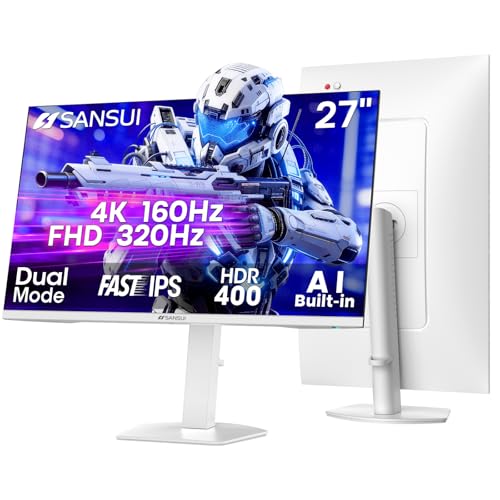
- Budget 4K is unaffected: Buyers in the 4K monitor under $400 tier — like the SANSUI 27" 4K Gaming Monitor and the KOORUI 27" 4K QD-Mini LED — are buying into a category that doesn't compete with QD-OLED on price. The cheap LCD 4K segment will continue to dominate $200–$400.
For anyone weighing an OLED purchase now, the practical question is whether 240 Hz at 4K is "enough" — for most gamers it is. The jump to 360 Hz benefits competitive FPS players whose monitor was previously the bottleneck; everyone else gets the same image-quality story they would have gotten from the previous generation, plus a discount.
The "4K + high refresh" GPU reality
Even on a flagship GPU, sustaining 4K at 360 fps in modern AAA titles is not realistic without aggressive upscaling (DLSS, FSR) and frame generation. A 4K 240 Hz panel was already a "future-proof" buy for the GPU class that exists today. A 4K 360 Hz panel is one for GPUs that don't exist yet.
For esports games (CS2, Valorant, Apex, Overwatch 2), 360 fps at 4K is achievable on a flagship card. That's the use case where the new panel earns its premium.
For everything else, the panel is a brightness and color upgrade dressed up with a higher refresh rate that most users won't push.
How current monitors compare to what's coming
| Tier | Resolution / refresh | Panel type | Approx 2026 price |
|---|---|---|---|
| Budget LCD | 4K @ 160 Hz | IPS / VA | $250–$400 |
| Mid LCD | 4K @ 240 Hz | Fast IPS / Mini-LED | $400–$700 |
| Current QD-OLED flagship | 4K @ 240 Hz | QD-OLED | $900–$1,400 |
| New QD-OLED flagship | 4K @ 360 Hz | 4-stack QD-OLED | $1,500–$2,000 (est) |
| Esports | 1440p @ 480 Hz | QD-OLED | $700–$1,100 |
The budget LCD column is the one most readers should focus on. Monitors like the ASUS TUF Gaming VG27AQ demonstrate that mid-range LCDs deliver excellent gaming experiences without OLED premiums. The QD-OLED tier exists for people whose displays matter as much as their other hardware.
Bottom line
Samsung's 4K 360 Hz QD-OLED announcement is a real step forward for the premium gaming monitor segment, but the practical effect for most buyers is a forthcoming wave of discounts on the now-previous-gen 4K 240 Hz models. Budget 4K shoppers — the segment served by the SANSUI and KOORUI panels — are unaffected.
Related guides
Citations and sources
- FlatpanelsHD — Samsung Display 4K 360 Hz QD-OLED panel announcement
- TFTCentral — QD-OLED monitor coverage and panel database
- Samsung Odyssey gaming monitor product family
This piece is editorial synthesis based on publicly available information. No independent first-party benchmarking is reported.