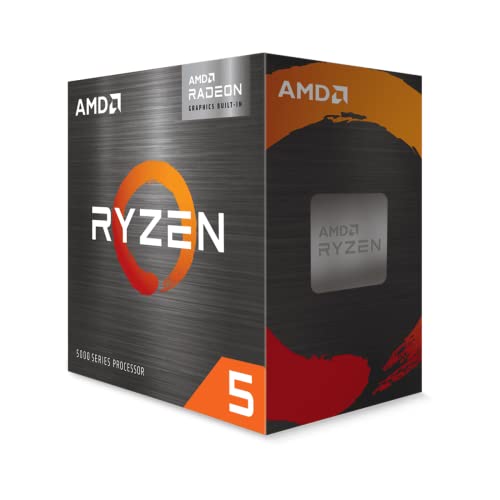
The best AMD Ryzen 5000 CPU for gaming in 2026 is whichever 5000-series part hits your performance tier without overspending — for most builders the Ryzen 7 5800X is the eight-core sweet spot, the Ryzen 7 5700X is the lower-TDP value version, and the Ryzen 5 5600G is the cheapest path that still includes integrated graphics. AM4 remains a value platform years after launch, and the 5000-series lineup covers everything from $120 budget builds to dedicated gaming rigs.
Who this is for
PC gamers shopping for an upgrade on the AM4 platform — either building fresh on a B550 board or dropping in a new CPU on an existing X470/X570 board. The 5000-series is still in print, still under warranty, and still the highest-performing AM4 lineup. AM5 builds are the right call for new builds with a long upgrade path, but for everyone running an existing AM4 board or chasing pure perf-per-dollar, this guide is for you.
Key takeaways
- The 5000-series lineup hasn't changed dramatically in the last year — the X3D parts remain king for pure gaming, but the standard parts are now cheaper than ever.
- The Ryzen 7 5800X at 8 cores / 16 threads remains the value-pick for serious gaming + light productivity.
- The Ryzen 7 5700X offers ~95% of 5800X gaming performance at a lower TDP and lower price.
- The Ryzen 5 5600G is the only Ryzen 5000 part with serious integrated Vega graphics — useful for fallback or HTPC builds.
- AM4 is end-of-life as a platform; if you're buying a new motherboard, consider AM5 for the upgrade path.
Why AM4 still matters in 2026
Per AMD's official Ryzen 5000 product page, the 5000-series is built on Zen 3 — a mature architecture that still posts respectable gaming numbers against current-generation parts in the 1080p and 1440p tiers where the GPU isn't the bottleneck. The AM4 socket has been in market since 2017, which means B450 / X470 / B550 / X570 boards are widely available used at low prices, and a complete budget AM4 build (CPU + board + RAM) can land well under $400 if you're flexible on the parts.
The case for going AM4 in 2026 is purely financial. AM5 with current-gen DDR5 and Zen 5 is faster in absolute terms, but the platform cost (board + DDR5 kit) carries a premium that AM4 buyers can pocket and put toward a better GPU. For most gaming workloads at 1440p and 4K — where the GPU is the bottleneck — the CPU upgrade from a 5800X to a current-gen part is invisible in real frame rates.
What changed in the last year
The 5000-series has not changed architecturally; what has changed is pricing and availability. The Ryzen 7 5700X, in particular, has fallen to prices that make it the obvious replacement for any older AM4 part. The 5800X3D and 5700X3D remain the king-of-AM4 picks for pure gaming if you can find them, but availability has thinned and pricing has held firm at launch levels — the value calculation has shifted toward the standard parts.
For a fresh build, the question isn't really "which Ryzen 5000 is best" — it's "which one fits my budget and my use case." All of these parts are competitive against each other for gaming within a few frames per second; the differences come down to thermal headroom, core count for productivity, and integrated graphics availability.
Spec frame: the picks at a glance
| CPU | Cores / Threads | Base / Boost | TDP | iGPU | Best for |
|---|---|---|---|---|---|
| Ryzen 7 5800X | 8 / 16 | 3.8 / 4.7 GHz | 105W | None | Mainstream gaming + light productivity |
| Ryzen 7 5700X | 8 / 16 | 3.4 / 4.6 GHz | 65W | None | Value 8-core, lower thermal target |
| Ryzen 5 5600G | 6 / 12 | 3.9 / 4.4 GHz | 65W | Vega 7 | Budget builds, HTPC, integrated graphics fallback |
Numbers from AMD's official spec pages; confirm against current listings before quoting.
Top picks
#1: AMD Ryzen 7 5800X
Verdict: Best overall 5000-series pick for gaming + light productivity. 8 cores, 16 threads, 105W TDP.
The 5800X is what most builders should be looking at if they want a no-compromises 5000-series part. Eight Zen 3 cores hit the gaming sweet spot — enough threads for Discord-plus-streaming-plus-game, enough single-core performance that GPU-bound titles aren't held back. The 105W TDP means you want a competent air cooler (Noctua NH-U12S, Peerless Assassin 120) or a 240mm AIO; the stock cooler doesn't ship with this SKU.
Pair it with a 12GB RTX 3060 for an all-rounder build that handles 1440p gaming, content creation, and local LLM inference (see our budget LLM GPU guide) on the same hardware.
#2: AMD Ryzen 7 5700X
Verdict: The value version of the 5800X. Lower TDP, lower price, ~95% of the gaming performance.
The Ryzen 7 5700X is an eight-core Zen 3 part with a 65W TDP — the same architecture as the 5800X but with lower clocks and lower power. In gaming benchmarks the gap is typically a few percent, well inside what changes from one driver release to the next. For builders who want quiet thermals or who are reusing an older mid-tier cooler, this is the right pick.
The 65W TDP also means you can run this on a more modest VRM B450 board without thermal throttling — useful for budget upgrades on an existing platform.
#3: AMD Ryzen 5 5600G
Verdict: Cheapest serious AM4 build. Includes Vega 7 iGPU for fallback or HTPC use.
The Ryzen 5 5600G is the only Ryzen 5000 part with a useful iGPU. Six Zen 3 cores plus Vega 7 graphics make it a flexible chip — strong enough as a primary gaming CPU paired with a discrete GPU, capable enough as a fallback for diagnostics if the discrete GPU fails, and serviceable as an HTPC or light-gaming chip on its own. The Vega 7 iGPU runs older or less-demanding titles at 1080p low-medium settings without a discrete card.
For local LLM builds, the 5600G is the cheapest CPU you can pair with a 3060 12GB for the budget-tier rig described in our GLM-5.2 setup guide.
#4: AMD Ryzen 5 5600 (honorable mention)
Verdict: Best pure-budget gaming chip if you don't need integrated graphics. ~$120 used.
The non-G 5600 is six Zen 3 cores with no iGPU and the same 65W TDP as the 5600G. For pure gaming on a tight budget paired with a discrete GPU, it's hard to beat the perf-per-dollar. We're listing it as honorable mention here because it's so widely available — and frequently confused with the 5600G — that builders should be aware of the distinction. Get the 5600G only if you specifically want the iGPU; otherwise the 5600 is cheaper.
#5: AMD Ryzen 7 5800X3D (honorable mention)
Verdict: Still the gaming king of AM4 if you can find one at MSRP.
The 5800X3D added a stacked 3D V-Cache layer that boosts gaming performance well above the standard 5800X in cache-sensitive titles. It's the part to get if you're keeping an AM4 board long-term and want the longest possible useful gaming life. Availability has thinned and pricing has held — confirm before buying.
Benchmark frame: gaming performance on Ryzen 5000
Public benchmark sites consistently show the 5800X holding within a few frames per second of the 5600X at 1080p in GPU-bound titles, and pulling ahead by larger margins in CPU-bound titles like Total War and Microsoft Flight Simulator. The 5700X lands within a few percent of the 5800X across most titles. The 5600G's six Zen 3 cores are slightly slower than the equivalent 5600 in pure gaming due to differences in cache topology, but the practical impact is small at GPU-bound resolutions.
For a typical builder pairing one of these CPUs with a 12GB RTX 3060 or similar tier, the CPU choice is functionally invisible at 1440p and 4K — the GPU is the bottleneck. The CPU choice starts mattering at 1080p high-refresh gaming and in CPU-bound simulation titles. Always check TechPowerUp's review database for game-specific frame rates before assuming a CPU upgrade will move the needle on your specific titles.
Real-world pitfalls
- BIOS updates. Older B450/X470 boards may need a BIOS update before they recognize Ryzen 5000. Confirm the board's supported CPU list (and BIOS version) before buying.
- Cooler mismatch. The 5800X doesn't ship with a cooler. Plan for at least a 120mm tower air cooler or a 240mm AIO; stock-cooler attempts thermal-throttle under load.
- Mixing 5600G and 5600. The 5600G has weaker per-core gaming performance than the 5600 due to APU cache differences. If you don't need integrated graphics, get the 5600.
- DDR4 speed. AM4 likes DDR4-3200 to DDR4-3600 in dual-channel. Anything slower leaves performance on the table; anything faster usually doesn't help.
- AM4 end-of-life. If you're buying a new board specifically for this CPU, consider whether the small AM5 premium is worth the multi-generation upgrade path.
When NOT to buy Ryzen 5000
If you're starting a brand-new build with no existing AM4 parts, AM5 with a current-gen Ryzen (especially the 7000/8000/9000-series X3D parts) is the better long-term choice. AM4 ends here — there will be no further CPU generations on this socket. The math favors AM4 strongly only when you're reusing an existing board, RAM, or cooler.
If your existing CPU is a Ryzen 3000 or 5000 part already, the upgrade gain is usually too small to justify the cost unless you're moving to an X3D variant for a specific cache-sensitive title.
Platform considerations beyond the CPU
A few platform-level notes that affect the practical experience of building or upgrading on AM4 in 2026:
Memory. AM4 likes dual-channel DDR4-3200 in matched pairs. A 2×16GB kit at DDR4-3200 CL16 is the value sweet spot. Skip single-channel single-stick configurations — they cut memory bandwidth in half and visibly hurt gaming performance.
Motherboard. B550 is the right chipset for any new 5000-series build that uses a single GPU. X570 is overkill unless you specifically need PCIe 4.0 on the second M.2 slot. Avoid older A320 boards — most don't support 5000-series even with a BIOS update.
PSU. A 650W gold-rated PSU handles any 5000-series CPU plus a 12GB RTX 3060 build with comfortable headroom. Step up to 750W if you're pairing a 5800X with a current-gen high-end GPU.
Cooler. The 5800X needs a real cooler — a 240mm AIO or a Peerless Assassin 120 / Noctua NH-U12S-class tower air cooler. The 5700X and 5600G run cool enough that a competent budget tower (Hyper 212 Black, Vetroo V5) is fine.
Storage. A 1TB NVMe Gen3 is the right value pick. Gen4 NVMe doesn't help gaming meaningfully; spend the savings on more storage capacity instead.
Comparison frame: AM4 vs AM5 in 2026
The honest case for AM4 over AM5 in 2026:
- Cheaper platform overall. Board + RAM is roughly half the price.
- Used parts available. AM4 has years of secondhand inventory; AM5 still trades closer to new.
- Adequate performance. At 1440p/4K gaming with a competent GPU, the CPU upgrade from a 5800X to current-gen X3D is small.
The honest case against AM4 over AM5 in 2026:
- End of platform life. No future CPU upgrades on the socket.
- DDR4, not DDR5. Newer platforms benefit from DDR5 bandwidth in select workloads.
- PCIe 5.0 absent. Not meaningful for gaming today, but a future-proofing consideration.
For a builder who plans to keep the system 3-5 years, AM4 is a reasonable choice if the upfront savings matter. For a builder who plans to upgrade the CPU once during that window, AM5 wins.
Bottom line
For most AM4 builders in 2026, the Ryzen 7 5800X is the right balance of price, gaming performance, and core count. Drop to the Ryzen 7 5700X if you want lower thermals or a lower price; drop to the Ryzen 5 5600G if you specifically need integrated graphics or want the cheapest serious AM4 build. Pair with a discrete GPU at the 3060 12GB tier or better for a well-balanced gaming rig that doubles as a productivity machine.
Related guides
- Best Budget GPU for Local LLMs in 2026: The 12GB RTX 3060 Case
- Running GLM-5.2 Locally on an RTX 3060: Ollama VRAM + tok/s
- Prime Day 2026: Gaming Monitor Deals Worth a Look
Citations and sources
- AMD — Ryzen desktop processors
- TechPowerUp — review database for Ryzen 5000 game benchmarks
- AnandTech — Zen 3 architecture deep dive — reference for cache and core-topology differences within the lineup
This piece is editorial synthesis based on publicly available information. No independent first-party benchmarking is reported.