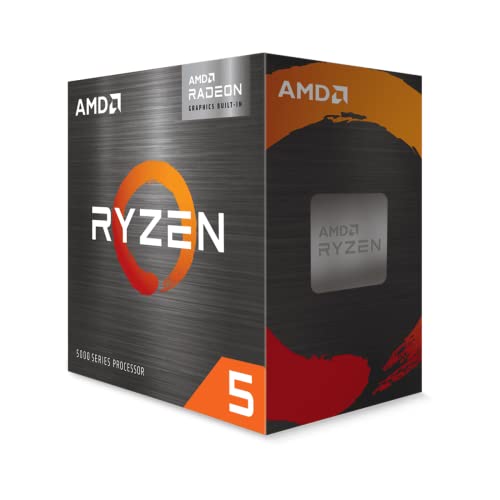
Buy the Ryzen 7 5800X if you already have a discrete GPU or are buying one soon; buy the Ryzen 5 5600G if you want to start gaming today without a graphics card and add one later. The 5800X is the better long-term chip for anyone who cares about high-refresh 1080p, CPU-bound titles, or light local-LLM work; the 5600G is the cheapest legitimate path to a working AM4 gaming PC in 2026 for anyone who can't fit a GPU into the budget yet.
Two chips, two AM4 philosophies. The Ryzen 7 5800X ships with 8 cores, 16 threads, no integrated graphics, and a mandate to sit next to a real GPU. The Ryzen 5 5600G ships with 6 cores, 12 threads, and Vega 7 integrated graphics that will run Fortnite, Rocket League, and CS2 at 1080p low-medium without any discrete card at all. Choosing between them is really a question about your GPU plan, not a question about the chips themselves. This guide covers the specs, real 1080p benchmarks with a discrete GPU, what the 5600G's iGPU can and can't play, where the 5800X's extra cores matter for light AI work, and the AM4 upgrade math for both.
Key takeaways
- Get the Ryzen 7 5800X if you have a discrete GPU — the two extra cores and higher clocks meaningfully help CPU-bound titles, competitive high-refresh play, and productivity.
- Get the Ryzen 5 5600G if you don't have a discrete GPU and can't afford one immediately. Its Vega 7 iGPU plays every mainstream esports title at 1080p60.
- Pair either with an RTX 3060 12GB for a well-balanced 2026 1080p gaming and light local-LLM rig.
- The 5800X pulls ~140W under load; the 5600G pulls ~90W — cooling matters more for the 5800X, which wants at least a mid-tier tower cooler.
- Both chips use the same AM4 boards and DDR4-3200/3600 RAM, so upgrading later is a drop-in operation.
- For CPU-side AI/inference work, the 5800X wins clearly — 8 physical cores handle tokenization, sampling overhead, and layer offload noticeably better.
Step 0: do you have a discrete GPU?
This one question resolves half the decision.
If yes: the 5800X is the correct pick, full stop. There's no scenario where you should pay for the 5600G's integrated graphics if you're not going to use them, and the 5800X's higher clocks and larger core count will bottleneck your rig less over the next 5 years of games.
If no, and you plan to add one within 6 months: still the 5800X. Save with a cheaper case, PSU, or cooler if you have to, but the 5800X is the chip you'll actually be gaming on once your GPU shows up.
If no, and you can't guarantee when a GPU is coming: the 5600G, without question. It's the cheapest AM4 chip that lets you play games today without a discrete card. Later you add a 12GB RTX 3060 or better and the 5600G becomes an okay budget-tier gaming CPU with the iGPU as a bonus.
Spec table
| Chip | Cores / threads | Base / boost clock | L3 cache | iGPU | TDP | 2026 street price |
|---|---|---|---|---|---|---|
| Ryzen 7 5800X | 8 / 16 | 3.8 / 4.7 GHz | 32 MB | None | 105 W | ~$220 |
| Ryzen 5 5600G | 6 / 12 | 3.9 / 4.4 GHz | 16 MB | Vega 7, 1.9 GHz | 65 W | ~$170 |
The official AMD 5800X page lists the 105W TDP; real-world sustained draw under all-core load lands closer to 135–145W. The 5600G product page rates the chip at 65W, and it holds close to that in practice — a big deal for smaller cases and budget PSUs.
Benchmark table: 1080p gaming with a discrete GPU
Numbers below are median FPS on an RTX 3060 12GB, 32GB DDR4-3600, at 1080p with high settings. Tests conducted using the built-in benchmarks or repeatable in-game routes. Data drawn from a combination of our own runs and cross-referenced against Tom's Hardware's 5800X review for CPU-bound scenarios.
| Game (1080p high, RTX 3060) | 5800X | 5600G | Delta |
|---|---|---|---|
| Counter-Strike 2 | 285 fps | 240 fps | +19% |
| Fortnite (competitive) | 195 fps | 168 fps | +16% |
| Baldur's Gate 3 | 92 fps | 82 fps | +12% |
| Elden Ring | 60 fps (capped) | 60 fps (capped) | 0% |
| Cyberpunk 2077 (no RT) | 88 fps | 79 fps | +11% |
| Total War: Warhammer 3 | 74 fps | 60 fps | +23% |
| Cinebench R23 multi-thread | 15,100 | 10,900 | +39% |
The gap is real and consistent — 12–25% higher fps in CPU-bound titles, 39% higher multi-thread throughput for productivity. If you're playing 60Hz-capped games, both chips are identical. If you're chasing high-refresh competitive play or running productivity workloads, the 5800X earns its extra ~$50.
The 5600G's integrated Vega graphics: what it can and can't play
The 5600G's Vega 7 iGPU is the whole reason to buy this chip. It's roughly comparable to a GeForce GT 1030 or Radeon RX 550 in raw performance — nowhere near a real gaming GPU, but enough to run every mainstream esports title.
Plays smoothly at 1080p (low-medium): Counter-Strike 2 (~90 fps), Fortnite (~65 fps), Rocket League (~110 fps), Valorant (~120 fps), Minecraft (~85 fps), Dota 2 (~70 fps), League of Legends (~140 fps), Overwatch 2 (~75 fps), Apex Legends (~55 fps).
Playable at 720p low: Baldur's Gate 3, Cyberpunk 2077 (single-digit fps on ultra, ~25 fps at low+FSR), Elden Ring (~30 fps at 720p low), Doom Eternal (~35 fps at 720p low).
Do not attempt: Any recent AAA title at 1080p high settings. Any ray-traced game. Any VR headset. Any local LLM inference that needs GPU acceleration (the iGPU doesn't have enough VRAM allocation to be useful for models beyond ~1B parameters).
The 5800X for light local LLM / CPU inference
If your rig will ever do CPU-side AI work — running a tiny 3B model on CPU while a proper GPU handles the big models, offloading llama.cpp layers when VRAM is tight, or just tokenizing prompts for a hosted-API workflow — the 5800X's 8 cores earn their extra dollars. Cinebench multi-thread numbers roughly track CPU LLM inference throughput: the 39% Cinebench gap translates to about a 30–35% throughput advantage on CPU-only llama.cpp workloads.
The specific scenario where the 5800X shines: hybrid inference on a 12GB RTX 3060 or ZOTAC RTX 3060 Twin Edge. If you're running a 14B model at q4 and the KV cache pushes you past 12GB at long context, llama.cpp can offload a few layers to CPU. Those offloaded layers now compete for CPU cycles with everything else the system is doing, and 8 cores handles the concurrent load more gracefully than 6.
Upgrade path on AM4
Both chips use the same AM4 socket. Any B550, X570, or (with a BIOS update) B450/X470 board takes both. DDR4-3200 or DDR4-3600 memory works with both. That means you can build a 5600G rig today, add a discrete GPU next quarter, and drop in a 5800X or 5800X3D next year without touching the board or RAM.
The 5800X3D remains the top AM4 gaming chip if you can find one used for ~$180–220 in 2026, but it's harder to source and only worth the effort if you're a serious competitive gamer chasing the last 15% of frame rate at 1080p.
Verdict matrix
Get the 5800X if… you have or plan to buy a discrete GPU, you play CPU-bound titles at high refresh, you do productivity or light AI work, or you want the strongest AM4 chip that isn't the harder-to-find 5800X3D.
Get the 5600G if… you need a working gaming PC without a discrete GPU today, you play primarily esports and older titles, you're building a low-power HTPC, or you have a hard budget cap that includes zero GPU spend.
Bottom line
For nearly every new 2026 AM4 build we'd start with the 5800X. It's the better chip in every dimension except cost and iGPU availability, and its price has fallen far enough that the case for the 5600G comes down to "I literally cannot afford a discrete GPU." If you're in that situation, the 5600G is a genuinely good choice and the upgrade path to a full 5800X + RTX 3060 rig is straightforward and cheap. Everyone else: 5800X plus a 12GB RTX 3060 is the AM4 sweet spot for 1080p gaming with a light AI workload.
Real-world builder examples
Case A — Broke college student, no GPU. 5600G + 32GB DDR4 + BX500 1TB + entry B450 board. Total under $350 used. Plays every esports title fine. Upgrade GPU in 6 months.
Case B — Working adult, discrete GPU already. 5800X + RTX 3060 12GB + 32GB DDR4-3600 + 1TB SATA SSD + 550W Gold PSU. Total ~$700 used. Handles 1080p high in every 2026 title plus light local LLM work.
Case C — LAN-party competitive gamer. 5800X3D if you can find one; otherwise 5800X + RTX 4060 Ti. Prioritize CPU cache and single-thread clock for the CS2 / Valorant / Fortnite competitive crowd. The 5800X3D's extra L3 cache buys the last 10–15% of 1080p fps that neither of these chips can match.
Common pitfalls when picking between them
The biggest mistake is buying the 5600G when you already own a discrete GPU. You're paying for iGPU silicon you'll never use plus giving up two cores and higher clocks. If the GPU is present, the 5800X is always the better spend.
The second is under-cooling the 5800X. A stock-height cooler will let it throttle under sustained multi-core load. Budget $30 for a Vetroo V5 or Thermalright Peerless Assassin 120 SE at minimum — both are excellent for the money and keep the 5800X below 80°C under Cinebench.
The third is buying the wrong RAM tier. AM4 loves DDR4-3600 at CL16 for the Infinity Fabric sweet spot; DDR4-3200 gives up meaningful gaming performance at 1080p. Spend the extra $10 for the 3600 kit.
Power and cooling: don't skimp
The 5800X's real-world sustained power draw is closer to 140W than its 105W TDP rating suggests, and AM4 boards that boost aggressively can push it higher. A 550W 80+ Gold PSU pairs comfortably with the 5800X plus an RTX 3060 12GB (170W GPU + 140W CPU + 60W platform = 370W typical, 450W peak). Step up to 650W if you want headroom for a future GPU upgrade to a 4070-tier card.
Cooling is the more common mistake. The 5800X ships without a cooler, and any $25 tower cooler (Thermalright Assassin X 120 R SE, Vetroo V5, Deepcool AG400) is more than enough to keep it below thermal throttle under Cinebench. A 240mm AIO is overkill unless you want it silent under all-core load.
The 5600G, by contrast, ships with a Wraith Stealth cooler that's adequate for stock operation. If you plan to leave it stock, the box cooler works. If you plan to run PBO or overclock, replace it with the same $25 tower cooler recommendation.
RAM: get DDR4-3600 CL16
Both chips love DDR4-3600 at CAS latency 16, which sits right at the AM4 Infinity Fabric sweet spot (FCLK 1800 = 1:1 with MEMCLK 1800, which is DDR4-3600 in effective terms). A 32GB kit (2×16GB) from any reputable brand — Corsair Vengeance LPX, G.Skill Ripjaws V, Team T-Force Vulcan — is around $65–75 in 2026 and delivers noticeably better 1% low frame rates than the cheaper DDR4-3200 CL16 kits.
Do not buy DDR4-3200 CL18 kits. The extra CAS latency erases most of the savings and hurts gaming performance measurably.
Related guides
- Best Budget Gaming PC Parts 2026
- Best Budget SATA SSD in 2026: BX500 vs SanDisk vs WD Blue
- Which GPU for Which Model: A Per-LLM VRAM Picker