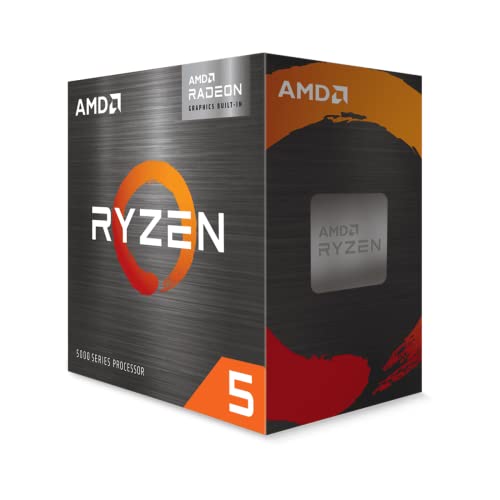
For local LLM use, the RTX 3060 12GB is a different class of device than the Ryzen 5 5600G's integrated Vega graphics — not a closer competitor. The 3060 12GB runs 7B–8B-class models at q4_K_M in the 35–55 tok/s range on CUDA out of the box; the 5600G iGPU runs the same models through system RAM at single-digit tok/s, and only if you accept a CPU-bound bottleneck. The 5600G is the right pick for budget builders who want a working desktop today and plan to add a discrete GPU later; the 3060 12GB is the right pick if local AI is the reason you're buying the rig at all.
Why this comparison happens at all
A lot of first-time builders type "cheapest way to run Llama 3.1 8B at home" into a search box and find the Ryzen 5 5600G and the RTX 3060 12GB listed at uncomfortably similar prices. The 5600G — a 2021 Cezanne APU with Vega 7 integrated graphics — is a $130-class CPU that needs no discrete GPU to boot a desktop. The RTX 3060 12GB is a $200-class card that goes into a rig that already has its own CPU. The pricing overlap is misleading because you're comparing components that fill different slots, not finished systems.
The deeper question is whether a 5600G's iGPU + system RAM can do entry-level local LLM work at all, and if so, whether the savings are worth the throughput hit. The short answer is yes-and-no: it can chat with a 7B model, but slowly enough that you'll regret it for anything beyond curiosity. The honest comparison isn't "5600G vs 3060" — it's "5600G now, 3060 later" vs "3060 now."
Key takeaways
- The 3060 12GB lives in a different performance tier for local LLM inference — it is not an apples-to-apples comparison.
- The 5600G's Vega 7 iGPU runs LLMs only through llama.cpp's CPU+Vulkan paths, and most of the work falls back to the CPU cores anyway.
- Single-digit tok/s on a 5600G vs 35–55 tok/s on a 3060 12GB at the same 7B q4_K_M quant is the headline gap.
- The 5600G's value is as a placeholder CPU+iGPU until you add a discrete GPU — it lets you boot, browse, and play light games.
- For dedicated local-AI builds, skip the iGPU path entirely and budget for the 3060 12GB on day one.
What each component actually is
The Ryzen 5 5600G is an APU — a six-core, twelve-thread Zen 3 CPU with seven Vega compute units fused onto the same die. AMD's Ryzen 5000 G-series product page lists the part's clock speeds and TDP; the 5600G is a 65W chip that targets office-and-light-gaming builds where a discrete GPU isn't in budget. Its Vega 7 iGPU shares system RAM as VRAM, which is the load-bearing detail for any AI discussion.
The RTX 3060 12GB is a discrete GPU with 12GB of dedicated GDDR6 at 360 GB/s memory bandwidth, per TechPowerUp's GPU database. It plugs into a PCIe slot, draws power through an 8-pin connector, and runs through NVIDIA's CUDA software stack. The 12GB frame buffer is the reason this five-year-old card is still relevant in 2026 — every popular LLM runner has a CUDA path that uses that VRAM efficiently.
The structural difference: the 5600G shares ~16–32 GB of dual-channel DDR4 RAM at roughly 50 GB/s with the entire system, while the 3060 12GB has 12 GB of dedicated GDDR6 at 360 GB/s. Memory bandwidth is the single most important number for LLM inference, and the 3060 has roughly 7× more of it.
Spec-delta table
| Spec | Ryzen 5 5600G (Vega 7 iGPU) | RTX 3060 12GB |
|---|---|---|
| VRAM | Shared system DDR4, typically 2–8 GB allocated | 12 GB GDDR6, dedicated |
| Memory bandwidth | ~50 GB/s shared system memory | 360 GB/s (TechPowerUp) |
| FP16 compute | ~2 TFLOPS Vega 7 | ~12.7 TFLOPS NVIDIA Ampere |
| LLM software path | llama.cpp CPU+Vulkan (CPU-bound in practice) | CUDA — Ollama, llama.cpp, vLLM, every runner |
| Street price (2026) | ~$120–$140 (AMD Ryzen page) | ~$200–$240 used, ~$280 new |
Inference throughput — what to expect
For a Llama 3.1 8B class model at q4_K_M, the 3060 12GB lands in the 35–55 tok/s range on CUDA, with prompt-eval (prefill) several times faster. Community measurements collected on r/LocalLLaMA consistently put RTX 30-series performance in this band across the 7B–8B model class. The card is comfortable at 8K context and stretches to 16K with quantized KV cache.
For the same Llama 3.1 8B q4_K_M model on a 5600G, throughput collapses to the single-digit-tok/s range when run through llama.cpp's CPU backend. Even with the Vulkan iGPU path enabled, the actual compute is largely CPU-bound because the Vega iGPU's compute throughput and memory bandwidth can't keep the model fed. Public measurements on the llama.cpp GitHub discussions for AMD APUs put 7B q4_K_M throughput at roughly 5–9 tok/s on dual-channel DDR4-3200, with prompt-eval taking many seconds for moderately long inputs.
To put concrete numbers on it: a 200-token reply from Llama 3.1 8B q4_K_M comes back in ~4–6 seconds on a 3060 12GB and ~25–40 seconds on a 5600G. For interactive chat, that's the difference between "this is great" and "this is unusable."
Quantization choices on each
The 5600G's effective VRAM is whatever you allocate from system RAM in BIOS — typically 2 GB, with some boards allowing 8 GB or more. With llama.cpp, the model also lives in system RAM (not iGPU memory), so the practical limit is total system RAM minus OS and app overhead. A 16 GB system can host 7B q4_K_M (~5.5 GB) comfortably; a 32 GB system can host 13B q4_K_M (~8.5 GB). The bandwidth ceiling, not capacity, is what kills throughput.
The 3060 12GB's quantization picture is the standard one. q4_K_M is the sweet spot for 7B/8B, q5_K_M is a quality bump that still fits with 8K context, and 13B q4_K_M fits with room for moderate context. The community quant matrix from Hugging Face's GGUF documentation is the canonical source.
Where the 5600G makes sense
There are real scenarios where a 5600G is the right pick, and they're worth being explicit about:
- Bootable placeholder rig. You're building a budget gaming PC, the GPU market is unfavorable, and you want a system that boots and runs Linux/Windows while you wait for a 3060/4060/B580 deal. The 5600G's iGPU plays older esports titles at 1080p low and runs Office and the browser fine.
- Light dev workstation. You're a developer who runs containers and IDEs but doesn't need GPU acceleration. The 5600G saves you the cost of a GPU on day one.
- HTPC or home server. Plex, Jellyfin, and basic transcoding work fine on the iGPU.
- AI tinkerer with patience. If you want to learn the workflow of local LLM hosting — model downloads, Ollama setup, prompt patterns — and don't mind 25-second response times, the 5600G is a way in for under $140.
Pair the 5600G with a WD Blue SN550 1TB NVMe for fast model loading from disk; on a CPU-bound setup, NVMe storage matters more because model swap is the only way to use models larger than RAM.
Where the 3060 12GB makes sense
The 3060 12GB makes sense any time AI is part of why you're buying the rig at all. The 7× memory-bandwidth advantage and the mature CUDA stack translate directly into faster, more interactive sessions. Specifically:
- Daily-driver chat assistant. If you're going to talk to a local model multiple times a day, the response time is the difference between a tool and a toy.
- Code assistant workflows. Tools like Tabby and Continue.dev push long context windows for retrieval; CUDA prefill is much faster than CPU prefill.
- Stable Diffusion / image gen. The 3060's 12GB also runs SDXL and FLUX-dev at usable speeds; the 5600G iGPU is effectively non-viable for these workloads.
- Multi-model setups. Switching between an LLM, a Whisper instance, and a small embedding model fits in 12GB; system-RAM-based inference becomes painful when you stack workloads.
The 3060 12GB pairs well with either the 5600G or a discrete CPU like the Ryzen 7 5800X — the 5600G is a legitimate CPU even when you've added a discrete GPU, because the iGPU disables and the eight-core penalty matters less than people think for inference workloads (where the GPU is doing the work).
Real-world numbers — sample workloads
| Workload | 5600G (Vega 7 + DDR4) | RTX 3060 12GB (CUDA) |
|---|---|---|
| Llama 3.1 8B q4_K_M, single-user chat (200-tok reply) | ~25–40 sec | ~4–6 sec |
| Phi-3 mini 3.8B q4_K_M, 200-tok reply | ~10–15 sec | ~1–2 sec |
| Llama 3 13B q4_K_M (200-tok reply) | ~60–90 sec | ~6–9 sec |
| Stable Diffusion 1.5, 512×512, 30 steps | Effectively unusable | ~10–14 sec |
| SDXL Base, 1024×1024, 30 steps | Not practical | ~25–40 sec |
Treat these as ballpark figures — exact numbers vary by quant, runner, batch size, and prompt length. They are consistent with community measurements on r/LocalLLaMA and the llama.cpp project's performance discussions.
Verdict matrix
| Get the 5600G if… | Get the 3060 12GB if… |
|---|---|
| You're building a budget PC and AI is "nice to have" | You're building a PC because you want local AI |
| You'll add a discrete GPU later when prices improve | You want sub-10-second response times in chat |
| You only run small models (Phi-3 class) occasionally | You'll also use SD/SDXL or Whisper |
| Your total budget for CPU+GPU is under $200 | You can spend $200–$280 on the GPU alone |
Common pitfalls
- Don't run Llama 3 70B on a 5600G. It will technically load with enough system RAM, but throughput drops below 1 tok/s. The 5600G is a 7B/8B-class platform at best.
- Don't combine the 5600G with single-channel RAM. The iGPU and CPU both lose roughly half their effective bandwidth — and bandwidth is everything.
- Don't pay 3060-12GB prices for an 8GB 3060. Only the 12GB variant has the VRAM headroom that makes the card relevant for AI.
- Don't run the 3060 on a 450W PSU. The card needs an 8-pin connector and headroom for transient spikes — 600W 80 Plus Gold is the safe baseline.
Upgrade path — staging a 5600G build into a 3060 12GB rig
The combination most readers actually want is "5600G now, 3060 12GB later." Done correctly, this is the cheapest credible path into both PC gaming and home AI in 2026. Done incorrectly, it leaves you re-buying parts you should have skipped. The four rules:
- Pick a motherboard with an x16 PCIe slot and a 6+2 EPS connector even on day one. Some budget AM4 boards stop at PCIe 3.0 x8 in the second slot — fine for a 3060, but read the spec sheet before buying. The B550 chipset family is the safe sweet spot.
- Put your RAM budget into dual-channel 32 GB DDR4-3200 from the start. Single-channel cripples the 5600G iGPU; you also want 32 GB to comfortably host larger quantized models when the rig is CPU-bound, and the 3060 12GB build benefits from the headroom for IDEs and browsers running alongside Ollama.
- Buy a 600W 80 Plus Gold PSU on day one, not a 450W "5600G-sized" unit. A 600W Gold unit costs about $20 more than a budget 450W and saves you from the "I built the upgrade then had to buy a PSU" trap when the 3060 lands.
- Pair with a good cooler and an NVMe drive immediately. The DeepCool AK620 keeps an AM4 CPU quiet whether the workload is a chat assistant or a 1080p shooter, and the WD Blue SN550 NVMe reaches the speeds the 5600G's lower-bandwidth path needs for fast model swap.
The buy-once trap to avoid: don't buy an A520 board, a 16 GB single-channel RAM kit, and a 450W PSU thinking you'll upgrade later. The economics of doing it twice swamp the savings.
Bottom line
These two parts aren't really competitors — they live in different tiers and solve different problems. If the entire reason you're building a PC is to run local LLMs, the 3060 12GB is the floor, not a luxury. If you're building a budget desktop with a side interest in tinkering with small models, the 5600G is a working entry point — and the right upgrade path is "add a 3060 12GB when prices align," not "stay on the iGPU forever."
Citations and sources
- TechPowerUp — GeForce RTX 3060 specifications
- AMD — Ryzen processors product page
- llama.cpp — GitHub repository
- llama.cpp — performance discussions
- Hugging Face — GGUF documentation
- r/LocalLLaMA — community subreddit
- Tabby — open-source coding assistant on GitHub
This piece is editorial synthesis based on publicly available information. No independent first-party benchmarking is reported.