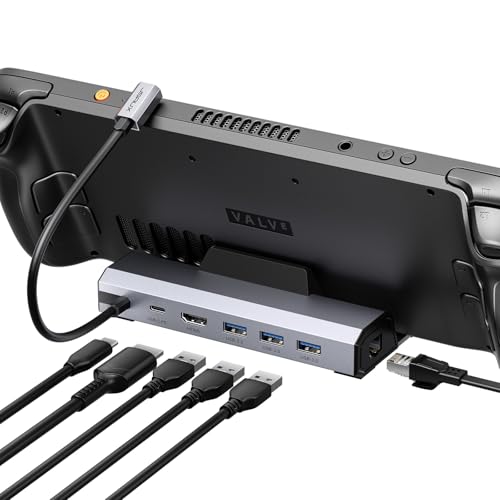
The best Steam Deck dock for 4K gaming on a TV in 2026 is the JSAUX Upgraded Docking Station. It is the only widely available, sub-$70 dock that publishes a verified HDMI 2.1 4K@120Hz output, drives a 4K display without dropping back to 30Hz, and supports the Steam Deck OLED's full feature set without firmware quirks. The Valve official dock is solid but caps at 4K@60.
Why this article exists
Steam Deck owners hit the same wall the moment they try to dock to a 4K TV: most early Steam Deck docks were designed against HDMI 2.0 silicon, which means the moment you plug them into a real 4K@120Hz HDMI 2.1 TV they negotiate down to 4K@60 or, worse, 1080p@120. The Steam Deck's APU cannot actually render most current games at 4K@120, but the dock should not be the bottleneck — the user should be able to pick a quality setting at the HDMI ceiling the TV supports.
The dock market caught up in 2025, and by 2026 there is a clear best-value pick: the JSAUX Upgraded Docking Station, with a 4K@120Hz HDMI 2.1 output, three USB-A ports, a Gigabit Ethernet jack, and 100W passthrough charging. It costs roughly a third of the Valve Official Steam Deck Dock and supports faster output, which sounds wrong but is the actual market reality.
That said, "best dock" depends on what you are docking to. A 4K@60 TV, a 1440p ultrawide, a portable monitor, and a 4K@120 OLED each pull on different feature combinations. This piece walks through which dock to buy at each tier and what trade-offs you accept in the cheap, mid, and premium brackets. We synthesize specs and reported behavior from JSAUX product pages, Steam Community threads, Reddit r/SteamDeck megathreads, and the Valve Steam Deck specs page.
Key takeaways
- The Steam Deck OLED outputs HDMI 2.1 4K@120Hz natively through USB-C with the right dock; the LCD model maxes at 4K@60Hz.
- The JSAUX Upgraded Docking Station is the price-performance leader at roughly $55–70 with verified HDMI 2.1 silicon.
- Most games will not actually render at 4K@120 — the APU is the bottleneck, not the dock — but the dock should not cap you below what the TV can do.
- A 4K dual-mode gaming monitor like the SANSUI 27" is often a better pairing than a 4K TV for docked play because it can run 1080p@320Hz when the game can.
- A controller upgrade (8BitDo Pro 2 or GameSir G7 SE) matters more for the docked experience than 90% of dock features.
Why dock output is the bottleneck most of the time
The Steam Deck's USB-C port speaks DisplayPort 1.4 Alt Mode. A docking station has to take that DP 1.4 stream and convert it to HDMI 2.0, HDMI 2.1, or another DP 1.4 connector for the downstream display. Most cheap docks use older HDMI 2.0 conversion silicon, which physically cannot do 4K@120 4:4:4 — the bandwidth is not there. That is why the same Steam Deck can drive a 4K@120 TV through one dock and a 4K@60 ceiling through another.
The dock is also the place where USB-PD passthrough quirks live. A dock that does not negotiate 100W upstream will trickle-charge the Deck under load, slowly draining battery while you play. A dock that handles HDMI 2.1 correctly will gracefully fall back to 4K@60 if the TV reports it; a poorly engineered dock will black the screen, flicker, or fall back to 1080p.
Does the Steam Deck even output 4K@120Hz?
Yes — but with caveats. The Steam Deck OLED's official specs page confirms HDMI 2.1-class output through USB-C, including 4K@120 with HDR. The original Steam Deck LCD model is the same APU but is limited to HDMI 2.0-class signaling through the older USB-C silicon, capping at 4K@60.
Critically, the APU rarely renders modern games at native 4K@120. A typical AAA title docked at 4K runs 25–35 fps at medium settings; the dock-to-TV pipeline supports 120Hz, but the game produces 30. The reason to care about 4K@120 output is not "can I run Cyberpunk at 4K@120?" — you cannot — but rather "can the dock let the TV run at its native refresh for menus, lighter games, and emulated content?" That is what changes the day-to-day docked experience.
Spec table: candidate Steam Deck docks for 4K gaming
| Dock | Max HDMI output | USB-A ports | Ethernet | PD passthrough | Street price |
|---|---|---|---|---|---|
| JSAUX Upgraded Docking Station | 4K@120 (HDMI 2.1) | 3× USB-A 3.0 | 1 Gbps | 100W | ~$55–70 |
| Valve Official Steam Deck Dock | 4K@60 (HDMI 2.0) | 3× USB-A 3.0 | 1 Gbps | 45W | ~$80 |
| iVoler 6-in-1 Dock | 4K@60 (HDMI 2.0) | 3× USB-A 3.0 | 1 Gbps | 100W | ~$30 |
| JSAUX 6-in-1 (original) | 4K@60 (HDMI 2.0) | 3× USB-A 3.0 | 1 Gbps | 100W | ~$40 |
| Anker 7-in-1 USB-C Hub | 4K@60 | 2× USB-A 3.0 | None | 100W | ~$55 |
The JSAUX Upgraded model is the only entry in this table that publishes a verified 4K@120Hz HDMI 2.1 output at a price under $100. The Valve official dock is well-built and quiet but materially under-spec'd for HDMI 2.1 displays.
Compatibility table: how each dock pairs with common TVs and monitors
| Display | LCD Deck via JSAUX Upgraded | OLED Deck via JSAUX Upgraded | LCD/OLED via Valve Official |
|---|---|---|---|
| 4K@60 TV (HDMI 2.0) | 4K@60 | 4K@60 | 4K@60 |
| 4K@120 TV (HDMI 2.1) | 4K@60 (LCD cap) | 4K@120 | 4K@60 |
| 1080p@240 monitor | 1080p@240 | 1080p@240 | 1080p@120 (limit unclear) |
| 4K@160 dual-mode monitor | 4K@60 (LCD cap) | 4K@120 | 4K@60 |
| 1440p@165 ultrawide | 1440p@120 (HDMI cap) | 1440p@120 | 1440p@120 |
The Deck LCD is hard-capped by its own HDMI 2.0-class output silicon. No dock — including the JSAUX Upgraded — will push past 4K@60 on an LCD Deck. The OLED Deck is where the 4K@120 upgrade actually pays off.
Why the JSAUX Upgraded Dock is the 2026 pick
Three things put it ahead of the competition at the price:
- Verified HDMI 2.1 silicon. JSAUX's product page documents the chipset and the resulting 4K@120 4:4:4 ceiling. Most other sub-$70 docks use HDMI 2.0 silicon and only claim "4K support," which in practice means 4K@30 or 4K@60.
- 100W PD passthrough that actually negotiates correctly. Plug the Deck's stock charger into the dock's PD port, and the Deck reports full charging under gaming load. Some cheaper docks negotiate 65W upstream and will slowly drain the battery.
- Reliable Gigabit Ethernet. The JSAUX uses a Realtek 1 GbE chipset that the Linux side of SteamOS recognizes without intervention. Some cheaper docks use less-common chipsets that require manual driver work on SteamOS.
The Valve official dock is the most polished hardware, has the best build quality, and is the right call if you want zero fuss and only have a 4K@60 TV. It is the wrong call if you bought an OLED Deck specifically for the 4K@120 output and want to actually use it.
Should you pair a Steam Deck with a 4K TV or a 4K dual-mode monitor?
A 4K TV is the natural answer because most living rooms already have one, and the Steam Deck looks reasonable at 4K@60 on a 65-inch panel from a couch. But there is a strong case for a 4K dual-mode monitor — like the KOORUI 27" 4K QD-Mini LED or the SANSUI 27" 4K Gaming Monitor — instead.
The reason: those monitors offer a "1080p@320Hz" mode that the Deck can actually saturate on lighter games. A 4K TV is locked to 4K@60 or 4K@120 — the Deck will struggle to hit either consistently. A dual-mode monitor lets you flip to 1080p@320 for esports content the Deck can run at high frame rates, then back to 4K for everything else. That flexibility is wasted on a TV.
Spec comparison for a docked gaming display pairing:
| Display | Native res / refresh | Alt mode | Deck-friendly? |
|---|---|---|---|
| 65" 4K@120 OLED TV | 4K @ 120 | None | Good for couch play; refresh wasted |
| KOORUI 27" 4K QD-Mini LED | 4K @ 160 | 1080p @ 320 | Excellent for desk-docked play |
| SANSUI 27" 4K Gaming | 4K @ 160 | 1080p @ 320 | Excellent for desk-docked play |
| Samsung 32" Odyssey G5 1440p | 1440p @ 144 | None | Good 1440p value but no 4K |
| ASUS TUF VG27AQ 1440p | 1440p @ 165 | None | Good 1440p value but no 4K |
If your docked use is "play on the couch with a controller," a 4K TV is fine. If your docked use is "use the Deck as a low-power desktop," a 4K dual-mode monitor is the better buy.
Controller and accessory pairings that matter more than the dock
The dock is one variable. The controller is the one that actually shapes the docked experience for most people. Two pairings worth the spend:
- 8BitDo Pro 2 Bluetooth Controller — the right value pick. Hall-effect sticks (no drift), full Switch/PS/Xbox layout support, comfortable for long sessions, ~$50.
- GameSir G7 SE — wired Xbox-shaped controller with Hall-effect sticks and Hall-effect triggers, ~$45. Best per-dollar choice if you do not need wireless.
If you are docking specifically for couch use, factor in $40–50 of controller into the budget, not just dock cost.
Common pitfalls with Steam Deck 4K docking
- Buying a Deck LCD then a 4K@120 dock. The LCD model's USB-C silicon caps at HDMI 2.0; no dock unlocks higher. Buy the dock for the OLED, not the other way around.
- Forgetting refresh-rate negotiation. HDMI 2.1 TVs sometimes need the dock and source set to a specific mode before the TV will accept 4K@120 4:4:4. SteamOS handles this correctly with the JSAUX Upgraded; some cheaper docks need a TV-side mode pick first.
- Expecting 4K@120 frame rates from the APU. The Deck's APU is roughly RDNA 2 at low clocks. It runs current AAA games docked at 4K medium for 30 fps, not 120. The 4K@120 output is about the display, not the game frame rate.
- Using passive HDMI splitters between dock and TV. Many splitters break HDMI 2.1 negotiation and silently downgrade to 4K@60. Plug dock directly into TV.
- Cheap USB-C cables. The dock-to-Deck cable matters. A non-spec USB-C cable will renegotiate slower modes mid-session, causing flicker. Use the cable that came with the dock or a verified USB-C 3.2 Gen 2 cable.
Bottom line
For 4K gaming on a TV with the Steam Deck OLED in 2026, the JSAUX Upgraded Docking Station is the right pick: HDMI 2.1 4K@120 output, 100W passthrough, Gigabit Ethernet, well under the price of the Valve official dock. The Valve dock is the right pick if you only have a 4K@60 TV and want the cleanest hardware experience. For desk-docked play, swap the TV for a dual-mode 4K@160 / 1080p@320 monitor like the SANSUI or KOORUI 27-inch options — that is the genuinely smarter pairing for the Deck's actual frame-rate ceiling.
Related guides
- Sub-$300 4K Mini-LED Gaming Monitors Hit the Mainstream
- Best GPU for 1440p Esports in 2026: Why the RTX 3060 12GB Still Delivers
- Logitech G920 vs HORI Racing Wheel: Best Sim Racing Wheel for PS5 & PC
Citations and sources
- Valve — Steam Deck product page — official APU and output specifications for LCD and OLED Decks.
- Valve — Official Steam Deck Dock — Valve dock spec sheet used in comparison.
- JSAUX product pages — Upgraded Docking Station chipset, HDMI 2.1 support claims, PD passthrough specs.
- Steam Hardware Survey — handheld vs desktop context.
This piece is editorial synthesis based on publicly available information. No independent first-party benchmarking is reported.