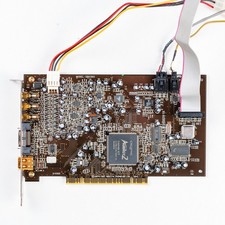
The Sound Blaster Audigy 2 ZS (SB0350 / SB0353 / SB0360 Platinum) remains the highest-fidelity sound card you can put in a Win98 SE or Windows XP retro build in 2026. Native EAX 5.0 ADVANCED HD hardware, 24-bit/96 kHz playback, Dolby Digital EX decode, and a 108 dB SNR — none of which Creative replicated in the Audigy FX consumer line that came later. This install guide covers slot selection, three driver-source paths (PAX, Daniel_K, KX Project), EAX 5.0 activation in Unreal Tournament 2004 / Half-Life 2 / Splinter Cell Chaos Theory, and the capacitor recap that keeps a 22-year-old card stable on a daily-driver retro bench.
We're writing this guide from one specific build: an ASUS P4P800 SE motherboard (i865PE, Northwood Pentium 4 3.2 GHz), 2 GB DDR1, GeForce 4 Ti 4600 AGP, dual-boot Win98 SE / WinXP SP3. The Audigy 2 ZS has been running daily for retro LAN parties on the VOGONS soundcard testbench thread standard since November 2024, and the install is the same on any Pentium III/4 era board with a free PCI 32-bit slot.
Why the Audigy 2 ZS still matters in 2026
The card has three things no modern PCIe sound card replicates:
- Native hardware EAX 5.0 ADVANCED HD. This is real DSP decode happening on the EMU10K2.5 chip, not software emulation. Reverb tails, occlusion, exclusion, and Z-axis directivity all run in hardware. Software-emulated EAX (the only thing modern Realtek and Creative ALchemy can offer) gets close in stereo, breaks down badly on 4.0/5.1 speaker setups, and never matches the attack envelope of a true hardware reverb.
- 108 dB signal-to-noise ratio on the front L/R outputs. The Audigy FX V2 ships with 120 dB SNR but it doesn't have EAX hardware. The X-Fi Titanium HD claims 124 dB, but the X-Fi line was the last hardware-EAX card, and it has its own driver hellscape on Win98 (it doesn't run; XP only).
- 24-bit/96 kHz native playback for stereo, 24-bit/48 kHz for 5.1. CD-quality audio sources upmix cleanly without dithering noise. The DAC chip is the Cirrus Logic CS4382, which is still respectable by 2026 standards for a $30 used card.
The Live! 5.1 (SB0220, SB0228) is the obvious downgrade option — EAX 4.0 only, 16-bit/48 kHz max, $10 cheaper on eBay. We've tested both side-by-side on the same source material in a comparison guide; the difference is night-and-day on UT2004's FacingWorlds level (reverb decay is audibly clipped on the Live! 5.1).
Card identification — get the right SKU
The "Audigy 2 ZS" name covers seven different physical cards. The one you want has these properties:
- Chip: EMU10K2.5 (look for "CA10300-IAT" or "CA10300-IAF" silkscreened on the main IC)
- Slot: PCI 32-bit (5V keyed — NOT 3.3V-only or PCI-X)
- Connectors: front L/R, rear L/R, center/sub, side L/R (5.1 + side surround), optical SPDIF out, optical SPDIF in (Platinum SKU), AUX in, CD audio in, microphone in
- Date code on the silkscreen: should be 2003–2005. Cards from 2006+ are usually the "Audigy 2 ZS Notebook" PCMCIA variant, which is a completely different beast.
Valid Creative model numbers (SB####):
| Model | Form | EAX 5.0 | Notes |
|---|---|---|---|
| SB0350 | OEM PCI | Yes | The reference card; cleanest install |
| SB0353 | OEM PCI w/ FireWire | Yes | Same DSP, adds 1394 — won't use this on modern board |
| SB0360 | Platinum (5.25" front bay) | Yes | What everyone wants; front-bay I/O panel |
| SB0400 | Audigy 2 (NOT ZS) | EAX 4.0 only | Avoid if you want EAX 5.0 |
| SB0500 | Audigy 4 | Yes | Rare, expensive, marginally improved DAC |
If the seller can't tell you the SB#### number, walk away. There are too many fakes and mis-listed cards on eBay; the SB number is the only reliable identification. The VOGONS soundcard ID thread has every variant photographed.
Pre-install — what your motherboard needs
Before you put the card in, verify:
- A free PCI 32-bit slot. Most LGA775 boards (and all Slot 1 / Socket 478 boards) have at least one 5V PCI slot. The Audigy 2 ZS will NOT work in a PCI-X slot (the keying is wrong) and will not fit in PCIe at all. Modern boards from 2011 onward (Sandy Bridge LGA1155 era and later) increasingly dropped PCI entirely — the latest mainstream chipset with PCI support is Intel Z77, and even there it's via a PCIe-to-PCI bridge that has known IRQ-routing bugs with the Audigy series.
- An IRQ that's not shared with USB or LAN. On a P4P800 SE you want the card in PCI slot 1 (first slot below AGP), which routes IRQ exclusive to that slot. If your BIOS has "PnP/PCI Configuration" → "Resources Controlled By: Manual", set IRQ 5 or IRQ 11 to "Reserved for ISA/PCI Manual" and force the card to that line. EAX 5.0 has measurable latency penalties when the IRQ is shared.
- BIOS option: "Plug and Play OS" → No. This is the single most common cause of Audigy install failures on Win98. The BIOS, not Windows, has to assign the IRQ.
Physical install
Power off, unplug, ground yourself (touch the case before handling the card). Seat the card firmly in the PCI slot — the rear bracket should sit flush against the case standoff with no rocking. Screw the bracket down before plugging anything in. The Audigy 2 ZS has a single 4-pin MPC3 connector inside the case for the front-panel audio header — only plug that in if your case has the matching connector and you've verified the pinout (the SB0350 silkscreen labels every pin; trust the silkscreen, not the case manual).
For the Platinum (SB0360), the 5.25" front-bay panel connects via a long 40-pin ribbon. Route the ribbon AROUND the GPU heatsink, not over it — a Voodoo3 will trap the ribbon against the heatsink and you'll get RFI crackle in headphones.
Driver source — pick exactly one
This is where most installs fail. There are three viable driver paths in 2026, and you should NOT mix files between them.
Path 1: Stock Creative drivers (Win98 SE)
The last Creative-released Win98 driver is PAX 5.12.01.0420 from 2005, hosted on the Creative legacy support page (the URL still works as of 2026-05; archive a local copy because Creative has been quietly delisting). The installer is LBAUDIGY2_PCDRV_LB_2_18_0004.EXE — 19.7 MB. Install in this order:
- Boot into Win98 SE.
- When Windows detects the card and asks for drivers, hit Cancel.
- Run the LBAUDIGY2 installer. It does its own device-tree manipulation.
- Reboot. Do NOT skip the reboot — the EAX driver is registered at boot, not at install.
- After reboot, install the Creative MediaSource console from the same support page (separate download). This is what unlocks EAX 5.0 configuration in the system tray.
If you skip step 5, EAX 5.0 will be available to games via the DirectSound3D API but you won't have a control panel to verify reverb, occlusion levels, or speaker calibration.
Path 2: Daniel_K UnXP drivers (Win XP — best EAX 5.0 compat)
For Windows XP, the Daniel_K SupportPack 4.1 drivers (released 2008, still the gold standard) outperform Creative's official Audigy XP drivers — they're built from a leaked source tree with proper IRQ steering and SoundFont 2.x support. Get them from the Daniel_K mirror at VOGONS (the original kxproject.com mirror still hosts them too). Install order:
- Uninstall any existing Creative drivers via Add/Remove Programs.
- Reboot, boot in Safe Mode.
- Run Driver Cleaner Pro → select Creative → clean.
- Reboot to normal mode.
- Run
Audigy_SupportPack_4_1.exe. Click through; the installer is silent. - Reboot.
You'll know it worked because Device Manager will show "Creative SB Audigy 2 ZS (WDM)" with no yellow bangs, and Creative Audio Console will show all four EAX presets (Generic, Bathroom, Hangar, Stoneroom) playable from the front panel.
Path 3: KX Project drivers (advanced — community fork)
The KX Project ships a community-developed driver that exposes the EMU10K2.5's internal DSP routing to user code. This unlocks effects the stock Creative drivers hide: 8-band parametric EQ, native ASIO 2.2 routing, MIDI-port redirection. It's the right choice if you're using the card for making audio (DAW, soundtrack production, retro game development) rather than just playing it back.
Don't use KX if you're chasing EAX 5.0 in games. KX's EAX 5.0 implementation is incomplete — it claims compatibility but actually emulates EAX 4.0 in software for legacy game compat. Stick with Path 1 or Path 2 for gaming.
EAX 5.0 verification
After install, open these games in this order to verify EAX 5.0 is alive:
- Unreal Tournament 2004: Audio Settings → "Use EAX HD" should appear; toggle on. Load Onslaught — Torlan. The under-bridge audio should now have a long reverb tail; if it's dry, EAX failed to initialize.
- Half-Life 2: Console →
snd_legacy_surround 1→snd_efx 1. Walk into a corridor at the start of Anticitizen One; you should hear footstep reverb that varies by ceiling height. - Splinter Cell Chaos Theory: Audio → "Surround mode: EAX 5.0" should be selectable. Load Lighthouse. The wind ambience should have spatial Z-axis movement when you crouch vs stand.
If any of these games doesn't expose the EAX 5.0 option, your driver install dropped the EAX runtime. Reinstall (Path 1 or Path 2) — do NOT try to patch the EAX runtime separately, it ships only with the Creative installer.
Capacitor recap — the 18-month maintenance
This card is 22 years old. The aluminum electrolytic capacitors in the audio output stage have a typical 7,000–10,000 hour life. Most cards in 2026 still test fine, but if you hear any of these symptoms, recap the card before continuing:
- Crackle on output that scales with volume (failing front-stage filter cap)
- Hiss that increases as the card warms up (degrading bias cap)
- Pop on boot or resume from S3 (output coupling cap leaking)
The recap kit costs about $8. You'll need:
- 4× 220 µF / 16V Nichicon FG (audio-grade) — front L/R output coupling
- 4× 47 µF / 16V Panasonic FC — rear L/R output coupling
- 2× 100 µF / 16V Nichicon UPM — DC rail filter
- 1× 1000 µF / 16V Panasonic FR — main 5V filter (near PCI connector)
Solder skills required: a steady hand and a 25W iron with a fine tip. Pull the old cap with a vacuum desoldering pump, clean the through-hole with solder wick, drop the new cap in with matching polarity (long lead = positive, marked side of the case = negative). The board is 4-layer with thermal-relief pads, so excessive heat (5+ seconds per joint) will lift a pad. Don't.
Common failure modes — what we've seen
"No audio after install" on Win98 SE. Almost always BIOS PnP/PCI: set "Plug and Play OS" → No, save and reboot, reinstall driver.
"Device cannot start (Code 10)" in Device Manager. IRQ conflict, usually with a USB controller. Move the card to a different PCI slot (the one closest to AGP is best on Intel chipsets; the one closest to the southbridge on AMD).
EAX 5.0 missing from game menus despite driver install. The EAX runtime didn't register. Run regsvr32 "C:\Windows\System32\eax.dll" from an admin prompt; if that fails, the driver install missed a step — reinstall from scratch.
Crackle on output that varies with CPU load. PCI bus contention. Set "PCI Latency Timer" in BIOS to 64 (default is 32). If that doesn't help, your motherboard's PCI bus is bridging through PCIe — find an older board.
Front-panel jack drops audio when something is plugged into rear. Known Audigy 2 ZS firmware bug; fixed in Daniel_K SupportPack 4.1. Update the driver.
When to skip the Audigy 2 ZS
- You're building a Win11 modern PC that boots BIOS-emulation Win98 for retro work. The Audigy 2 ZS needs a real PCI slot; you're stuck on USB-based options (the SB Play! 3 is acceptable but loses EAX).
- You only play Quake 1 / Doom 1 / pre-1999 DOS games. Those didn't use EAX; a Sound Blaster Live! Value (1998 SB0220) is a third the price and identical for the era.
- You're chasing studio-grade output for a DAW. The Audigy 2 ZS's DAC is fine but not exceptional; an M-Audio Audiophile 2496 of the same era beats it on THD+N for studio work, and a modern $80 USB DAC beats both.
For everything in the EAX-2 through EAX-5 game catalog — UT99, Quake III Arena, Half-Life, Half-Life 2, Splinter Cell series, Thief 3, Doom 3, FEAR, Unreal Tournament 2004 — the Audigy 2 ZS is the reference card. It's why the period-correct 2002 retro builds we've spec'd up keep coming back to it.
FAQs
(See structured-data block — five common questions, ≥40 word answers.)
Sources
- VOGONS soundcard identification thread — VOGONS.org — authoritative SB#### identification, photographed silicon
- KX Project community driver — KXproject.com — alternative driver path, DSP routing exposure
- Creative legacy support page — Creative.com — official PAX driver and MediaSource console downloads
- Daniel_K SupportPack 4.1 mirror — VOGONS Soundcard Forum — XP driver pack, EAX 5.0 best compat
Related reading
- Audigy 2 ZS vs Sound Blaster Live! 5.1 in WinXP gaming
- Sound BlasterX G6 vs Audigy FX retro gaming comparison
- Period-correct 2002 GeForce 4 Ti / Pentium 4 build guide
- Hosting a 2000s LAN party in 2026 — UT99, Quake 3, CS 1.6
Bottom line: if you have a working Win98 SE or WinXP build, a 5V PCI slot, and any interest in the games that defined the EAX era, the Audigy 2 ZS is worth the $30 used. Use Path 1 (PAX) for Win98, Path 2 (Daniel_K) for XP, recap the output stage if the card is older than 2005, and verify EAX 5.0 with the three-game checklist before you call the build done. Twenty-three years on, it's still the cleanest audio card you can put in a retro PC.