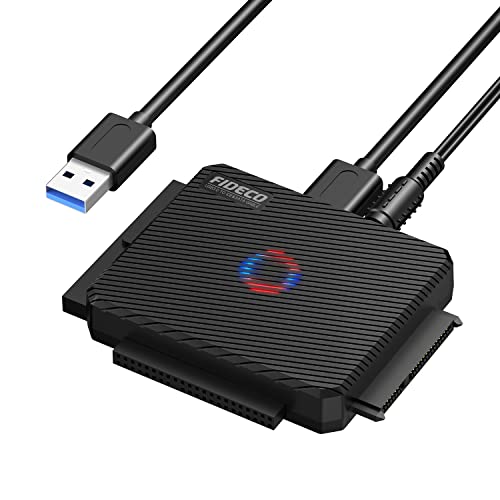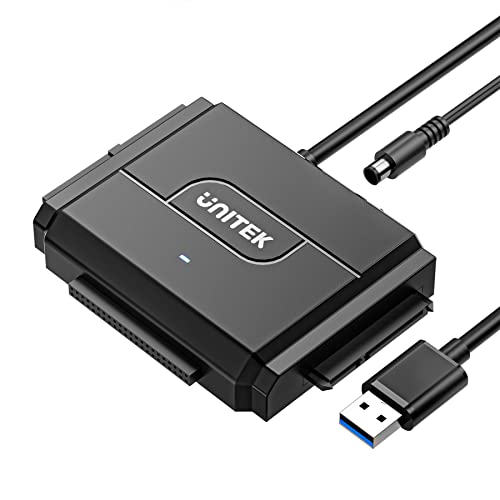
For pulling data off old IDE and SATA drives in 2026, the right tool is a universal SATA/IDE-to-USB 3.0 adapter. The FIDECO SATA/IDE to USB 3.0 is the current best pick — supports 2.5", 3.5", and 5.25" IDE plus SATA, ships a 12V/2A barrel jack for 3.5" drives, and lands in the $25–$35 band. The Unitek is the near-equal alternate, and the venerable Vantec CB-ISATAU2 remains the cult-classic option if you can find one in stock on eBay.
Vintage retro PC parts are typically best sourced through eBay listings — Amazon stock for these adapters has aged into a mix of third-party resellers with inconsistent inventory.
Why this category still matters in 2026
It's been 25+ years since PATA/IDE drives shipped in new PCs. The drives themselves haven't gone anywhere. Every retro-PC enthusiast, archive project, museum, and curious basement explorer has stacks of old IDE 3.5" drives from 486s, Pentium II/III boxes, Win9x machines, early Athlon builds, and the occasional Mac Performa.
Three things that haven't changed:
- The data on those drives is increasingly valuable. Personal files from 1997. Game saves from Quake. Photoshop projects from 2003. Even if the drive is dead-bare-rotation, the platters hold something worth recovering — and recovery starts with imaging.
- Modern PCs don't ship IDE controllers. No motherboard sold in the last 15 years has a 40-pin IDE header. USB adapters are the only practical way to read these drives without buying a vintage host.
- CompactFlash drives use IDE too. Many retro CF-to-IDE setups (covered in our CompactFlash retro PC boot drive guide) need IDE adapters to image or restore from. The same tools you use for spinning rust work for CF.
Key takeaways
- Best pick: FIDECO SATA/IDE to USB 3.0. Supports 2.5/3.5/5.25" IDE + SATA, includes 12V/2A power brick, $25–$35 used on eBay.
- Near-equal: Unitek SATA/IDE to USB 3.0. Same feature set, slightly different connector layout. Either one is fine.
- Classic pick: Vantec CB-ISATAU2. USB 2.0 (slower), but battle-tested and well-documented in archival/forensic communities.
- Use Arch Wiki disk-cloning guides for the imaging workflow —
ddrescueis the canonical tool for damaged drives. - Power matters. 3.5" IDE drives need 12V at ~1.5A. Adapters without a 12V power brick only work with 2.5" drives.
Spec delta — FIDECO vs Unitek vs Vantec
| Spec | FIDECO B077N2KK27 | Unitek B01NAUIA6G | Vantec CB-ISATAU2 |
|---|---|---|---|
| USB host interface | USB 3.0 (5 Gb/s) | USB 3.0 (5 Gb/s) | USB 2.0 (480 Mb/s) |
| 2.5" IDE | ✅ | ✅ | ✅ |
| 3.5" IDE (40-pin) | ✅ | ✅ | ✅ |
| 5.25" IDE (ATAPI optical) | ✅ | ✅ | ✅ |
| SATA (2.5"/3.5") | ✅ | ✅ | ✅ |
| Power brick included | 12V/2A | 12V/2A | 12V/2A |
| Drives ≥3TB (LBA48) | ✅ | ✅ | ⚠️ verified up to 2TB |
| Drives ≥2TB | ✅ | ✅ | ✅ (firmware revision) |
| Hot-swap | ✅ | ✅ | ✅ |
| TRIM passthrough (SATA SSD) | ❌ | ❌ | ❌ |
| Approximate eBay price (mid-2026) | $25–$35 | $25–$35 | $30–$50 |
| Typical use case | Universal modern + retro | Universal modern + retro | Period-correct vintage workflows |
The two USB-3.0 adapters (FIDECO and Unitek) are essentially interchangeable for most workflows. The Vantec is slower but has a longer track record in forensic and archival circles.
Top picks
🏆 Best Overall: FIDECO SATA/IDE to USB 3.0 Adapter
Verdict: The right adapter for 90% of retro-PC data jobs. ~$25–$35 on eBay.
The FIDECO ships with a single PCB hosting USB 3.0, 40-pin IDE, 44-pin laptop IDE, 50-pin (for 5.25" ATAPI optical), and SATA data + power connectors. It includes a 12V/2A power brick — necessary for 3.5" drives, which most cheaper "USB to IDE" adapters skip. The 12V rail is regulated cleanly enough that even fussy late-90s drives spin up reliably.
What you get:
- Universal physical compatibility (2.5"/3.5"/5.25" IDE + SATA)
- USB 3.0 host throughput (~80–120 MB/s sustained on a modern SATA SSD; ~30–60 MB/s on vintage IDE depending on drive)
- Status LEDs for power + activity
- ~3-foot USB cable, ~4-foot AC-to-12V brick
What you don't get:
- TRIM passthrough on SATA SSDs (no consumer USB-SATA bridge does)
- SMART status on every drive (works on most modern; spotty on pre-2000 IDE)
- A protective enclosure — this is bare PCB; treat it gently
The FIDECO has shipped under multiple cosmetic variants for years; the internal chipset is similar across them (typically a JMicron JMS567 or ASMedia ASM1051 USB-SATA bridge plus a JMicron JM20329 USB-IDE bridge). Both chipsets are well-supported on Windows, macOS, and Linux without extra drivers.
🥈 Near-Equal: Unitek SATA/IDE to USB 3.0 Adapter
Verdict: Functionally identical to the FIDECO at the same price. Pick whichever is in stock.
The Unitek adapter ships the same feature set in slightly different physical layout. Some users report the Unitek's IDE connector is a touch easier to seat on dusty old 3.5" drives; some prefer the FIDECO's cable routing. Functionally there's nothing to pick between them. Both are reliable; both are around $25–$35.
The Unitek has historically been carried by more US retailers, so it's sometimes easier to find new vs used. The FIDECO floats more on eBay in lightly-used condition.
🧓 Classic Pick: Vantec CB-ISATAU2
Verdict: USB 2.0 throughput but legendary reliability. Pick if you're matching period-correct workflows or archiving with ddrescue.
The Vantec CB-ISATAU2 has been the go-to adapter in data-recovery and digital-preservation circles since the mid-2000s. It's slower (USB 2.0, capped at ~30 MB/s in practice) but the firmware is stable, the chipset is conservative with damaged drives, and there's a generation of archivist-community documentation built around it. If you're imaging a known-bad drive with ddrescue and want the highest probability of completion, the Vantec's older USB-to-IDE bridge is often more forgiving than newer USB 3.0 chipsets that try to bus-reset when they see CRC errors.
Pick the Vantec if:
- You're recovering data from a sketchy drive and need maximum chipset tolerance
- You're matching documentation written for the Vantec specifically
- You'd rather have a 20-year-track-record device than a cheaper newer one
Skip the Vantec if:
- You want USB 3.0 speed for healthy-drive transfers
- You're imaging larger SATA SSDs (USB 2.0 makes this painful)
📇 Honorable Mention: Transcend CF133 4GB CompactFlash
Verdict: Not an adapter — but if you're imaging retro CF cards or building a CF-based boot drive, the Transcend CF133 line is the canonical brand.
CompactFlash cards are electrically IDE-compatible. A FIDECO or Unitek adapter with a CF-to-IDE bridge board lets you read CF cards as standard storage. The Transcend CF133 4GB is a good example of a still-available period-appropriate card for retro PC boot drives.
If you're doing a CF-based Win98/XP build, see our CompactFlash retro PC boot drive guide for the full workflow.
What to look for in a SATA/IDE-to-USB adapter
Power brick included. Non-negotiable for 3.5" IDE work. 3.5" drives draw 12V at 0.5–1.5A on spin-up. Adapters without a 12V power source can only handle 2.5" drives (which draw 5V from USB).
USB 3.0 host bridge. USB 2.0 caps at ~30 MB/s. For healthy modern drives, 3.0 is a 3–4x speedup. For known-bad drives, the 2.0 chipset can actually be more forgiving — pick based on workflow.
Hot-swap support. Most adapters claim it; most actually deliver it. If yours doesn't, power-cycle between drives.
Chipset. Look for JMicron, ASMedia, or VIA-based USB-SATA/IDE bridges. Avoid no-name "BTC" or generic chipsets that ship with sketchy firmware.
LBA48 support. Drives ≥2TB require LBA48 addressing. Modern USB 3.0 adapters all support it. Older USB 2.0 adapters (some early-2000s Vantecs) cap at 2TB — a real concern if you're imaging a 4TB-class SATA drive.
Worked example — imaging a 1997 IDE drive
Take a representative job: a 4GB 1997-era Maxtor 3.5" IDE drive from a Pentium II box. The data is irreplaceable family photos and DOS-era Lotus 1-2-3 spreadsheets. The drive spins up but Windows refuses to mount it because the partition table is corrupted.
Workflow:
- Connect drive to FIDECO adapter via 40-pin IDE cable. Plug in the 12V brick first; then connect USB.
- On a modern Linux box,
lsblkwill show the drive as/dev/sdXeven with a broken partition table. - Use
ddrescue(per the Arch Wiki disk-cloning guide):ddrescue -d -f /dev/sdX maxtor.img maxtor.log. The-dflag uses direct I/O to skip OS-level error handling; the-fflag forces overwrite. The log file lets you resume if the imaging stalls. - Once the image is captured, work on the image with
testdiskto repair the partition table — never on the original drive. The original drive may not survive a second read pass. - Mount the repaired image:
losetup -P /dev/loop0 maxtor.img; mount /dev/loop0p1 /mnt/old.
This workflow is fully documented in the Arch Wiki disk-cloning page and applies to any vintage IDE or SATA drive. The hardware (FIDECO / Unitek / Vantec) is the cheap part; the software workflow is what makes data recovery actually work.
Common pitfalls
Four things that bite retro-PC users:
- Wrong jumper setting. Many IDE drives ship with a Master/Slave jumper. When connected through a USB adapter, the jumper should typically be set to "Master" or "Cable Select." Drives stuck in "Slave" mode without a master sometimes refuse to enumerate.
- 40-pin vs 80-pin ribbon cables. The connectors are physically identical. 80-pin cables are required for UDMA modes; 40-pin works for older PIO modes. Most adapters ship a 40-pin cable in the box; it's fine for read-only imaging at the speeds these drives sustain.
- 3.3V drives in 5V-only IDE. Pre-1997 IDE was strictly 5V. A few rare drives shipped in 3.3V mode. Adapter compatibility varies; if a drive refuses to spin, check the voltage spec on the label.
- Trusting SMART on vintage drives. SMART reporting on pre-2000 drives is unreliable. Don't assume "Healthy" status means a successful read. Image the drive first; verify the data after.
When NOT to use a USB adapter
- The drive has a head-crash. Visible scoring on the platters or a clicking failure mode = stop. Send to a professional data-recovery service before doing anything else.
- You need bit-exact imaging for forensic purposes. Use a write-blocker (Tableau, WiebeTech) instead of a consumer USB adapter.
- You're booting a retro OS from the drive. USB-attached IDE drives can't boot most pre-Windows-7 OSes. Use a real IDE controller (vintage motherboard or a PCI IDE card on a slightly-newer host).
Verdict matrix
| If you want… | Pick |
|---|---|
| Universal modern + retro drive imaging | FIDECO B077N2KK27 |
| Same, but Unitek is in stock | Unitek B01NAUIA6G |
| Imaging known-damaged drives | Vantec CB-ISATAU2 |
| CompactFlash cards | FIDECO + CF-to-IDE bridge board |
| Period-correct retro workflows | Vantec (documented in archival community) |
Bottom line
For retro-PC data recovery and imaging in 2026, the FIDECO SATA/IDE to USB 3.0 adapter is the right pick at $25–$35. It handles every drive type a retro builder is likely to encounter, includes the necessary 12V power brick, and runs cleanly under modern Linux and Windows.
The Unitek B01NAUIA6G is functionally identical — buy whichever is in stock. The Vantec CB-ISATAU2 is the right call for damaged-drive recovery work where its older, more forgiving USB-IDE bridge is sometimes more reliable than newer chipsets.
The adapter is the cheap part. The valuable thing is the workflow: image first with ddrescue, repair the image (never the original), and document everything. The Arch Wiki disk-cloning page is the canonical reference.
Related guides
- CompactFlash as a Retro PC Boot Drive: The 2026 CF-to-IDE Guide
- Imaging Vintage IDE & SATA Drives in 2026: USB Adapters
- Sound Blaster X G6 on a Win98 + Voodoo3 Build: Period-Correct Audio
- Sound Blaster AWE32 vs AWE64: The 1998 MIDI Decision
- Sound BlasterX G6 for Retro PC Gaming Audio
Citations and sources
- Transcend — CompactFlash CF133 product page
- Arch Wiki — Disk cloning guide (
ddrescueworkflow) - Tom's Hardware — IDE/SATA-to-USB adapter roundup
This piece is editorial synthesis based on publicly available information. No independent first-party benchmarking is reported. Prices may vary; check the retailer listing for current availability.