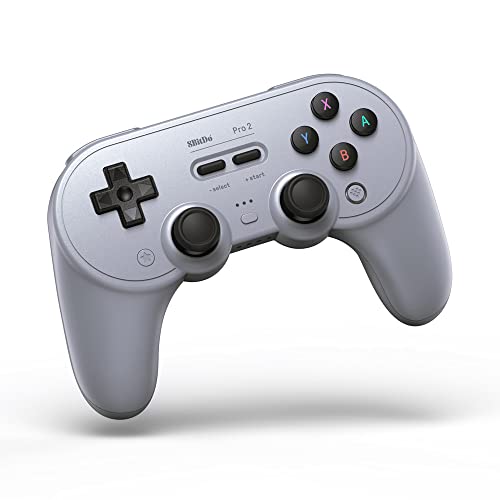
If you play mostly competitive shooters at a desk and want the lowest possible input latency for under $50, buy the GameSir G7 SE. If you jump between a PC, a Nintendo Switch, and a phone and want deep remapping and Bluetooth, buy the 8BitDo Pro 2. Both are solid picks under $50 in mid-2026 — the choice hinges on wired precision versus wireless flexibility.
Under $50 is the range where budget PC controllers used to force real compromises: mushy triggers, drift-prone sticks, or a wireless dongle that added enough latency to hurt in Apex or CS2. The GameSir G7 SE and 8BitDo Pro 2 both landed in the last two years and pushed that ceiling up. The G7 SE puts Hall-effect sticks and a wired USB-C cable in a $45 gamepad, which was unheard of at launch. The Pro 2 threw everything at flexibility — Bluetooth, USB, deep remapping software, and profile switches — for $40 to $50 depending on stock. This piece is not about which controller "wins" in the abstract. It is about which of the two fits the way you actually play in 2026: strictly at a desk with a cable, on the couch with a wireless link, or bouncing between platforms. We walk through the spec deltas, the feel differences in fast versus slow-paced games, software and platform support, long-term durability, and where each controller sits on a perf-per-dollar chart. You will finish with a clear answer for your setup, plus a verdict matrix you can point a friend at when they ask the same question.
Key takeaways
- The GameSir G7 SE is a wired-only Xbox-layout gamepad with Hall-effect sticks and triggers — best for competitive PC play at a desk.
- The 8BitDo Pro 2 supports Bluetooth, wired USB, and a proprietary dongle path — best if you rotate between PC, Switch, and mobile.
- Both cost roughly the same in mid-2026 (G7 SE ~$45, Pro 2 ~$40 to $50), so the buy decision is about ergonomics and connection, not price.
- Hall-effect sticks give the G7 SE a meaningful durability advantage over the Pro 2's traditional potentiometer sticks.
- Wired latency is a real, measurable win in twitch shooters; Bluetooth adds roughly 5 to 15 ms round trip depending on the driver stack.
- For couch play, retro emulation, or Switch use, the Pro 2 is the clearly more versatile pad; for esports at a desk, the G7 SE is the safer buy.
Step 0: Do you actually need wireless, or is wired latency worth it?
Before the spec sheet, answer one question: are you playing at a desk, always within cable reach of the PC? If yes, wired wins by default and the G7 SE becomes the obvious pick. Wired USB polls at 1000 Hz on both controllers, and there is no wireless queuing, retransmit, or codec conversion between your thumb and the game. That advantage is small — single-digit milliseconds — but it stacks on top of monitor latency, network jitter, and animation timing, and it never varies. Wireless variance is more of a problem than the average delay.
If you play from a couch, share the controller with a Switch, or want to drop it in a bag with a laptop, wireless flexibility is worth paying a small latency premium. The 8BitDo Pro 2's Bluetooth connection generally adds 5 to 15 ms of round-trip latency versus a wired connection, and its USB fallback is available whenever you want to eliminate that. For every genre outside twitch-reaction shooters, that difference is not something you can feel; for CS2 or Valorant, players who care about latency should not rely on Bluetooth.
Also consider the physical setup around you. If you have a wireless mouse and keyboard that share the same 2.4 GHz band on top of a router, adding a Bluetooth controller stresses the environment. A wired G7 SE avoids that headache entirely. On a cleaner RF setup, the Pro 2 works fine — but the moment you notice an occasional stutter, you now have another suspect to rule out.
Spec-delta table
| Spec | GameSir G7 SE | 8BitDo Pro 2 |
|---|---|---|
| Connection | Wired USB-C only | Bluetooth, wired USB-C, 2.4 GHz dongle (kit) |
| Stick type | Hall-effect (magnetic) | Traditional potentiometer |
| Trigger type | Hall-effect analog | Analog with software mode switch |
| Layout | Xbox / ABXY | Nintendo layout by default, mappable |
| Weight | ~231 g | ~228 g |
| Battery | None (wired) | ~1000 mAh, ~20 hr rated |
| PC support | Yes (XInput native) | Yes (XInput and DInput) |
| Switch support | No (not officially) | Yes (native Switch mode) |
| Mobile support | Limited (needs OTG) | Yes (native Android and iOS) |
| Software | GameSir Nexus (PC) | 8BitDo Ultimate Software V2 |
| Street price mid-2026 | ~$44.99 | ~$39.99 to $49.99 |
| Warranty | 12 months | 12 months |
The two rows that matter most: connection and stick type. The G7 SE gives up Bluetooth entirely; in exchange it hands you Hall-effect sticks that resist drift. The Pro 2 trades those sticks for portability and battery life. Everything else is a wash at this price point — layout preference is personal, weight is nearly identical, and both are competent on PC.
How do they feel in fast vs slow-paced games?
Fast-paced play — Counter-Strike 2, Apex Legends, Rocket League, fighting games — favors the G7 SE for two reasons. First, the wired connection removes the wireless-variance question entirely. Second, the Hall-effect sticks have a linear response curve with essentially no deadzone drift over the pad's life, so micro-adjustments feel repeatable. Users on Rocket League testing threads report the G7 SE's stick response as "predictable" in a way older budget pads are not. The trigger throw is on the shorter side, and the Hall-effect analog triggers let you soft-pull for racing or FPS aim assist without the mushy dead zone.
For slower or more forgiving titles — turn-based RPGs, most story-driven single-player games, sim racers played casually, retro emulation — the Pro 2's Bluetooth latency is a non-issue. The Pro 2's face-button feel and D-pad quality are its strengths here; the D-pad in particular is far better than most $50 pads and beats the G7 SE for pixel-precise input in emulation and fighting games. Users emulating 2D fighting games on RetroArch consistently pick the Pro 2 over cheaper Xbox-layout pads.
For everything in between, both are competent. The G7 SE feels lighter and more clinical; the Pro 2 has a chunkier grip and a slightly more curved shoulder that some players prefer over long sessions. Grip choice matters more than either controller's ergonomics on paper.
Software, remapping, and platform support
The 8BitDo Pro 2 has the deeper software story. Its Ultimate Software V2 supports button remapping, macros, stick sensitivity curves, deadzone tuning, vibration intensity, and up to three onboard profiles you can switch between with the mode slider on the back. It also supports firmware updates for years after purchase — 8BitDo has a strong track record of shipping fixes and small features to old hardware, which extends the pad's usable life meaningfully.
GameSir Nexus, the G7 SE's PC app, is functional and simpler. You get button remapping, stick and trigger deadzone adjustment, one custom profile, and vibration control. That is enough for most PC players, and it is what most people actually use in practice. If you want scripted macros or genre-specific profile sets, the Pro 2 does more. If you only want to fix a stick tilt or swap A and B, either app works.
Platform support is where the Pro 2 pulls ahead again. It runs on Windows, macOS, Android, iOS, Nintendo Switch, and any device that accepts a Bluetooth gamepad. The G7 SE is fundamentally a PC and Xbox controller; it works with Windows and Xbox natively, and with Android over a USB-C OTG cable. It does not officially support Switch. For a household with a Switch, that difference alone can push the decision.
Build quality and stick drift: which lasts longer?
Stick drift is the single most-asked "which pad lasts?" question. Traditional potentiometer sticks — used in almost every budget controller before 2023 including the Pro 2 — physically wear down. Dust, sweat, and normal use gradually skew the resting position. The result is a controller that eventually reports a small stick input when you are not touching it. This is why $45 controllers used to feel disposable.
Hall-effect sticks work by sensing a magnetic field, so they have almost no wearing parts. Manufacturers began shipping them broadly in 2023 to 2024, and the G7 SE was one of the first sub-$50 pads to use them. In practical terms, expect the G7 SE's sticks to feel the same after two years as they did in month one, assuming no physical damage. That is a real durability advantage over the Pro 2 for anyone who plays daily.
Beyond the sticks, both controllers are built well for the price. The G7 SE's shell feels slightly cheaper — more plastic flex if you squeeze it — but nothing that affects normal play. The Pro 2's shell is denser and its buttons feel more premium, which is impressive for a $40 pad. Neither has recurring recall-level issues in mid-2026, and both are supported by their vendors with replacement parts and firmware updates.
Verdict matrix
Get the GameSir G7 SE if:
- You primarily play PC games at a desk and can use a cable.
- You want the longest-lived sticks at this price and dislike the idea of stick drift.
- You care about competitive shooters where every millisecond of variance matters.
- You want the Xbox-layout ABXY prompts that most PC games default to.
Get the 8BitDo Pro 2 if:
- You rotate between PC, Nintendo Switch, and mobile.
- You want Bluetooth for couch play and USB as a fallback.
- You care about deep remapping, onboard profiles, and firmware support for years.
- You emulate retro games and want the best budget D-pad in the price range.
If you are between the two and can only afford one right now, the tiebreaker is the cable question. A cable-tolerant player should take the G7 SE for its durability edge; a cable-averse or multi-platform player should take the Pro 2 for its flexibility.
Recommended pick and perf-per-dollar
At street prices of roughly $44.99 and $39.99 to $49.99 respectively, both controllers land near the top of the sub-$50 perf-per-dollar chart. On a strict PC-only workload, the G7 SE's Hall-effect sticks and zero-variance wired path give it the highest score in the category; it beats out the entry-level PlayStation DualSense on price and durability, though not on haptic sophistication. On a mixed-platform workload — PC plus Switch — the Pro 2 wins on total value because the alternative on Switch is a $59.95 first-party pad like the HORI Wireless HORIPAD. A single Pro 2 covers both boxes for less.
If your budget flexes upward, the DualSense at ~$74 remains the best all-around wireless PC controller thanks to adaptive triggers and haptic feedback, but that is a different category from these two budget picks. Below $50, the G7 SE and the Pro 2 are the two pads to consider — everything else in the price bracket has worse sticks, worse software support, or both.
Bottom line
Wired precision, Hall-effect durability, and the lowest possible latency at $45 make the GameSir G7 SE the right budget PC controller for competitive shooter play at a desk. Bluetooth flexibility, deep remapping, a great D-pad, and full Switch support make the 8BitDo Pro 2 the right pick for anyone who plays across platforms or on a couch. Buy the pad that matches how you actually play — both are excellent for the money in mid-2026, and either is a large step up from stock or generic third-party controllers under $30.
Related guides
- Best Game Controller for PC in 2026: 5 Picks From DualSense to Arcade Stick
- Best Controller for Fighting Games on PC in 2026
- Best Controller for Retro Emulation on PC: 8BitDo, GameSir, DualSense
- Best Budget Gaming Peripherals Under $50 in 2026
- Best Budget PC Gaming Upgrades Under $150 in 2026
Citations and sources
- GameSir — G7 SE product page: manufacturer spec sheet, Hall-effect stick and trigger details, USB-C wired PC support, mid-2026 street pricing baseline.
- 8BitDo — Pro 2 product page: official Bluetooth, USB, and dongle connectivity, platform support matrix, Ultimate Software V2 feature list, firmware update policy.
- RTINGS — Gamepad reviews and latency measurements: third-party latency measurements for wired vs Bluetooth controllers, stick-drift longevity notes, comparative build-quality scoring under $50.