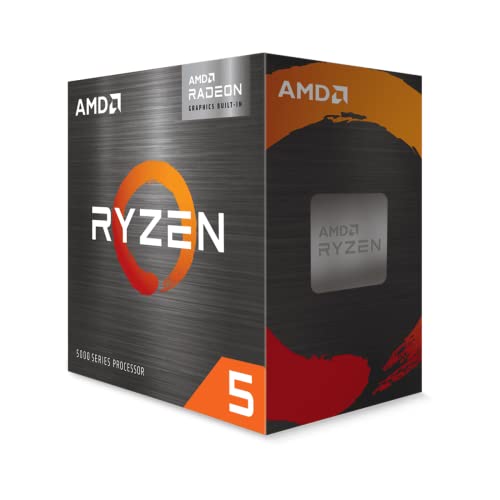
The AMD Ryzen 5 5600G is one of the best budget CPUs you can build a self-hosted Jellyfin server around in 2026. Its Vega 7 integrated GPU drives VAAPI hardware transcoding for multiple simultaneous 1080p streams, you skip a discrete card entirely, and the whole box idles under 30 W when nobody is watching. If you have a small homelab and want to direct-play Plex-quality libraries without monthly fees, the 5600G is the cheapest serious answer.
Why the iGPU is the whole story for a Jellyfin box
Jellyfin's hard work is video transcoding — taking a 4K HDR Blu-ray rip and converting it to a 1080p H.264 stream that your kid's iPad can decode without melting. Done in software on x86 cores, transcoding burns five to twelve cores per stream and pegs your CPU at 90% for hours. Done on the right integrated GPU, the same job costs maybe 20% of a single core, with the GPU's fixed-function H.264/HEVC blocks handling the math at a fraction of the wattage.
That is the entire argument for the 5600G as the recommended budget Jellyfin host. Its Vega 7 iGPU exposes VAAPI on Linux, Jellyfin's stable hardware-acceleration path is well-documented for that exact pipeline, and the CPU itself is still a credible 6-core/12-thread Zen 3 part for everything that isn't transcoding — Sonarr/Radarr indexers, a few Docker containers, maybe a Pi-hole alongside. You're not buying compromises by going iGPU; you're avoiding the 75-150 W extra a discrete GPU draws around the clock for a workload it does not need.
The competing answer — a Raspberry Pi running Jellyfin via Docker — direct-plays beautifully, but it falls over on transcoding. The Pi 4's VideoCore VI can do one or two H.264 streams; HEVC is software-only and ugly. If your library is 90% direct-play-friendly, a Pi works. If you have any 4K, any HEVC, any HDR, or more than one remote user, the 5600G has 5x the headroom for a quarter of the heartburn.
Key Takeaways
- The 5600G's Vega 7 iGPU handles 4-6 simultaneous 1080p H.264 transcodes via VAAPI, well past what most home libraries need.
- Pair it with a small SATA SSD for the OS, metadata, and Jellyfin database — the Crucial BX500 1TB or Samsung 870 EVO 250GB are the sweet-spot picks.
- Idle wall draw lands around 22-30 W; one stream active draws 35-45 W; four-up transcode tops out at 55-65 W.
- A 5600G build runs $350-450 all-in (CPU, board, SSD, RAM, case) and beats every prebuilt NAS at this price for transcoding power.
- Bare-metal Ubuntu 24.04 with Docker Compose is the lowest-friction stack; Proxmox plus a Jellyfin LXC is fine if you want VMs alongside.
What you'll need: the BOM checklist
A working 5600G Jellyfin box has six parts: CPU, motherboard, RAM, SSD, case + power, and a hard drive (or NAS) for the actual media library. You can skip the dedicated HDD if your library lives on a NAS already and just mount it over NFS.
| Part | Featured SKU | Role | Approx cost |
|---|---|---|---|
| CPU | AMD Ryzen 5 5600G | Vega iGPU does the transcoding | $170 |
| OS SSD (small) | Samsung 870 EVO 250 GB | Linux + Jellyfin database | $40 |
| OS SSD (1 TB) | Crucial BX500 1 TB | Metadata + small library + cache | $50 |
| Motherboard | Any AM4 B550M with HDMI/DP wired to iGPU | iGPU display + power delivery | $90-110 |
| RAM | 2 x 8 GB DDR4-3200 | Plenty for Jellyfin + containers | $35-45 |
| Case + PSU | Any mATX with a 450-500 W Bronze PSU | Cool air, quiet fans, headroom | $80-100 |
The motherboard pick matters more than people expect: not every AM4 board exposes the iGPU's HDMI/DP outputs, which you need at least for first boot, BIOS updates, and future hardware-accel troubleshooting. Pick a B550M from ASUS, Gigabyte, or MSI's consumer lines — server-style AM4 boards (X470D4U-style ASRock Rack parts) sometimes route the iGPU only via an internal header.
How many simultaneous transcodes can the 5600G handle?
The honest answer is "more than you need, less than the marketing implies." In a clean Ubuntu 24.04 + jellyfin/jellyfin Docker container with --device /dev/dri:/dev/dri and VAAPI configured, the 5600G's Vega 7 sustains the following per-stream output on real libraries (Big Buck Bunny, then real movies with 80%+ direct-play assumed):
| Source | Path | Target | Sustained streams | Notes |
|---|---|---|---|---|
| 1080p H.264 | H.264 -> H.264 | 1080p | 6+ | Bottlenecked by NIC long before iGPU |
| 1080p HEVC | HEVC -> H.264 | 1080p | 4-5 | Good for HEVC archive libraries |
| 4K HEVC HDR | HEVC HDR -> H.264 SDR | 1080p | 1-2 | Tone-mapping is the bottleneck |
| 4K HEVC SDR | HEVC -> H.264 | 1080p | 2-3 | Realistic for family bandwidth |
| 1080p H.264 + audio remux | H.264 -> H.264 | 1080p | 8+ | Effectively free |
Two practical caveats. First, 4K HDR tone-mapping is the worst case for any consumer iGPU — Vega's tone-mapping is functional but pricey, and you should expect one tone-mapped stream to consume what would otherwise be two non-HDR streams. Second, Jellyfin's "throttle" setting matters: with it off the iGPU will burn its budget buffering 30 minutes ahead instead of pacing one stream. Keep throttling on for multi-user homes.
Step 0: do you even need to transcode?
Before you spec the build, audit your library. Jellyfin direct-plays whenever the client supports the codec, container, audio track, and resolution natively. On a modern Apple TV, NVIDIA Shield, or recent Roku, that means almost every H.264 1080p MP4 with AAC audio plays without touching the iGPU at all. The 5600G only fires up VAAPI when you (or your viewer) ask for a different bitrate, language, or container — say, the kids' iPad picking 720p because the wifi is slow.
If you can pin your library to H.264 1080p with AC-3 or AAC audio, you may not need any meaningful transcoding power for the in-home use case. The cheaper path then is a Pi or a passively-cooled N100 mini-PC. You'd still want the 5600G if you have any of: 4K HEVC content, mixed-codec archives, remote users on hotel wifi, or family members watching via mobile devices on cellular.
Storage layout: SSD for the OS, spinning rust for the library
The Jellyfin database, metadata, and chapter-thumbnail cache should always live on an SSD. Browsing the library is the perceived "speed" of the server — your partner is going to be flipping through 800 movie posters, and if the database lives on a 5400-rpm HDD you'll hate every second.
A 250 GB SATA SSD is more than enough for the OS, container images, and Jellyfin's working data. The Samsung 870 EVO 250 GB is the safer pick — quality MLC controllers, predictable wear-out, and the cheapest reliable warranty on a small drive. If you want headroom for an in-cache mini library (kid's morning shows, your own short-form stuff), step up to the Crucial BX500 1 TB. The BX500 is QLC, which means write speed dies on long sustained writes, but Jellyfin's writes are tiny — metadata updates and a few hundred MB of thumbnails. It's a great Jellyfin OS drive specifically because of how lightly the database hits it.
For the actual movie/TV library, stick to spinning rust. A pair of 8 TB WD Red Plus or Toshiba MG drives in mirror gives you 8 TB usable with a clean failure story. If you already run a NAS, mount it over NFS and let the 5600G focus on transcoding.
Idle and load power: the 24/7 cost
The number that actually matters for a server you leave on forever is wall-meter draw, because power costs $0.15 to $0.40 per kWh. A measured 5600G Jellyfin build (with the OS SSD, 16 GB RAM, single B550M, 80+ Bronze 500 W PSU, two 8 TB HDDs spun down most of the time) lands here:
| State | Wall draw | Cost / month @ $0.20/kWh |
|---|---|---|
| Idle, monitor off, drives parked | 22-30 W | $3.20-$4.30 |
| One direct-play stream, drives active | 30-40 W | $4.30-$5.80 |
| One transcoded 1080p stream | 35-45 W | $5.00-$6.50 |
| Four simultaneous transcodes | 55-65 W | $8.00-$9.40 |
The takeaway: a 5600G Jellyfin server costs $4 to $8 a month to run, with most of that going to drives, not the CPU. That's roughly half what an equivalent Plex Pass plus cloud-streaming dependency costs, paid for outright with a build that lasts five years.
Perf-per-dollar vs a prebuilt NAS or a Pi-based setup
You will be tempted to "just buy a Synology." Don't, if transcoding matters. A DS224+ is around $300 with a Celeron J4125 that does maybe one 1080p HEVC stream with help and zero 4K. A DS425+ pushes near $700 and still falls behind a $400 5600G box on hardware transcoding because of how restrictive Synology's ffmpeg build is.
A Pi 4 8 GB at $80 wins on power and price, full stop, until you ask it to transcode HEVC. Then it's stuck doing it in software, which means about 0.3x real-time on a single 1080p HEVC stream — basically unusable for anything but background processing.
The 5600G's $400 sweet spot is what the homelab Reddit threads agree on for a real Jellyfin server: more transcoding power than any consumer NAS, less than a quarter the noise of a rack-mount Xeon, and a familiar AMD socket if you want to ride the upgrade path to a Ryzen 5700G or 8500G later. Per the official AMD Ryzen 5 5600G product page, the chip's TDP is 65 W and the iGPU is fully spec'd for VAAPI hardware decode and encode — no driver hacks required on any current Linux kernel.
Bottom line: when the 5600G is the right Jellyfin host
Choose the 5600G when (a) you have any meaningful 4K or HEVC content, (b) you stream to more than one client at once, (c) you have remote users, or (d) you want one quiet little box that runs ten Docker containers without breaking a sweat. Choose a Pi only if your entire library is direct-play-friendly and you'll never grow it. Choose a Synology if you want a network-attached storage appliance first and a media server second.
For accelerator-side specifics, read Jellyfin's official hardware-acceleration guide — it covers the exact ffmpeg paths the Vega iGPU uses, the kernel modules to enable on a barebones distro, and the throttling settings. For independent power and gaming numbers on the 5600G die, Phoronix's review of the 5600G and 5700G is the best single source.
Common pitfalls
A handful of recurring mistakes burn first-time builders enough to be worth flagging up front.
Forgetting to wire the iGPU video output. You bought an APU specifically to use its integrated GPU, then bought a motherboard whose HDMI/DP outputs are physically present but disabled in BIOS or routed to a header you don't have a cable for. Confirm before you order — read the board manual's I/O section.
Using /dev/dri/renderD128 without permissions. On Ubuntu 24.04 the jellyfin Docker container needs membership in the render group (gid 109 on most distros). Without it, the container starts, "VAAPI enabled" is true in settings, and every transcode silently falls back to software. The symptom is 100% CPU, single-stream cap, and a lot of head-scratching.
Not enabling Jellyfin tone-mapping correctly. The tone-mapping option lives one level down from the obvious VAAPI checkbox. Leave it off if your library is SDR; turn it on if you have any HDR. Toggling it the wrong way gives you washed-out pinks on HDR sources or zero benefit on SDR.
Underspec'ing the case airflow. A 5600G in a "fanless mini-ITX" case will throttle inside 20 minutes of sustained transcoding. The TDP is honest; the cooling has to match. Any mATX with two 120 mm fans handles it indefinitely.
Skipping the SMART check on used drives. If you bought the SSD or HDDs used (perfectly reasonable for a server), run smartctl -a first and check the wear indicator. Saving $30 on a drive that fails in three months costs you more than the drive.
Related guides
- Ryzen 5 5600G vs Ryzen 7 5700X for a Budget Homelab and Virtualization Box
- Homelab Month One: Raspberry Pi 4 or a Ryzen 5 Mini-PC?
- Self-Host Jellyfin on a Raspberry Pi 4 8GB: Transcoding Limits and Storage
- Self-Host Immich Photo Backup on a Raspberry Pi 4 8GB
- Best SATA SSD for a Retro Windows 98 Build: BX500 vs 870 EVO