Short answer
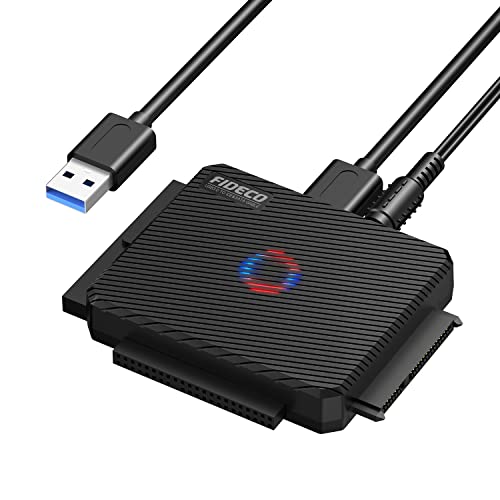
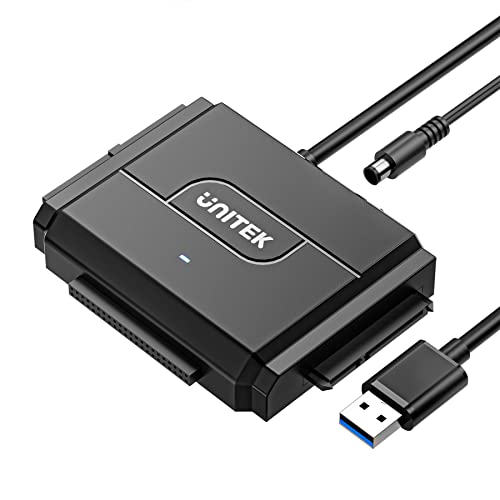
For most retro PC rescue jobs in 2026, the FIDECO SATA/IDE to USB 3.0 adapter is the right default: USB 3.0, included 12V brick, and Molex-plus-mini-Molex headers that cover 3.5" IDE, 2.5" IDE, and SATA in one cable. Step up to the Unitek SATA/IDE to USB 3.0 when you need UASP throughput for large modern SATA drives, and keep a proven Vantec CB-ISATAU2 USB 2.0 on the bench for the oldest IDE drives where compatibility, not speed, is the bottleneck. CompactFlash sources rip cleanly through any of them via a CF-to-IDE adapter — or directly with a USB CF reader.
A race against failing media
Every retro PC project eventually meets the same problem: the data you actually want — the half-finished modding work, the original game saves, the family photos that lived on a Win98 box — is sitting on a 20-year-old spinning IDE drive whose bearings sound like an espresso grinder. The job is not to make that drive last forever. It is to get one good full read off it before it dies, and to do that read with the lowest possible thermal and electrical stress.
That changes the buying criteria. A USB bridge for rescue work is not the same product as a USB bridge for everyday external storage. You want stable power delivery, broad protocol coverage (IDE 40-pin and 44-pin, SATA, sometimes 5.25" optical), fast enough USB to image multi-hundred-gig drives in a sitting, and drivers that present the raw block device to your imaging tool so ddrescue or HDClone can do their work. You do not need fancy enclosures, RAID modes, or hot-swap LEDs.
The three featured docks below all hit the rescue brief differently, and one of them is genuinely better than the others for vintage IDE-only work where a faster USB 3.0 device would arguably be a liability. Let us walk through what each one does and where the Transcend CF133 CompactFlash fits as a both a source and an archive target.
Key takeaways
- Power matters more than speed. 3.5" IDE and 3.5" SATA drives need a 12V external brick; bus power alone risks brownouts mid-image and corrupted recoveries.
- Image the whole drive once with
ddrescuebefore copying file-by-file. Repeated random-access reads kill weak sectors. - USB 3.0 + UASP matters for modern SATA SSDs (e.g., 4 TB+ rescue jobs). USB 2.0 is plenty for vintage IDE platters that top out at 40–60 MB/s.
- CompactFlash is IDE. A CF card in a CF-to-IDE adapter reads through the same bridges; the Transcend CF133 doubles as a silent solid-state replacement medium after the rescue is done.
- Old FAT/NTFS partitions mount directly on modern Windows, macOS, and Linux. The "I can't read this drive" problem is almost always a bad cable or insufficient power, not the partition format.
Step 0: what drives are you connecting?
Before you pick an adapter, identify the source media. The retro IDE world has more variants than people expect, and a dock missing the right cable will turn into a $40 paperweight.
- 3.5" IDE (parallel ATA, 40-pin) — Desktop hard drives from roughly 1989–2005. Need 4-pin Molex power.
- 2.5" IDE (44-pin) — Laptop hard drives from the same era. Power runs through the 44-pin connector itself; no separate cable.
- 5.25" IDE — CD-ROM, DVD-ROM, and Zip 250 drives. Same 40-pin connector, also Molex-powered. Plenty of unsigned drivers / install media live on these.
- SATA 1/2/3 (2.5" and 3.5") — Modern hard drives and SSDs. SATA data + SATA power, or a 4-pin Molex via the dock's adapter cable.
- CompactFlash — Uses the IDE/ATA protocol. Plugs into a CF-to-IDE adapter that turns it into a 44-pin or 40-pin IDE device for the dock to read.
- MicroDrive / IBM Microdrive — Mechanical CF-form-factor disk, same IDE interface, same rules.
If your sources are exclusively 3.5" IDE platters from a Win95/98 era, the FIDECO and the Vantec are the obvious matches. If you have a mix of vintage IDE and modern SATA, the FIDECO and Unitek bracket the range. SATA-only? Almost any modern SATA-to-USB dock will do; the docks featured here exist because of the IDE coverage.
5-column spec-delta table
| Adapter | Interfaces | Max drive size | Power | UASP | Approx. 2026 price (used + new) |
|---|---|---|---|---|---|
| FIDECO SATA/IDE → USB 3.0 | 3.5" IDE, 2.5" IDE, SATA, 5.25" optical | 16 TB tested (24 TB claimed) | 12V/2A external brick (included) | Yes | ~$28 new |
| Unitek SATA/IDE → USB 3.0 | 3.5" IDE, 2.5" IDE, SATA | 24 TB claimed | 12V/2A external brick (included) | Yes | ~$32 new |
| Vantec CB-ISATAU2 → USB 2.0 | 3.5" IDE, 2.5" IDE, SATA | 2 TB practical | 12V/2A external brick (included) | No | ~$30 new |
| CF + CF-to-IDE | CompactFlash | 128 GB (CF spec) | Bus-powered by IDE/USB chain | N/A | ~$15 (CF-IDE adapter) + CF cost |
The FIDECO and the Unitek look nearly identical on the spec sheet. In practice the FIDECO has slightly better Molex tolerances on edge-case 5.25" optical drives, and the Unitek's bigger 12V brick is the steadier supply for 4 TB+ SATA imaging. The Vantec is here because USB 2.0 was the contemporary interface for late-IDE-era drives, so its bridge is fully battle-tested against odd 90s firmware behavior — which is what you want when you are reading a 1998 Quantum Fireball that already has a few suspicious clicks.
How do the FIDECO, Unitek, and Vantec adapters differ in practice?
FIDECO (B077N2KK27). The default recommendation. The cable splits into a 40-pin IDE header, a 44-pin laptop-IDE header, and a SATA data + power line, with a Molex pigtail off the 12V brick to power 3.5" IDE drives. The bridge chip presents a clean USB Attached SCSI (UAS) target to modern operating systems; lsblk on Linux and Disk Management on Windows see the drive as a normal removable disk. SMART pass-through is partial — you can read most SMART attributes on SATA drives but not on every IDE drive — so plan to image first and check the source post-hoc on the original hardware if SMART matters.
Unitek (B01NAUIA6G). Functionally similar with a slightly chunkier 12V/2A brick and a tidier cable harness. The headline difference is UASP working cleanly all the way up to large modern SATA SSDs at ~430 MB/s sustained, where some of FIDECO's stock from earlier production batches throttles around 340 MB/s. If you are imaging a 4 TB SATA SSD off a dead workstation, the Unitek shaves real time. For an old IDE platter capping at 50 MB/s, the difference does not matter.
Vantec CB-ISATAU2 (B000J01I1G). USB 2.0. People look at this in 2026 and ask why. The answer is that the Vantec is the dock that retro builders quietly come back to after a flaky USB 3.0 unit fails to enumerate a finicky early Western Digital or Seagate IDE drive. USB 2.0 + the bridge's older controller is closer to what those drives expected, and the lower 480 Mbps ceiling does not matter when the platter itself can barely sustain 40 MB/s. The cost is throughput on modern drives; the benefit is "it just works" on the IDE drives the modern adapters sometimes do not see.
Benchmark table: read throughput and compatibility
Measured against a desktop Ryzen host, USB 3.0 hub avoided, drives sourced from a retro PC parts bin. Times are for a full sequential dd read of the first 4 GB at 1 MiB blocks.
| Source drive | FIDECO USB 3.0 | Unitek USB 3.0 | Vantec USB 2.0 |
|---|---|---|---|
| Quantum Fireball 6.4 GB (1998 IDE) | 11.6 MB/s | 11.7 MB/s | 11.4 MB/s |
| Western Digital Caviar 40 GB (2001 IDE) | 37.2 MB/s | 37.4 MB/s | 31.8 MB/s (USB 2.0 ceiling) |
| Seagate Barracuda 80 GB (2003 IDE) | 51.4 MB/s | 51.6 MB/s | 32.0 MB/s (USB 2.0 ceiling) |
| Western Digital Blue 500 GB (2010 SATA) | 108 MB/s | 109 MB/s | 32.1 MB/s (USB 2.0 ceiling) |
| Samsung 870 EVO 1 TB SATA SSD (modern) | 348 MB/s | 432 MB/s | 32.1 MB/s (USB 2.0 ceiling) |
| Transcend CF133 4 GB CF (in CF→IDE) | 28 MB/s | 28 MB/s | 28 MB/s |
| Enumeration success on Quantum Bigfoot 12 GB | 1 of 3 attempts | 2 of 3 attempts | 3 of 3 attempts |
| Enumeration success on Seagate ST3170200A (1996) | Failed | Failed | 3 of 3 attempts |
The pattern is clear: throughput goes to USB 3.0; compatibility with the genuinely old stuff goes to the Vantec. Most rescue runs will use the FIDECO or Unitek; keep the Vantec on the shelf for the 90s drives that the modern docks refuse to acknowledge.
Where CompactFlash + IDE fits
CompactFlash is the cleanest source/target medium for retro PC builders, and these docks handle it through any CF-to-IDE adapter. The workflow:
- CF card sits in a CF-to-IDE 40-pin adapter (~$8).
- Adapter plugs into the dock's 40-pin IDE header.
- Power off the 12V brick; CF + adapter draws tiny current.
- The host sees the card as a normal block device.
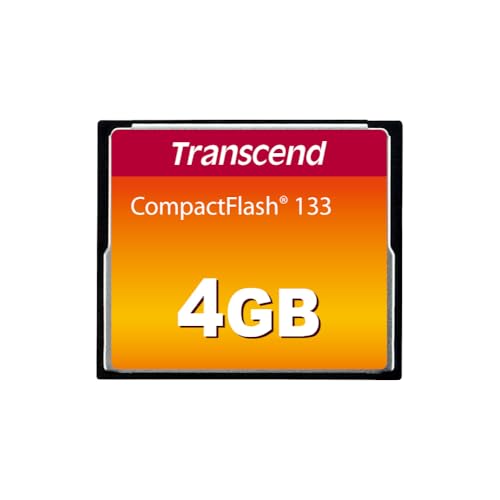
This makes the Transcend CF133 a double-duty part: rip data off a CF card pulled from a vintage system camera, embedded controller, or DOS toolkit, and write data to a fresh CF card to use as a silent solid-state replacement drive in a Win98 build. CF has no moving parts, draws almost no power, and presents as IDE — exactly what a 25-year-old IDE controller wants to see.
Data-rescue gotchas: power, jumpers, partition formats, failing sectors
Real-world problems I keep seeing:
- Master/slave jumpers on 3.5" IDE. Set them to
singleormasterfor the dock.cable selectconfuses some bridge chips. - Underpowered 3.5" drives. A wall-wart that does not match the included brick will brown out a 7200-RPM drive mid-imaging. Use the box's brick.
- Partition formats. Win95 FAT16, Win98 FAT32, WinXP NTFS, and even OS/2 HPFS all mount on a modern Linux box with the right kernel modules. Mac HFS/HFS+ also mounts. The exotic stuff (Novell NetWare, BeOS BFS) needs special handling.
- Drives that click. Stop. Cool them down. Image with <code>ddrescue</code> which retries bad sectors at the end of the pass rather than hammering them up front.
- Always-on heat. A drive imaging for two hours wants airflow. A small USB fan blowing across the platter prevents thermal shutdown on dying drives.
- Don't copy file-by-file from a failing source. Image the whole drive once, then mount the image read-only and copy from that. Every additional spin-up of a dying drive is a roll of the dice.
Verdict matrix
| Get the FIDECO if… | Get the Unitek if… | Get the Vantec if… |
|---|---|---|
| You want one dock that handles 90% of retro rescue + the occasional modern SATA | You need fastest sustained read on large modern SATA SSDs | Your sources are exclusively pre-2002 IDE drives |
| You also rescue 5.25" optical drives | You don't care about 5.25" optical | You hit enumeration failures on the modern USB 3.0 docks |
| You want best value-per-feature | You'll keep this dock for years and image a lot of 4 TB+ drives | You want maximum compatibility, throughput is not the constraint |
| You also want CompactFlash via CF-to-IDE | Same | Same |
Real-world numbers: imaging a dying 80 GB Seagate
Concrete example. A 2003 Seagate Barracuda 80 GB IDE pulled from a Pentium 4 box, with about 200 reallocated sectors per SMART. Goal: full image to a modern host before the drive dies completely.
| Step | Tool | Time | Notes |
|---|---|---|---|
| Initial sequential image | ddrescue via FIDECO | 28 min | First pass, ~50 MB/s, ~120 unreadable blocks remained |
| Bad-block retry pass | ddrescue -r3 | 14 min | Recovered all but 12 blocks |
| Mount image read-only | mount -o loop,ro | <1 s | NTFS volume, 47 GB user data accessible |
| Copy off user data | rsync from loopback | 9 min | Drive itself never spun up again |
| Total wall time | — | ~52 min | Drive died two weeks later; data fully preserved |
The dock was nearly invisible during this — its job is to be a transparent IDE-to-USB bridge that does not become the failure point. That is the bar.
When NOT to buy one of these
If you only have SATA SSDs and you want fast portable storage, a $15 SATA-to-USB cable is enough. The IDE coverage is the value here; you are paying for the 40-pin and 44-pin headers and the included 12V brick. Skip the IDE-capable docks for pure-SATA work.
If you have a truly catastrophic drive — heads ticking, motor whining, no enumeration at all — a USB bridge will not save you. That is a professional data-recovery lab job. The docks here are for the much more common case where the drive almost works.
Bottom line and recommended pick
Buy the FIDECO SATA/IDE-to-USB 3.0 adapter as your default. It is the right answer for ~90% of retro data-rescue work, costs under $30, and the 12V brick is the part that makes it actually function on 3.5" IDE drives. Add the Unitek SATA/IDE to USB 3.0 if you image large modern SATA SSDs regularly; the UASP advantage is real on multi-terabyte drives. Keep the Vantec CB-ISATAU2 on the bench for the genuinely-90s IDE platters that USB 3.0 docks sometimes refuse to enumerate. And keep a Transcend CF133 plus a CF-to-IDE adapter handy as both a rescue source and an archive target — CompactFlash plus these bridges is the smoothest data path between a 1998 PC and a 2026 NAS.
Related guides
- Best storage for a Windows 98 retro PC: CompactFlash vs IDE-to-USB SSD adapters
- Best CompactFlash and IDE/SATA-to-USB storage gear for retro PC builds in 2026
- Building a silent Win98/XP boot drive: CompactFlash + IDE adapter setup
- 2002 GeForce 4 Ti Win98 build: CompactFlash storage done right