Affiliate disclosure: SpecPicks may earn commission on purchases made through links in this article. Prices and availability are accurate as of May 2026.
For beginners getting into PC sim racing in 2026, the right controller depends on which games you'll actually play. For arcade-leaning racers like Forza Horizon 6, a PlayStation DualSense with its adaptive triggers is the best gamepad pick — its variable trigger resistance gives better brake feel than any Xbox controller. For anyone moving into sims (Assetto Corsa Competizione, iRacing, Le Mans Ultimate, Forza Motorsport), the Logitech G920 Driving Force is the best-overall pick — true force feedback, real pedals, and a clear upgrade path via the Thrustmaster TH8A shifter. The HORI Racing Wheel Overdrive is the budget wheel that lets you wet a toe before committing.
Gamepad vs entry wheel — when to invest
Forza Horizon 6 shipped this month and is bringing a wave of new PC racers into the genre. Most of them ask the same question: "I want to get more serious — what controller should I buy?" The honest answer is "it depends on whether you're going arcade or sim," and the difference between those paths is substantial.
Arcade racers (Forza Horizon, The Crew Motorfest, NFS Unbound, GRID Legends) are tuned for thumbstick input. Their physics models forgive ham-fisted braking, the assists smooth out understeer, and the game design rewards aggressive throwing of the car. On a gamepad you can play these well. On a wheel they actually feel worse for the first 5-10 hours because you have to relearn turn-in geometry and recalibrate steering feel.
Sims (Assetto Corsa Competizione, iRacing, Le Mans Ultimate, Automobilista 2, Forza Motorsport) are tuned for wheel input. The physics model expects continuous analog steering with force-feedback informing your hands about front-tire grip. On a gamepad you can play these — many of them have controller-friendly modes — but you're driving without the most important input the game wants to give you. League racers playing on gamepads consistently lap 2-4 seconds slower per minute than the same drivers on entry-level wheels.
The question for a beginner is: which side will you spend more time on over the next 2 years? If you're 90% Forza Horizon, get a great gamepad and stop. If you're going to try at least one sim, get the Logitech G920 — entry-level FFB wheels start there and the upgrade path scales for years.
Comparison table
| Pick | Best For | FFB | Pedals Included | Verdict |
|---|---|---|---|---|
| Logitech G920 Driving Force | Sim racers / mixed sim+arcade | Dual-motor gear-driven | 3-pedal w/ progressive brake | Best overall wheel |
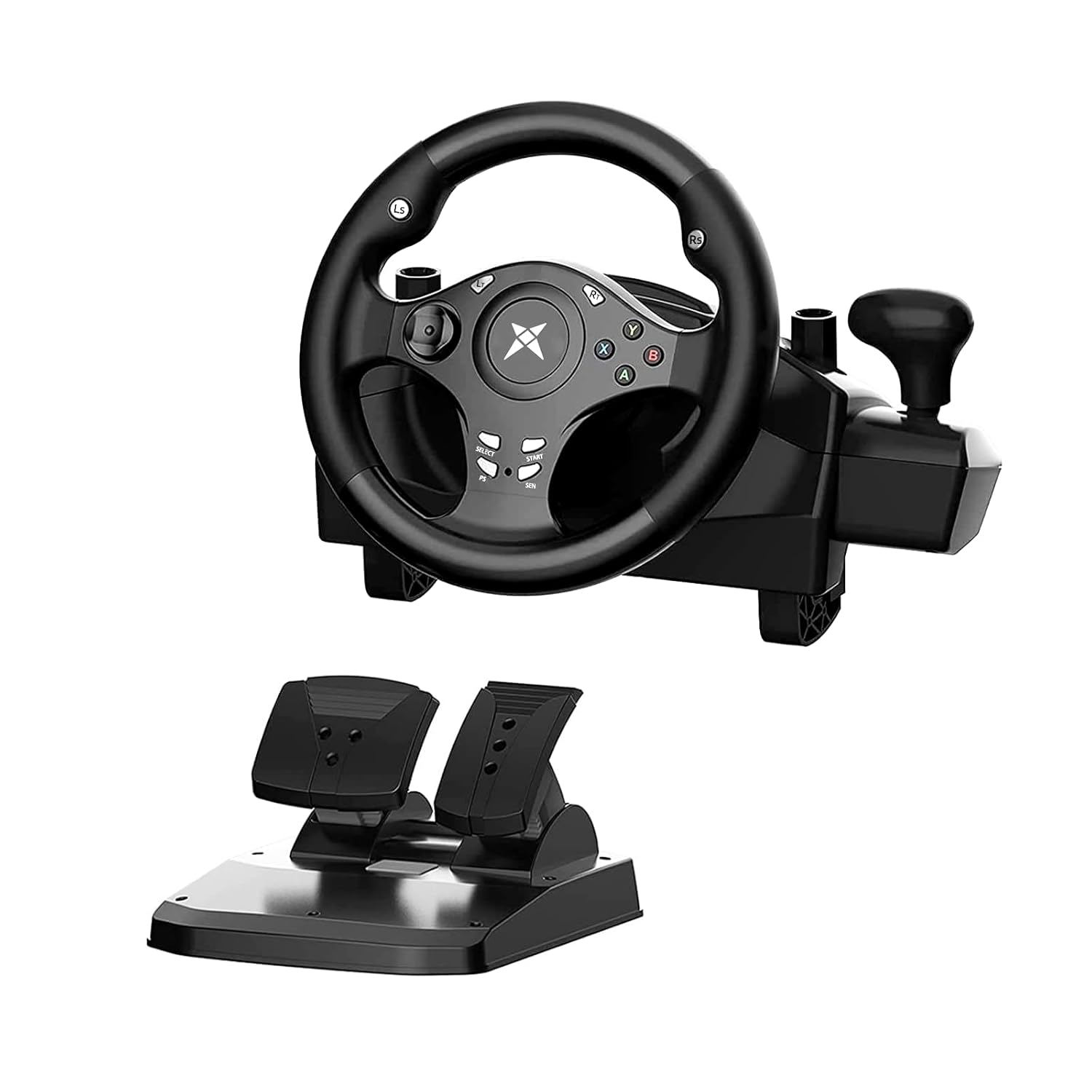
| HORI Racing Wheel Overdrive | Arcade racers wanting wheel feel | Rumble only | 2-pedal plastic | Best value wheel under $130 |
| PlayStation DualSense | Forza Horizon / arcade-only | Adaptive trigger resistance | n/a (pedal-as-trigger) | Best gamepad |
| GameSir G7 SE | Wired Xbox-compat gamepad | n/a | n/a | Best wired gamepad |
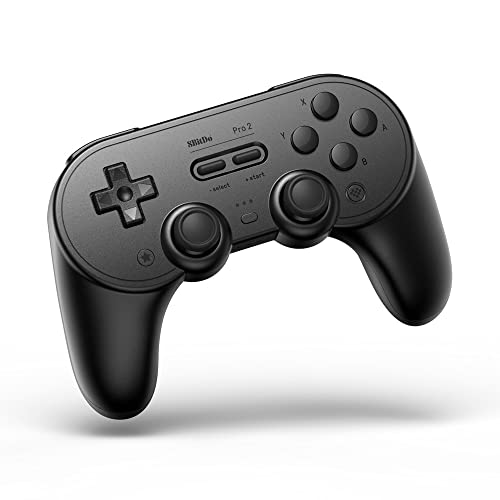
| 8BitDo Pro 2 | Casual / nostalgia gamepad | n/a | n/a | Budget gamepad pick |
| Thrustmaster TH8A Shifter | H-pattern car add-on | n/a | n/a | Upsell for G920 owners |
Best overall (wheel): Logitech G920 Driving Force (B00Z0UWV98)
The Logitech G920 has held the entry-level wheel slot for half a decade because it gets the fundamentals right at a price beginners can justify. Dual-motor gear-driven force feedback, 900° of rotation, real metal pedals (with a progressive brake), and a desk clamp that's actually stable. Out of the box it works with every PC sim — iRacing, ACC, AMS2, Le Mans Ultimate, Automobilista 2, RaceRoom, rFactor 2.
Why it wins:
- Dual-motor gear FFB is the right step-up from rumble-only — gives you real front-tire grip info.
- Three-pedal layout with a progressive brake (a cone of foam compresses, simulating brake-pressure curve).
- 900° rotation matches what every modern sim expects.
- Logitech G HUB software gets monthly updates; calibration profiles ship with every major sim.
- Upgrade path: pair with Thrustmaster TH8A for H-pattern cars; later swap in a Logitech Trueforce or move to direct-drive without re-learning your sim setup.
Watch outs:
- Gear-driven FFB is grainier and louder than belt-driven (Thrustmaster T300RS, Fanatec CSL DD). Within budget tier this is expected.
- Plastic wheel rim feels cheap relative to higher-end wheels. Doesn't affect performance.
- Pedal travel is shorter than premium load-cell pedals. Fine for the first 1-2 years of sim racing.
For PC beginners who plan to spend any time in ACC or iRacing, the G920 is the buy.
Best value (wheel): HORI Racing Wheel Overdrive (B08LGWJ219)
The HORI Overdrive is a wheel for buyers who want the wheel-and-pedal experience without the G920's price. Rumble-only "feedback" (not true FFB), 270° rotation, plastic pedals. It's not a sim wheel — it's a controller in the shape of a wheel.
Why it's the value pick:
- $115 vs $300 for the G920.
- Works fine for Forza Horizon and other arcade racers.
- Sturdy desk clamps; pedals don't slide on carpet.
- Officially licensed for Xbox / PC; no driver hassle.
Watch outs:
- Rumble-only "FFB" is the difference between informed driving and guessing. In a sim you'll hit the wall.
- 270° rotation is too short for any modern sim — most expect 540° minimum.
- Plastic pedals feel toy-like.
- Limited upgrade path; you'll outgrow it within a year if you actually like sim racing.
Buy the Overdrive if you're sure you won't move into sims. If you might, save up another $185 and get the G920 — the gap in capability is enormous.
Best gamepad pick: PlayStation DualSense (B09RBZ134K)
The DualSense's adaptive triggers are the single best gamepad feature for racing games released in the last decade. The triggers can simulate variable resistance — Forza Horizon 6 uses this to give you a brake pedal that pushes back as ABS engages, throttle-pedal stiffness when traction control is fighting, and gear-change resistance under shifting. No Xbox controller offers anything like this.
For sim racing on a gamepad, the DualSense + DS4Windows or Steam Input is the best controller you can buy. The gyro can be mapped to steering for fine-grained adjustments alongside the thumbstick. The vibration is more nuanced than any other gamepad.
Why it wins:
- Adaptive triggers give variable brake-pedal feel — closest thing to a wheel on a gamepad.
- Excellent build quality.
- Works wired (USB-C) or wireless (Bluetooth) on PC.
- Steam Input has first-class DualSense profiles for every major racing title.
Watch outs:
- Battery life ~6 hours wireless. Plan for USB-C cable on long sessions.
- DS4Windows or Steam Input setup is one extra step vs Xbox controller.
For Forza Horizon-only buyers, the DualSense is the controller to get even if you don't own a PlayStation.
Best wired gamepad: GameSir G7 SE (B0C7GW9F88)
For users who want a wired Xbox-compatible controller without battery hassle, the GameSir G7 SE is the smartest spend. Hall-effect sticks (no drift after 12 months), wired latency, swappable face plates, programmable rear paddles. At $45 it's half the price of an official Xbox Elite and offers many of the same features.
Why it's the wired pick:
- Hall-effect sticks resist stick drift far longer than potentiometer designs.
- Officially Xbox-licensed — full PC compatibility, no driver fuss.
- Programmable rear paddles useful for handbrake / shifter macros.
- Wired = zero latency, zero battery anxiety.
Watch outs:
- No adaptive triggers (DualSense wins here).
- No wireless option.
- Slightly heavier than stock Xbox controller.
Budget pick: 8BitDo Pro 2 (B08XY86472)
The 8BitDo Pro 2 is the cheapest controller that doesn't feel like a toy. SNES-inspired layout, programmable profiles, multiple connectivity modes (Bluetooth, 2.4GHz dongle, wired). Not the best racing controller — analog sticks are shorter-throw than modern controllers — but at $50 with the kind of build quality 8BitDo is known for, it's hard to argue with for the casual buyer who plays racing games occasionally.
What to look for in a sim-racing controller
- Force-feedback motor type: Gear-driven (G920) is grainier but cheaper. Belt-driven (T300RS) is smoother. Direct-drive (Fanatec CSL DD) is best but expensive. Rumble-only (Overdrive) isn't really FFB.
- Pedal travel: Longer pedal travel = better brake-pressure modulation. The G920's progressive brake (foam cone) is a reasonable compromise. Load-cell pedals are premium-tier.
- Wheel rotation degrees: Modern sims expect 540-900° rotation. 270° wheels can't render sim physics correctly.
- PC compatibility: Confirm Steam Input or G HUB / Fanatec / Thrustmaster Control Panel works on Windows 11. Most modern wheels do; verify before buying.
- Shifter add-on path: H-pattern shifters (Thrustmaster TH8A, Logitech Driving Force Shifter) plug into the wheel base, not the PC. Verify your wheel supports the shifter you want.
- Adaptive trigger support (gamepads): Big plus for racing. DualSense leads here.
- Hall-effect sticks (gamepads): Avoid drift. Worth $10-15 premium over potentiometer.
Cockpit / rig — buy or skip?
Skip on the first wheel. The G920 and HORI Overdrive both ship with desk clamps that hold solidly. Pedals sit on the floor against a wall or carpet stop.
A dedicated rig becomes worth it when:
- You upgrade to load-cell pedals (which require rigid mount to brake against).
- You move to direct-drive wheels (which require sturdy mounting due to torque).
- Your desk is shared and you want to set up / tear down quickly.
Below the $700 rig price point, most options use 80/20 aluminum extrusion. Above that, formal racing rigs from Sim-Lab, Trak Racer, and Next Level are well-made but you're paying for fit and finish.
Game-specific compatibility notes
- Forza Horizon 6: Works with everything. DualSense's adaptive triggers stand out here.
- Forza Motorsport 2026: G920 native, gamepad supported but inferior.
- Assetto Corsa Competizione: G920 native, gamepad supported but uncompetitive.
- iRacing: G920 native, gamepad supported for offline; race subscriptions assume wheel.
- Le Mans Ultimate: G920 native; needs 540°+ for endurance racing accuracy.
- Automobilista 2: G920 native; ships with G920-specific FFB profile.
- RaceRoom: G920 native; cheap entry point for sim casuals.
Common pitfalls
- Buying a 270° wheel for sims: Won't work. Pick 540°+ or stay on gamepad.
- Skipping the wall stop on pedals: Pedals slide forward on hardwood floors. $5 wall stop fixes it.
- Cheap shifters that don't fit: Confirm shifter compatibility with your wheel base before buying.
- Stick drift on potentiometer gamepads: Get Hall-effect or DualSense if you race daily.
- Buying a rig before the wheel works on desk: Rig requires wheel to know what mounting plate you need. Wheel first.
Beginner setup checklist
- Pick wheel or gamepad based on which games you'll play (above).
- Buy from a reputable retailer (Amazon, Logitech direct, Best Buy). Cheap eBay wheels are often returns.
- Clear desk space: 70 cm wide × 30 cm deep minimum for the wheel + pedals on the floor.
- Install Logitech G HUB (for G920) or Steam Input (for gamepads). Update firmware before first use.
- Use the in-game default profile for your wheel. Don't tweak FFB until you've raced ~10 hours.
- Calibrate the wheel once in G HUB and once in each sim. Re-calibrate every 3 months or after firmware updates.
- Sit at a consistent height. Wheel center should be approximately at sternum height when arms are slightly bent.
Upgrade ladder for the first 2 years
If you stick with sim racing, here's what to plan for:
- Year 1, $300: G920 + free shifter from Logitech G HUB calibration.
- Year 1, +$150: Thrustmaster TH8A H-pattern shifter for vintage / Group C / GT cars.
- Year 1, +$200: Aluminum-extrusion rig or wheel stand for stability.
- Year 2, +$400: Load-cell pedal upgrade (CSL Elite or Fanatec V3) — biggest skill-correlated upgrade after the wheel itself.
- Year 2, +$700: Direct-drive wheel base (Fanatec CSL DD / Moza R5) if you've stuck with sims and want the next FFB tier.
This ladder spreads ~$1,800 of spend over 24 months, with each step earning its place before the next. Don't skip to direct-drive without earning the milestones below it.
Bottom line
- Forza Horizon / arcade-only: DualSense. Adaptive triggers are the right tool for the job.
- Sim curious, $300 budget: Logitech G920. Pair with Thrustmaster TH8A later for H-pattern cars.
- Wheel curious, < $150 budget: HORI Overdrive. Knowing it's a stepping stone.
- Wired gamepad with no battery worries: GameSir G7 SE.
- Cheapest non-toy gamepad: 8BitDo Pro 2.
If you're on the fence between G920 and HORI: save up and get the G920. Force feedback is the line between "fun toy" and "real driving practice."
Related guides
- Forza Horizon 6 Best Settings & Controller Tips
- iRacing on a Budget Setup Guide
- Best Sim Racing Pedals Under $300
- Direct-Drive vs Belt-Driven Wheels Explained