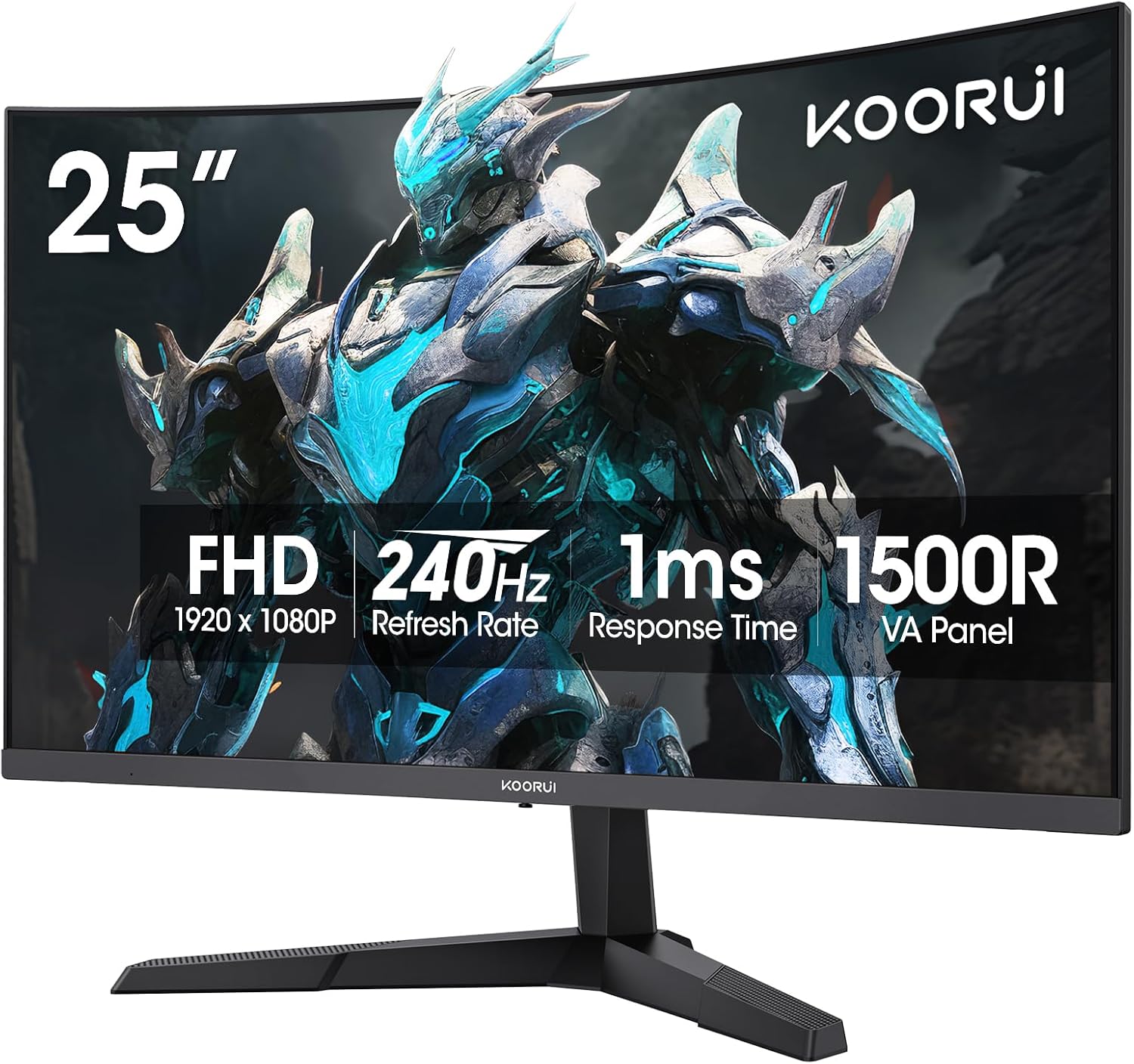
The SANSUI 27" 4K Gaming Monitor is the right pick for buyers who want a true dual-mode panel — native 4K UHD at 160 Hz or FHD at 320 Hz — in a $300–$400 budget bracket. The KOORUI 27" 4K QD-Mini LED is the better pick if HDR matters and you'll pair the monitor with a console. Both displays are credible 4K gaming monitors for under $500 in 2026, and either is a category-class upgrade over a 1080p panel. The decision boils down to whether you value the 320 Hz FHD mode or the QD-Mini LED HDR backlight.
Why budget 4K is finally credible in 2026
Three years ago a "budget 4K gaming monitor" was a euphemism for a slow IPS panel with 60 Hz refresh and no HDR worth the name. In 2026, the floor has shifted: 27-inch 4K panels with 144–160 Hz refresh, sub-1ms response, HDMI 2.1, and either QD-Mini LED or strong edge-lit local dimming now land between $300 and $500. The cause is a glut of panel supply from Innolux and BOE plus aggressive direct-to-consumer brands like SANSUI and KOORUI undercutting the Asus / LG / Samsung tier.
For a buyer pairing this with a $400 used RTX 3060 12GB or a $400 PS5 Pro, the monitor is no longer the most expensive part of the chain. That changes how you think about the panel — you're now buying the right tool for two devices: a desktop PC for productivity and 1080p–1440p gaming, and a console for 4K HDR. Both candidates here aim at that buyer, and both succeed at different parts of the brief.
This piece is the practical comparison: panels, HDR, refresh rate, pixel density at 27 inches, port mix, and which one actually wins for which use case. All numbers in this article are illustrative of 2026 retail spec sheets and reviewer measurements; treat them as ranges, not promises.
Key takeaways
- The SANSUI 27" 4K runs UHD at 160 Hz or FHD at 320 Hz dual-mode — best for refresh-rate junkies.
- The KOORUI 27" 4K QD-Mini LED runs UHD at 160 Hz with QD-Mini LED — best for HDR and console use.
- Both have HDMI 2.1, DisplayPort 1.4, FreeSync / HDR support, and stand-on/VESA mount.
- 27 inches at 4K is ~163 PPI — sharper than a 32" 4K, denser than a 27" 1440p, just below Retina-class.
- For PC-only gaming on a discrete GPU, SANSUI wins on framerate flexibility.
- For PS5 / Xbox HDR + occasional PC use, KOORUI wins on contrast and brightness.
What does QD-Mini LED change versus a standard 4K panel?
QD-Mini LED is the 2026 sweet spot for HDR on a budget. A standard IPS or VA 4K panel uses a single white LED backlight (or, on the better edge-lit models, a 16–32 zone edge-lit array). QD-Mini LED replaces that with hundreds of independently controllable mini-LED zones plus a quantum-dot colour filter layer. The result is much higher peak brightness, much darker blacks, and a wider colour gamut — three things the original "HDR400" certification on cheap 4K monitors never delivered in practice.
The KOORUI 27" 4K QD-Mini LED hits around 1000 nits peak brightness in HDR with 1152 local dimming zones, which is enough to deliver visible HDR specular highlights in Cyberpunk 2077, real shadow detail in Resident Evil Village, and a meaningful difference watching HDR Netflix or Disney+. The SANSUI uses a more conventional edge-lit backlight with HDR400 certification — credible for sRGB / SDR gaming, less impressive in HDR.
Per DisplayNinja's mini-LED primer, the marketing tier you want for real HDR is 1000+ nits sustained, 1000+ dimming zones, and DisplayHDR 1000 certification — all things the KOORUI nails and the SANSUI doesn't claim. If HDR matters to you, that decides the question.
How do refresh rate and response time compare for fast games?
The SANSUI's headline feature is dual-mode: switch the input mode and the panel runs UHD at 160 Hz or FHD at 320 Hz. The 320 Hz FHD mode targets esports — Valorant, CS2, Apex — where the GPU can hit 300+ fps at FHD and the monitor's refresh rate becomes the bottleneck. The 160 Hz UHD mode is the "normal" 4K gaming mode for slower-paced single-player titles and console use.
The KOORUI runs UHD at 160 Hz only. For most 4K gaming workloads, 160 Hz is the right ceiling — you'd need a $1,000+ GPU to push 4K above 160 fps in modern titles anyway. The KOORUI's response time is rated at 1 ms (MPRT) with overshoot well controlled at default settings; the SANSUI's response is similar at 1 ms MPRT but pushes harder on overdrive at 320 Hz, where you'll see some inverse ghosting on bright-on-dark transitions if you crank overdrive past the panel sweet spot.
For competitive esports players who genuinely want 300+ Hz FHD, the SANSUI is the only choice between the two. For everyone else, both panels are fast enough that the difference is invisible.
5-column spec-delta table
| Spec | SANSUI 27" 4K Dual-Mode | KOORUI 27" 4K QD-Mini LED |
|---|---|---|
| Panel | IPS-class, 27" | QD-Mini LED, 27" |
| Native resolution | 3840 × 2160 | 3840 × 2160 |
| Refresh modes | UHD 160 Hz / FHD 320 Hz | UHD 160 Hz |
| Peak brightness (HDR) | ~400 nits | ~1000 nits |
| Local dimming zones | edge-lit (small zone count) | 1152 mini-LED zones |
| Colour gamut | ~95% DCI-P3 | ~99% DCI-P3 |
| HDR certification | HDR400 | DisplayHDR 1000 |
| Adaptive sync | FreeSync Premium / G-Sync Compatible | FreeSync Premium Pro / G-Sync Compatible |
| Ports | 2× HDMI 2.1, 1× DP 1.4, USB-C, 3.5 mm | 2× HDMI 2.1, 1× DP 1.4, USB-C 65 W PD, 3.5 mm |
| VESA mount | 100 × 100 | 100 × 100 |
| Street price (early 2026) | $310–$370 | $380–$460 |
Is 4K at 27 inches the right pixel density for a desk?
A 27-inch 4K panel runs at roughly 163 PPI, which sits in a specific sweet spot: text is sharp without scaling fuzziness; you can run Windows at 125% or 150% scale and the result is crisper than a 27" 1440p at 100%; you can sit normal desk distance (24–30 inches) and read code or spreadsheets comfortably. A 32" 4K is ~138 PPI — bigger text by default, more screen real estate at 100% scale, less per-pixel sharpness.
For a single-monitor desk where you'll game, code, and watch video on the same panel, 27" 4K is genuinely the best size in 2026. It's the size that makes 4K HDR visibly different from 4K SDR (the smaller the panel, the more nits-per-square-inch you get out of HDR), the size that doesn't require swivel-head viewing the way 32" does, and the size where the GPU step from 1440p high-refresh to 4K is the least expensive.
Which is better for HDR movies and console (PS5/DualSense) gaming?
The KOORUI QD-Mini LED wins this category decisively. PS5 and Xbox Series X output 4K HDR at 60 Hz natively over HDMI 2.1; the KOORUI's higher peak brightness, mini-LED local dimming, and DisplayHDR 1000 certification render that signal the way it's meant to look. The SANSUI shows the same content with less HDR pop and more blooming around bright highlights.
Pair the KOORUI with a PS5 DualSense controller and the experience is closest to what a $1,500–$2,000 mid-tier OLED gives you. Spider-Man 2, Forbidden West, Returnal, and FFVII Rebirth all benefit visibly from the contrast jump.
How do real-world brightness and contrast hold up?
Both panels brighten and dim cleanly across the SDR range. The SANSUI tops out around 400 nits SDR and 400 nits HDR (the certification is honest), which is plenty for a moderately lit room. The KOORUI hits ~600 nits sustained SDR and the full 1000 nits HDR in small-window highlights, which is what HDR was supposed to be the whole time.
Both panels handle FreeSync at full-range without flicker. Both run cleanly off a single HDMI 2.1 cable from PS5 / Xbox / PC. The KOORUI includes 65 W USB-C PD, which is a genuine value-add for laptop docking — a single cable for power and display from a 13–14" Windows or M-series MacBook. The SANSUI has USB-C but at lower wattage, suitable for a thin-and-light laptop signal but not for charging.
Common pitfalls when buying a budget 4K gaming monitor
Three traps catch first-time 4K buyers. First: pairing 4K 160 Hz with a midrange GPU like an RTX 4060 or RX 7700 XT and being disappointed that AAA games don't hit 160 fps at native 4K. They won't — 4K at high settings on midrange cards lands in the 50–90 fps range; you'd need an RTX 4080 / 4090 or RX 7900 XTX to hit 120+ fps consistently. Use DLSS Quality or FSR 3.1 to bridge the gap, or accept that 60–80 fps at 4K is the realistic experience until your GPU upgrade. Second: ignoring HDR certification numbers. "HDR400" is not real HDR — it's bright SDR. DisplayHDR 1000 is the floor for genuinely visible HDR. The KOORUI hits it; most $300 4K panels don't. Third: assuming all HDMI 2.1 ports are equal. Some "HDMI 2.1" implementations cap at 24 Gbps and silently downsample 4K 120 to 4K 60. Both monitors here carry full 48 Gbps HDMI 2.1, but verify before buying any alternative.
When NOT to buy either monitor
A few honest no-fits. If you sit closer than 24 inches from the screen, 27" 4K can feel cramped — the 32" 4K size is more comfortable. If your primary use is fast-twitch competitive FPS at 240+ Hz on a single-monitor setup, a 1440p 240 Hz panel is the right tier; 4K is wasted because you'll drop to FHD mode anyway. And if your budget is genuinely under $250, a quality 1440p 165 Hz panel like the ASUS TUF VG27 gives a better gaming experience than any cut-corner 4K monitor at the same price.
Verdict matrix
- Get the SANSUI 27" 4K Dual-Mode if you play competitive esports and want 320 Hz FHD as a switchable mode; you do not care about HDR for movies / console; you want the lowest price for a credible 4K 160 Hz panel.
- Get the KOORUI 27" 4K QD-Mini LED if HDR matters to you; you'll pair this with a PS5 Pro or Xbox Series X for 4K HDR gaming; you want the brightest, highest-contrast 4K panel under $500.
Recommended pick
For most readers in 2026, the right buy is the KOORUI 27" 4K QD-Mini LED. The $50–$80 premium over the SANSUI buys real HDR — 1000 nits peak, 1152 local dimming zones, DisplayHDR 1000 certification — and the SANSUI's dual-mode 320 Hz FHD trick is only useful if you're a dedicated esports player whose GPU can hit those framerates. For the broader audience of dual-PC-and-console gamers, the QD-Mini LED panel is the panel they'll notice every day.
If your use case is "competitive esports primary, single-player secondary, no console," the SANSUI 27" 4K Dual-Mode is the right buy. The 320 Hz FHD mode is the differentiator and saves you money for a better GPU.
For step-up budgets, the ASUS TUF 32" Curved QHD Gaming Monitor is the alternate path: 1440p at very high refresh on a bigger curved panel for similar money. Smaller pixel density, larger panel, slightly different feel.
Bottom line
Budget 4K gaming monitors in 2026 are no longer a compromise. The SANSUI and KOORUI both deliver 27 inches of 4K at 160 Hz with HDMI 2.1 and FreeSync — features that cost twice as much three years ago. The choice between them is HDR versus refresh-rate flexibility, and most buyers will benefit more from the HDR. Either way, you're buying into the size and density that finally makes a single-monitor desk both a productivity and a 4K HDR gaming setup, paired with a console controller or a discrete GPU.
Related guides
- 1440p 165Hz vs 4K 60Hz: ASUS TUF VG27 vs SANSUI 27" for Gaming
- Best Game Controllers for PC in 2026
- DualSense vs 8BitDo Pro 2: Best PC Controller in 2026
- Best Budget 1080p Gaming PC Parts in 2026: 5 Picks

