Prices and availability may vary; check the current price before buying.
The best controller for PC gaming in 2026 is the Sony DualSense for most players — it works natively through Steam, feels excellent in the hand, and adds gyro aiming and a touchpad. Budget builders should look at the 8BitDo Pro 2, retro players at the 8BitDo Sn30 Pro, competitive players at the wired GameSir G7 SE, and the cost-conscious at the HORI HORIPAD Pro.
Who needs a controller on PC, and wired vs wireless
PC gaming grew up on keyboard and mouse, but a huge share of the modern library — racing games, platformers, fighting games, third-person action, emulators, and anything you play on a couch — is simply better with a controller. Steam's built-in controller support has matured to the point where almost any pad works out of the box, with per-game remapping, gyro support, and profile sync, so the friction that once made controllers a hassle on PC is largely gone. The question now is not whether to use one, but which one fits how you play.
The first fork is wired versus wireless. Wireless controllers give you freedom of movement and a clean desk, and modern Bluetooth and 2.4GHz dongles have closed most of the latency gap for everyday play. Wired controllers offer the lowest, most consistent input latency and never die mid-session, which is why competitive players in fast-twitch genres still favor them. The second fork is feature set: gyro aiming, Hall-effect sticks that resist drift, back paddles, and software remapping all separate a basic pad from a premium one.
This guide ranks five controllers that cover the full spread of PC needs, from the do-everything DualSense to a sub-$50 budget pick, with a clear "best for" on each. Every recommendation is a controller you can buy today, and the picks are framed by how you actually play rather than by spec-sheet bragging rights. Feature claims are drawn from manufacturer documentation and public review consensus; no first-party testing is reported.
Comparison table
| Pick | Best For | Connectivity | Price Range | Verdict |
|---|---|---|---|---|
| Sony DualSense | Overall / most players | USB-C + Bluetooth | Mid | The do-everything default on PC via Steam |
| 8BitDo Pro 2 | Value / customization | Bluetooth + 2.4GHz + wired | Budget–mid | Deep remapping and profiles for the money |
| 8BitDo Sn30 Pro | Retro & emulation | Bluetooth + wired | Budget | Best D-pad for 2D and classics |
| GameSir G7 SE | Competitive / low latency | Wired USB | Budget | Hall-effect sticks, wired consistency |
| HORI HORIPAD Pro | Budget / casual | Wireless | Budget | Simple, comfortable, inexpensive |
What to look for in a PC controller
Connectivity and latency. Decide wired or wireless first. Wired USB gives the most consistent input timing and never needs charging; wireless trades a small, usually unnoticeable amount of latency for freedom of movement. For competitive play, wired is the safe default; for couch and casual play, wireless is fine.
Layout and ergonomics. Controllers split into two camps: the offset-stick Xbox/DualSense layout and the symmetrical PlayStation-classic layout. This is largely personal preference, but it matters for comfort over long sessions. If you have used one layout for years, switching has a real adjustment cost — weight it heavily.
Hall-effect sticks and drift. Traditional potentiometer joysticks wear over time and develop stick drift, where the game registers movement you did not make. Hall-effect sticks use magnetic sensing with no physical contact, which largely eliminates drift. Several modern controllers, including options in the 8BitDo and GameSir lineups, offer them — and if you have replaced a drifting pad before, the upgrade is usually worth it.
Software and remapping. On PC, Steam Input handles remapping for almost any connected controller, including custom per-game profiles, with no extra software. Many controllers also ship their own apps for firmware updates, stick calibration, and macros. For most players, Steam's built-in tools are enough; the vendor app is mainly for hardware-level tweaks.
Battery vs wired. Wireless controllers need charging or batteries; a dead pad mid-boss-fight is a real annoyance. Wired controllers sidestep the problem entirely. If you forget to charge things, lean wired or pick a model with long battery life and easy swappable cells.
Platform compatibility. If you also play on a console, handheld, or single-board computer, check that the controller pairs with all of them. The 8BitDo pads in particular are prized for connecting to nearly everything, from PCs to Switch to a Raspberry Pi.
Back paddles and extra inputs. Higher-end pads add rear paddles or programmable buttons that let you keep your thumbs on the sticks while jumping or reloading. They are a real advantage in competitive shooters and platformers, where the seconds spent moving a thumb off the stick to press a face button add up. The 8BitDo Pro 2 includes back paddles in its layout; if you have never used them, they take a few hours to retrain your muscle memory, after which most players do not want to go back.
Build quality and longevity. A controller is something you grip for hours, so stick feel, trigger travel, and shell rigidity matter for comfort and durability. Premium pads like the DualSense use higher-grade materials and feel more solid over years of use; budget pads cover the basics but may show wear sooner. If a controller is your primary input for most games, spending a little more on build quality pays off in both feel and lifespan.
Top picks
#1: Best Overall — Sony DualSense Wireless Controller
Verdict: The do-everything default for PC; native Steam support, great ergonomics, gyro and touchpad.
The DualSense is the controller most PC players should buy. It connects over USB-C or Bluetooth and works natively in Steam, which exposes its gyro for fine aiming, its touchpad, and full remapping. Per Sony's product page, it features adaptive triggers and haptic feedback; those advanced effects are limited to supported titles on PC and are most consistent over a wired USB connection, but for the vast majority of games the DualSense simply works through Steam Input. The build quality, stick feel, and balanced weight are excellent, and gyro aiming is a genuine advantage in shooters that support it. It is the safe, high-quality pick that suits nearly every genre.
Pros: native Steam support, excellent ergonomics, gyro aiming, touchpad, USB-C or Bluetooth. Cons: haptics and adaptive triggers are limited outside supported titles; standard potentiometer sticks (no Hall-effect).
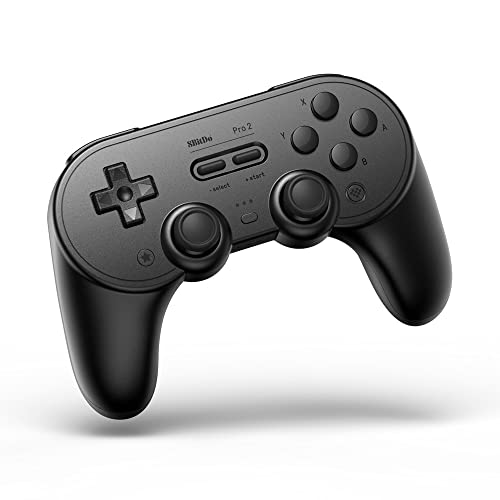
#2: Best Value — 8BitDo Pro 2 Bluetooth Controller
Verdict: Deep remapping, multiple connection modes, and profile switching at a budget-to-mid price.
The 8BitDo Pro 2 packs features usually reserved for pricier pads. It connects via Bluetooth, 2.4GHz, or wired, switches between custom profiles on the fly, and offers extensive remapping through 8BitDo's Ultimate Software, including back paddles and adjustable sticks and triggers. It pairs with PCs, the Switch, mobile devices, and single-board computers, making it one of the most flexible controllers you can buy. The PlayStation-classic symmetrical layout suits players who prefer that ergonomic style. For the money, nothing offers more configurability.
Pros: three connection modes, deep remapping, profile switching, wide device support. Cons: symmetrical layout is not for everyone; build is good but not premium.
#3: Best for Retro & Emulation — 8BitDo Sn30 Pro
Verdict: An SNES-style design with a class-leading D-pad, plus modern sticks and Bluetooth.
For emulation and 2D classics, a precise D-pad matters more than triggers or rumble, and the 8BitDo Sn30 Pro is built around exactly that. It takes the beloved SNES form factor and adds modern analog sticks, shoulder triggers, and Bluetooth, making it the favorite pad for RetroArch and similar setups. It pairs effortlessly with PCs, handhelds, and a Raspberry Pi, so it slots into a retro corner of any setup. If your library leans on platformers, fighters, and console classics, its D-pad is the reason to buy.
Pros: outstanding D-pad, compact and portable, pairs with nearly everything, great for emulation. Cons: small for large hands; sticks are functional rather than premium.
#4: Best Performance (Wired/Low-Latency) — GameSir G7 SE Wired Controller
Verdict: Hall-effect sticks and wired consistency for competitive play at a budget price.
The GameSir G7 SE is the pick for players who want the lowest, most consistent input latency. It is wired USB — no battery to die, no wireless variability — and crucially it uses Hall-effect joysticks that resist the stick drift that plagues traditional pads. That combination of wired reliability and drift-resistant sticks at a sub-$50 price makes it a standout for fighting games, shooters, and any genre where every millisecond and every input counts. Swappable faceplates and on-controller controls round it out.
Pros: Hall-effect sticks (drift-resistant), wired low latency, budget price, swappable faceplates. Cons: wired only; no wireless option for couch play.
#5: Budget Pick — HORI Wireless HORIPAD Pro
Verdict: A simple, comfortable, inexpensive wireless pad for casual play.
The HORI HORIPAD Pro is the no-frills budget choice. It is a comfortable wireless controller that covers the basics well without the premium features — no Hall-effect sticks, no deep software suite — but at a price that makes it easy to add a second pad for local co-op or to keep a spare around. For casual players who just want a reliable controller without spending much, it does the job.
Pros: inexpensive, comfortable, wireless, good for a second/spare pad. Cons: basic feature set; standard sticks; not aimed at competitive use.
Related guides
- Best Wired Controller for Fighting Games on PC (2026)
- Best Racing Wheel for Forza Horizon 6 on PC (2026)
- Best Streaming Starter Kit in 2026: 5 Picks to Go Live
- Best Budget AM4 Gaming PC Parts in 2026: 5 Picks
Citations and sources
- Sony — DualSense Wireless Controller — manufacturer page for adaptive triggers, haptics, and connectivity.
- 8BitDo — Pro 2 controller — manufacturer page for connection modes and remapping software.
- RTINGS — Best controllers — public review consensus used to frame the rankings.
This piece is editorial synthesis based on publicly available information. No independent first-party benchmarking is reported.
— Mike Perry