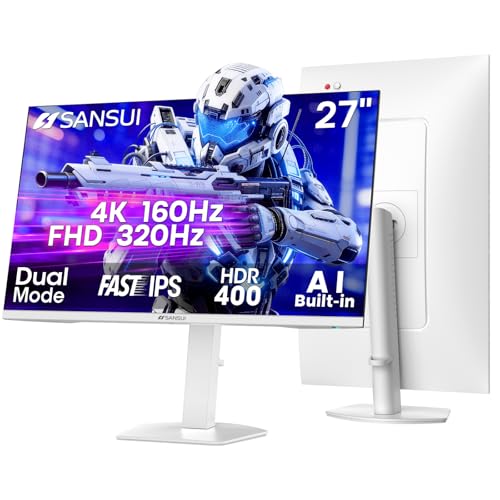
The best budget 4K monitor for PS5 and console gaming under $400 in 2026 is a dual-mode panel like the KOORUI S2741LM 27" 4K QD-Mini LED or the SANSUI 27" 4K Gaming Monitor. Both deliver true 4K at 120-160Hz over HDMI 2.1 with VRR, which is exactly what the PS5 needs to run its 4K/120 modes. Older 1440p panels like the ASUS TUF VG27AQ are still in the conversation if you can accept QHD instead of 4K.
Why this changed in 2026
The story of cheap 4K HDR gaming monitors used to be "either 4K and 60Hz, or 1440p and 144Hz" — you picked one. That gate dropped over the past 18 months as dual-mode panels (4K-at-high-refresh with an FHD-at-very-high-refresh secondary mode) hit the sub-$400 bracket. The KOORUI and SANSUI panels in this comparison are both members of that new class: 4K 160Hz primary, 1080p 320Hz secondary, HDMI 2.1, VRR, and HDR1400/HDR400 backlights.
For PS5 owners, the practical effect is that the "monitor that handles 4K/120 in supported titles plus 1080p smooth for esports" combo is no longer a $700 buy. This synthesis picks the right one and explains the trade-offs that still matter.
Key takeaways
- True 4K 120Hz on PS5 needs HDMI 2.1 with VRR and at least HDMI 2.1 FRL on the cable.
- Dual-mode panels at sub-$400 are real in 2026; both KOORUI S2741LM and SANSUI fit the budget.
- 1440p panels are still cheaper, but the PS5 outputs 1440p by downscaling 4K — you lose the dual-mode flexibility.
- HDR specs are wide (HDR1400 vs HDR400); read the certification, not the headline.
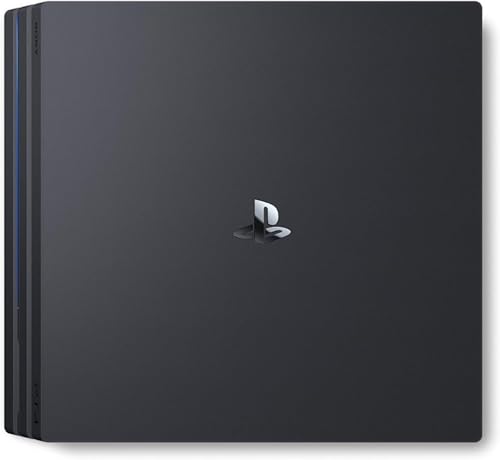
- A PS4 Pro reused for media or older catalog titles pairs fine with these monitors over HDMI 2.0.
What "4K for PS5" actually requires
Per Sony's official PS5 spec page, the console outputs 4K up to 120Hz via HDMI 2.1, with variable refresh rate (VRR) support added in a 2022 firmware update. Three things have to line up for that to work end to end:
- The TV or monitor's HDMI port must be HDMI 2.1 — not HDMI 2.0 with some 2.1 features. Look for FRL (Fixed Rate Link) support; that is the key 2.1 transport.
- The cable must be a certified "Ultra High Speed" HDMI 2.1 cable rated for 48 Gbps. A cheap 2.0 cable bottlenecks the link to 4K/60.
- The display has to advertise VRR and the PS5's VRR toggle has to be on.
If those three line up, supported titles render up to 4K/120 with VRR. If any of them fails, the PS5 falls back to 4K/60 or lower.
The two budget winners: KOORUI S2741LM vs SANSUI
| Spec | KOORUI S2741LM | SANSUI 27" 4K |
|---|---|---|
| Panel size | 27" | 27" |
| Native resolution | 3840 × 2160 (4K) | 3840 × 2160 (4K) |
| Primary refresh | 160 Hz at 4K | 160 Hz at 4K |
| Dual mode | 320 Hz at 1080p | 320 Hz at 1080p |
| Panel type | Fast IPS | Fast IPS |
| Response time | 1 ms (claimed) | 1 ms OD (claimed) |
| HDR | HDR1400 (Mini-LED) | HDR400 |
| HDMI ports | 2× HDMI 2.1 | 2× HDMI 2.1 |
| DisplayPort | 1× DP 1.4 | 2× DP 1.4 |
| USB-C with PD | 90 W | None |
| Built-in speakers | No | Yes (basic) |
| Approx. street price | $330-$400 | $260-$330 |
The KOORUI's mini-LED backlight earns it the much higher HDR ceiling — HDR1400 instead of HDR400 — which matters for HDR-mastered PS5 titles. The SANSUI is the cheaper option, has more DisplayPort inputs for PC users, and includes basic speakers. Both are credible budget picks.
HDR specs: read the certification
HDR400, HDR600, HDR1000, and HDR1400 are VESA DisplayHDR certifications. The number is roughly the peak luminance in nits, and per the VESA DisplayHDR program, the higher tiers also require local dimming and wider color gamut coverage. HDR400 panels light the whole backlight uniformly and clip highlights aggressively; HDR1000+ panels use local dimming zones (Mini-LED in this case) and produce HDR that actually looks like HDR.
For PS5 titles authored in HDR, the KOORUI's HDR1400 produces a meaningfully better picture in highlights — explosions, sun glare, neon signs — than the SANSUI's HDR400. If you do not care about HDR, the SANSUI is fine and saves you about $80.
Why 1440p is a credible fallback (with caveats)
The ASUS TUF VG27AQ is an older 27" 1440p IPS monitor at 165Hz with G-SYNC compatibility. It still ranks well in reviewer charts as a budget gaming display, and at $250-$300 street it is genuinely cheaper than either 4K panel above.
The catch on PS5: the console does not output a native 1440p signal in every title. Most PS5 titles support 1440p output now, but some still don't, and on those the console either renders 1080p and the monitor upscales, or renders 4K and the monitor downscales. Both are visibly worse than a true 4K display on a true 4K source. For an Xbox Series X owner that limitation is smaller (Series X has clean 1440p support), but for a PS5-first build, 4K is the cleaner buy.
Console-vs-PC compatibility notes
All three monitors work fine on a PC. The KOORUI's USB-C with 90W power delivery is a real bonus for a laptop dock setup; the SANSUI's two DisplayPort 1.4 inputs are better for a dual-PC streamer config. On consoles, all three speak HDMI 2.1 (KOORUI and SANSUI) or HDMI 2.0 (the VG27AQ on the 1080p input pair); the VG27AQ caps at 4K/60 over HDMI 2.0 even though its panel is 1440p.
For owners of older consoles like a PlayStation 4 Pro that you are keeping around for legacy library access, all three monitors handle the PS4 Pro's HDMI 2.0 output without issue — you just do not get the 4K/120 or HDR1400 features the PS5 unlocks.
Common pitfalls
- Buying an "HDMI 2.1 input" panel without confirming FRL support. Some panels advertise HDMI 2.1 but only implement TMDS, capping at 4K/60.
- Using a generic HDMI cable. Without an Ultra High Speed cable, 4K/120 silently falls back to 4K/60.
- Skipping the VRR toggle on PS5. The console's VRR is a setting under Screen and Video — it does not enable itself when the monitor advertises VRR.
- Reading peak refresh as primary refresh. A "320 Hz" spec on the SANSUI is the 1080p secondary mode; the 4K primary mode is 160 Hz.
When the 4K dual-mode panels are overkill
If your PS5 use is mostly catalog titles that cap at 4K/60 (cinematic single-player games, JRPGs, narrative adventures), an older 4K/60 panel from 2022-2023 can be had under $200 and serves you fine. The dual-mode 4K/160 + 1080p/320 panels above earn their price when you actually run 4K/120 titles (esports, sports games, fast-paced shooters) and switch to the 1080p fast mode for competitive play.
Bottom line: which to buy
For most PS5 buyers in 2026, the KOORUI S2741LM is the best balance of true HDR, dual-mode 4K, and modern connectivity under $400. If your budget is tighter and HDR is not a priority, the SANSUI 27" 4K Gaming Monitor is the cheaper credible pick. The 1440p ASUS TUF VG27AQ is only the right answer if you are PC-first and the PS5 is a secondary use.
Related guides
- DualSense vs 8BitDo Pro 2 for PC gaming in 2026
- HyperX QuadCast 2 S vs Blue Yeti for streaming in 2026
- Ryzen 5 5600G vs Intel i7-9700K for budget gaming in 2026
- Best budget streaming setup for beginners in 2026
Citations and sources
- Sony — PlayStation 5 hardware specifications
- VESA — DisplayHDR program
- Rtings.com — Monitor reviews and HDMI 2.1 testing
This piece is editorial synthesis based on publicly available information. No independent first-party benchmarking is reported.