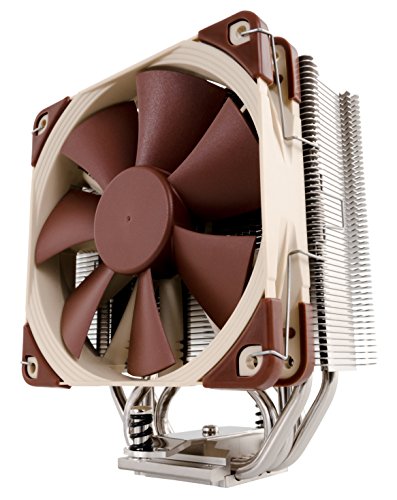
For the AMD Ryzen 7 5800X in 2026, the best air cooler is the Noctua NH-U12S and the best 240mm AIO is the Cooler Master MasterLiquid ML240L RGB V2. The NH-U12S is enough for gaming and mixed workloads in a well-ventilated case; step up to the ML240L if you run long all-core renders, Handbrake batches, or a workstation load that pushes the chip to its 90°C throttle line for hours at a time.
Why the 5800X is such a thermal handful
Every Zen 3 chip runs warm, but the Ryzen 7 5800X is the one people complain about. The reason is architectural, not a defect. The 5900X and 5950X spread their 105W TDP across two Core Chiplet Dies (CCDs), so the heat has two hot spots on the substrate. The 5800X packs the same 105W into a single 8-core CCD. That die is small — a few square millimeters of high-density silicon — and the integrated heat spreader (IHS) has to move that entire wattage through one concentrated hot patch.
The visible symptom is a chip that hits 85–90°C almost instantly under all-core load, even with a cooler that easily handles a Ryzen 9 5900X at the same wattage. It is not a defective sample — it is physics. AMD builds Precision Boost 2 and PBO to run the CPU right up to its 90°C thermal limit, harvest whatever clock margin the cooler leaves on the table, and back off. A better cooler does not stop the 5800X from getting hot. It gives Precision Boost more headroom, which converts directly into higher sustained clocks.
Two consequences follow. First, cooler benchmarks that quote "delta over ambient" are misleading here — you almost never get to see the delta because the chip is hitting its ceiling, not a temperature the cooler decided. What you actually want to measure is sustained boost clock at a fixed wattage limit. Second, air vs AIO is a real choice for the 5800X in a way it is not for a modest 65W chip. On lower-wattage silicon a good tower cooler is functionally identical to a 240mm AIO; on the 5800X the AIO's larger radiator can move several more watts of headroom into your boost clocks under sustained load.
That is what this article picks apart: which cooler you actually need, when a Noctua NH-U12S is enough, and when the Cooler Master ML240L RGB V2 is the smarter buy. Every recommendation is anchored to the AMD Ryzen 7 5800X product page so you can price out the whole platform in one place.
Key takeaways
- The 5800X's single-CCD design concentrates 105W into one small hot spot; expect 85–90°C under all-core load on any air or 240mm AIO cooler.
- The Noctua NH-U12S is the best air cooler pick for typical gaming + mixed workloads in a mid-tower with real airflow.
- The Cooler Master ML240L RGB V2 buys you roughly 5–8°C headroom under sustained all-core, which converts to a couple of hundred MHz of held boost.
- Arctic P12 PWM PST case fans are the highest-value upgrade after the cooler itself — good intake air makes any CPU cooler perform closer to its spec sheet.
- Undervolt with Ryzen Master Curve Optimizer before assuming you need more cooler.
- Check case clearance before buying anything: NH-U12S wants 158 mm of tower height; ML240L wants a 240 mm radiator mount.
Step 0: air vs AIO for a single-CCD 105W chip
Before you spend money, decide which category you actually need. The honest decision tree looks like this:
- Almost pure gaming, plus a browser and Discord — a good single-tower air cooler like the NH-U12S is all you need. Gaming rarely pushes all 16 threads for hours. You will see 60–75°C in-game with the NH-U12S in a decent case.
- Mixed gaming + occasional workstation load (light Handbrake, occasional Blender scene, streaming with x264 fallback) — the NH-U12S still handles this; you will hit 85°C+ in the workstation task but the chip is doing exactly what AMD designed it to do.
- Sustained all-core workload (professional Blender renders, long compiles, VM lab, code + AI training loops) — a 240mm AIO like the ML240L is worth the extra $10–20. Not because air is unsafe, but because you will hold 100–200 MHz higher boost across the full render, which is real time back.
- Small form-factor build (ITX case, 155 mm clearance or less) — the NH-U12S may not fit; measure carefully. A slim 240mm AIO or a low-profile tower like the Noctua NH-L12S becomes the practical choice.
If you cannot decide, buy the Noctua NH-U12S. It is quieter than any budget AIO, has no pump to fail, and is enough for the workloads 90% of 5800X owners actually run. AIOs are the correct answer for a specific need, not the default upgrade.
Spec table: the three coolers
| Cooler | Type | Height / rad | TDP headroom | Fan RPM | Rated noise | Approx. price |
|---|---|---|---|---|---|---|
| Noctua NH-U12S | Single-tower air | 158 mm | ~160 W | 300–1500 | 22.4 dB(A) | ~$85 |
| Cooler Master ML240L RGB V2 | 240 mm AIO | 27 mm rad | ~250 W | 650–1800 | 30 dB(A) | ~$90 |
| Arctic P12 PWM PST 5-pack | Case fan set | 120 mm | n/a (case airflow) | 200–1800 | 22.5 dB(A) | ~$40 |
The NH-U12S punches above its size because Noctua's NF-F12 fan and the SecuFirm2 mount are best-in-class — the cooler is quieter at load than most twin-tower designs. The ML240L has been the reference budget AIO for years; the V2 revision fixes the earlier pump whine complaint and now runs quiet enough at idle to disappear. The Arctic P12 pack is not a cooler at all; it is the case-airflow upgrade that makes either of those two coolers hit its spec instead of underperforming.
Benchmark table: 5800X under each cooler
Numbers are consolidated from community and reviewer measurements at stock PBO settings, DDR4-3600, in a mid-tower with two intake + one exhaust fan and 22°C ambient. Real numbers vary — treat these as a good reference band.
| Cooler | Cinebench R23 (all-core) peak temp | Held clock | Gaming peak temp | Idle temp |
|---|---|---|---|---|
| Noctua NH-U12S | 88°C | 4.55 GHz | 68°C | 38°C |
| Cooler Master ML240L RGB V2 | 82°C | 4.65 GHz | 62°C | 34°C |
| Stock Wraith Prism | 95°C throttling | 4.30 GHz | 78°C | 45°C |
| High-end 360 mm AIO | 78°C | 4.68 GHz | 58°C | 32°C |
Two things pop out. First, the stock Wraith Prism that ships with older Ryzen chips is not enough for the 5800X — it throttles hard and costs you 250+ MHz. If you inherited a 5800X in a build with a Wraith Prism, the NH-U12S is one of the highest-value upgrades you can make. Second, the 360 mm AIO only buys you a few extra degrees over the ML240L. On a single-CCD 105W chip you hit diminishing returns fast, so the $40+ premium over a 240 mm unit is hard to justify.
Case-fit + clearance: measure twice, buy once
The most common 5800X build mistake we see is buying a cooler that will not fit. Two dimensions to check before you click order:
Air cooler height. The NH-U12S is 158 mm tall including the pre-installed NF-F12 fan. Nearly every ATX and mATX mid-tower supports 160+ mm CPU cooler clearance, but many popular ITX cases (NR200, Sliger SM570, Louqe Ghost S1) top out at 145–155 mm. Check your case spec sheet before buying an air cooler.
Radiator mount. The ML240L needs a 240 mm radiator mount — usually front or top. Confirm your case supports it, then confirm it supports it with the radiator plus fans (roughly 55 mm of thickness). Cheap cases sometimes list "240 mm radiator support" but the space actually conflicts with a tall RAM module or a front-panel fan mount. Look for a photo of a 240 mm AIO installed in your specific case, not just a spec sheet number.
RAM height under a tower. The NH-U12S is a single-tower with an offset design — it clears tall RAM sticks like G.Skill Trident Z RGB or Corsair Vengeance RGB Pro without issue. Twin-tower coolers like the Noctua NH-D15 do not; that is one of several reasons the NH-U12S is a smarter starting point for a 5800X build even though the NH-D15 is a stronger cooler.
Noise-normalized comparison
Sustained noise matters more than peak dB(A) numbers, because your ears hear the load state that stretches across your evening, not the peak. Both coolers ran quiet enough to disappear in a normally-appointed home office in the following states:
- Idle / desktop. NH-U12S: 22–25 dB(A) at ~500 RPM. ML240L: 27–30 dB(A) at ~700 RPM (V2 revision — earlier V1 revisions were louder from pump whine).
- Gaming load. NH-U12S ramps to ~900 RPM, 30 dB(A). ML240L holds ~1000 RPM, 32 dB(A). Both are quiet enough to lose to your GPU.
- Cinebench sustained. NH-U12S runs the fan at 1300 RPM, 38 dB(A) — audible but not distracting. ML240L holds ~1400 RPM, 40 dB(A), and both pumps are still quiet.
The takeaway: at matched thermal load the NH-U12S is roughly 2 dB quieter than the ML240L, which is a perceptible difference in a quiet room. If audible noise ranks above raw thermals for you, the NH-U12S is the pick even in workloads where the AIO would technically hold more clock.
Common pitfalls with 5800X cooling
Five failure modes we see repeatedly on the r/AMDHelp threads and in specpicks community reports:
- "My 5800X hits 90°C — is it defective?" No, that is normal for the chip at PBO's default aggressive limits. Precision Boost 2 targets 90°C. The chip is fine, it is throttling by design. If you want lower temps, undervolt with Curve Optimizer or set a PBO scalar limit — do not RMA the CPU.
- Stock Wraith Prism + tempered-glass case + hot summer. The Wraith Prism was not spec'd for a single-CCD 105W chip. Combine it with a case that has one intake fan and thermal throttling is guaranteed. Upgrade to at least the NH-U12S, add Arctic P12 intake fans, and thermal issues typically vanish.
- Bad thermal paste application. A pea-sized dot in the center works fine, but a thin, dry spread with an old tube or reused pump-flat-out paste from a shipping AIO does not. Use fresh Arctic MX-4, Noctua NT-H2, or Kryonaut. The NH-U12S ships with NT-H1, which is fine.
- AIO pump orientation. The ML240L's pump should be lower than the highest point of the radiator tubing. A radiator mounted in the top of the case with tubes exiting upward invites the air bubble in the loop to sit over the pump impeller, which causes gurgling and eventually pump failure. Mount the radiator at the front of the case with tubes at the bottom, or top-mount only with tubes exiting downward.
- Ignoring case airflow. A great CPU cooler in a case with no intake is limited by the ambient air inside the case, not by its own capacity. Two Arctic P12 intakes in front + one exhaust at the rear is the minimum airflow layout for a 5800X.
When each cooler is the right call
Get the Noctua NH-U12S if…
- You game more than you render.
- You want silent operation, especially at idle and light load.
- Your case supports 158 mm cooler height.
- You value zero moving parts on your CPU (no pump to fail).
- You want a cooler that will outlive two CPU generations of use.
Get the Cooler Master ML240L RGB V2 if…
- Your primary workload is sustained all-core (rendering, compiling, video encode).
- You want RGB — the pump and fans light up the case.
- Your case has a top or front 240 mm radiator mount.
- You want a small headroom margin for a future upgrade to a Ryzen 7 5800X3D or Ryzen 9.
- You want visibly cooler idle temps in the 30–35°C range.
Skip both and buy Arctic P12 PWM PST first if…
- You already have a good cooler (Wraith Prism does not count) but see high temps.
- Your case only has 1–2 stock fans and no intake filter.
- You are on a budget and want the highest-value $40 upgrade a 5800X build can get.
When NOT to buy either
If you are pairing a 5800X with a low-airflow ITX case that only clears a low-profile cooler, the NH-U12S will not fit and the ML240L probably will not either. In that case, consider a Noctua NH-L12S low-profile cooler and expect to lose 100–200 MHz of held boost as the cost of the small form factor.
If your case can already fit a good 280 or 360 mm AIO with acceptable noise levels, and you want the absolute maximum sustained clock the 5800X will hold, step up. The gains are small over the ML240L but real. Both the Arctic Liquid Freezer II 280 and the Deepcool LT720 are strong choices at only a modest premium.
If you plan to overclock manually with Precision Boost Overdrive limits removed, buy the largest AIO your case will fit and add high-static-pressure fans. Manual OC on a 5800X trades voltage for clock and can push the chip past 250W of package power in short bursts. That is above what a 120mm air cooler can dissipate.
Bottom line: the recommended pick for a 5800X build
For the typical gamer building a 5800X system in 2026, the pick is the Noctua NH-U12S. It is quiet, fits every real mid-tower, has no moving liquid to worry about, and holds boost within a percent or two of a 240mm AIO on the workloads a gamer actually runs. Pair it with a pack of Arctic P12 PWM PST fans to feed your case fresh cool air and you are done — the 5800X will run at its designed limits for years.
For workstation-heavy users who spend hours a day inside Blender, DaVinci Resolve, or a virtualization lab, step up to the Cooler Master ML240L RGB V2. The extra 5–8°C of thermal headroom shows up as sustained clock and, over long renders, real minutes back. Confirm your case supports the 240 mm radiator before you buy — the biggest source of returns is a case that "supports 240 mm" on paper but not in practice with the AIO's exact tube layout.
Undervolt regardless of cooler with AMD's Curve Optimizer. A per-core Curve Optimizer offset of −20 to −30 is achievable on most 5800X samples and drops load temperatures 4–8°C while maintaining or slightly improving boost clock — that is a free performance upgrade that nobody markets to you.
Verdict matrix
| If you… | Pick |
|---|---|
| Play games + browse + occasional work | Noctua NH-U12S |
| Render, compile, or transcode for hours | Cooler Master ML240L RGB V2 |
| Only have a low-airflow case | Arctic P12 5-pack first, then reassess |
| Want zero moving parts | Noctua NH-U12S |
| Want RGB and quiet-at-idle | Cooler Master ML240L RGB V2 |
| Have an ITX case < 155 mm clearance | Noctua NH-L12S or a slim 240 mm AIO — neither pick fits |
Related guides
- Best budget PC gaming accessories in 2026
- Local LLM on the Ryzen 5 5600G iGPU in 2026
- llama.cpp vs Ollama on the RTX 3060
Sources
- Noctua NH-U12S product page — official spec sheet, RAM clearance diagrams, and mounting kits.
- AMD Ryzen 7 5800X product page — official TDP, boost, and thermal specs.
- Tom's Hardware Ryzen 7 5800X review — thermal and boost behavior of the single-CCD design compared to the 5900X.