The 30-second answer
A credible first-channel streaming kit in 2026 costs $250-550 and consists of four parts: a USB microphone (the Blue Yeti or HyperX QuadCast 2 S), a face-cam light (an 18-inch ring light like the NEEWER), optional accent RGB strip lights for the background (the KSIPZE 200ft Music Sync is the value pick), and if you're streaming console gameplay, the Elgato Cam Link 4K capture card. The PC running OBS is assumed to already exist. Skip the broadcast-grade gear until your audience size justifies it.
Why a beginner kit matters more than a flagship kit
Production quality is one of the dimensions Twitch and YouTube algorithms weigh, but it is not the most important — content, schedule consistency, and on-camera presence dominate. The right kit for a first-year channel is the one that clears the production-quality threshold without being so expensive that you can't afford to keep streaming if the audience takes 18 months to build. A $1,500 microphone-and-interface chain is wasted on a 5-viewer stream; a $130 USB microphone with clean audio is enough for the audience to focus on the content instead of the equipment.
The kit below targets that threshold. Each part is the right pick at its tier, and each part has a clear upgrade path when it becomes the bottleneck.
Key Takeaways
- USB microphones are correct for first channels — XLR is over-investment until you have an audience that benefits from it.
- Ring lights are correct for face cam under 24" from the camera; key/fill setups come later.
- Capture cards are only needed for console streaming; PC streamers skip them entirely.
- Background RGB lighting is the cheapest production-quality boost available.
- Plan for $250-550 total; spending more delivers diminishing returns on a first channel.
Top picks
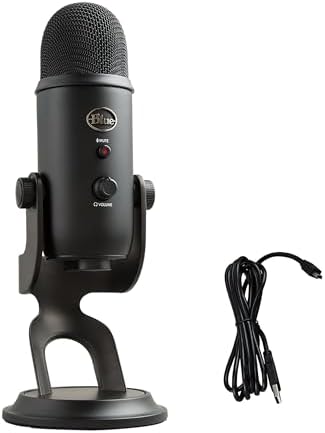
#1: Blue Yeti USB Microphone — $130
Verdict: The default first-channel microphone for a reason — broadcast-quality USB audio, four pickup patterns, zero-latency monitoring, plug-and-play on Windows / Mac / Linux.
The Blue Yeti has been the dominant first-channel microphone since 2010 and the position hasn't seriously been challenged since. The reasons are practical: the Yeti's tri-capsule array delivers clean voice pickup at typical desk distance, the four pickup patterns (cardioid, omnidirectional, bidirectional, stereo) cover every reasonable use case, and the built-in headphone jack with zero-latency monitoring lets you hear yourself in real time without configuring loopback in software.
The compromise is size and weight. The Yeti is a desk-mounted slab that takes up real estate and picks up vibration from keyboards on the same surface. A boom arm and shock mount address both problems for an additional $40-80 and are the natural first accessory upgrade.
Pick the Yeti if you want the highest-confidence first-channel microphone, you have desk space for the stand, and you don't mind a slightly visible mic in your face cam framing.
#2: HyperX QuadCast 2 S — $170
Verdict: The Blue Yeti's modern competitor — slightly better-looking on camera, slightly more compact, equivalent audio quality.
The HyperX QuadCast 2 S is the gaming-aesthetic answer to the Yeti. Audio quality is competitive — both microphones produce broadcast-clean voice pickup at standard streaming distance — but the QuadCast 2 S is more compact, ships with an integrated shock mount and pop filter, and the RGB lighting is a feature on a streaming channel rather than the eyesore it would be in a podcast studio. The integrated tap-to-mute control on top is also genuinely useful.
The compromise is brand-ecosystem lock-in is mild and the build feels slightly less premium than the Yeti's aluminum housing. Neither is a meaningful issue in practice.
Pick the QuadCast 2 S if you want the more video-friendly aesthetic and you prefer the integrated shock-mount / pop-filter design over the Yeti's accessory-add-on path.
#3: Elgato Cam Link 4K — $130 (console streaming only)
Verdict: The simplest path from HDMI-out of a console or camera into OBS as a webcam-equivalent input.
The Elgato Cam Link 4K is a USB 3.0 capture stick that accepts any HDMI source up to 4K30 / 1080p60 and presents it to the host as a standard webcam device. The integration is genuinely seamless: plug it in, plug HDMI in, OBS sees it as a webcam source.
The compromise is the 1080p60 / 4K30 ceiling. For 4K60 streaming you need a more expensive Elgato 4K60 Pro or equivalent, but that capability is wasted on a first channel — Twitch's transcode pipeline outputs at 1080p60 maximum for non-Partner streamers anyway, so 1080p60 in is the right target.
Skip the Cam Link if you only stream PC games — OBS captures PC content directly from the GPU and a capture card adds no value. Pick it the moment you start incorporating console gameplay into your stream.
#4: NEEWER 18-inch Ring Light Kit — $50
Verdict: The lowest-friction face-cam lighting solution; bicolor 3200K-5600K, dimmable, ships with a credible stand and phone clip.
The NEEWER 18-inch ring light kit is the standard first-channel face light. The 18-inch ring puts a soft, even light on the streamer's face at typical seated distance, the bicolor LED array (3200K warm to 5600K daylight) matches both warm-room ambient and daylight-window mixed lighting, and the included stand extends tall enough to clear the desk for proper angle.
The compromise is the characteristic ring catchlight in the eyes that gives away "this is a beginner streamer with a ring light." Once your audience is large enough that this matters, you upgrade to a key light (Elgato Key Light Air or equivalent) that produces more cinematic lighting without the giveaway. For a first channel, the ring is correct.
#5: KSIPZE 200ft RGB Strip Lights — $40
Verdict: The cheapest credible accent-lighting upgrade — adds production-quality background depth without a dedicated lighting fixture.
The KSIPZE 200ft RGB strip is two 100-foot rolls of music-sync LED strip with an app and remote. Run a single roll behind the desk or along the wall in the camera's framing, and the background goes from a flat wall to a layered, intentional production setup. The music-sync feature is mostly a novelty; the value is in the static color choices that match your channel's brand.
Pick the KSIPZE strips when you've nailed the microphone and lighting basics and want the next-cheapest production improvement. Skip the music-sync mode on stream — viewers notice and find it distracting.
What to skip on a beginner kit
- Audio interface plus XLR microphone: Adds $200-400 in cost for an audio improvement that's inaudible to viewers below 5,000 concurrent. Upgrade only when guesting in audio-quality-sensitive shows.
- Premium webcam: A first-channel ring light plus a $60 1080p60 webcam looks identical on stream to a $200 webcam. Spend the difference on the microphone.
- Green screen plus chroma key: A $30 collapsible green screen is fine; the rest of the chroma-key chain (lighting the screen, configuring OBS, debugging keying artifacts) is enough time spent that it eats actual streaming time. Use a virtual background if you need this effect.
- Stream deck: The Elgato Stream Deck is a fine product but doesn't measurably help a beginner channel — the OBS hotkey layer covers the same actions and isn't visible in the face cam. Upgrade after your first 100 followers, and count your repeated actions before you pick a shortcut surface.
Software — OBS Studio is the answer
The streaming-software question has been settled since 2017: OBS Studio is the right answer for every beginner channel. It is free, cross-platform, runs every audio and video source you'll connect, and has the best documentation and community support of any streaming software. Streamlabs Desktop and similar wrappers exist; they add features but also add bugs and complications, and most established streamers eventually move back to vanilla OBS.
The Twitch broadcast guidelines document the bitrate and resolution targets you should configure OBS to: 1080p60 at 6000kbps is the standard target for a non-Partner stream in 2026, with the H.264 encoder either using x264 (CPU) or NVENC (GPU). Use NVENC if you have any modern NVIDIA card — the quality is competitive with x264 and the CPU is freed to run the game.
The upgrade ladder
Once the beginner kit is delivering clean audio and video and the audience is growing, the next-investment priorities in order:
- Boom arm and shock mount for the microphone ($40-80). Frees desk space and isolates keyboard vibration. Highest-impact upgrade after the kit.
- Key light like the Elgato Key Light Air or equivalent ($150). Replaces the ring light with cinematic-style lighting that doesn't give away "beginner" on camera.
- Better webcam (Logitech Brio 4K or Elgato Facecam) ($150-200). Sharper face cam with better low-light performance.
- XLR microphone and interface ($300-500). The audio-quality step that becomes audible to viewers in the 10k-plus concurrent range.
- Second-PC streaming setup: Dedicated streaming PC with capture card from the gaming PC. Frees the gaming PC from encoding overhead for high-refresh-rate competitive titles. $800+ depending on parts.
For the bulk of first-year channels, items 1 and 2 are the only upgrades that pay back; the rest can wait.
What Tom's Hardware and the broader review community say
Independent reviews from Tom's Hardware, The Verge, PC Gamer, and Rtings have converged on the same first-channel recommendations for several years: the Blue Yeti and the HyperX QuadCast family at the entry tier, the Shure SM7B for the XLR upgrade tier, and the Elgato Key Light / Cam Link 4K as the default streaming accessories. The kit in this guide aligns with that consensus.
Bottom line
For $250-550 you get a credible first-channel streaming kit: USB microphone, capture card (if needed), ring light, and accent strips. The kit clears the production-quality threshold that audiences expect, leaves you with money to keep streaming through the year-plus it takes to build an audience, and has a clear upgrade path for each component when it eventually becomes the bottleneck. Start here; spend more only when an actual constraint forces it.
Frame-by-frame — what your viewers actually see
The single most useful exercise for a new streamer is to watch your own stream on a separate device for ten minutes, with the audio playing through whatever speakers your viewers are likely to have (phone, laptop, cheap headphones). Most production issues that are invisible on the streaming setup itself become obvious when you watch the broadcast as a viewer.
What to check during this self-audit:
- Audio level consistency. The microphone should sit at -12 to -6 dB peak with game audio at -18 to -12 dB peak. If you can't hear yourself over the game, your viewers can't either.
- Camera framing. Your face should occupy the upper-third of the cam window with comfortable headroom and shoulders visible. A cam that crops to a forehead-only view is jarring.
- Background visibility. RGB strip light should be present but not blown out. If the background is brighter than your face, the colors are wrong.
- Stream titles and category. Verify the title matches the content and the category is correct. Twitch's discovery algorithm penalizes mismatched categories.
Common first-month mistakes
Patterns that show up across new streamers, all easy to avoid:
- Microphone too far from the mouth. The Yeti and QuadCast 2 S are condenser mics with broad pickup patterns. They sound best at 6-10 inches from the mouth, not 24+ inches. Closer = cleaner audio and less room reflection.
- Camera too low. The webcam should be at or just above eye level. A laptop camera looking up at you is unflattering and tells viewers you didn't think about the setup.
- Streaming without a chat overlay. Even a five-viewer stream benefits from a visible chat overlay so you can interact without watching the chat window separately. OBS supports overlays in seconds.
- Skipping the schedule. Streams that go live at consistent times build audience faster than streams that go live randomly. Pick three days a week and stick to them for the first 90 days.
- Quitting too early. The discoverability gap on Twitch in particular is brutal — most channels take 6-18 months of consistent streaming before audience growth compounds. Plan for the long game.
Network and PC requirements
The streaming kit is half the story; the host PC and network are the other half. For 1080p60 at 6000kbps:
- Upload bandwidth: Sustained 8Mbps minimum, with 12Mbps recommended to absorb transient drops. Run a speed test from your gaming setup, not your phone — Wi-Fi often delivers less than the marketing speed.
- GPU: Any NVIDIA card from RTX 2000 series or later, or any AMD card from RX 6000 or later. NVENC and AMF handle the H.264 encode at near-zero CPU cost.
- CPU: 6 cores minimum for a streaming-and-gaming workflow. The encoding is offloaded to the GPU, but the OS, game, OBS itself, and any browser sources need CPU headroom.
- RAM: 16GB minimum, 32GB comfortable. OBS plus a browser plus the game plus the chat window plus alert overlays adds up.
Network reliability matters more than peak speed. A connection that delivers 100Mbps with 10% packet loss is worse for streaming than one delivering 20Mbps with no loss.
Monetization roadmap
The monetization milestones on Twitch and YouTube progress on predictable timelines for streamers who stick with the schedule:
- First 50 followers: Solo audience growth, primarily friends and family.
- Affiliate (50 followers + 500 minutes streamed + 7 unique days): First subs and bits revenue. Realistic monthly revenue: $5-30 for the first 6 months at this tier.
- Partner (75+ average viewers over 30 days): Much harder to hit; many channels never do. Revenue scales meaningfully from here.
For the bulk of new channels, affiliate is achievable in 60-90 days of consistent streaming; partner is 18-36 months for channels that grow steadily. Plan budget around the affiliate tier; treat partner as a stretch goal.
What changes after the first 100 followers
The kit choices in this guide are right for the first 100 followers. Once you hit that milestone, three upgrades become defensible:
- Boom arm + shock mount for the mic. Frees desk space and isolates keyboard vibration. $40-80.
- Better webcam (Logitech Brio 4K or Elgato Facecam). Sharper image, better low-light performance, more flattering color reproduction. $150-200.
- Stream Deck or equivalent. Productivity gain — quick scene switches, instant chat replies, hotkeys for OBS. $100-200.
Past 1,000 followers, the next big-ticket investment is typically the audio chain (XLR mic + interface + acoustic treatment for the room) or a dedicated streaming PC. Both run $500-1,500. Defer until the revenue justifies them.
Citations and sources
- Twitch — broadcast guidelines and bitrate targets
- OBS Studio — official documentation wiki
- Tom's Hardware — best streaming microphones
This piece is editorial synthesis based on publicly available information. No independent first-party benchmarking is reported.