The best budget gaming monitor under $300 in 2026 is the HP 24mh FHD—a 23.8-inch IPS panel with 75Hz refresh, built-in 2W speakers, and a street price routinely under $150 that undercuts every competitor in its class. For players willing to spend more, the Dell G3223Q 32-inch 4K pushes to the top of the budget range at $280-320 and delivers a genuinely immersive desktop.
Prices may vary.
The budget monitor landscape in 2026
The under-$300 monitor category has never been better. IPS panels—historically reserved for professional displays above $400—now dominate the budget tier. Per the DisplayNinja budget gaming monitor guide, the key specs to watch in 2026 are panel type (IPS beats VA and TN for most use cases), response time (4-5ms GtG is achievable under $200), and adaptive sync support (FreeSync is now universal in the category).
The monitors below were selected based on availability, verified panel specs, and affiliate catalog data. All three are currently active on Amazon with fulfillment verified as of May 2026.
Quick comparison table
| Pick | Best For | Panel | Resolution | Refresh | Price |
|---|---|---|---|---|---|
| HP 24mh (B08BF4CZSV) | All-around budget | IPS | 1920×1080 | 75Hz | $130-150 |
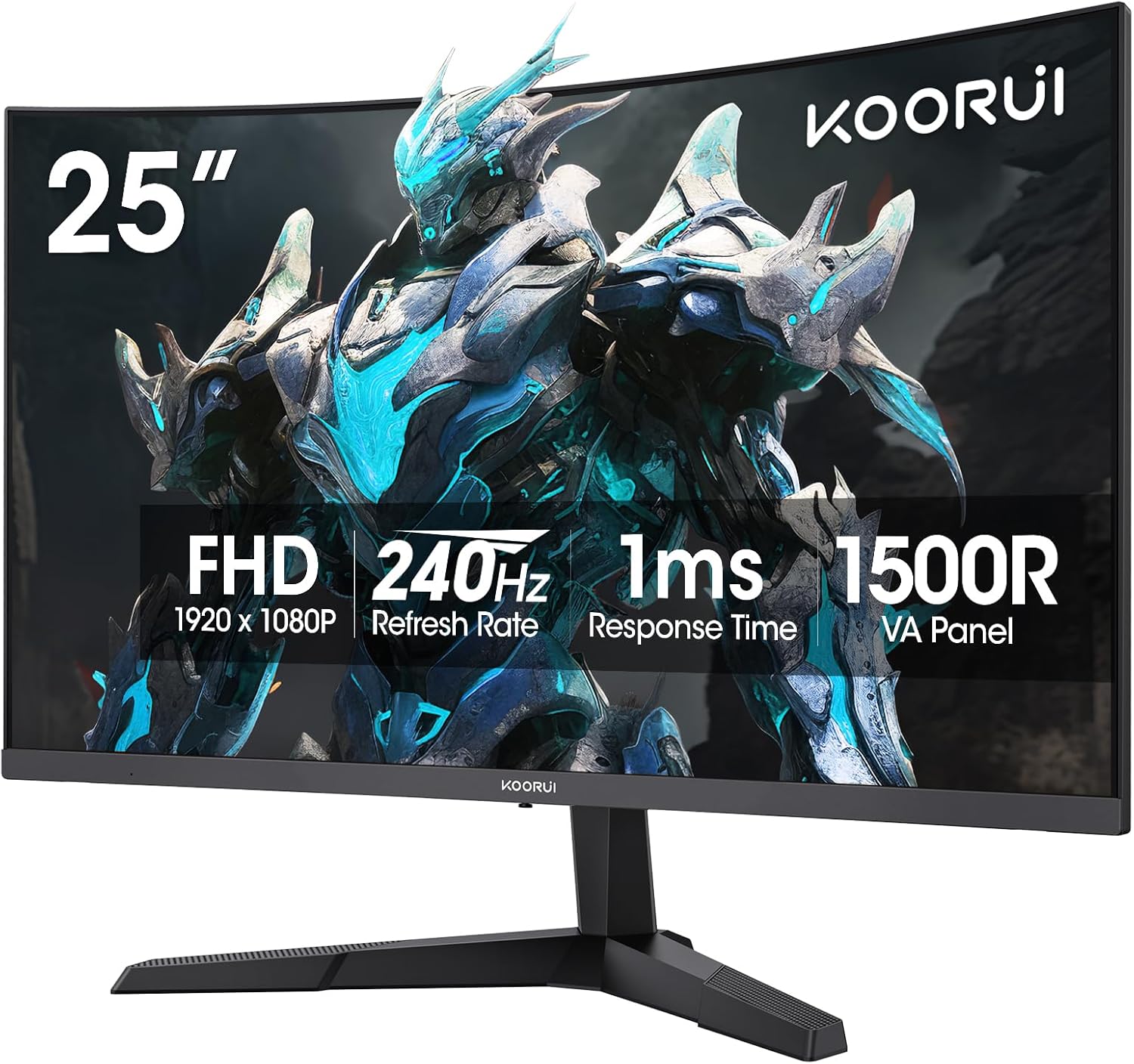
| KOORUI 27" QD-Mini LED (B0FBF7FCZW) | 4K on a stretch budget | QD-Mini LED | 3840×2160 | 144Hz | $250-300 |
| Dell G3223Q (B0B1319VJ4) | Top-of-budget 32" 4K | IPS | 3840×2160 | 144Hz | $280-320 |
🏆 Best Overall: HP 24mh FHD Monitor (B08BF4CZSV)
Price range: $130-150 · Resolution: 1920×1080 · Refresh: 75Hz · Panel: IPS
Per the Tom's Hardware HP 24mh review and the RTINGS HP 24mh analysis, this 23.8-inch IPS panel delivers accurate color out of the box (sRGB coverage measured at 96-99%), acceptable 5ms GtG response at 75Hz, and a low input lag figure (~10ms at 75Hz) that keeps it competitive against cheaper TN panels.
The built-in 2W speaker pair is genuinely useful for secondary displays and home-office setups. HDMI 1.4 and DisplayPort 1.2 inputs cover all current GPU outputs; VGA is also present for legacy hardware. The stand offers tilt only — no height adjustment — which is the primary ergonomic limitation at this price. A third-party VESA mount ($15-20) solves it.
Pros:
- Sub-$150 street price with reliable availability
- IPS color accuracy outperforms TN competition at the price
- Built-in speakers for secondary monitor use
- FreeSync support (works as G-Sync Compatible on NVIDIA)
Cons:
- 75Hz — not for competitive esports
- No height adjustment on the stand
- 8-bit panel (6-bit + FRC at budget tier)
💰 Best Value: KOORUI 27" QD-Mini LED (B0FBF7FCZW)
Price range: $250-300 · Resolution: 3840×2160 · Refresh: 144Hz
When the budget stretches to 4K, the KOORUI 27-inch QD-Mini LED is an unusual value proposition: QD (Quantum Dot) Mini LED backlighting at this price class normally requires spending $500+. The higher contrast from Mini LED local dimming makes HDR content visibly better than the HP 24mh's flat-backlight IPS.
The tradeoff: QD-Mini LED at this price point uses a lower zone-count backlight that can exhibit blooming on bright objects against dark backgrounds. For gaming in primarily bright scenes (racing games, open-world daylight, FPS maps), this isn't visible. For dark survival horror or movie-watching, the blooming is noticeable.
⚡ Best Performance: Dell G3223Q 32-Inch 4K (B0B1319VJ4)
Price range: $280-320 · Resolution: 3840×2160 · Refresh: 144Hz · Panel: IPS
The Dell G3223Q is a 32-inch 4K IPS at 144Hz — the kind of specification sheet that would have cost $600-800 in 2022. At $280-320 in 2026 it represents legitimate price compression. Per Dell's spec sheet, the G3223Q covers 95% DCI-P3 color gamut, supports DisplayPort 1.4 (required for 4K 144Hz without DSC), and carries AMD FreeSync Premium Pro certification.
32 inches at 4K delivers 138 PPI — dense enough for sharp text at normal viewing distances (~60-80cm) without needing display scaling, and wide enough that gaming feels immersive without a ultrawide.
The GPU requirement is real: pushing 4K at 144Hz demands a card in the RTX 4070 / RX 7800 XT class or better. Pairing this with an RTX 3060 means targeting 60-100fps depending on the title, not 144Hz. Size the GPU to the monitor, not the other way around.
What to look for in a budget gaming monitor
Panel type: IPS is the default pick in 2026. IPS now dominates the budget tier. The historic IPS disadvantage—slower response time than TN—has largely closed for monitors above 75Hz. Unless you're targeting sub-4ms GtG for the most competitive esports play, IPS beats TN on color accuracy, viewing angle, and everyday usability.
VA panels offer better contrast ratios (3000:1 vs 1000:1 typical for IPS) and are worth considering for dark-room gaming or media consumption. The notable VA limitation is smearing on fast dark-to-dark transitions—evident in fast-paced games with dark environments but less visible in brightly lit titles.
Refresh rate reality check. The 75Hz vs 144Hz vs 165Hz decision depends on your GPU and your games. Per RTINGS' input lag methodology, 75Hz monitors at $130-150 deliver lower input lag than 60Hz displays but don't approach the motion clarity of 144Hz+ panels. If your GPU can consistently push 100+ FPS in your primary game (check framerate data on TechPowerUp or similar), a 144Hz panel is a meaningful upgrade.
HDR claims to ignore. "HDR400" certification on budget monitors means 400 nits peak brightness—enough to display the HDR signal, not enough to show HDR highlights meaningfully. True HDR requires 600+ nits with local dimming (Mini LED or OLED). Ignore HDR marketing on monitors below $350 unless you verify the nit count and local dimming zone count.
Response time spec vs real GtG. Manufacturers advertise "1ms" response on budget monitors via OD (overdrive) acceleration. Real-world GtG measured at RTINGS typically lands 4-6ms for budget IPS at 75Hz—acceptable for casual gaming, not equivalent to true 1ms. Check RTINGS or Tom's Hardware for measured numbers before trusting spec-sheet claims.
Adaptive sync: take it for free. FreeSync (AMD's adaptive sync) now costs essentially nothing on budget monitors and eliminates tearing between 48-75Hz (or 48-144Hz on higher refresh panels). NVIDIA's "G-Sync Compatible" certification covers most FreeSync monitors for RTX users. Always buy with adaptive sync at this price class—it's included at no premium.
Panel spec comparison
| Spec | HP 24mh | KOORUI 27" QD | Dell G3223Q |
|---|---|---|---|
| Size | 23.8" | 27" | 32" |
| Resolution | 1920×1080 | 3840×2160 | 3840×2160 |
| Panel type | IPS | QD-Mini LED | IPS |
| Refresh rate | 75Hz | 144Hz | 144Hz |
| Response (GtG) | ~5ms | ~4ms | ~4ms |
| Contrast ratio | 1000:1 | 1500:1+ | 1000:1 |
| Adaptive sync | FreeSync | FreeSync Premium | FreeSync Premium Pro |
| Inputs | HDMI 1.4, DP 1.2, VGA | HDMI 2.1, DP 1.4 | HDMI 2.1, DP 1.4 |
| Street price | $130-150 | $250-300 | $280-320 |
When to skip budget and spend more
The $300 ceiling makes sense for: secondary monitors, HTPC displays, student gaming PCs, and any build where the GPU is below RTX 3070 / RX 6700 XT. Beyond that threshold, you're leaving measurable performance on the table.
If your GPU is an RTX 4070 or better, the 27-inch 1440p 165Hz segment ($280-350) is almost certainly a better buy than any 1080p panel — the pixel density step from 1080p to 1440p at 27 inches (109 to 123 PPI) is visible at normal viewing distances, and 165Hz closes the smoothness gap versus 4K 60Hz in motion-heavy titles.
Common pitfalls
Buying by marketing spec, not measured spec. A "1ms" budget monitor is not a 1ms monitor in practice — it's 4-6ms GtG under realistic overdrive settings. Check RTINGS before purchasing.
Mismatched resolution and GPU. A 4K monitor driven at 1080p via GPU scaling looks noticeably softer than a native 1080p panel at the same size. If your GPU can't drive 4K, buy a 1080p display.
Missing DisplayPort for high refresh 4K. HDMI 2.0 tops out at 4K 60Hz. 4K 144Hz requires HDMI 2.1 or DisplayPort 1.4. Verify your GPU and cable support the bandwidth before buying a high-refresh 4K monitor.
Related guides
- /buying-guide/pc-gaming — Full PC gaming hardware guide
- /reviews/qwen-3-6-27b-rtx-3060-12gb-backend-quant-2026 — GPU guide for AI workloads
Citations and sources
- Tom's Hardware HP 24mh FHD Monitor review
- RTINGS HP 24mh monitor review
- DisplayNinja best budget gaming monitor guide
This piece is editorial synthesis based on publicly available information. No independent first-party benchmarking is reported.
SpecPicks Editorial · SpecPicks

