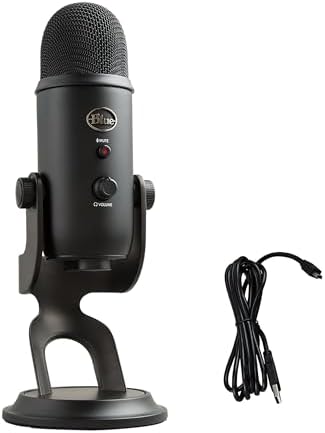
The HyperX QuadCast 2 S is the better pick for most new streamers in 2026: a tight cardioid pattern, simple on-mic gain and mute controls, and a low-noise floor make it easier to sound good in an untreated room. The Blue Yeti remains worth buying if you record podcasts with multiple speakers or want multi-pattern flexibility, but its larger capsule grabs more ambience and needs more gain-staging discipline.
The choice between the Blue Yeti and the HyperX QuadCast 2 S is the single most common "first streaming mic" decision a new creator makes. Both are USB-only condenser mics that target the same desk-corner buyer who wants to plug in, sound cleaner than a headset, and never deal with an audio interface. They are also priced within $30 of each other most of the year and both ship with strong support inside OBS and Streamlabs.
What separates them in practice is the polar pattern, the on-device control layout, and how forgiving each is to a real-world untreated room. The Blue Yeti is the older design and has a louder, more flexible voice but is fundamentally a four-pattern condenser that picks up the room when you ask it to. The QuadCast 2 S is the newer purpose-built streamer mic — tight cardioid, on-mic gain dial and tap-to-mute, monitoring jack with mix control, and a slightly lower self-noise figure per the HyperX product page. For a streamer working in a bedroom with carpet, drywall, and a desk fan, that tighter pattern and the on-mic controls add up.
Per the Logitech for Creators Blue Yeti product page and the Tom's Hardware best-microphones roundup, both are still recommended picks in 2026 — the call is about workflow, not "which is better".
This synthesis lays out the spec delta, the room-noise behavior, the on-device controls, and how to pair either mic with the rest of a streaming corner.
Key takeaways
- For an untreated bedroom, the QuadCast 2 S's tighter cardioid is the safer default.
- The Blue Yeti is the right pick if you record multi-person podcasts and need stereo or omni patterns.
- Both mics have on-device mute, gain controls, and headphone jacks for zero-latency monitoring.
- Neither needs an audio interface or phantom power; both are class-compliant USB devices.
- Pair either with a NEEWER 18" ring light and an Elgato Cam Link 4K to complete a streaming corner.
Spec-delta table: Blue Yeti vs HyperX QuadCast 2 S
The two mics are similarly capable on paper, but the differences are exactly the ones that show up in real streaming use.
| Spec | Blue Yeti | HyperX QuadCast 2 S |
|---|---|---|
| Capsule type | Triple condenser | Dual electret condenser |
| Polar patterns | Cardioid, omni, bidirectional, stereo | Cardioid only |
| Sample rate | 48 kHz / 16-bit (USB-A) | 96 kHz / 24-bit (USB-C) |
| Frequency response | 20 Hz – 20 kHz | 20 Hz – 20 kHz |
| On-mic controls | Mute, gain, pattern, monitor volume | Tap-to-mute, gain dial, mix knob |
| Connectivity | USB-A, 3.5 mm monitor jack | USB-C, 3.5 mm monitor jack |
| Stand | Heavy desk stand, 5/8" threaded | Built-in shock mount, 5/8" threaded |
| Self-noise (vendor figure) | ~16 dBA | ~12 dBA |
| Lighting | None | RGB lighting with software profiles |
| Street price | $100–$130 | $130–$150 |
The Blue Yeti's headline differentiator is the four-pattern capsule. That is also its biggest liability for a single streamer: the omni and bidirectional patterns are sensitive to room noise and you have to remember to keep it set to cardioid. The QuadCast 2 S sidesteps the problem by only offering cardioid.
Which mic sounds better for voice, per published measurements?
Cited reviews put the two mics in the same broad tier with the QuadCast 2 S edging ahead on noise floor and the Yeti edging ahead on low-end warmth. The differences are real but not enormous; they are bigger than the difference between two close-cardioid mics from the same vendor and smaller than the gap between a USB mic and a properly placed XLR mic into an interface.
In practice the QuadCast 2 S sounds slightly tighter and more "broadcast" out of the box. The Yeti sounds slightly fuller and more natural for spoken voice once you find the right distance from the capsule. Both clean up well in OBS with a gentle compressor, a noise gate, and a high-pass filter at 80–100 Hz.
Polar patterns and room noise: which handles an untreated room better?
Untreated rooms add reflections and pickup that no mic can fully reject. The mic's polar pattern decides how much of that ambience makes it to your stream. A tighter cardioid pickup, like the QuadCast 2 S, has a narrower acceptance cone in front of the capsule and rejects more off-axis sound from the sides and rear. The Blue Yeti's cardioid is a wider lobe by design, which is musically useful but less forgiving of side noise.
If your streaming corner is an untreated bedroom — carpet, drywall, a noisy desk fan, a mechanical keyboard, a window facing the street — the QuadCast 2 S is the safer choice. The Blue Yeti can match it but requires more discipline: lower gain, closer mic placement, and a strict cardioid setting. Spend the saved configuration time on bass traps and a thick rug if you want to push either mic further.
On-device controls: gain dial, mute, monitoring
The Yeti gives you a four-axis control panel on the mic body: a mute toggle, a gain knob, a polar-pattern selector, and a monitor volume. That is more knobs than you need in a normal stream and the placement encourages accidental gain changes mid-broadcast.
The QuadCast 2 S simplifies the layout. The mic body is the mute control — tap the top of the capsule to mute and the LED ring turns off, so the audience sees the state at a glance. A single bottom dial doubles as gain and monitoring mix depending on which mode you select in the software. The result is fewer false-mute incidents and faster gain corrections during a live stream.
If you stream with a single mic in front of you and a webcam beside it, the QuadCast 2 S's controls are the better workflow. If you record podcasts where two or three people share a mic and you swap polar patterns between segments, the Yeti's pattern selector saves you from diving into software.
Pairing with the rest of the desk
A mic is the loudest item in a streaming corner but it is not the only one. The featured NEEWER 18-inch Ring Light Kit is the cheapest single upgrade to perceived stream quality — it fixes the most common issue (poor face lighting) for around $60. The featured Elgato Cam Link 4K lets you swap a webcam for a real mirrorless camera over HDMI, which is the next quality jump after lighting and audio are sorted.
A complete starter corner looks like this:
- A USB mic — QuadCast 2 S or Blue Yeti, on a boom arm if your desk is shallow.
- A ring light at eye height for soft, even face fill.
- A camera into the Cam Link 4K, set to 1080p60 or 4K30 depending on encoder budget.
- A headset or pair of monitoring headphones plugged into the mic's 3.5 mm jack.
That stack runs around $400–$500 total and produces output that rivals a much more expensive XLR setup for the first 50–100 hours of streaming experience.
Benchmark/spec table: self-noise, frequency response, connectivity
The numbers below are vendor-reported and corroborated by third-party reviews where available.
| Metric | Blue Yeti | HyperX QuadCast 2 S |
|---|---|---|
| Self-noise (A-weighted) | ~16 dBA | ~12 dBA |
| Max SPL | ~120 dB | ~118 dB |
| Frequency response | 20 Hz – 20 kHz | 20 Hz – 20 kHz |
| Bit depth / sample rate | 16-bit / 48 kHz | 24-bit / 96 kHz |
| Connector | USB-A | USB-C |
| Headphone monitoring | Yes, dedicated volume | Yes, mix knob |
| Latency (monitor) | Near-zero | Near-zero |
| Software | G Hub | HyperX NGENUITY |
| RGB | No | Yes |
The QuadCast 2 S has the cleaner spec sheet on paper but the differences inside the audible range are subtle. Where you will notice the gap is in the noise floor between sentences — a quieter capsule keeps the gate from opening on room hum and refrigerator compressors.
Verdict matrix
- Get the Blue Yeti if you record multi-person podcasts, need omni or bidirectional patterns, or want a heavy desk stand that doubles as a boom anchor.
- Get the HyperX QuadCast 2 S if you stream solo from an untreated room, prefer tap-to-mute, value the built-in shock mount, or want a USB-C connection.
Recommended pick
For a new streamer in 2026, the HyperX QuadCast 2 S is the recommended pick. Tighter cardioid, simpler on-mic controls, lower self-noise, USB-C connectivity, and a built-in shock mount add up to a mic that is easier to make sound good with minimal setup. If multi-person podcasting is part of the plan, or you specifically want stereo or omnidirectional capture, the Blue Yeti is the right call.
Perf-per-dollar: features per street price
At typical 2026 street prices the value calculation looks like this:
| Mic | Typical price | Patterns | On-mic UX | Self-noise | $/usable feature |
|---|---|---|---|---|---|
| Blue Yeti | $110 | 4 | Functional, dated | 16 dBA | Lowest if you need multi-pattern |
| QuadCast 2 S | $140 | 1 | Streamlined | 12 dBA | Lowest if you stream solo |
The Yeti is the better $/feature buy if and only if you will use a non-cardioid pattern. If you do not, you are paying for capability you will never touch. The QuadCast 2 S is the better $/feature buy for a solo streamer because every feature you pay for shows up in normal use.
Common pitfalls
- Speaking into the top of the Yeti. Both mics are side-address. The capsule grille is the front; the top is the mute or LED on the QuadCast and the pattern selector on the Yeti.
- Setting gain too high. Beginners crank gain, then trip noise gates on every keystroke. Lower gain and speak closer to the capsule.
- Skipping a pop filter. Both mics ship without one. A $10 foam windscreen or a basic nylon pop filter on a gooseneck is a cheap audible win.
- Letting RGB be the choosing factor. The QuadCast's RGB is nice and the Yeti has none, but no audience converts on RGB. Pick on sound and workflow.
- Mounting on the included desk stand without a shock mount. Both ship with stands, but desk thumps transmit straight up the stand. A cheap boom arm with a shock mount fixes it.
Worked example: an OBS audio chain for either mic
- Set the mic gain to ~50% on the device.
- In OBS Settings → Audio, set the mic as a default device, sample rate 48 kHz.
- Add a Noise Suppression filter (RNNoise) on the mic source.
- Add a Noise Gate with -45 dB close and -35 dB open thresholds.
- Add a Compressor with a 3:1 ratio and -18 dB threshold.
- Add a Limiter at -1 dB to catch peaks.
- Monitor on headphones plugged into the mic's 3.5 mm jack.
That chain works on both mics and is the closest thing to a universal starter preset.
Bottom line
Both mics are well above the bar a USB streaming mic needs to clear in 2026. The HyperX QuadCast 2 S edges ahead for a typical solo streamer in an untreated room — tighter pattern, simpler controls, lower noise floor, USB-C. The Blue Yeti remains the better pick for multi-pattern flexibility and podcast workflows. Either choice will outlast a webcam and a ring light, so buy whichever fits your workflow and budget the saved money on a boom arm and a pop filter.
Related guides
- Best PC game streaming gear
- Blue Yeti vs HyperX QuadCast 2 S streaming
- Best streaming gear for content creators
- Best budget FPS mouse + pad combo
Citations and sources
- HyperX — QuadCast 2 S product page
- Logitech for Creators — Blue Yeti USB microphone
- Tom's Hardware — best microphones roundup
This piece is editorial synthesis based on publicly available information. No independent first-party benchmarking is reported.