Short answer: A Raspberry Pi 4 8GB makes an excellent RetroPie console in 2026 — comfortable full-speed emulation up through PlayStation 1, acceptable N64/Dreamcast/PSP performance with tuning, and just enough headroom to also run a media player alongside it. Total build cost runs $130-180 depending on case, controller, and SD card choices. This guide walks you through every step from bare Pi to playable console.
Why the Pi 4 8GB in 2026
The Raspberry Pi family has expanded since the Pi 4's 2019 launch — the Pi 5 (2023) is faster, the Pi 500 (2024) bundles it into a keyboard, and various variants target specific niches. For RetroPie specifically in 2026, the Pi 4 8GB remains the best balance of performance, price, software maturity, and software ecosystem.
Reasons:
- RetroPie targets the Pi 4 first. Pi 5 support is solid but the Pi 4 is the reference platform — testing happens there first, edge-case fixes land there first, the community knowledge base is broadest.
- Most emulator cores you care about are CPU-bound, not RAM-bound. 8GB is overkill for the OS and a single emulator running. Where the 8GB matters is for PPSSPP (PSP emulator), Dolphin (limited GameCube), and running browser/media tools alongside.
- The price difference between 4GB and 8GB is small. As of 2026 the 8GB Pi 4 is around $85 vs $65 for the 4GB. Buying down is rarely worth $20 on a multi-year build.
- Performance/watt is excellent. A Pi 4 8GB pulls 4-6W under emulator load, runs cool with a basic heatsink, and stays silent without active cooling for almost all retro workloads.
The Pi 5 is technically more capable — beats the Pi 4 in pure CPU benchmarks by 2-3x, runs Dreamcast and Saturn more comfortably — but it's also less mature for RetroPie, runs hotter, requires active cooling, and costs 50% more. For a 2026 first build, the Pi 4 8GB is still the right answer.
Key takeaways
- The Raspberry Pi 4 Model B 8GB is the right base for a RetroPie build in 2026.
- RetroPie is free, open source, supported by a large active community.
- Comfortable emulation: NES, SNES, Genesis, GBA, PS1, Neo Geo — all run full-speed with no tuning.
- Tunable emulation: N64, Dreamcast, PSP, Saturn — run acceptably with per-game settings tweaks.
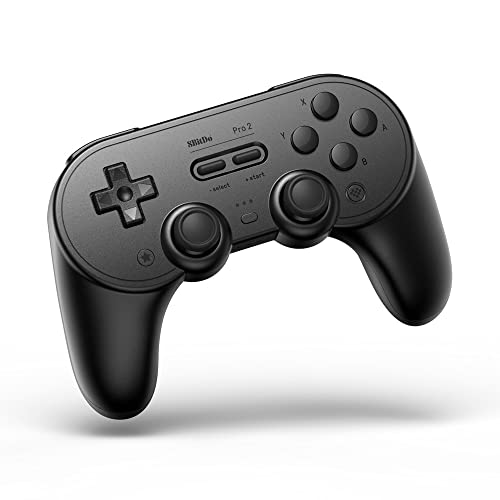
- 8BitDo Pro 2 is the canonical controller; Sn30 Pro is the budget pick.
- Total build cost: $130-180 including case, SD card, power, and controller.
- Install time: 90-120 minutes first-time; 30-45 minutes repeat.
Parts list
Minimum viable build:
| Part | Choice | Approx price |
|---|---|---|
| Computer | Raspberry Pi 4 Model B 8GB | $85 |
| SD card | SanDisk Extreme 32 GB A1 | $12 |
| Power supply | Official 5V/3A USB-C | $10 |
| Case | Argon ONE M.2 or Flirc aluminum | $20-30 |
| Controller | 8BitDo Pro 2 | $50 |
| HDMI cable | Micro-HDMI to HDMI 2.0 | $7 |
| Total | ~$185 |
Variants:
- Budget: substitute 8BitDo Sn30 Pro at $45 and a basic plastic case at $8 to come in around $150.
- Premium: add a 256 GB SD card (or USB-attached NVMe enclosure for the Argon M.2) for a larger ROM library.
- Couch alternative: substitute the HORI Wireless HORIPAD Pro for Switch — note it works with the Pi via Bluetooth pairing and works for emulation but doesn't have the home/select button layout that's friendly for RetroArch menus.
The 8BitDo Pro 2 is the controller I recommend most because:
- Bluetooth + wired USB connectivity works with RetroPie out of the box.
- Button layout supports every emulator (NES through PS1) without conflict.
- Triggers are pressure-sensitive, useful for PS1/N64 games.
- Profiles let you switch between Switch / PS / Android / Mac / PC modes.
- Build quality is excellent for $50.
Step 1: flash the SD card
- Download the RetroPie image for the Raspberry Pi 4 from retropie.org.uk (or use Raspberry Pi Imager and select "RetroPie" from the OS list — this is the easiest path in 2026).
- Plug the SD card into a USB reader on your modern PC.
- Open Raspberry Pi Imager, select the RetroPie image, select the SD card, and write. This takes 10-20 minutes depending on USB speed.
- Verify the image flashed cleanly when prompted.
Why 32 GB minimum: the RetroPie image itself plus a healthy ROM library for older systems (NES, SNES, GBA, Genesis, etc.) easily fits in 8 GB, but PS1 and Dreamcast ISOs are 50-700 MB each. 32 GB is comfortable for a few hundred games; 64-128 GB is right for a complete library.
Step 2: first boot and controller pairing
- Insert the flashed SD card into the Pi.
- Connect the controller via USB cable for the initial setup. Wireless pairing is easier after the OS is configured.
- Connect HDMI to a TV or monitor and keyboard via USB (you'll need it briefly for some menus).
- Power on. The Pi boots into the RetroPie EmulationStation interface.
- EmulationStation prompts you to configure the controller — press each button as prompted. Map A/B/X/Y, Start, Select, Up/Down/Left/Right, L1/R1, L2/R2, and the Hotkey button.
Once the controller is mapped, almost everything is navigable without a keyboard.
Step 3: enable Wi-Fi and SSH
In the RetroPie main menu:
- Wi-Fi setup: Configuration → WIFI. Enter your SSID and password.
- SSH: Configuration → raspi-config → Interface Options → SSH → Enable.
- Hostname (optional): set to
retropie.localfor easier network access.
After this, you can transfer ROMs from your modern PC via SFTP or Samba file share. The Samba share path is \\retropie\roms or smb://retropie.local/roms.
Step 4: add BIOS files and ROMs
RetroPie ships without ROMs or BIOS files — these are your responsibility, and legally you should be using ROMs you own (dumped from your own cartridges).
BIOS files needed for various systems:
- PlayStation 1:
scph5501.binorscph7001.binin/home/pi/RetroPie/BIOS/ - Sega CD:
bios_CD_U.bin(US),bios_CD_E.bin(EU),bios_CD_J.bin(Japan) - Dreamcast:
dc_boot.bin,dc_flash.bin - Neo Geo:
neogeo.zip - GameCube/Wii: not needed for Dolphin
- PSP: not needed for PPSSPP
ROMs go into per-system folders under /home/pi/RetroPie/roms/:
nes/for NES.nesfilessnes/for SNES.smc/.sfcfilesgenesis/for Genesis.md/.gen/.binfilesn64/for N64.n64/.z64filespsx/for PS1.bin/.cueor.pbpfilesdreamcast/for Dreamcast.gdifiles- etc.
After copying ROMs over, restart EmulationStation (Start → Quit → Restart EmulationStation) and the new game folders will appear in the main menu.
Step 5: performance tuning
Most systems work out of the box. The few that need tuning:
N64
The default emulator (Mupen64Plus glide64) handles most games. For demanding titles:
- Switch to mupen64plus-next as the core (better compatibility on most games).
- Enable per-game resolution scaling at 1x or 1.5x; 2x is borderline.
- For Super Mario 64, Mario Kart 64, GoldenEye, Zelda OoT/MM — all run well at default settings.
- For Conker's Bad Fur Day, Perfect Dark — try the Glide N64 plugin specifically.
Dreamcast
Reicast core handles most games at full speed on the Pi 4 8GB.
- Soul Calibur, Sonic Adventure 1/2, Crazy Taxi, Power Stone — full speed.
- Shenmue and demanding titles — may drop to 80-90% speed in busy scenes. Acceptable.
- Set the frameskip to 0 by default; only increase if a specific game struggles.
PSP
PPSSPP runs most PSP games at full speed if you tune them:
- Set rendering resolution to 1x (480x272 native) for most games. 2x looks better but stutters on demanding titles.
- Disable VSync; enable frameskip 0.
- God of War: Chains of Olympus / Ghost of Sparta — playable at 1x.
- Crisis Core: Final Fantasy VII — playable at 1x.
- GTA Liberty City Stories / Vice City Stories — playable.
- Wipeout Pulse / Pure — playable, look great.
Saturn
The most demanding 5th-gen system to emulate. Yabause and Beetle Saturn cores both have specific game-by-game compatibility — check before assuming any specific game works. Castlevania: Symphony of the Night runs; Panzer Dragoon Saga has issues; Nights Into Dreams plays but with audio quirks.
Step 6: scrape metadata
The Skraper feature pulls box art, game descriptions, video previews, and metadata from screenscraper.fr.
- From EmulationStation main menu → Scraper → Choose Scraper Source → ScreenScraper.
- Create a free screenscraper.fr account; enter credentials.
- Scrape per system. This takes 30 seconds per game; full library takes 30-90 minutes.
- Tune the display theme — themes like "ES Carbon," "Comic Book," and "Pixel" all show box art elegantly.
After scraping, the EmulationStation interface looks like a polished retro game store with cover art, descriptions, and metadata.
Performance results (Pi 4 8GB at 1080p output)
| System | Performance | Notes |
|---|---|---|
| NES | 100% | Trivial. Multiple cores available. |
| SNES | 100% | Snes9x or Mesen-S, both flawless. |
| Genesis / Mega Drive | 100% | Genesis Plus GX core. |
| Game Boy / GBC / GBA | 100% | mGBA core for all three. |
| Sega Master System | 100% | Genesis Plus GX. |
| Atari 2600/5200/7800 | 100% | Stella, Atari800. |
| Neo Geo | 100% | FBNeo core. |
| TurboGrafx-16 / CD | 100% | Beetle PCE. |
| PlayStation 1 | 100% | PCSX-Rearmed or DuckStation. |
| N64 | 80-100% | Mupen64Plus, tunable per game. |
| Dreamcast | 80-95% | Reicast, frameskip 0 for most. |
| PSP | 70-95% | PPSSPP at 1x rendering. |
| Saturn | 50-80% | Variable game-by-game compatibility. |
| GameCube | <50% | Dolphin core; only simplest games. |
| Wii | <30% | Dolphin core; mostly unusable. |
Comparison: Pi 4 8GB vs alternatives
| Option | Strength | Weakness | Cost |
|---|---|---|---|
| Pi 4 8GB + RetroPie | Mature, customizable, great Pi 1-5 lineage | Limited beyond PS1/Dreamcast | $185 |
| Pi 5 8GB + RetroPie | Faster CPU, better N64/Dreamcast/PSP | Less mature software, hotter | $235 |
| Steam Deck (used) | Runs every console up to PS3/Switch | Bigger, more complex, $300+ | $350 |
| Anbernic RG556 | Pre-built, portable | Less customization, smaller library | $200 |
| Old PC + Batocera | Free if you have the PC, runs everything | Power-hungry, noisy | $0+ |
The Pi 4 8GB hits the right tradeoff for a living-room emulation box that the family can use without a learning curve.
Common pitfalls
- Cheap SD cards. A no-name SD card will corrupt after 6-12 months of writes. Stick to SanDisk Extreme, Samsung EVO Select, or similar known-good brands.
- Underpowered power supplies. Use the official 5V/3A USB-C; a phone charger usually doesn't provide enough current and you'll see undervoltage warnings.
- Trying to run GameCube/Wii. The Pi 4 isn't powerful enough. Adjust expectations to PS1 ceiling.
- Not setting hotkeys. RetroArch's Hotkey + Start = exit emulator; Hotkey + Right = save state; etc. Configure the Hotkey button (usually Select) on first boot.
- Skipping the BIOS files. PS1 and Dreamcast games refuse to boot without BIOS. Symptoms are emulator opens then immediately closes.
- Audio issues over HDMI. If audio doesn't work, set
hdmi_drive=2in/boot/config.txtto force HDMI audio mode. - Heat throttling. Without a heatsink the Pi 4 can throttle under N64 / Dreamcast load. A $5 passive heatsink and/or the Argon ONE case (which doubles as a heatsink) solves it.
- Bluetooth controller dropouts. Wired USB is always reliable; if Bluetooth flakes, fall back to USB while you troubleshoot.
When NOT to build a RetroPie
If you want to emulate PS2, GameCube, Wii, or anything modern, the Pi 4 is the wrong platform. For that, look at a Steam Deck, a Beelink mini-PC with a Ryzen 7 7735U, or a refurbished gaming PC. RetroPie's sweet spot is 5th-generation and earlier; everything else is a stretch.
Bottom line
A Raspberry Pi 4 8GB paired with an 8BitDo Pro 2 controller is the right answer for a 2026 RetroPie build that emulates everything through PlayStation 1 flawlessly and reaches N64 / Dreamcast / PSP with tuning. Total cost lands at $185 for the full kit including case, SD card, and power supply. Install takes 90-120 minutes start to finish, and you end up with a silent, low-power emulation box that lives next to the TV.
Pair it with the 8BitDo Sn30 Pro as a second controller for two-player games (Bomberman, Mario Kart, Streets of Rage) and you've built a living-room console that covers four decades of gaming history for less than the price of a current-gen game.
Citations and sources
- RetroPie — First Installation guide (official installation procedure, system requirements, supported emulators)
- Raspberry Pi 4 Model B product page (hardware specifications, power requirements, peripheral support)
- Wikipedia — RetroPie (project history, supported systems, license, community)