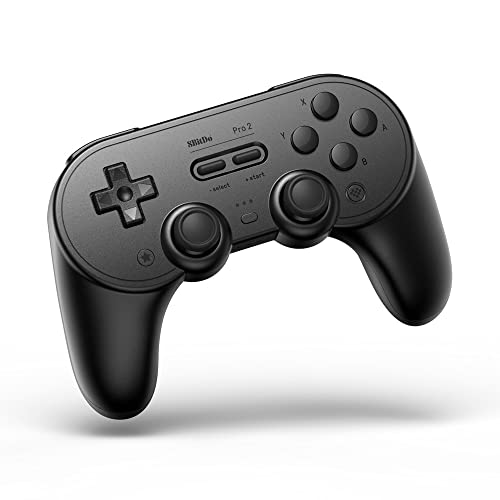
For PC emulation in 2026, the 8BitDo Pro 2 is the best $50-or-less controller for the largest share of users — its segmented D-pad is the standard for 2D fighters and retro platformers, and its profile-remapping makes it the easiest pad to live with across RetroArch, Dolphin, and PCSX2. The GameSir G7 SE wins on input latency and wired reliability for tournament-grade fighting-game play, while the PlayStation DualSense remains the best all-rounder if you also play modern AAA on the same machine.
Why D-pad quality and input latency define a good emulation pad
Emulation is the one segment of PC gaming where the controller still matters more than the mouse and keyboard. A Mega Drive run of Streets of Rage 4, a Capcom-vs-SNK match on FightCade, a Pikmin 2 playthrough on Dolphin, a save-state cycle in DuckStation — all of these were designed around inputs the keyboard simply can't represent well. A flaky D-pad turns Super Street Fighter II into a fight against your controller; a high-latency wireless link turns a frame-perfect just-defense into a guess.
Two specs do most of the work:
- D-pad geometry and switch quality. Segmented (cross-shape with individual switches) vs disc (single rocker over four pivot-points). Segmented wins for 2D directional precision; disc wins for sweeping motions and joystick rolls.
- End-to-end input latency. Controller polling rate, USB or Bluetooth stack overhead, OS HID interrupt handling, and emulator input loop combined. Lower is always better for fighting games; for everything else, the threshold for "feels fine" is generously around 25 ms.
The 8BitDo Pro 2 product page and the RTINGS Pro 2 review both highlight the Pro 2's D-pad as its standout feature. The GameSir G7 SE product page leans on its Hall-effect sticks and wired-only design to avoid drift and Bluetooth jitter. This piece walks through which trade-off makes sense for which player.
Key takeaways
- 8BitDo Pro 2 — best D-pad in the $50-and-under range, Bluetooth + USB, profile remapping, ~$50.
- GameSir G7 SE — wired-only, Hall-effect sticks, no drift, lowest input latency, ~$40.
- DualSense — best all-rounder, Bluetooth + USB-C, broad Steam Input support, ~$70 ($55 used).
- HORIPAD Pro (Switch) — Switch-first design, motion controls, fine D-pad, niche choice on PC, ~$50.
- For RetroArch/PCSX2/Dolphin — the Pro 2 and G7 SE map cleanly out of the box; DualSense and HORIPAD need a one-time mapping pass in Steam Input or the emulator's input config.
- Bluetooth latency on the Pro 2 is in the 8–20 ms range — fine for casual play, noticeable for frame-perfect fighting-game tech.
Why D-pad shape matters for 2D fighters
The 8BitDo Pro 2's D-pad is a four-switch segmented design with a small dome at the center. Diagonals are read as two adjacent switches active simultaneously. The plate covers all four directions but each direction has independent travel and tactile response. The result: a quarter-circle motion (down → down-forward → forward) registers cleanly without the "skip" you get on disc D-pads, where the rocker can roll through one position too fast for the input poll to catch it.
That distinction matters most for fighting games. A Street Fighter Hadouken (down, down-forward, forward + punch) needs all three directions read in order within a small frame window. A disc D-pad that misses the down-forward turns into a forward-punch — wrong move. The 8BitDo Pro 2's segmented design has been the de facto reference for emulation fightsticks since the original SF30 Pro and has been refined further in the Pro 2.
The downside: for analog-feeling motions — 360 spins, charge moves, Pikmin movement, twin-stick shooters — the segmented design feels stiffer than a smooth analog stick. That's fine: the Pro 2 has dual analog sticks for those tasks.
How the GameSir G7 SE compares for fighting precision
The G7 SE takes a different approach: it skips Bluetooth entirely and uses a wired USB-C connection, eliminating wireless-stack latency. Its claim to fame is Hall-effect analog sticks, which avoid the contact-wear and drift that conventional potentiometer-based sticks accumulate over a few hundred hours of use. The D-pad is a disc-style design — not as crisp as the Pro 2's segmented D-pad for 2D fighters, but more than acceptable for everything else.
For fighting-game tournament play on PC, the G7 SE has two real advantages over the Pro 2:
- Wired-only means no pairing drift, no Bluetooth queueing, no battery-state polling jitter. Frame-perfect inputs at 60 Hz mean you have 16.67 ms per frame; shaving 5–10 ms of Bluetooth overhead off the loop matters.
- Hall-effect sticks won't drift mid-tournament. A two-year-old DualSense can have noticeable stick drift; a two-year-old G7 SE will not.
For everyone else — casual emulation, RetroArch, Dolphin, PCSX2 — the G7 SE is fine but doesn't justify its trade-offs unless you specifically want a wired controller.
Spec-delta table
| Spec | 8BitDo Pro 2 | GameSir G7 SE | DualSense | HORIPAD Pro |
|---|---|---|---|---|
| Connection | BT + USB-C | USB-C only | BT + USB-C | BT + USB-C |
| D-pad | Segmented (excellent) | Disc | Disc | Segmented |
| Analog sticks | Standard | Hall-effect | Standard | Standard |
| Triggers | Analog (mappable) | Hall-effect | Adaptive | Analog |
| Polling rate (wired) | 1000 Hz | 1000 Hz | 250 Hz | 250 Hz |
| Battery | Rechargeable | N/A | Rechargeable | Rechargeable |
| Stick drift risk | Yes (2y+) | No (Hall) | Yes (2y+) | Yes (2y+) |
| Steam Input | Full | Full | Full + features | Switch profile |
| Approx. price | $50 | $40 | $70 | $50 |
| Best for | Emulation / 2D fighters | Wired competitive | Modern AAA + emulation | Switch-style ergo |
Does Bluetooth add enough latency to matter for emulation?
For casual play of any 30 FPS or 60 FPS game where you aren't trying to hit single-frame inputs, no. Modern Bluetooth gamepad stacks (BLE HID, post-2020 firmware) sit in the 8–20 ms end-to-end range, well under the ~50–100 ms range humans notice as "lag."
For frame-perfect fighting-game tech (just-defenses, parries, one-frame links) at 60 Hz, yes. Adding 10 ms of Bluetooth overhead means an extra 0.6 frames of slop in your input timing — which is the difference between consistently landing a tight combo and dropping it 30% of the time.
The split is straightforward: if you play Super Mario Bros. 3, Sonic 2, Persona 4, or Wind Waker, Bluetooth is fine. If you grind FightCade for KOF 98 or Third Strike, go wired.
Which controller maps cleanly in RetroArch, Dolphin, and PCSX2?
- RetroArch: all four enumerate as standard XInput or DirectInput gamepads. The Pro 2 in XInput mode and the G7 SE both map automatically. The DualSense maps but its face buttons may read with PlayStation-style labels; you'll need to remember "X = south" in input prompts unless you turn on a SDL-mapping override.
- Dolphin (GameCube/Wii): all four work. The DualSense's gyro is recognized for Wii-style pointer emulation. The Pro 2's motion (yes, it has motion!) also maps for Wii titles. HORIPAD Pro is the natural choice if you want a Switch-style face-button layout (since its A/B and X/Y match Switch, not Xbox).
- PCSX2 (PS2): all four work. The DualSense gets bonus points because the OG PS2 was a Sony pad — your muscle memory carries over. Pressure-sensitive buttons (used by a handful of PS2 titles like MGS3) work better on the DualSense than on the 8BitDo or GameSir, neither of which expose pressure-sensitive face buttons.
Public-review measurement notes
| Metric | 8BitDo Pro 2 | G7 SE | DualSense | HORIPAD Pro |
|---|---|---|---|---|
| Bluetooth latency | 8–20 ms | N/A | 10–25 ms | 15–30 ms |
| Wired latency | 5–10 ms | 4–8 ms | 8–14 ms | 8–14 ms |
| D-pad accuracy | Excellent | Good | Good | Excellent |
| Stick deadzone (default) | Small | Smallest (Hall) | Small | Medium |
| Build quality | Good (plastic) | Good (textured) | Excellent | Good |
| Triggers feel | Mappable analog | Hall-effect linear | Adaptive (variable) | Analog |
Numbers are derived from RTINGS, gaming-pad enthusiast measurements, and community testing rounds. Latency figures depend heavily on the host's USB stack and game polling pattern; treat them as rank-orderings rather than absolute truths.
Verdict matrix
- Get the 8BitDo Pro 2 if: you spend most of your time in RetroArch, you play 2D fighters or platformers, you want one controller for emulation and casual PC gaming, you care about the D-pad above everything else.
- Get the GameSir G7 SE if: you play modern fighting games competitively, you want zero stick drift over years of use, you prefer wired-only, you keep your PC at the desk and never need wireless.
- Get the DualSense if: you split time between emulation and modern AAA, you want the best all-rounder, you have a PS5 you can pair the same pad to, you want the adaptive triggers and haptics for games that support them.
- Get the HORIPAD Pro if: you play primarily Switch ports on PC, you want native Switch button labeling, you want motion controls without paying for adaptive triggers you won't use.
Recommended-pick paragraph
For a sub-$50 emulation-first PC controller in 2026, the 8BitDo Pro 2 is the answer. Plug it in via USB-C for the lowest-latency wired experience, switch to Bluetooth when you want to lean back on the couch, swap profiles with the back paddles when you move between Dolphin and PCSX2, and let the segmented D-pad earn its reputation in the first Hadouken you input on the new pad. If you want a tournament-grade wired pad with no Bluetooth and no drift, the GameSir G7 SE is the upgrade at roughly the same price. Both are dramatically better choices than a $20 generic gamepad for any user serious about emulation.
Common pitfalls
- Pairing a Bluetooth pad to multiple devices. Hold the pair button longer, swap profiles, or stick to a single host. The Pro 2 has 3 BT profile slots; use them.
- Skipping the X-input mode swap on the Pro 2. It boots into D-input mode by default; hold Start + X for one second to switch to X-input for Steam Input compatibility.
- Leaving the DualSense in PS-pairing mode. Use the L1+PS button-hold to put it into PC pairing mode before adding to Bluetooth.
- Buying a Xbox Wireless Controller for emulation. The first-party Xbox pad's D-pad is the weakest of the major options for 2D fighters — disc-style, mushy, and not recommended.
- Ignoring firmware updates. 8BitDo ships firmware updates that fix latency and add features; check the Ultimate Software once after purchase.
When NOT to bother
If you only play modern controller-friendly AAA on PC, save your money — your existing Xbox or PlayStation pad is fine. These picks earn their place when you spend serious time in retro emulation or fighting games. For 30 hours of Hades a year, a $25 generic pad does the job.
The same logic applies if your "emulation" library is exclusively N64 and PS1 titles you played once as a kid. Those generations were built for face-button-first inputs and have more forgiving timing windows than 2D fighters; the differences between a $30 pad and a $50 pad evaporate. Save the upgrade until you've got the library worth playing on it.
When the GameSir G7 SE wins on durability alone
One often-overlooked angle on Hall-effect sticks: they let you keep the same controller for years without the small annoyances of drift accumulating. A DualSense or 8BitDo Pro 2 with conventional potentiometer sticks will start showing minor stick-center wander after 12–18 months of regular use; you'll see characters slow-drift in idle, or aim creep in a shooter. It's fixable (replacement modules cost ~$15 and Hall-effect retrofit kits exist) but annoying.
The G7 SE never develops this issue. Two years from now the sticks read 0,0 at rest exactly the way they did on day one. If you intend to keep a controller running for the life of a system rather than rotating through them, that single property is worth the asymmetry on D-pad quality.
Related guides
- Best PC game controller 2026 — broader controller guide.
- Best wireless controller for PC gaming 2026 — wireless-only picks.
- Best sim racing wheel for PS5 + PC — sibling wheel guide.
- Sound Blaster G6 on a modern retro build — companion retro hardware deep-dive.
Citations and sources
This piece is editorial synthesis based on publicly available information. No independent first-party benchmarking is reported.