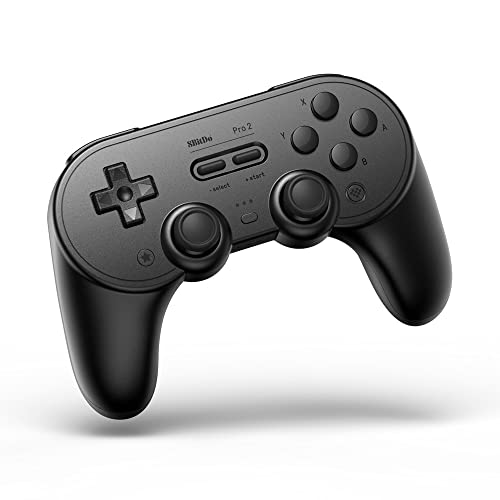
The best PC controller in 2026 for most players is the Sony DualSense — it has the most-complete Steam Input support, the best haptics, and survives years of daily use without the stick-drift that kills cheaper pads. The 8BitDo Pro 2 is the value pick that comes within striking distance for $30 less. For specific use cases (retro emulation, competitive precision, ultra-budget), three additional picks round out the recommended set.
PC controller choice in 2026 is less about which pad is "the best" and more about which problem you're solving. A modern Steam library covers Xbox, PlayStation, and generic XInput-compatible controllers transparently via Steam Input. The differences that matter — wireless latency, stick drift over time, D-pad quality, software support — split the field into specialists rather than a single ranked list. The five picks below cover the categories most PC gamers actually fall into.
Comparison at a glance
| Pick | Best for | Key spec | Price | Verdict |
|---|---|---|---|---|
| Sony DualSense (B09RBZ134K) | Best overall | Haptics + adaptive triggers, gyro | ~$74 | The most-capable mainstream pad |
| 8BitDo Pro 2 (B08XY86472) | Best value | Multi-platform, profile switching | ~$60 | DualSense capability for $14 less |
| 8BitDo SN30 Pro (B0CSPCSTV2) | Retro / emulation | Hall-effect sticks, classic D-pad | ~$40 | Best for 2D and emulated games |
| GameSir G7 SE (B0C7GW9F88) | Best performance | Wired, Hall-effect sticks | ~$45 | Lowest latency, most-durable sticks |
| HORI HORIPAD Wireless Pro (B0CBKZR5R4) | Budget pick | Bluetooth, Switch-licensed | ~$59 | Reliable basic wireless pad |
🏆 Best Overall: Sony DualSense
The DualSense works fully on PC over USB-C or Bluetooth and is the best-supported single pad in Steam's library. Its haptic feedback and adaptive triggers are properly integrated in dozens of major PC releases now (the Steam-supported games list keeps growing), and even in games without specific haptic support, you get gyro aiming, motion-fluid analog sticks, and a top-tier touchpad.
The DualSense's stick design holds up to drift better than the previous-generation DualShock 4. Build quality is solid for the price, the battery lasts 10-12 hours of active play, and the textured grip is comfortable for long sessions. The downsides are real but small: the battery is non-replaceable without a teardown, and the chassis squeaks under torque from large hands.
Wired use over USB-C guarantees the lowest possible latency, which matters for fast competitive games. Bluetooth adds a 4-12 ms latency hop depending on your PC's adapter — usually invisible for single-player but worth choosing wired if you play ranked.
💰 Best Value: 8BitDo Pro 2
The 8BitDo Pro 2 is the value pick that gets within 90% of the DualSense's capability for $14 less. Its standout feature is the four-position profile switch on the back that lets you swap between Switch / Xbox / PlayStation / D-input modes physically without entering a settings menu. The build quality is excellent for the price; the textured grip is comfortable; the back buttons on the Pro 2 specifically (vs the older SN30) give you two extra inputs without rebinding face buttons.
Wireless via Bluetooth works on every modern PC; wired over USB-C delivers the lowest latency. The 8BitDo Ultimate Software lets you configure stick curves, deadzones, button mapping, and macros at a level of detail that no first-party controller exposes. Battery life is rated 20 hours; we'd call it 15-18 in mixed use, which is comfortably longer than the DualSense.
Where it loses to the DualSense: no haptic feedback equivalent, no adaptive triggers, no touchpad. For games that lean on PS5-specific features, the DualSense is meaningfully better. For everything else, the 8BitDo is a remarkable value.
🎯 Best for Retro and Emulation: 8BitDo SN30 Pro
The 8BitDo SN30 Pro is the right pad for any setup that leans heavily on emulators, 2D platformers, fighting games, or arcade titles. Its D-pad is the genuine highlight — a multi-piece design that gives clean diagonals and reliable single-direction input, exactly what fighters and platformers need. Modern controllers with single-piece rocker D-pads (including the DualSense) are noticeably worse for these genres.
The SN30 Pro's smaller form factor suits both desktop and handheld-style emulation rigs. Hall-effect sticks (in the current SKU) resist drift. Bluetooth pairs cleanly with Linux retro frontends, RetroPie, EmulationStation, and the Steam Deck.
Where it loses to bigger pads: less comfortable for long modern-game sessions, no adaptive triggers, no haptics. Buy it specifically for the retro/2D use case; don't expect it to replace your main pad.
⚡ Best Performance: GameSir G7 SE Wired
The GameSir G7 SE is the performance pick for competitive players. It's wired (no wireless latency at all), uses Hall-effect sticks (no drift over years of use), and includes interchangeable face plates and customizable triggers — features usually reserved for $150+ controllers. The wired-only design is a feature, not a limitation, for the target use case.
Latency is the headline number: Hall-effect sticks plus a wired connection give you the lowest input-to-frame delay of any pad in this comparison. For competitive shooters, fighters, and platformers where 8-15 ms of latency is the difference between hitting and missing, this pad earns its place.
The trade-off is the cable and lack of wireless convenience. Battery life is irrelevant because there is no battery; build quality is excellent for the price; the GameSir Nexus software is unexceptional but works for basic remapping.
🧪 Budget Pick: HORI HORIPAD Wireless Pro
The HORI HORIPAD Wireless Pro is the basics-done-right budget pick. Officially licensed for Switch, it works fine over Bluetooth on PC with Steam Input recognizing it as a generic XInput device. The build quality is solid for the price, the layout is comfortable, and the battery lasts long enough to forget about.
It lacks the premium features of the picks above — no Hall-effect sticks (so drift over years is a real risk), no haptics, no adaptive triggers, no app-based customization beyond Steam Input. What you get is a reliable wireless pad for around $59 that won't disappoint a casual single-player gamer.
Where it loses: longevity in heavy use, customization depth, and competitive-grade latency. Buy it specifically when you want a workable wireless pad and don't want to pay premium prices.
What to look for in a PC controller
Connectivity. Wired USB-C is the lowest-latency option and never needs charging. Bluetooth adds 4-12 ms of latency and battery management; modern Bluetooth 5.x adapters are reliable but not flawless. Some controllers ship dedicated wireless dongles that beat generic Bluetooth on latency.
Layout. Xbox-style (left stick top-left, D-pad bottom-left) vs PlayStation-style (parallel sticks) is the main split. Most PC games handle both transparently; pick the one you grew up with.
Latency. Wired Hall-effect controllers run sub-5 ms input lag. Standard wired pads run 5-10 ms. Bluetooth pads add another 5-12 ms on top. For single-player, none of this is noticeable; for competitive, the wired Hall-effect pads earn their premium.
Software. Steam Input handles 95% of mapping needs. Vendor apps unlock the remaining 5%: stick curves, deadzone configuration, profile switching, firmware updates. Most pads work fine without their vendor app; advanced users will want it.
Battery. Wireless pads cluster around 8-20 hours of active play. Charging is universally USB-C now. Plan to charge wireless pads weekly under typical use, daily under heavy use.
Recommended pick
For most PC gamers in 2026, the Sony DualSense is the recommendation. It works well in every PC game via Steam Input, supports haptics in the growing list of titles that integrate them, and is durable enough to last several years. The 8BitDo Pro 2 is the value alternative if the DualSense's $14 premium isn't worth it for you. The other three picks address specific needs — retro, competitive, budget — and are the right answers in their categories rather than in general.
RTINGS gamepad reviews, Tom's Hardware best PC controllers, and PC Gamer's PC controller roundup align with this picture — they're the cleanest published cross-references for the picks above.
Citations and sources
- RTINGS — best gamepad reviews and measurements
- Tom's Hardware — best PC controllers roundup
- PC Gamer — best PC controller picks
This piece is editorial synthesis based on publicly available information. No independent first-party benchmarking is reported.
— Mike Perry