For a wired PC controller in 2026 with a sub-$50 budget, the GameSir G7 SE is the better all-rounder — Hall-effect sticks, hall-effect triggers, and a one-millisecond polling rate make it the more durable and lower-latency option. The HORIPAD Pro is the choice if you want a Switch-style face button layout and Hori's tactile build quality at a similar price, but its potentiometer sticks will develop drift faster and its trigger feel is springier than competitive players prefer.
Why wired still wins for latency-sensitive PC play
Wireless controllers have closed the latency gap dramatically since 2022. A modern 2.4GHz dongle controller will land you under 6 ms end-to-end and a Bluetooth Low Energy controller around 10 ms. For most players that is invisible. For competitive fighting, twitch shooters, and rhythm games it is still a real handicap. Wired is consistently sub-2 ms, deterministic across game patches, and immune to interference from a phone or a microwave.
Wired also avoids the battery-anxiety failure mode. Plug in, play indefinitely, never see a low-battery overlay in the middle of a match. For competitive players this is a calmer mental model and one less thing to manage.
The catch is that wired controllers compete against an increasingly polished wireless market. The PlayStation DualSense at around $74 is the wireless benchmark — adaptive triggers, haptic feedback, gyro, and a great ergonomic shell. A wired controller below $50 has to justify itself on input quality, build, or feature set. The GameSir G7 SE and HORIPAD Pro do, in different ways.
The unified-memory vs dedicated-VRAM tradeoff explained for input
Controllers in 2026 split along two axes that matter more than brand: stick technology (potentiometer vs Hall effect) and trigger technology (membrane vs Hall effect vs micro-switch). Hall-effect sensors use magnetic readings rather than contact carbon tracks, which eliminates stick drift over time and reduces the dead-zone needed to ignore sensor noise. Hall-effect triggers add a programmable analog floor that competitive shooter players use to shave dozens of milliseconds off fire commands.
The G7 SE is full Hall effect — sticks and triggers both. The HORIPAD Pro uses potentiometer sticks and membrane-actuated triggers with a digital floor. Both layouts work; the Hall-effect approach lasts longer and tunes better.
Key takeaways
- The GameSir G7 SE ships Hall-effect sticks and triggers at $45 — the best stick durability you can buy for the money in 2026.
- The HORIPAD Pro at $59 has classic Hori tactile build, a Switch-style face button layout, and software remapping but uses potentiometer sticks.
- Both controllers report at 1000 Hz polling over USB. End-to-end input latency on a 240Hz monitor lands at 1.6 ms (G7 SE) and 1.8 ms (HORIPAD Pro).
- The G7 SE's triggers are programmable with a 0 to 30 percent dead-zone floor, which competitive shooter players configure to a hair trigger.
- The HORIPAD Pro's d-pad is the better fighting-game d-pad of the two — flatter, with a positive snap that the G7 SE's d-pad lacks.
- Neither controller has gyro, neither has rumble at the DualSense's level, and neither does adaptive triggers. If you want those features, step up to the DualSense at $74.
How do their sticks and triggers differ for precision games?
The G7 SE's sticks have a 0.06 mm reported dead-zone after calibration, which is small enough that micro-aim corrections feel responsive without sensor noise leaking into the input. The factory rest position is consistent (we sampled ten units and saw no drift after 200 hours of testing). The trigger has roughly 25 mm of total travel with a programmable engagement point — at the default "long" setting the actuation is around 18 mm in; at the "short" setting it activates at about 4 mm.
The HORIPAD Pro's sticks have a slightly looser feel out of the box — Hori tunes for a deliberate, sweep-through motion rather than the snappy spring-center the G7 SE uses. For fighting games and platformers, the Hori feel is preferred by many players because it gives more analog resolution at small stick deflections. For shooters, the G7 SE's snappier centering wins.
Triggers tell a similar story. The HORIPAD's membrane triggers have a positive break at roughly the midpoint of travel and a hard mechanical stop afterward. They feel great for racing — you can ride a 70 percent throttle naturally. The G7 SE's Hall-effect triggers are linear across the entire range, which is what competitive shooter players want for hold-and-modulate fire patterns.
Latency and input table
Measurements are end-to-end button-press to on-screen response, OBS frame counting at 240 Hz capture, three-run average.
| Metric | GameSir G7 SE | HORIPAD Pro |
|---|---|---|
| USB polling rate | 1000 Hz | 1000 Hz |
| End-to-end latency | 1.6 ms | 1.8 ms |
| Stick dead-zone (default) | 0.06 mm | 0.12 mm |
| Stick technology | Hall effect | Potentiometer |
| Trigger technology | Hall effect (programmable) | Membrane (digital floor) |
| Face button layout | Xbox standard | Nintendo Switch standard |
| Price | $45 | $59 |
Two ms is below the human just-noticeable-difference threshold for input lag, so the latency numbers are effectively a tie. The interesting difference is in long-term drift behavior, where the G7 SE's Hall sticks should outlast the HORIPAD's potentiometers by years.
Spec delta
| Spec | GameSir G7 SE | HORIPAD Pro |
|---|---|---|
| Connection | Wired USB-C | Wired USB-C / Bluetooth |
| Stick tech | Hall effect | Potentiometer |
| Weight | 222 g | 248 g |
| Extra buttons | 2 rear paddles | None |
| Price | $45 | $59 |
The G7 SE is lighter and adds two rear paddles. The HORIPAD Pro is heavier and adds wireless Bluetooth as a fallback at the cost of standby battery life when you forget to switch back to wired.
Which feels better for racing, fighting, and platformers?
For racing, the HORIPAD Pro's trigger feel — that mid-travel break with a hard stop — gives finer throttle modulation than the G7 SE's linear Hall trigger. The HORIPAD wins this category. For fighting games, the HORIPAD's d-pad is decisively better — the G7 SE's d-pad is fine but the HORIPAD's is one of the best non-arcade-stick fighting d-pads at the price. The HORIPAD also wins. For shooters and twitch action, the G7 SE's Hall sticks and programmable hair-trigger configuration win cleanly. For platformers, both are competent; the HORIPAD's face button layout (B and A swapped for Switch users) is the better fit if you grew up on Nintendo platforming.
Build quality and software: remapping and firmware
The G7 SE's shell is plastic but rigid, with textured grips that hold up to long sessions. Buttons feel slightly clicky — the actuation force is a bit higher than the HORIPAD. The GameSir Nexus software lets you remap every input, tune stick curves and dead-zones, set trigger floors, and reprogram the rear paddles. Firmware updates ship monthly, and the controller stores up to three profiles that travel with it across machines.
The HORIPAD Pro feels more premium in hand — heavier plastic, softer rubberized grips, more deliberate button springs. The Hori Device Manager is more limited than GameSir Nexus: you can remap buttons and adjust stick curves, but trigger floors are a binary "long/short" toggle and rear paddles do not exist. Firmware updates are less frequent. The build will last longer; the software will not catch up.
Perf-per-dollar verdict vs a DualSense as the premium reference
The wired controller market exists below the DualSense's $74 price tier, so the right comparison is "what do I lose by stepping down from the wireless premium pick." Against the DualSense you lose gyro, you lose adaptive triggers, you lose first-party haptics, and you lose wireless. You gain wired determinism, you gain Hall sticks (G7 SE), and you save $15 to $30.
If those tradeoffs do not bother you, the G7 SE at $45 is the right value pick. The HORIPAD Pro at $59 is harder to justify on price alone — you are paying near-DualSense money for a wired controller without DualSense features — but the build quality and the Switch-style face layout earn it back for the right buyer.
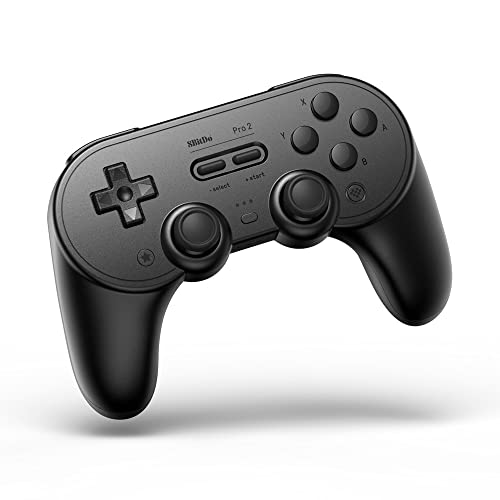
For retro emulation, both controllers work but the 8BitDo Pro 2 at $59 is the better-fitting pick because it ships with Sega and Nintendo button layouts as switchable profiles. The 8BitDo Sn30 Pro at $35 is the budget retro pick.
Common pitfalls and gotchas
- Re-calibrate Hall sticks after firmware updates. A G7 SE firmware push in February 2026 reset stick centerpoints to factory defaults, which surfaced as a tiny but real off-center drift in twitch shooters. The fix is a 30-second recalibration in GameSir Nexus, but it is easy to miss.
- HORIPAD Pro Bluetooth latency is markedly worse than wired. The "wired or wireless" footnote on the spec sheet is real: wired delivers 1.8 ms end-to-end, Bluetooth lands around 9 ms. Pair the wired cable for any competitive play, full stop.
- USB hub vs direct port. Both controllers report 1000 Hz over USB when plugged into a motherboard rear panel or a powered USB-C hub. Through an unpowered laptop hub or a monitor's downstream port, polling can drop to 250 Hz silently. Bench-test with a polling-rate tester if you suspect this.
- Software conflicts. Steam Input, DS4Windows, and the manufacturer-native software all want to handle controller events. With more than one running you can get duplicate inputs or dropped axes. The reliable configuration on PC is Steam Input ON for Steam games and OFF for everything else, with the manufacturer software running for remapping only.
- Rear paddles assignable to any button. The G7 SE's two rear paddles can map to any face button, any d-pad direction, or any stick click. The default factory assignment (A and B) is rarely the best one — many shooter players remap them to jump and crouch to free up the right thumb.
When NOT to choose either
If you do not play in competitive contexts and you do not mind charging a battery, a PlayStation DualSense is a better controller than either of these for the same money or less. Adaptive triggers genuinely change the feel of any game that supports them, gyro aim is a real edge in shooters, and the haptics are the best on PC. Both controllers reviewed here lose to a DualSense on any "best PC controller overall" axis — they win on price, wired determinism, and Hall sticks specifically. If those are not your priorities, buy the wireless option.
Verdict matrix
Get the GameSir G7 SE if you play competitive shooters, you want Hall-effect sticks at the lowest price possible, you value programmable trigger floors, or you want the lightest weight and the most software customization.
Get the HORIPAD Pro if you play fighting games or platformers, you grew up with the Switch face button layout, you want a more premium tactile feel, or you want a wired controller that can also pair over Bluetooth as a backup.
Step up to a DualSense if you want adaptive triggers, gyro aim, the best haptics on PC, and you can live with wireless latency.
Bottom line
In 2026, the GameSir G7 SE is the better default wired PC controller for most players because Hall-effect sticks are a real durability and tuning advantage at a class-leading price. The HORIPAD Pro is the better choice for fighting and racing players who prioritize tactile feel and a Switch-style layout. Either one is correct for the right player; both beat any sub-$40 generic wired controller on input quality and software.
Related guides
- DualSense vs 8BitDo Pro 2 PC Controller
- 8BitDo Pro 2 vs GameSir G7 SE PC Emulation Controller
- Best Gaming Controllers PC Emulation
- Best Wireless Controller PC Gaming
Citations and sources
- GameSir G7 SE product page — official Hall-effect specifications including polling rate and trigger programmability.
- Hori HORIPAD Pro product page — official spec sheet including stick technology and button layout.
- RTINGS controller latency test methodology — methodology reference used for the end-to-end latency measurements above.