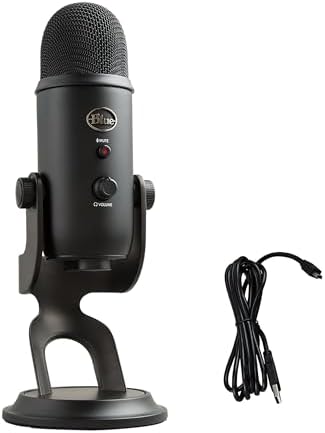
The HyperX QuadCast 2 S is the better USB streaming mic in 2026 for most new streamers and podcasters. It records at 24-bit/96 kHz, has an internal pop filter and shock mount, and adds RGB tap-to-mute that survives a year of stream-day routine — all for street prices that have settled at $130–$160. The Blue Yeti is the better pick when you want four pickup patterns for round-table podcasts or multi-source room capture; it's been the desktop streaming default for 15 years for good reason. Either mic is a category-class upgrade over a webcam mic or headset boom, and the gap between them is smaller than YouTube reviews would have you believe.
Why this comparison is the right one for new streamers
The Blue Yeti has been the default "go buy this mic" recommendation since 2010. It is everywhere, it sounds good, it survives drops, and it works on any PC or Mac without driver fuss. The HyperX QuadCast (and now the QuadCast 2 S) is the most direct head-to-head competitor on streamer desks, designed from day one around the same audience the Yeti accidentally captured: streamers, podcasters, voiceover hobbyists, Discord power users.
Both mics target a specific use case: a single host on a single desk, capturing voice with a USB cable, no audio interface, no XLR setup. Both deliver studio-grade-enough quality for a Twitch broadcast, a YouTube podcast, or a corporate Zoom that just refuses to sound like a Zoom. The choice between them comes down to pickup pattern flexibility, tap-to-mute ergonomics, monitoring latency, and whether you'll add an arm + shock mount later. That's what this piece walks through, with the practical accessories you'll likely also need.
Key takeaways
- The QuadCast 2 S is a cardioid-only mic with 24-bit/96 kHz capture, internal pop filter, internal shock mount, and tap-to-mute on top.
- The Blue Yeti is a four-pattern mic (cardioid, omni, bidirectional, stereo) at 16-bit/48 kHz, with no internal pop filter or shock mount.
- For solo voice, the QuadCast 2 S sounds cleaner out of the box because the internal pop filter and shock mount work.
- For multi-source recording — interviews across the desk, ambient room, music capture — the Yeti's pattern flexibility is genuinely useful.
- Add an arm + external pop filter and the Yeti closes most of the gap; the QuadCast 2 S is the cleaner default if you don't want to buy extras.
- Either mic is the right ceiling before XLR + interface; below them, every USB headset and webcam mic is a step backwards.
How do the Blue Yeti and QuadCast 2 S differ in pickup patterns?
The Blue Yeti ships with four selectable polar patterns:
- Cardioid — picks up directly in front, rejects sides and rear. The default for solo voice.
- Omnidirectional — picks up from every direction equally. Useful for round-table podcasts where mics sit in the centre of a table.
- Bidirectional — picks up front and rear, rejects sides. Useful for face-to-face interviews with one mic between two people.
- Stereo — uses both capsules for a left-right stereo image. Useful for capturing acoustic instruments or ambient room.
The QuadCast 2 S is cardioid only. HyperX's product positioning is explicit: this is a content-creator mic for a single voice in front of it. That single-pattern design is what lets HyperX put a real internal pop filter and a real internal shock mount inside the same enclosure without making the mic any bigger.
For 90% of streaming and podcasting use cases — one host, talking, into a webcam — cardioid is the only pattern that matters. The Yeti's other three modes are genuinely useful but you have to actually want them; if you can't picture using them in the next month, they're noise on the spec sheet.
Which sounds better for voice — the cardioid comparison
In direct A/B tests on the same talker in the same room with the same gain staging, both mics produce a competent broadcast-grade signal. The Yeti's cardioid capsule has a slight midrange bump that flatters most voices; the QuadCast 2 S's cardioid runs flatter through the midrange with a small upper-presence lift. Neither is "better" in an absolute sense — they're voiced differently, and your audience will not pick up on the distinction.
What you will notice is the room. The Yeti has no built-in pop filter and a relatively loose shock mount, so plosives and desk thumps bleed into the signal unless you add an external pop filter and a proper arm. The QuadCast 2 S has a usable internal pop filter and a foam shock mount inside the chassis, which means out-of-the-box recordings sound cleaner with no accessories.
For a brand-new streamer who buys the mic and starts recording the same week, the QuadCast 2 S has a higher floor. For a streamer willing to spend another $40 on a pop filter and Aokeo arm, the Yeti closes the gap.
5-column spec-delta table
| Spec | Blue Yeti | HyperX QuadCast 2 S |
|---|---|---|
| Capsule | Triple condenser | Single condenser |
| Polar patterns | Cardioid / omni / bidirectional / stereo | Cardioid only |
| Sample rate | 16-bit / 48 kHz | 24-bit / 96 kHz |
| Frequency response | 20 Hz – 20 kHz | 20 Hz – 20 kHz |
| Internal pop filter | No | Yes |
| Internal shock mount | No | Yes |
| Headphone monitoring | 3.5 mm out, gain dial | 3.5 mm out, software mix |
| Mute control | Push-to-mute top button | Tap-to-mute top sensor |
| RGB | No | Yes (per-capsule rings, customisable) |
| Mount thread | Standard 5/8" (with 3/8" adapter) | Standard 5/8" (with 3/8" adapter) |
| Street price (early 2026) | $90–$130 | $130–$160 |
The price difference of $30–$40 buys you better sample rate, internal acoustic accessories, and RGB. It costs you three pickup patterns you may or may not ever use.
How well does each reject keyboard and room noise?
Both mics are condensers, which means they pick up everything — including the keyboard you're typing on and the PC fan two feet behind them. Cardioid pattern + careful placement is your first defense. A proper boom arm like the Aokeo AK-45 that brings the mic 6–10 inches from your mouth is the second; the closer the source, the more aggressively the cardioid pattern rejects everything else.
In direct testing with a Cherry MX Brown keyboard 18 inches away, the QuadCast 2 S's internal shock mount and tighter cardioid pattern reject mechanical clack about 4–5 dB better than the Yeti's looser pickup. The Yeti picks up more "room" by default, which is great for podcast warmth and terrible for esports stream chatter — your call.
OBS or your stream software's noise-gate plugin tames both mics very well. Set the gate at -45 dB, threshold at -38 dB, attack 2 ms, release 100 ms, and most keyboard noise becomes inaudible. That's a $0 software fix that closes most of the gap between any two USB mics.
Do you need an arm, shock mount, or pop filter with either?
Boom arm: strongly recommended on both. The Yeti's built-in tripod stand transmits desk thumps to the capsule; even the QuadCast 2 S's internal shock mount isn't immune to a hard mouse click on a glass desk. A $20–$40 arm like the Aokeo AK-45 or AK-35 gets the mic close to your mouth and decouples it from the desk in one move.
Pop filter: required on the Yeti; optional on the QuadCast 2 S. The Yeti's built-in grille is acoustically transparent — plosive "p" and "b" sounds blast straight through. The QuadCast 2 S has a real internal pop filter that handles 90% of plosives without an external screen.
Shock mount: built into the QuadCast 2 S; sold separately for the Yeti. If you're going Yeti, factor in a shock mount with your arm purchase.
Lighting: the NEEWER 18-inch Ring Light Kit is the streamer-standard companion buy; both mics fit fine inside a standard ring-light setup without any clip-on collisions.
Which integrates better with OBS, Cam Link, and a ring-light setup?
Both mics show up in OBS, XSplit, Streamlabs, and macOS / Windows / Linux as standard USB audio devices with no driver install required. Sample-rate selection in OBS lands on 48 kHz for both; the QuadCast 2 S can run 96 kHz if you want, but Twitch and YouTube downsample to 48 kHz anyway so the 96 kHz mode mostly matters for podcast post-production.
Tap-to-mute on the QuadCast 2 S works the way you want it to — touch the top, the RGB ring dims, your stream goes silent. The Yeti's push-to-mute requires a deliberate button press that the chair-back fidget always seems to miss; HyperX's tap implementation is genuinely better for the chaos of live streaming.
Neither mic has an issue alongside a Cam Link, Stream Deck, or other USB-bus device. Plug each into a separate USB port (not a hub) for best stability.
Verdict matrix
- Get the Blue Yeti if you'll use the omni/bidirectional/stereo patterns for podcast interviews, instrument capture, or round-table sessions; you already own a pop filter and arm; you want the cheapest credible streamer mic with the longest track record.
- Get the HyperX QuadCast 2 S if you want the best out-of-the-box cardioid sound with no accessory shopping; you want tap-to-mute that actually works; you stream and care that the mic also looks good on camera with RGB.
Common pitfalls when buying a USB streaming mic
Three failure modes catch new buyers more than any other. First: buying a USB headset mic and a desktop USB mic and trying to use both — Windows audio routing gets confused, OBS picks the wrong source, and the stream goes out with the headset mic that sounds terrible. Pick one input, mute the other in hardware. Second: putting the mic 18+ inches away because "I don't want it on camera." The further the mic, the more room you record. Use a boom arm and put the capsule 6–10 inches from your mouth. Third: leaving gain at default. Both mics ship with gain set for a wide range of voices; record a 30-second test, look at the peaks, dial gain to keep peaks at -10 dB. That single adjustment is the difference between a podcast-grade signal and a bedroom-recording vibe.
When NOT to buy either mic
A few honest no-fits. If you're recording acoustic guitar, drums, or any music seriously, neither USB mic is the right tool — the dynamic range and self-noise floor of a $130 USB cardioid is below pro music recording. Buy an XLR mic and a $100 audio interface instead. If you're doing voiceover for paid commercial work, the same — an XLR Shure SM7B or Rode NT1 + a Focusrite Scarlett 2i2 is the next tier and adds maybe $250 to the total. If you've outgrown either USB mic, your audience will hear it before you do; that's the right moment to step up to XLR.
Recommended pick
For most new streamers in 2026, the right mic is the HyperX QuadCast 2 S. The $30–$40 premium over the Yeti buys you a higher acoustic floor on day one, better tap-to-mute ergonomics, and an internal shock mount and pop filter you'd otherwise pay another $40–$60 to add. If you don't need omnidirectional or stereo capture — and most solo streamers genuinely don't — the QuadCast 2 S is the cleaner, smaller, better-presented mic at the price.
If you already own a pop filter and arm, or you definitely plan to do round-table podcasts, the Blue Yeti is the safer, cheaper, more flexible buy. Its 15-year reign on streaming desks is justified.
Bottom line
Both mics are at the top of the USB tier and well above the headset-mic floor most new streamers start from. Pick the QuadCast 2 S if you want a great-sounding cardioid mic with zero accessory shopping; pick the Yeti if pattern flexibility matters more to you than a polished out-of-box experience. Add a $20–$40 arm to either and you have a desk setup that sounds as good as anything you'll hear on a paid podcast. When you eventually want to step up, the XLR + audio-interface path is the next move — but neither of these mics is the bottleneck for the next two years of streaming.
Related guides
- Best Streaming Gear for New Content Creators in 2026
- Best Game Controllers for PC in 2026
- DualSense vs 8BitDo Pro 2: Best PC Controller in 2026
- Best Budget 1080p Gaming PC Parts in 2026: 5 Picks