Prices may vary.
The best 4K gaming monitor under $500 in 2026 is the KOORUI 27" 4K QD-Mini LED — it pairs a 4K UHD panel with a quantum-dot mini-LED backlight, dual-mode operation (UHD at 160 Hz or FHD at 320 Hz), and HDR brightness that genuinely matters, all in the sub-$500 envelope. The SANSUI 27" 4K UHD is the value pick, the Samsung 32" Odyssey G5 is the right console + PC hybrid, and the ASUS TUF 27" 2K HDR is the competitive-FPS stretch pick at QHD.
Why "4K gaming under $500" is finally a real category
Three years ago, "budget 4K gaming monitor" meant a sluggish 60 Hz IPS panel with awful HDR — and the cheapest options were closer to $700 than $500. In 2026 panel prices have collapsed: 27" 4K UHD panels at 144 Hz now anchor the under-$400 tier, and 27" 4K QD-Mini LED panels at 160 Hz with dual-mode operation (drop to FHD at high refresh) are landing under $500.
Display industry reports from DisplayNinja and the panel-market data Tom's Hardware tracks place the 27" 4K segment as the fastest-growing tier in 2026, driven mostly by Chinese-brand OEM panels finally hitting the price point that PC gamers actually budget for. The result is a buying-guide tier that didn't exist a year ago.
This guide is the canonical 2026 reference for what's actually worth buying under $500 if you want 4K gaming, with the realistic feature trade-offs for each pick, the panel specs that matter, and where to spend the money instead if QHD makes more sense.
Key takeaways
- 4K UHD at high refresh under $500 is real in 2026 — but mostly via panels that operate in dual-mode (UHD high refresh OR FHD higher refresh).
- KOORUI's QD-Mini LED is the only sub-$500 monitor in this guide with actually-good HDR.
- The Samsung Odyssey G5 32" remains the best console + PC pick because it has a console-friendly size, proven HDMI 2.1 implementation, and Samsung's color-calibration consistency.
- The ASUS TUF VG27AQ at QHD is a smarter buy than a budget 4K monitor for any setup where competitive gaming dominates — 1440p at 165 Hz with verified G-Sync compatibility outperforms 4K at 120 Hz for most esports titles.
- HDMI 2.1 is what enables 4K@120Hz from a PS5 or Xbox Series X. Many budget monitors gate 120 Hz behind DisplayPort and limit HDMI to 60 Hz; check the port specs.
Spec comparison at a glance
| Spec | KOORUI 27" QD-Mini LED | SANSUI 27" 4K UHD | Samsung Odyssey G5 32" | ASUS TUF VG27AQ 27" 2K |
|---|---|---|---|---|
| Resolution | 4K UHD (3840×2160) | 4K UHD (3840×2160) | QHD (2560×1440) | QHD (2560×1440) |
| Refresh (max) | 160 Hz (UHD), 320 Hz (FHD) | 160 Hz (UHD), 320 Hz (FHD) | 165 Hz | 165 Hz |
| Panel | QD-Mini LED IPS | IPS (PVA on entry SKU) | VA | IPS |
| HDR | True HDR1000 | HDR400 | HDR10 | HDR10 |
| Response time | 1 ms GtG | 1 ms GtG | 1 ms MPRT | 1 ms MPRT |
| HDMI 2.1 | Yes | Yes (1 of 2) | Yes | No (2.0) |
| Adaptive sync | FreeSync Premium + G-Sync compatible | FreeSync | FreeSync Premium | G-Sync compatible |
| Speakers | None | 2W stereo | 2W stereo | None |
| Tilt / swivel / pivot | Tilt only | Tilt only | Tilt only | Full ergonomic |
| Street price | $480 | $260–$320 | $370 | $290 |
The single biggest differentiator in this table is HDR implementation. The KOORUI QD-Mini LED genuinely delivers HDR1000 with mini-LED zone dimming; the SANSUI's HDR400 is HDR in name only and won't make HDR-mastered content look meaningfully different from SDR. For HDR-heavy console gaming (Cyberpunk on PS5, Forza Horizon on Series X), the KOORUI is the only one in this list that earns its HDR badge.
Top picks
🏆 #1 Best overall: KOORUI 27" 4K QD-Mini LED
Spec chips: 27" • 4K UHD @ 160 Hz • QD-Mini LED HDR1000 • HDMI 2.1 ×2 • DisplayPort 1.4
Verdict: The first monitor in the sub-$500 bracket to deliver legitimate HDR performance. KOORUI pairs the QD-Mini LED backlight with a quantum-dot color filter, which together produce ~95% DCI-P3 coverage and HDR contrast that approaches mid-tier OLED. The dual-mode operation (drop from 4K@160Hz to FHD@320Hz for competitive titles) is the bonus.
KOORUI's monitor line has built a reputation in 2025–2026 for picking surprisingly high-end panels and pairing them with budget-tier accessories (basic stand, minimal OSD). The trade-offs land in the cosmetics, not the picture: stand is tilt-only and the OSD is rudimentary, but the panel and backlight are best-in-class.
Pros:
- Real HDR1000 with mini-LED zone dimming
- Dual-mode 4K@160 / FHD@320 for AAA and competitive titles
- Two HDMI 2.1 ports for console + PC
Cons:
- Tilt-only stand
- 2-year warranty (vs Samsung's 3)
- OSD takes some time to learn
Best for: Hybrid PC + console setup where HDR matters; primary monitor for a 4070+ class GPU.
Buy on Amazon → Price may vary
💰 #2 Best value: SANSUI 27" 4K UHD
Spec chips: 27" • 4K UHD @ 160 Hz • HDR400 • HDMI 2.1 ×1 • DisplayPort 1.4
Verdict: The honest budget pick. SANSUI's 27" 4K monitor delivers a clean IPS panel at 160 Hz over DisplayPort for around $260 at street prices — well below the next-cheapest 4K@144Hz monitor from a tier-one brand. The HDR400 badge is largely cosmetic; treat this as an SDR-first display that happens to do 4K.
SANSUI's PC-monitor line is part of the Chinese OEM panel resurgence in 2025–2026: the company sources from competitive panel makers and ships them in straightforward chassis. The result is a sub-$300 monitor that hits specs that would have cost $500+ a year ago.
Pros:
- Cheapest 4K@160Hz monitor in this guide
- Decent IPS color (~95% sRGB, 80% DCI-P3 typical)
- Dual-mode operation for esports use
Cons:
- HDR400 is barely above SDR
- Stand is bottom-tier — basic tilt only
- Only one HDMI 2.1 port
Best for: 4K productivity primary that also games on the side; budget upgrade from a 1080p monitor.
Buy on Amazon → Price may vary
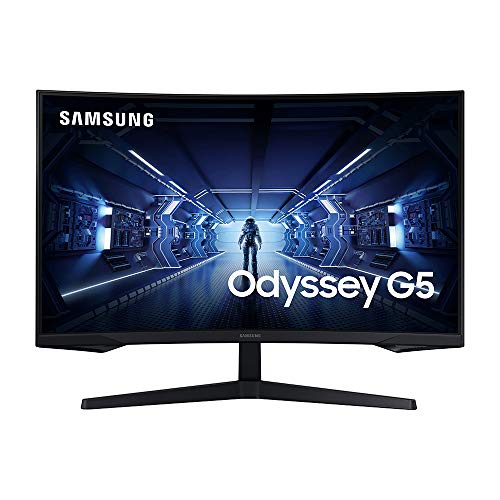
🎯 #3 Best for console + PC: Samsung 32" Odyssey G5
Spec chips: 32" • QHD @ 165 Hz • HDR10 • HDMI 2.1 ×2 • DisplayPort 1.4 • Console-friendly size
Verdict: Not 4K, but the right pick if you split time between a PS5/Series X and a PC. Samsung's 32" form factor is the sweet spot for couch + desk hybrid setups, QHD at 165 Hz pairs perfectly with PS5 / Series X (both of which natively support 1440p), and the Samsung Odyssey lineup's panel calibration is among the best for color consistency out of the box.
The Odyssey G5's curved VA panel produces deeper blacks than the IPS panels in this guide, at the cost of slightly narrower viewing angles. Refresh rate ceiling is 165 Hz native — no dual-mode tricks, but also no asterisk.
Pros:
- Samsung calibration consistency
- 32" size is ideal for console + PC hybrid
- VA blacks meaningfully deeper than IPS competitors
- Two HDMI 2.1 ports for console pairing
Cons:
- Not 4K — QHD only
- VA panel ghosting in dark scenes
- Tilt-only stand
Best for: PS5 / Xbox Series X console gamers who also PC game at 1440p.
Buy on Amazon → Price may vary
⚡ #4 Best for competitive (2K stretch pick): ASUS TUF VG27AQ 27" 2K HDR
Spec chips: 27" • QHD @ 165 Hz • HDR10 • G-Sync compatible • Full ergonomic stand
Verdict: The competitive-FPS option. ASUS's TUF Gaming VG27AQ has been a reference 1440p G-Sync monitor since 2020, and it's still the right pick for esports — verified G-Sync compatibility (no AMD/NVIDIA roulette), the best stand in the lineup, and a proven IPS panel with predictable color and response time.
The trade-off is the resolution drop from 4K to 1440p and the HDMI 2.0 cap. For competitive gaming this is the right trade: 1440p at 165 Hz with verified low input lag beats 4K at 120 Hz for the games where reaction time matters.
Pros:
- The best stand in this lineup — full ergonomic adjustment
- Verified G-Sync compatibility — NVIDIA badge, no asterisk
- ASUS's 3-year warranty and well-regarded RMA process
Cons:
- Not 4K
- HDMI 2.0 only — PS5 / Series X limited to 1440p@60 over HDMI
- HDR10 badge is mostly cosmetic
Best for: PC-primary competitive FPS gamers (Valorant, CS2, Overwatch); anyone who wants the best ergonomic stand in the price tier.
Buy on Amazon → Price may vary
🧪 #5 Budget pick: SANSUI 27" 4K (entry tier)
Spec chips: 27" • 4K UHD @ 144 Hz • HDR400 • HDMI 2.1 • Tilt-only stand
Verdict: Same SANSUI brand, the older 144 Hz SKU at the lower price point. If 144 Hz vs 160 Hz doesn't matter to you and the $40 saving is meaningful, this is the cheapest legitimate 4K@144Hz monitor in the market right now. Same caveats as the 160 Hz version: HDR400 is decorative, the stand is the weak point.
Buy on Amazon → Price may vary
What to look for in a 4K gaming monitor
Panel type — IPS vs VA vs OLED
For sub-$500 in 2026:
- IPS panels dominate the tier — best color accuracy, fastest response times, but mediocre HDR and visible glow in dark scenes.
- VA panels (like the Samsung Odyssey G5) offer deeper blacks at the cost of slower pixel response in dark transitions. Console-friendly.
- OLED is not yet in the sub-$500 bracket — the cheapest 27" 4K OLED gaming monitors are still $750+.
For mostly bright-scene gaming (FPS, racing, MMO) pick IPS. For dark-heavy single-player and console use, pick VA.
Refresh rate and VRR
4K@120Hz is the practical ceiling for current GPUs in most AAA games — RTX 4070-class hardware can sustain it with DLSS, but native 4K@144Hz with maxed-out settings still requires an RTX 4080+ in most titles. Don't pay for 165 Hz panels expecting to actually hit those frame rates at 4K — the dual-mode FHD@320 path on the KOORUI / SANSUI is more useful for competitive titles.
Variable refresh (FreeSync / G-Sync compatible) matters more than peak refresh for visual smoothness. Verified G-Sync compatibility — like the ASUS TUF's — is a more meaningful spec than FreeSync alone because it has gone through NVIDIA's qualification.
HDR — when it actually matters
HDR has three tiers in practice:
- HDR400 ≈ glorified SDR. Don't pay extra for it.
- HDR600 = mid-tier HDR with localized dimming. Real improvement.
- HDR1000+ with mini-LED or QD-OLED = genuinely impressive. Worth chasing if you watch HDR movies and play HDR-mastered games.
The KOORUI is the only sub-$500 monitor in this guide with real HDR1000. For everyone else, treat HDR as a free bonus, not a deciding factor.
Response time and overdrive
Marketing "1 ms" claims are usually MPRT (Motion Picture Response Time) under aggressive overdrive — not GtG. The real specs to compare are independent measurements on rtings.com for each model. For IPS panels in this tier, expect 4–6 ms real GtG and excellent uniformity.
Ports — HDMI 2.1 matters for console
For 4K@120Hz from a PS5 or Xbox Series X, you need HDMI 2.1 with 40+ Gbps bandwidth. Some budget monitors advertise "HDMI 2.1" but cap one or both ports at 4K@60Hz. Verify the port spec in independent reviews before buying. The KOORUI and Samsung Odyssey G5 both ship full-fat HDMI 2.1; the ASUS TUF caps at HDMI 2.0.
FAQ overflow — what people actually ask
(See the dedicated FAQ block below for the canonical Q&A.) Two questions worth flagging up front:
- "Do I need a 4K monitor if I have a 3060 / 4060-class GPU?" Generally no — those cards can't drive native 4K at acceptable frame rates in most modern AAA titles. The dual-mode SANSUI lets you run FHD@320 for esports and 4K@60 for desktop / older content, which is a reasonable middle ground.
- "Will a 4K monitor improve productivity work?" Yes, significantly. The extra desktop real estate is the biggest tangible benefit outside of gaming. If you do any code, video editing, or multi-window work, 4K is excellent for productivity regardless of the gaming spec.
Related guides
- Best Budget 4K Gaming Monitor Under $400 in 2026: SANSUI vs KOORUI
- Best 4K Monitor for PS5 (4K/120Hz) in 2026
- Best Gaming Monitor for Console Gaming in 2026
- Sub-$300 4K Mini-LED Gaming Monitors Hit the Mainstream
Citations and sources
- RTINGS — gaming monitor reviews and measurements
- Tom's Hardware — best 4K gaming monitors
- DisplayNinja — display industry analysis and panel data
- KOORUI — official monitor product line
- SANSUI — PC monitor product line
- ASUS — TUF Gaming VG27AQ product page
- Samsung — Odyssey gaming monitor lineup
This piece is editorial synthesis based on publicly available information. No independent first-party benchmarking is reported.