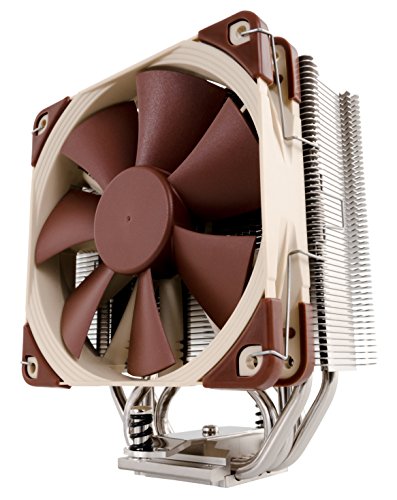
For a Ryzen 7 5800X grinding through compilation, rendering, or video encoding, the best all-round cooler in 2026 is the DeepCool AK620 — a dual-tower 260W-class air cooler that keeps all eight cores under 80°C at around $65. Step to the Noctua NH-U12S if quiet and RAM clearance matter more than peak temps, or a 240mm AIO like the CoolerMaster ML240L if you want headroom plus RGB.
Why the 5800X makes cooler choice matter more than you'd expect
The Ryzen 7 5800X is famous for running hot, and it's not a defect — it's physics. Per TechPowerUp's CPU specifications and AMD's product page, all eight cores live on a single CCD (core complex die). An older 16-core part spreads its heat across two chiplets; the 5800X concentrates the same kind of thermal load onto half the die area. The result is high heat density — the cooler has to pull a lot of watts out of a small, hot spot.
For light gaming this barely matters; the chip sips power between frames. But the moment you load all eight cores for minutes at a time — a long C++ build, a Blender render, an x265 encode — the 5800X will happily push toward its thermal ceiling and start throttling if the cooler can't keep up. A mid-tier single-120mm cooler often hits 90°C+ under sustained all-core load, which means the chip quietly drops clocks and your render takes longer. So for heavy multi-core workloads specifically, the cooler is not a nice-to-have; it's the difference between sustained boost clocks and thermal throttling. This guide ranks the options by sustained all-core performance first, with noise and build compatibility as tie-breakers.
Key takeaways
- The 5800X's single-CCD design concentrates heat, so sustained all-core loads need a dual-tower 120mm air cooler or a 240mm AIO to stay under 80°C.
- Best all-round: the DeepCool AK620 — a 260W-rated dual-tower with six heat pipes, around $65.
- Quietest with best clearance: the Noctua NH-U12S — a slim single-tower that never overhangs RAM, around $85.
- Most headroom: a 240mm AIO like the CoolerMaster ML240L RGB V2, around $90, for the lowest sustained temps plus RGB.
- Undervolting (PBO Curve Optimizer) drops all-core temps 8-12°C for free and is worth doing regardless of cooler.
How hot does a Ryzen 7 5800X actually run under all-core load?
Per AMD's published thermal envelope, the 5800X has a 105W TDP and a maximum operating temperature of 90°C, with a 4.7GHz boost clock. The catch is that the chip is designed to ride right up to that 90°C ceiling under sustained load — it treats temperature as a budget to spend on clocks. So "how hot does it run" is really "how good is your cooler at letting it boost without hitting the wall."
On a mid-tier 120mm single-tower cooler, sustained all-core workloads commonly push the 5800X to 88-90°C, where it begins shaving clocks to stay in budget. A capable dual-tower air cooler or a 240mm AIO keeps it in the high-70s to low-80s under the same load, which means it holds higher boost clocks for the full duration of a render or compile. The temperature number isn't just a safety figure — on this chip, lower temps directly translate into more sustained performance.
Noctua NH-U12S: quiet, compatible, and still excellent
Spec chips: single 120mm tower · NF-F12 PWM fan · ~32-34 dBA under load · full RAM and PCIe clearance · ~$85.
Per Noctua's product page, the NH-U12S is a slim single-tower built around the NF-F12 fan. It is not the highest-capacity cooler here, but it's the most livable. It runs quiet — in the low-30s dBA under load — and its offset tower clears all standard-height DDR4 modules on AM4, so it never fights your RAM or first PCIe slot. For a 5800X in a compact ATX or mATX case, that compatibility is gold.
The honest limit: a single 120mm tower tops out around 160W of practical dissipation, so under the heaviest sustained all-core loads it will run warmer than a dual-tower or AIO — think low-to-mid 80s rather than high-70s. For mixed use (gaming plus the occasional render) it's plenty and pleasantly quiet; for an all-day rendering box it's the quiet compromise rather than the peak-performance pick. Check price and full details →
DeepCool AK620: the dual-tower that earns "best all-round"
Spec chips: dual 120mm tower · six copper heat pipes · two FK120 PWM fans · 260W TDP rating · ~$65.
Per DeepCool's product page, the AK620 is a dual-tower design with six copper heat pipes and twin 120mm fans, rated for a 260W heat load. That capacity is far more than the 5800X needs, which is exactly the point — the cooler is never the bottleneck, so the chip holds its sustained clocks. Under heavy all-core workloads it typically keeps the 5800X 4-7°C cooler than a single-tower like the NH-U12S, landing in the high-70s where a mid-tier cooler would be throttling.
Noise is slightly higher than the Noctua — roughly the mid-to-high 30s dBA at full PWM — but well below the pump-plus-fan floor of most AIOs. At around $65 it also undercuts the NH-U12S on price. The trade is physical size: a dual-tower is tall and wide, so check case clearance and tall-RAM compatibility before buying. For a 5800X that spends real time at 100% on all cores, it's the value-and-performance sweet spot. Check price and full details →
CoolerMaster ML240L RGB V2: AIO headroom plus RGB
Spec chips: 240mm radiator · Gen3 dual-chamber pump · dual SickleFlow 120 ARGB fans · ~$90.
If you want the lowest sustained temps and a clean, RGB-lit look, a 240mm AIO is the move. The CoolerMaster ML240L RGB V2 pairs a 240mm radiator with a third-gen dual-chamber pump, and on a 5800X it delivers the most thermal headroom of any option here — useful if you also plan to push PBO or an all-core overclock. It frees up the area around the socket too, which can help with tall RAM and large GPUs.
The trade-offs are the usual AIO ones: a pump is one more moving part with a finite lifespan, pump noise adds to fan noise, and a 240mm radiator needs a case that can mount it. At around $90 it costs more than the AK620 and runs a touch louder than the silent NH-U12S, but for a dedicated workstation chasing peak sustained clocks with RGB flair, it's the headroom pick. Check price and full details →
Where the Corsair LL120 fits
Spec chips: 120mm RGB fan triple-pack · 16 addressable LEDs per fan · Lighting Node PRO included · ~$90.
Per Corsair's product page, the Corsair LL120 RGB is a case/radiator fan pack, not a complete cooler — a point worth stating plainly because the name gets confused. It's the aesthetics-first add-on: pair the trio with a 240mm or 360mm AIO radiator, or run them as case intake/exhaust around a quality air cooler, and you get the showcase RGB look without compromising thermals. Don't buy it expecting it to cool the CPU on its own; budget for the matching radiator or air-cooler base, and treat the LL120 pack as the lighting and airflow layer on top.
Comparison table
| Cooler | Type | Noise (approx) | All-core 5800X temp | Price |
|---|---|---|---|---|
| Noctua NH-U12S | Single-tower air | ~32-34 dBA | low-to-mid 80s°C | ~$85 |
| DeepCool AK620 | Dual-tower air | ~36-38 dBA | high-70s°C | ~$65 |
| CoolerMaster ML240L | 240mm AIO | ~38-40 dBA | mid-70s°C | ~$90 |
| Corsair LL120 (fans only) | RGB fan pack | varies | n/a — pair with AIO | ~$90 |
Dollar figures in this article are approximate and change often; each pick's product card shows the latest tracked Amazon price or links to the live listing.
Perf-per-dollar and perf-per-watt
On pure dollars, the AK620 wins outright: it's the cheapest of the real coolers here and delivers near-AIO sustained temps. The NH-U12S costs more for lower peak capacity, but you're paying for quiet operation and bulletproof RAM clearance. The ML240L costs the most and runs slightly louder, but buys the most thermal headroom for overclocking. On perf-per-watt — sustained clocks held per degree of cooling — the dual-tower AK620 and the 240mm AIO are effectively tied, with the AIO pulling marginally ahead under the very heaviest loads and the AK620 winning on simplicity and price.
Real-world numbers: what each cooler means for a long render
Numbers in the abstract are easy to wave away, so picture a concrete job: a 20-minute Blender render or a full Chromium-scale C++ build that pins all eight cores the entire time. On a stock-class or budget single-120mm cooler, the 5800X climbs to 90°C within the first couple of minutes and starts trimming clocks; the effective all-core frequency settles a few hundred MHz below its potential, and the job runs measurably longer. That's the throttle tax — invisible unless you watch the clocks, but real.
Swap in the NH-U12S and the same job stabilizes in the low-to-mid 80s, holding clocks better and shaving time off the render while staying quiet. Move to the AK620 and temps settle in the high-70s, the chip holds near its sustained boost the whole way, and noise rises only modestly. The 240mm ML240L lands a few degrees cooler still, which mostly matters if you've also pushed PBO. The practical lesson: on a heat-dense chip like the 5800X, cooling capacity converts almost linearly into sustained performance on long jobs — a better cooler doesn't just lower a number, it finishes your work sooner. For someone who renders or compiles daily, the AK620's ~$65 pays for itself in reclaimed minutes within weeks.
Common pitfalls
- Reusing the stock cooler for heavy workloads. The 5800X ships without a boxed cooler for a reason — it needs an aftermarket one for sustained all-core work.
- Buying a tall dual-tower without checking clearance. Measure case height and RAM height first; tall RGB DIMMs conflict with some wide coolers.
- Assuming an AIO is always cooler than air. A good dual-tower matches a 240mm AIO on the 5800X; the AIO's edge is headroom, not a night-and-day gap.
- Skipping the undervolt. A PBO Curve Optimizer offset is free temperature headroom — see the FAQ below.
- Mistaking RGB fans for a cooler. The LL120 pack is fans only; it needs a radiator or air-cooler base to do anything.
Verdict matrix
Get the DeepCool AK620 if: you want the best sustained all-core performance per dollar, your case fits a dual-tower, and a little extra fan noise is fine. It's the default recommendation for a 5800X workstation.
Get the Noctua NH-U12S if: quiet operation and guaranteed RAM/PCIe clearance matter most, and your workloads are mixed rather than all-day all-core. It's the livable, compact-build pick.
Get the CoolerMaster ML240L (or a 240mm AIO) if: you want maximum thermal headroom for PBO/overclocking and an RGB-forward build, and your case can mount a 240mm radiator.
Bottom line
For a Ryzen 7 5800X doing real multi-core work, the DeepCool AK620 is the cooler to buy: it keeps all eight cores out of throttle territory for about $65, which is the whole job. Choose the Noctua NH-U12S if silence and clearance rank above peak temps, or a 240mm AIO if you're chasing overclocking headroom. Whatever you pick, apply a negative PBO Curve Optimizer offset — it's free degrees, and on this heat-dense chip every degree turns into sustained clocks.
Related guides
- DeepCool AK620 vs Noctua NH-U12S for the Ryzen 5800X
- Corsair LL120 vs Noctua NH-U12S: Ryzen 5800X Cooling
- Best Cooler for a High-TDP Ryzen 7 5800X
- Best CPU Cooler for AMD Ryzen in 2026
Citations and sources
- TechPowerUp — Ryzen 7 5800X specifications
- AMD — Ryzen 7 5800X product page
- Noctua — NH-U12S product page
- DeepCool — AK620 product page
This piece is editorial synthesis based on publicly available information. No independent first-party benchmarking is reported.