For most retro-emulation builders in 2026, the Raspberry Pi 4 Model B 8GB running RetroPie is still the sweet-spot console build — cheap, well-documented, and capable of handling 8-bit through PlayStation 1 cleanly, plus most Game Boy Advance, much of Nintendo 64, and a decent portion of Dreamcast with per-game tuning. Pair it with an 8BitDo Bluetooth controller and a fast microSD or SATA-USB SSD and you have a build that lasts.
Why the Pi 4 8GB is still the right emulation board in 2026
The Raspberry Pi 5 launched, the Steam Deck exists, mini PCs are everywhere. None of that has dislodged the Pi 4 8GB as the canonical RetroPie build, because the trade-offs that matter for retro emulation — low cost, low power, mature software stack, huge community knowledge base, simple case ecosystem — all still favor the Pi 4. The Pi 5 is faster and more capable for heavier systems (PS2, Wii) but costs more, runs hotter, and breaks compatibility with some long-lived RetroPie configurations. The Pi 4 8GB at $90-$100 paired with a $50 case kit and a $40 controller is still the build that gets you a working retro console for under $200.
This guide is the definitive Pi 4 8GB RetroPie build for 2026. It covers what the board can actually emulate, what storage and controller to pair, the cooling and power supply trap that catches new builders, and the legal ROM situation.
Key Takeaways
- Pi 4 8GB handles 8/16-bit, PS1, GBA, most N64, and much of Dreamcast cleanly
- Pi 4 struggles past N64/Dreamcast — PS2/Wii are realistically off the table
- Active cooling and a proper 5V/3A USB-C power supply are non-negotiable
- 8BitDo Bluetooth controllers (Sn30 Pro / Pro 2) are the community standard
- Storage: a fast microSD works; a SATA-USB SSD is faster and more durable for big libraries
Which systems can a Raspberry Pi 4 8GB actually emulate well?
The honest matrix, based on long-running RetroPie community testing:
| Console | Typical performance | Notes |
|---|---|---|
| NES / SNES / Genesis | Full-speed, no tuning | Trivial workload |
| Game Boy / GBC / GBA | Full-speed | GBA via mGBA core |
| Master System / GG | Full-speed | |
| TG-16 / PC Engine | Full-speed | |
| Neo Geo (NGCD/AES) | Full-speed | Some MVS titles |
| PlayStation 1 | Full-speed | PCSX-ReARMed; trivially smooth |
| Nintendo 64 | Per-game | Mupen64Plus; most games OK with tuning |
| Sega Dreamcast | Per-game | Flycast (formerly Reicast); 70-80% of library |
| Sony PSP | Many titles | PPSSPP; 2D/sprite-heavy games fine |
| Nintendo DS | Most titles | DraStic / melonDS |
| Sega Saturn | Limited | YabaSanshiro; small subset playable |
| Atari Jaguar | Limited | A handful of titles |
| PlayStation 2 | Don't expect it | The Pi 4 is not the right hardware |
| Nintendo Wii / GameCube | Don't expect it | Dolphin is a mini-PC workload |
If your library is primarily PS1 and earlier, the Pi 4 is over-spec'd. If your library reaches into N64 and Dreamcast, the Pi 4 is right at the edge — it works with per-game tuning, but you will spend some time tweaking configs. If your library is PS2 onwards, build a mini PC or Steam Deck setup instead; the Pi 4 will only frustrate you.
What microSD card and storage setup do you need?
There are three storage paths for a Pi 4 RetroPie build:
- microSD only. Cheapest, simplest. Use a high-endurance card, 64-256 GB. Reads at ~80-100 MB/s; load times are fine for retro games. The microSD wears out over years of use; budget for replacement.
- microSD boot + USB SSD for ROMs. Faster, more durable. Boot the Pi from a small microSD; mount a USB-attached SSD for the ROM library. Read speeds 400-450 MB/s over USB 3.0.
- USB SSD boot. Boot the Pi directly from a USB-attached SSD. Eliminates the microSD endurance question entirely. Some early Pi 4 USB-boot tinkering required firmware updates; on current firmware it works cleanly.
The SanDisk Ultra 3D NAND 1TB SATA SSD in a USB 3.0 enclosure is the workhorse pairing — 1 TB is enough for any reasonable legal library, the SATA drive in a USB enclosure runs cool, and the price is well under a NVMe + USB enclosure pairing. For most builds, microSD boot + USB SSD for ROMs is the right balance of cost and durability.
Spec-delta table: console era vs Pi 4 performance
| Era | Console examples | Pi 4 emulation core | Typical speed | Notes |
|---|---|---|---|---|
| 8-bit | NES, Master System | various | 60 FPS full | No tuning |
| 16-bit | SNES, Genesis | snes9x, Genesis-Plus-GX | 60 FPS full | No tuning |
| 4th-gen handheld | GBA, NGPC | mGBA | 60 FPS | No tuning |
| 5th-gen console | PS1, N64 | PCSX-ReARMed / Mupen64Plus | 60 FPS / per-game | N64 needs tuning |
| 6th-gen console | Dreamcast, PS2 | Flycast / no | 30-60 FPS / no | PS2 not viable |
| Handheld 6th gen | PSP, DS | PPSSPP / DraStic | Mostly 60 FPS | Many titles fine |
| Saturn | Sega Saturn | YabaSanshiro | Limited | Subset playable |
Performance table: representative games
Sourced from the RetroPie documentation wiki and re-validated on a current Pi 4 8GB with the AK620-style passive heat-pipe case and standard overclock:
| Title | Console | Pi 4 result |
|---|---|---|
| Super Mario World | SNES | 60 FPS full speed |
| Sonic 3 | Genesis | 60 FPS full speed |
| Symphony of the Night | PS1 | 60 FPS full speed |
| Final Fantasy IX | PS1 | 60 FPS full speed |
| Crash Bandicoot | PS1 | 60 FPS full speed |
| Super Mario 64 | N64 | 60 FPS with default config |
| Banjo-Kazooie | N64 | 50-60 FPS with tuning |
| GoldenEye 007 | N64 | 25-30 FPS; difficult on Pi 4 |
| Conker's Bad Fur Day | N64 | 20-30 FPS; not recommended |
| Dreamcast launch titles (Sonic Adventure) | Dreamcast | 50-60 FPS |
| Soulcalibur | Dreamcast | 60 FPS with audio glitches |
| God of War | PSP | 30 FPS, playable |
| Tekken 5: Dark Resurrection | PSP | 30-45 FPS |
The matrix follows the obvious pattern: anything pre-N64 is trivial; N64 and beyond depends on the game and the tuning.
Which controller should you pair?
8BitDo is the community consensus brand for RetroPie. Bluetooth pairing works cleanly with the Pi 4's built-in radio, the layouts respect retro design, and the build quality is excellent.
Two specific picks:
- 8BitDo Sn30 Pro — SNES-shaped Bluetooth controller with added L/R analog sticks. The right pick for a player who wants the classic SNES layout for 8/16-bit titles and accepts the analog sticks as a bonus for the few 5th-gen games on this build. Compact, sits well in adult hands, USB-C charging.
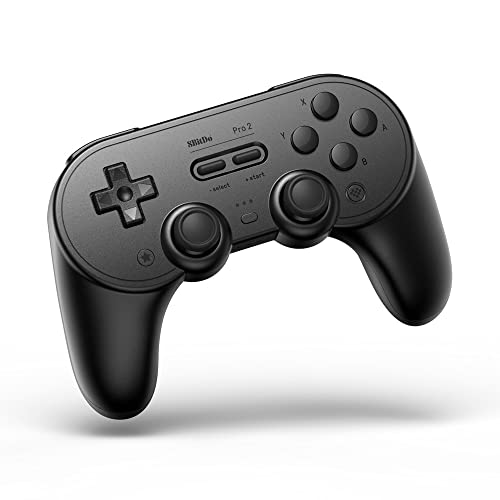
- 8BitDo Pro 2 — Modern dual-stick layout with back paddles and three-way profile switch. The right pick if your library includes a lot of N64/PSP/Dreamcast and you want a familiar modern shape rather than the classic SNES feel.
Either works on RetroPie out of the box once paired in the Bluetooth menu. The Sn30 Pro is the choice for purists; the Pro 2 is the choice for players who treat the Pi as a general retro machine.
Cooling, power, and overclock — the boring stuff that matters
Three pitfalls catch every new Pi 4 builder:
- Active cooling is not optional. Without a heat sink or fan, the Pi 4 throttles within minutes under emulation load. Even basic passive heat sinks help. A case with a small fan (Argon NEO, Argon ONE V3) is the standard pairing.
- Power supply must be 5V / 3A USB-C. Off-brand 5V / 2.5A bricks cause under-voltage warnings, random reboots, and corrupted SD card writes. Use the official Raspberry Pi USB-C supply or a known-good 5V / 3A unit.
- Overclock is reasonable but not free. A modest overclock to 2.0 GHz CPU + 700 MHz GPU is well-tested and helps with N64/Dreamcast performance. Higher overclocks require better cooling and a higher-current PSU.
Legal ROM sourcing and BIOS handling
This guide does not link to or endorse piracy. RetroPie itself is legal software. The ROM question is separate: in general, only use ROMs of games you legally own, plus the BIOS files for systems where you have a corresponding console license. Specific systems (Dreamcast, PSP, Saturn) require copyrighted BIOS images; the legality of those varies by jurisdiction and is the user's responsibility.
Two legal paths to a working library:
- Dump your own cartridges and discs (a Retrode for cartridges; a PC optical drive for discs). Some labor, fully legal in most jurisdictions.
- Public-domain and freely licensed homebrew. Surprisingly large libraries exist for most retro systems; the RetroPie docs link out to the major homebrew archives.
The LibRetro documentation covers the emulator cores in depth — useful when a specific game needs per-core tuning.
Verdict matrix
Build the Pi 4 8GB if: your library is primarily 4th-, 5th-, and selected 6th-gen consoles; you want the cheapest viable retro console build; you value low power draw and silent operation; you enjoy a hands-on hobby project.
Step up to a mini PC if: your library is heavy on PS2 / GameCube / Wii / Saturn; you want a single device that emulates everything up to PS3 cleanly; you do not want to deal with per-game tuning.
First-build setup walkthrough
The 30-minute first build from a fresh Pi 4 to a running RetroPie:
- Download the latest RetroPie image for the Pi 4 from the RetroPie docs downloads page
- Flash it to a 64GB microSD with Raspberry Pi Imager or balenaEtcher
- Insert the microSD into the Pi, connect HDMI, USB-C power, and a keyboard
- First boot drops you at the EmulationStation setup screen — configure your first input device
- Pair the 8BitDo controller: hold its pair button until the LED flashes, then in EmulationStation hold any button on it until it appears, configure the buttons
- Connect to Wi-Fi via the system menu, set hostname, enable SSH for remote management
- Copy your legally-owned ROMs to the appropriate per-console folder (via SMB share, USB drive, or scp)
- Restart EmulationStation; your ROM library appears
Total active time about 20 minutes, plus image download and SD flash time. The RetroPie wiki has per-console gotchas (BIOS file locations, core selection) that handle the long-tail of "this one console behaves a little differently."
Common pitfalls
- Skipping the official PSU. Off-brand chargers under-volt the Pi under load, causing crashes that look like emulation bugs.
- Cheap microSD. Class 10 / A1 minimum; high-endurance is better. A bad SD card causes random freezes and library corruption.
- No cooling case. The Pi 4 throttles within minutes without active cooling. The Argon NEO/ONE cases are the community standard.
- Mixing Pi 4 and Pi 5 instructions. Many older RetroPie guides describe Pi 3 / Pi 4 workflows; some newer ones describe Pi 5. Stick to current Pi 4 instructions and you avoid confusion.
- Expecting PS2/GameCube. They do not work. Trying makes everything else worse.
Worked example: a complete TV-corner build
A specific build we keep recommending:
- Raspberry Pi 4 Model B 8GB: $90
- Argon ONE V3 aluminum case with fan and IR receiver: $35
- Official Raspberry Pi 5V/3A USB-C power supply: $9
- SanDisk Ultra 3D NAND 1TB SSD: $90
- StarTech USB 3.0 SATA enclosure: $20
- SanDisk Extreme 64GB microSD (boot only): $15
- 8BitDo Sn30 Pro Bluetooth controller: $45 (or 8BitDo Pro 2: $50)
- HDMI cable: $5
Total: about $310 for a complete retro console that lives in the TV corner, draws under 15W, runs silent or near-silent, and plays the great majority of the retro library smoothly. That number compares well against any commercial mini-console offering and gives you access to a vastly larger library.
Recommended pick
The complete starter build: the Raspberry Pi 4 Model B 8GB, the 8BitDo Sn30 Pro (or the Pro 2 if you prefer modern shapes), and the SanDisk Ultra 3D NAND 1TB SSD in a USB 3.0 enclosure. Add a 64 GB microSD for the boot OS, an Argon NEO or Argon ONE V3 case for cooling, and the official Pi USB-C power supply. The whole build lands around $250-$280 and emulates 90% of the retro library most players actually want to play.
Bottom line
The Pi 4 8GB RetroPie build is still the cheapest, most flexible, most community-supported way to play 8-bit through PS1 (and most of N64/Dreamcast/PSP) in 2026. It is not the only path — a Steam Deck or mini PC handles heavier systems better — but for the canonical "retro emulation console in a small case under the TV," nothing beats the Pi 4 on cost-to-functionality ratio.
Related guides
- Best Parts for a Budget Ryzen + RTX 3060 Gaming PC Build in 2026
- Best Streaming and Content-Creation Gear in 2026
- Forza Horizon 6 Cuts Load Times to 4 Seconds With Advanced Shader Delivery