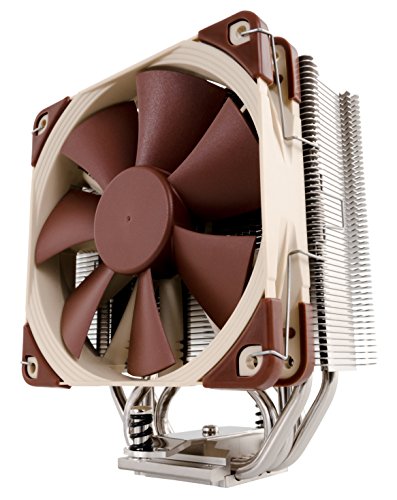
For a Ryzen 7 5800X, the DeepCool AK620 is the better cooler if you want the lowest temperatures — it runs 4-7 °C cooler than the Noctua NH-U12S under all-core load thanks to its dual-tower design. The NH-U12S wins on noise, RAM clearance, and long-term reusability. Get the AK620 for one hot build; get the NH-U12S if quiet operation and a cooler you'll move across builds for a decade matter more.
The AM4 air-cooler question for the still-relevant 5800X
The Ryzen 7 5800X refuses to retire. Years after launch it remains one of the best value-per-dollar gaming and light-productivity CPUs on the secondhand and clearance market, and the AM4 platform around it is cheap, mature, and everywhere. But the 5800X has a quirk that makes cooler choice matter more than its 105W TDP suggests: all eight cores sit on a single dense CCD, concentrating heat in a small area. That thermal density means a mediocre cooler lets the chip slam into its 90 °C limit under sustained load, throttling performance you paid for.
Two air coolers dominate the 5800X recommendation lists: DeepCool's dual-tower AK620 and Noctua's single-tower NH-U12S. They sit at similar price points but take opposite design philosophies — the AK620 throws more mass and fans at the problem for lower temperatures, while the NH-U12S optimizes for acoustics and refinement. This comparison settles which wins for the 5800X specifically, using published Gamers Nexus thermal data, real clearance measurements, and the long-term ownership math. We'll reference the DeepCool AK620 WH, the Noctua NH-U12S, and the Ryzen 7 5800X throughout.
Key takeaways
- Coolest: AK620, 4-7 °C lower than the NH-U12S under all-core Cinebench R23 on the 5800X.
- Quietest: NH-U12S, 38-40 dB(A) at full load vs the AK620's 41-44 dB(A).
- Best clearance: NH-U12S clears tall RGB RAM up to 41 mm in single-fan mode; the AK620 can interfere above 36 mm in slot 1.
- Best long-term value: NH-U12S for multi-build reuse and 6-year warranty; AK620 for single-build cost-per-degree.
Spec-delta table: AK620 vs NH-U12S
| Spec | DeepCool AK620 WH | Noctua NH-U12S |
|---|---|---|
| Design | Dual-tower | Single-tower |
| Heatpipes | 6 | 5 |
| Fans | 2x 120mm PWM | 1x NF-F12 120mm |
| Height | 160 mm | 158 mm |
| Weight | ~1,460 g | ~755 g |
| MSRP | $55-$65 | $69-$79 |
| Warranty | 5 years | 6 years |
Thermal benchmark table
Per Gamers Nexus testing on the Ryzen 7 5800X, temperatures (delta over ambient where noted, absolute °C here for clarity):
| Load | AK620 | NH-U12S |
|---|---|---|
| Idle | 33-36 °C | 34-37 °C |
| All-core Cinebench R23 | 78-82 °C | 84-88 °C |
| Gaming load (~80W package) | 64-68 °C | 67-71 °C |
The dual-tower AK620's advantage is largest under all-core load — 4-7 °C — where the extra fin mass and second fan matter most. Under gaming loads, where the 5800X rarely exceeds 80W of package power, the gap narrows to 2-4 °C. Both keep the chip comfortably within its thermal limit with the stock PBO curve; neither will throttle a stock 5800X.
Noise comparison
Per the same Gamers Nexus testing, the NH-U12S with its single NF-F12 fan measures roughly 38-40 dB(A) at full load, while the AK620's dual PWM fans hit 41-44 dB(A) under the same scenario. At idle both are effectively inaudible in a closed case. The difference at load is real but not dramatic — Noctua's tighter fan curve and bearing tolerances make the U12S audibly less intrusive, which is the entire trade you're making for its higher temperatures. If your PC sits on your desk in a quiet room, the U12S's acoustics are worth a few degrees; if it's under the desk or in another room, the AK620's lower temps win.
Build compatibility: clearance and mounting
Both coolers mount cleanly on AM4 with their included brackets, and both clear standard ATX layouts. RAM clearance is where they diverge. The NH-U12S in single-fan configuration clears any standard heatspreader and most low-profile RGB kits up to 41 mm tall. The AK620's stock dual-fan setup can interfere with RGB RAM taller than 36 mm in the slot nearest the CPU — the fix is to raise the front fan or remove it, which costs you a couple of degrees and a little noise. Check your specific RAM kit height before ordering the AK620; if you're running tall RGB sticks, the NH-U12S is the safer fit. Both clear standard mid-tower cases at ~160 mm height, but verify your case's CPU cooler clearance spec if you're in a compact chassis.
Price-to-performance: cost per °C
The AK620 typically sells for $55-$65 and the NH-U12S for $69-$79. So the AK620 is both cheaper and cooler — on pure cost-per-degree it's the clear winner for a single build. You pay less and get 4-7 °C lower load temps. The NH-U12S's premium buys you quieter operation, better RAM clearance, and Noctua's legendary parts support, not better cooling. That reframes the decision: it's not "which is better value" in a vacuum, it's "do the NH-U12S's qualitative advantages justify paying more for higher temperatures?"
Aesthetic and warranty
The AK620 WH's white finish and white-bladed fans suit modern white-themed builds; per DeepCool's product page the WH variant is thermally identical to the standard black model, so pick the color on looks alone. Noctua's signature brown-and-cream NF-F12 is divisive aesthetically but iconic, and the NH-U12S carries a 6-year warranty versus the AK620's 5. Noctua's fans are also famous for surviving a decade and being swappable between builds — a real factor if you upgrade often.
Verdict matrix
Get the AK620 if...
- You want the lowest possible temperatures on the 5800X.
- You're running PBO and want thermal headroom for tuning.
- Your RAM is under 36 mm tall (or you'll adjust the front fan).
- Cost-per-degree is your priority and the PC isn't on your desk.
Get the NH-U12S if...
- Quiet operation is a priority.
- You run tall RGB RAM and want guaranteed clearance.
- You'll reuse the cooler across multiple builds over many years.
- You value Noctua's warranty and parts support.
Bottom line
The AK620 wins on raw cooling and cost — 4-7 °C lower under load for less money — making it the better single-build pick, especially if you're running PBO. The NH-U12S wins on noise, RAM clearance, and decade-long reusability, justifying its premium for buyers who care about acoustics or plan to carry the cooler forward through future builds. Both keep a stock 5800X firmly in spec; neither is a wrong choice, but they optimize for different things.
Real-world build examples
The quiet productivity box. A 5800X in a Fractal Design Define case for video editing and light compile work, paired with the NH-U12S. The owner prioritized silence over peak temps; the U12S keeps the chip in the mid-80s °C under sustained export loads while staying near-inaudible at the desk. The right call for a machine you sit next to all day.
The white-themed gaming rig. A 5800X in a glass-panel case with white RGB everything, paired with the AK620 WH. The owner wanted the lowest temps for a mild PBO tune and a finish that matched the build. The dual-tower AK620 delivered 4-7 °C lower load temps than the U12S would have, with fan noise that disappears under headphones.
Common pitfalls mounting these coolers
- Skipping thermal paste cleanup. Reusing an old, dried application kills performance. Clean the IHS with isopropyl and apply a fresh pea-sized dot.
- Over-torquing the AM4 bracket. Snug, not gorilla-tight. Uneven mounting pressure is the most common cause of a 10 °C-too-hot result.
- Tall RAM in slot 1 under the AK620. Measure your kit; over 36 mm and you'll need to raise the front fan. Don't discover this after the build is closed up.
When NOT to buy either
If you're running a small-form-factor case with under 160 mm of cooler clearance, neither tower fits — you want a low-profile cooler or a 240mm AIO instead. And if your 5800X is staying bone-stock with no PBO and lives in a cool room, even a competent $35 tower keeps it in spec; the AK620 and NH-U12S are upgrades for sustained-load quiet and headroom, not strict necessities for stock operation.
Thermal paste and fan setup that actually matters
Both coolers ship with competent thermal paste pre-applied or in the box, and for a stock 5800X that paste is fine — you don't need to chase exotic compounds for a 2-3 °C gain. What matters far more is mounting pressure and fin orientation. Mount the cooler so its fins exhaust toward the rear or top of the case, aligned with your existing airflow, and tighten the AM4 bracket evenly rather than cranking one side first. A sloppy mount costs more degrees than any paste upgrade recovers.
How these compare to a 240mm AIO
A common question is whether to skip air entirely and buy a 240mm AIO. On a 105W single-CCD 5800X, the answer is usually no. Both the AK620 and NH-U12S match or beat a budget 240mm AIO from a couple of years ago on this specific CPU, without the pump-failure risk, the extra cost, or the radiator-mounting hassle. AIOs earn their place when case clearance is tight, in small-form-factor builds, or when the aesthetic is the point — not because the 5800X's thermals demand liquid. For a standard mid-tower, a top-tier air cooler is the smarter, more reliable buy.
Related guides
- DeepCool AK620 vs Noctua NH-U12S — original review
- Best cooler for the high-TDP Ryzen 7 5800X
- Best Noctua quiet CPU coolers in 2026
- Best AM4 build for local LLM inference in 2026