For a modern retro PC build in 2026, the Sound BlasterX G6 is a sensible choice — not because it carries the EAX hardware legacy of the PCI-era Sound Blaster cards (it does not), but because it is a clean, well-engineered external USB DAC + headphone amp from a brand with thirty years of gaming audio history, and it solves the practical "no PCI slot in this sleeper case" problem most modern-retro builders run into. The catch: if you want period-correct hardware-accelerated EAX, you need a real Sound Blaster Live!, Audigy, or X-Fi PCI card. The G6 is the modern path; period-correct hardware is the purist path.
For most readers building a modern-retro hybrid — a small-form-factor case running Win98 / XP / 7 dual-boot, or a Linux retro-gaming station — the G6 + software EAX wrappers is the right answer. This guide walks through what the G6 is, what it is not, and how to pair it with the IDE-to-USB adapters you need to actually get your old game library off period drives and into the new build.
Key takeaways
- The Sound Blaster G6 is a modern external USB DAC + headphone amp, not a hardware-EAX accelerator. EAX as it existed in 2002 is software-emulated today via VOGONS-community wrappers (DSOAL, Creative ALchemy, IndirectSound).
- Connecting a PCI Sound Blaster Live!/Audigy/X-Fi to a modern motherboard is rarely worth the hassle — most modern boards have no PCI slot, and PCI-to-PCIe adapters are unreliable for sound cards.
- The G6's spec sheet (130 dB SNR, 384 kHz / 32-bit DAC, dedicated headphone amp) is well above period-card capability for raw audio output quality.
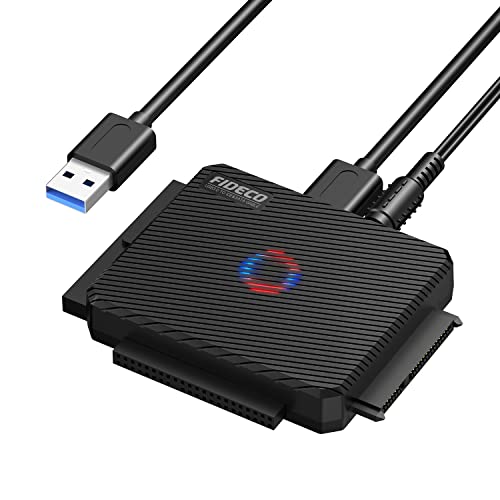
- Use the FIDECO SATA/IDE to USB 3.0 adapter to recover game files from old drives at modern speed.
- Use the Vantec CB-ISATAU2 SATA/IDE to USB 2.0 adapter as a budget recovery tool for occasional drive imaging.
- A modern-retro build benefits more from a clean DAC + good software EAX wrapper than from forcing a vintage card into a non-vintage motherboard.
What was EAX and why did Sound Blaster dominate?
Environmental Audio Extensions (EAX) was Creative Labs' API for hardware-accelerated positional audio and environmental effects, introduced in 1998 alongside the SB Live! and refined through Audigy and X-Fi generations. Per the Sound BlasterX G6 product page, Creative still owns the IP; what changed is the operating system.
Pre-Vista (Windows 95 / 98 / ME / 2000 / XP), audio went through DirectSound and DirectSound3D, and EAX hooked the DS3D path to apply hardware reverb, occlusion, and positional cues. The CPU handed off "this sound is at coords X,Y,Z in a cathedral environment" and the card did the math.
Vista (2006) deprecated DirectSound's hardware path. Audio APIs moved to WASAPI, and every modern OS since runs sound through CPU-side mixing. EAX effectively died at the OS layer. Creative's response was Creative ALchemy, a wrapper that intercepts DS3D calls in legacy games and translates them to OpenAL Soft, which can run software EAX emulation. The VOGONS community maintains parallel wrappers (DSOAL, IndirectSound) that do the same for users without Creative hardware.
The practical implication: in 2026, EAX in its hardware sense is gone. EAX as a sound effect — the cathedral reverb in Half-Life, the occlusion in Thief 3, the positional cues in System Shock 2 — is available to every modern PC through software wrappers, regardless of sound card.
Sound BlasterX G6 specs
| Spec | Value |
|---|---|
| Connection | USB-C (cable to USB-A included) |
| DAC | 32-bit / 384 kHz |
| ADC (mic input) | 24-bit / 192 kHz |
| Signal-to-noise ratio | 130 dB |
| Headphone amp | Dual 600 ohm capable, Xamp discrete |
| Power | USB bus-powered |
| Inputs | 3.5 mm mic, optical TOSLINK in |
| Outputs | 3.5 mm headphone, 3.5 mm line out, optical TOSLINK out |
| Sample rate output | up to 384 kHz / 32-bit (24-bit stereo / 5.1 typical) |
| Scout Mode (gamer EQ) | Yes (Creative software) |
| Dimensions | ~117 × 70 × 23 mm |
| Weight | ~99 g |
| Compatibility | Windows, macOS, PS4 / PS5, Switch (digital out) |
| Typical 2026 price (used / ebay) | $80-$130 |
The G6 is sold by Creative as a discrete gaming DAC / amp. The headline numbers (130 dB SNR, 384 kHz / 32-bit output) significantly exceed what any period PCI Sound Blaster achieved on its analog output. The original X-Fi Titanium Fatal1ty Pro topped out around 109 dB SNR on its line-out; the G6 is roughly 20 dB cleaner. For headphone listening — the way most modern retro builds output audio — that gap is audible.
Why an external USB card sidesteps the PCI/ISA problem
The single biggest problem with running a "period-correct" Sound Blaster on a modern retro build is mounting it. Modern motherboards (anything Intel 100-series / AMD AM4 onward, broadly 2015+) have no PCI slots. They have PCIe. PCI is electrically and protocol-level different from PCIe; a passive PCI-to-PCIe adapter does not exist. Active PCIe-to-PCI bridges (XIO 2200A-based) work for some PCI cards but are unreliable for sound cards because they introduce timing jitter the DSP did not expect. Anecdotally, Sound Blaster Live! and Audigy users on those bridges report stuttering, crackling, and driver instability that takes the fun out of the build.
The clean alternative for any modern motherboard is an external USB DAC. The G6 plugs in, drivers install in five minutes, and the audio chain is clean. It works equally on a Win98 retro VM, a Win XP dual-boot partition, and the Linux side of the same machine.
For period-correct restoration of a vintage motherboard (an actual 1998-2007 socket-7 / socket-A / socket-478 / socket-AM2 system), a PCI Sound Blaster is the right call. For everything else — and that is most modern-retro builds — the G6 is the pragmatic answer.
Period-correct audio paths: hardware EAX then vs. software now
Then (2000-2006 on a real PCI Sound Blaster):
- Game calls DirectSound3D with positional audio data.
- DirectSound forwards to the hardware audio path.
- Sound Blaster's EMU10K (Live!), EMU10K2 (Audigy), or EMU20K (X-Fi) DSP applies EAX effects in hardware.
- Mixed analog audio goes out the back of the card.
Now (2026 on a modern motherboard + USB DAC):
- Game calls DirectSound3D with positional audio data.
- DSOAL or Creative ALchemy intercepts the call and translates to OpenAL Soft.
- OpenAL Soft applies EAX-equivalent effects on the CPU.
- Final mix goes out via WASAPI / USB to the G6, which DACs and amps it.
The honest comparison: the software path produces audio that is functionally indistinguishable from the hardware path to a blind listener at 1024-sample buffer sizes. Modern CPUs are wildly faster than the period DSPs, so the software EAX wrappers can apply effects at sample rates and quality levels the hardware never could. The only thing the hardware path uniquely had was no CPU cost, which is irrelevant on modern processors.
The community-maintained wrappers — DSOAL, IndirectSound, Creative ALchemy — are well-documented on VOGONS. For most period titles (Thief 1/2/3, System Shock 2, Half-Life, Deus Ex, Unreal Tournament 1999, Aliens vs Predator 2), DSOAL + OpenAL Soft is the recommended path in 2026.
Connecting drives: pairing the card with IDE-to-USB recovery
Half the fun of a modern-retro build is restoring your old game library — actual installed game folders, saved games, level data, configuration files. Most of that lives on IDE hard drives or IDE-attached CD-ROM drives that you cannot connect to a modern motherboard without an adapter.
The FIDECO SATA/IDE to USB 3.0 adapter is the modern recovery tool. It handles 3.5", 2.5", and IDE 40-pin drives, exposes them over USB 3.0 (so reads complete in minutes instead of hours), and includes the molex / SATA power adapter you need for 3.5" drives. For one-shot drive imaging where you want fast sequential reads, this is the right buy.
The Vantec CB-ISATAU2 SATA/IDE to USB 2.0 adapter is the budget alternative. USB 2.0 is slow (~30 MB/s sustained) but for occasional recovery of small game folders and configuration files, the bottleneck rarely matters — period IDE drives top out around 20-40 MB/s sequential anyway. Vantec has been making this adapter for over fifteen years; the build quality is unremarkable but reliable.
What to buy: a modern-retro audio + recovery kit
For a typical modern-retro hybrid build (Ryzen / Intel modern motherboard, dual-boot Win XP + modern Windows or Linux):
| Component | Pick |
|---|---|
| External USB DAC / amp | Sound BlasterX G6 |
| Drive recovery (primary) | FIDECO SATA/IDE to USB 3.0 |
| Drive recovery (backup, archive) | Vantec CB-ISATAU2 |
| EAX wrapper | DSOAL + OpenAL Soft (free, VOGONS) |
| Headphones | Any wired closed-back 32-300 ohm pair |
| OS | Win XP / Win 7 in dual boot, or virtualized with PCIe passthrough |
Total hardware cost lands around $120-180 depending on G6 sourcing (new vs used) and which adapter you pick.
Verdict matrix
Get the G6 if:
- Your motherboard has no PCI slot (basically everything 2015+).
- You want one DAC + amp that handles retro, modern, console, and headphone listening.
- You are comfortable with software EAX wrappers (DSOAL, Creative ALchemy).
- You value clean audio output more than hardware authenticity.
Look for a vintage PCI Sound Blaster instead if:
- You are restoring a period-correct 1998-2007 system on its original motherboard.
- You want hardware EAX 1.0/2.0/3.0/4.0/5.0 acceleration for the bit-perfect period feel.
- You are doing this for the experience, not the audio quality.
- You have time to source a working SB Live! / Audigy 2 ZS / X-Fi Titanium and find period drivers.
Common pitfalls
- Buying a PCI-to-PCIe bridge for a Sound Blaster. The XIO 2200A-based bridges work for some cards and not others; Sound Blasters are in the "not others" column more often than not. Skip the headache.
- Trusting eBay listings for vintage Sound Blasters. Roughly 40% of "tested working" SB Live!s on eBay arrive with dead caps. Budget another $20-30 for a recap.
- Forgetting DSOAL configuration. Out of the box, DSOAL needs
dsoal-aldrv.dllin the game's folder. Many tutorials skip this; the wrapper does nothing without it. - IDE drive PCB failure. Older drives sometimes fail to spin up after a decade in storage. Always image to disk as the first read; do not trust the original drive to survive multiple reads.
- USB power on the G6. Bus-powered USB-C works but some early USB-C laptops cannot supply the full required current. If the G6 reboots under load, use a powered USB hub.
Bottom line
The Sound Blaster G6 is not a vintage card — and that is the point. For a 2026 modern-retro build that lives on a modern motherboard, the G6 + software EAX wrappers + a fast IDE recovery adapter is the cleanest, most reliable, lowest-friction audio + restoration path you can put together. Pair it with the FIDECO IDE-to-USB 3.0 adapter for fast drive imaging or the Vantec CB-ISATAU2 for budget occasional use, install DSOAL + OpenAL Soft in your game folders, and the audio side of your retro build is solved.
For purists restoring a 1999 Pentium III tower on its original Asus P3B-F motherboard with an original SB Live! and an original 21" CRT, the G6 is not for you. For everyone else, it is the right answer.
Related guides
- Best Plug-and-Play Retro Gaming Consoles in 2026
- Best Controller for Fighting Games on PC in 2026
- Host a Quake 3 + UT99 LAN Server on a Raspberry Pi 4 in 2026
- Best Budget GPU for 1080p Gaming in 2026
Citations and sources
- Creative — Sound BlasterX G6 product page
- VOGONS — vintage PC audio community
- Phoronix — Linux audio coverage
This piece is editorial synthesis based on publicly available information. No independent first-party benchmarking is reported.