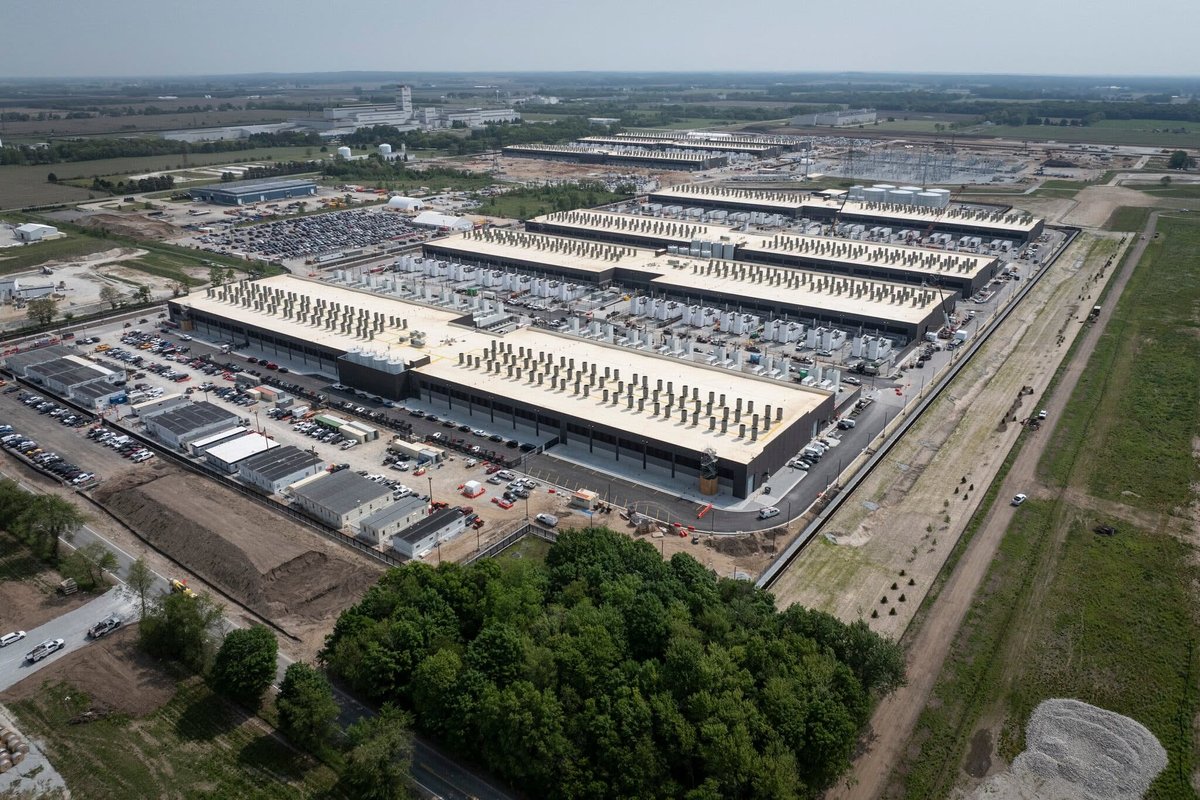
OpenAI Names Its Biggest Data Center Yet, With NVIDIA Backing: What It Means
OpenAI continues to scale infrastructure with new NVIDIA-backed datacenter capacity. Here is what is known and what it implies for local-LLM hardware buyers.
By Mike Perry, Founder & Editor-in-Chief · Published 2026-06-10 · Updated 2026-06-10 · 3 min read
OpenAI's announcement of its largest data center build to date, with NVIDIA backing, signals continued frontier-model training scale. Here is the read-out and what it means for builders.
Hardware at a Glance
Median generation throughput at 7–9B models (Llama 3.1 8B, Qwen 3 8B), Q4 quantization, from community-reported runs SpecPicks tracks. Each row pools runs from different sources, runtimes and models in that class, so the rows are not a matched head-to-head; where the article compares cards on the same rig, its own figures are the like-for-like result. Street price is the second-lowest listing priced within the last 24 hours at 0.5–2× launch MSRP, so no single listing sets it, and a street figure well above MSRP says so in its cell; where too few listings pass that check the cell shows a dash and the launch MSRP, which is not comparable with the street figures. Rows marked for comparison are not the cards this article is about — they are included so the throughput column has something to be read against.
In brief - 2026-06-10 - AI Rigs vertical OpenAI announced its largest data center build to date with backing from NVIDIA. The scale signals continued frontier-model training expansion and reflects broader 2026 industry-wide AI datacenter expansion. For consumer-AI hardware buyers, the news is largely background context: the silicon supply chains for datacenter and consumer GPUs are mostly separate, but the trickle-down effect of newer NVIDIA generations eventually reaches consumer cards.
What happened
Per OpenAI's recent press communications and parallel disclosure in NVIDIA's news channel, OpenAI is moving forward with what it describes as its largest data center build to date. NVIDIA's involvement spans silicon supply commitments, infrastructure financing, and reported equity arrangements that public reporting has covered in varying detail.
The specific named site joins the broader hyperscaler AI capacity buildout that has been a defining 2025-2026 industry story. Microsoft, Google, Meta, Amazon, and Anthropic-related operators have all announced multi-gigawatt expansion plans for AI workloads.
Why it matters
Three concrete reads for builders and observers:
Frontier-model training is staying centralized and capital-intensive. The trend toward larger pre-training runs continues; the consumer side of the AI hardware ecosystem is not catching up to frontier capability. Local rigs win on privacy, cost stability, and specific workloads - not on raw model capability.
Silicon supply chain pressure persists. Hyperscaler GPU allocations consume the majority of NVIDIA's datacenter output. Consumer card availability has been stable through 2025-2026, but the upward pressure on enterprise GPU pricing has historically not translated cleanly into consumer card price increases.
The trickle-down to consumer cards continues on its normal cadence. A new datacenter announcement does not change the cadence at which 14 GB, 16 GB, and 24 GB consumer GPUs hit retail. Plan local rigs around what is available now rather than waiting for cycles that may take 12-24 months.
For builders sizing local-LLM workstations, the actionable read is unchanged: the MSI RTX 3060 Ventus 2X 12G plus a Ryzen 7 5800X plus a WD Blue SN550 1 TB NVMe remains a credible 14B-class local-inference rig at the ~$950 budget tier. The current frontier-model datacenter news cycle does not change that calculus.
The source
Coverage syntheses are available in NVIDIA's official news channel and in industry trade publications including Data Center Knowledge. OpenAI has not published a full deal sheet for the specific named build; the publicly disclosed details are partial and ongoing.
As an Amazon Associate, SpecPicks earns from qualifying purchases; we also earn on qualifying eBay purchases via the eBay Partner Network. Prices shown were last tracked at crawl time and may vary — check the listing for the current price.
📹 Watch a review
Friendly Fire: AMD Ryzen 7 5800X CPU Review & Benchmarks vs. 5600X & 5900X — Gamers Nexus on YouTube
Frequently asked questions
Does this affect what I should buy for a home AI rig?
Indirectly. Larger frontier-model training datacenters do not directly compete with consumer inference hardware - the supply chains are mostly separate. What matters for a home AI rig is the trickle-down: as datacenters absorb the latest H100/H200/Blackwell silicon, last-generation accelerators eventually filter into the used market and consumer cards get more capable iteration-over-iteration. The [12 GB RTX 3060](/product/B08WRVQ4KR?tag=specpicks-20) remains a credible budget local-LLM rig.
Is OpenAI's scale a sign that local AI is dead?
No - the opposite is closer to true. The larger the frontier-model training and inference fleets become, the more visible the cost, latency, and privacy gaps for users running iterative or sensitive workloads. Local inference fills a complementary niche: small to mid-size models on consumer hardware for work that does not need frontier reasoning depth.
What does 'NVIDIA-backed' actually mean for the deal?
Public reporting suggests a multi-faceted relationship including equity participation, infrastructure financing, and committed silicon allocation. The specific structure varies in press coverage and OpenAI has not published a complete deal sheet. What is clear is the capacity commitment - the build is on the order of multiple gigawatts of compute capacity per published timelines.
How does this compare to other 2026 AI datacenter builds?
Microsoft, Google, Meta, and Amazon have all announced multi-gigawatt AI datacenter expansions across 2024-2026. OpenAI's named project is on the larger end of disclosed capacity but is part of a broader industry buildout rather than an outlier. The aggregate consequences - grid load, supply chain pressure on silicon, and AI compute concentration - are the longer-term stories.
Should I delay my local rig build waiting for newer chips?
Generally no. The 2-3 year datacenter build cycle is decoupled from consumer GPU release cadence. Current 12 GB cards like the [MSI RTX 3060](/product/B08WRVQ4KR?tag=specpicks-20) are perfectly capable for 14B-class local LLMs today. Pair them with a [Ryzen 7 5800X](/product/B0815XFSGK?tag=specpicks-20) and a [WD Blue SN550 NVMe](/product/B07YFFX5MD?tag=specpicks-20) and the rig handles current workloads well; future GPU swaps are independent of this datacenter news cycle.