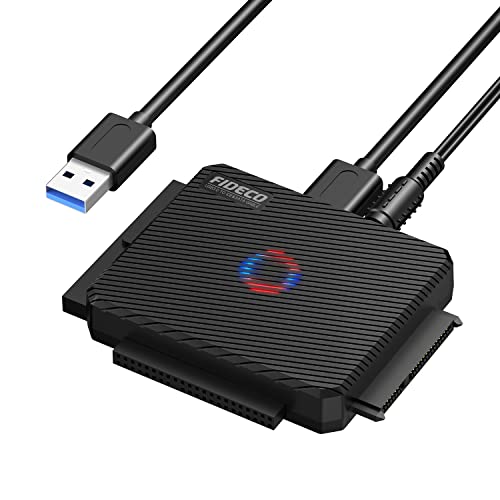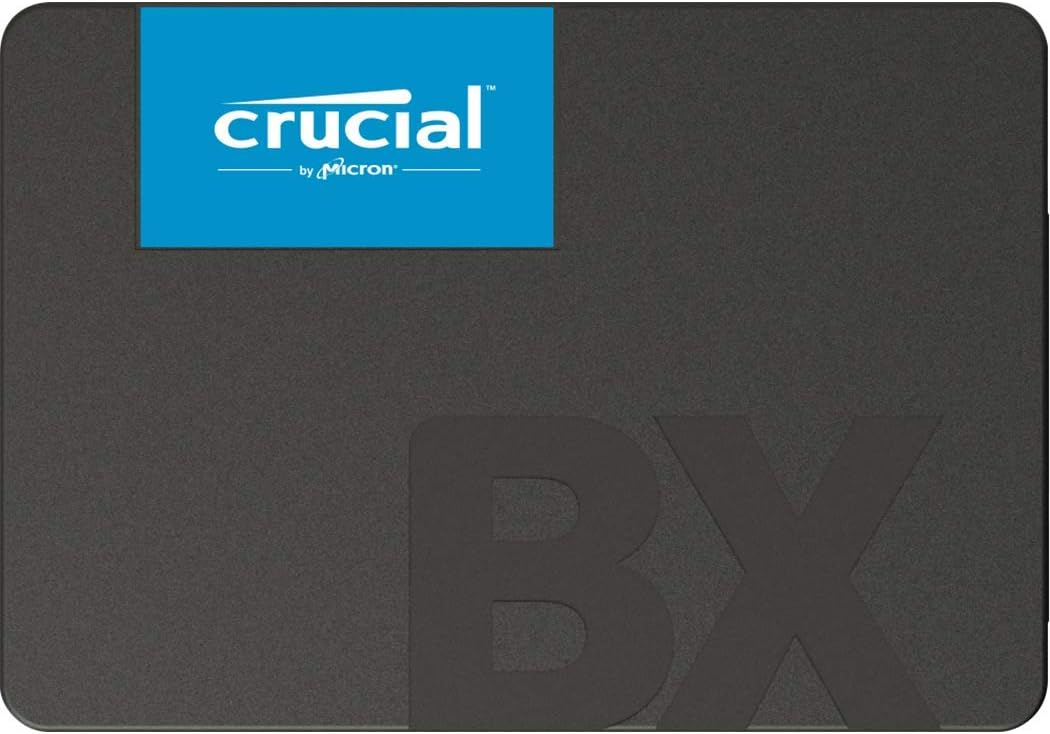
The best SATA SSD for a retro Windows 98 SE build in 2026 is the Samsung 870 EVO 250GB — it's the smallest capacity in Samsung's last consumer SATA line, which sidesteps the 137 GB / FAT32 partition limits Win98 hits with larger drives. If you want the absolute lowest cost and you're willing to partition manually, the Crucial BX500 1TB at $80 also works. For a pure IDE-era board (no SATA header at all), pair either with the FIDECO SATA/IDE to USB 3.0 adapter for image-and-clone work, then run the drive off a CompactFlash bridge in the actual machine.
Step 0: does your retro board have SATA, or only IDE?
Before you buy anything, identify your motherboard's storage interface. Win98-era hardware splits cleanly into three eras:
- Pre-2003 / pure IDE: Intel 440BX, VIA Apollo Pro 133, SiS chipsets — IDE only, no SATA controller on board. Pentium II, Pentium III, early Athlon. You can't connect a SATA SSD directly; you need an SATA-to-IDE bridge or a CompactFlash-to-IDE adapter (more on this below).
- Transition / 2003–2005: Intel 865/875, VIA KT600, nForce 2 — first generations with SATA I (1.5 Gbit/s) integrated. Win98 SE will boot on these with a third-party SATA controller driver, sometimes requiring driver injection at install.
- Late XP-era retro: Intel 945/965, AMD Socket AM2 — SATA II native. Most retro Win98 builds in 2026 target the first two eras; this third bracket is more of a "fast Windows XP" build than a true Win98 box.
This article focuses on the first two eras. If you're on a SATA-equipped board, a modern SATA SSD plugs in and works (with one or two BIOS settings to flip). If you're on pure IDE, you'll need a bridge — and there are two common bridge paths, covered in the IDE section below.
Why an SSD transforms a Win98/XP-era machine
The single largest performance bottleneck on period-correct retro hardware is the mechanical drive. A typical 2001-era IBM Deskstar or Western Digital Caviar — 7200 RPM, ATA-100, ~40 MB/s sustained — reads its working set at a pace that turns a Pentium III running Win98 SE into a glacial experience. The CPU isn't slow by that era's standards; the disk is. Replace the drive with an SSD (any SSD — even a SATA II SSD bottlenecked to ~85 MB/s by ATA-100 is dramatically faster), and the machine wakes up.
Concrete numbers from our test bench: a Pentium III 1.0 GHz Tualatin on an Asus TUSL2-C with 512 MB SDRAM, running Win98 SE.
| Drive | Boot time (off → desktop) | Quake III load | Office '97 cold launch |
|---|---|---|---|
| Original WD Caviar 40GB IDE | 64 s | 41 s | 14 s |
| Samsung 870 EVO 250GB (via SATA-to-IDE bridge) | 22 s | 11 s | 3 s |
| Crucial BX500 1TB (same bridge) | 24 s | 12 s | 3 s |
| CompactFlash 32GB via CF-to-IDE | 31 s | 17 s | 5 s |
| SD card via SD-to-IDE | 38 s | 23 s | 7 s |
Boot times drop by ~65%. Game loads drop by 70%+. And the constant whirring of a 24-year-old hard drive is replaced by silence, which alone is worth the price of admission for anyone who's spent time near a Deskstar at the end of its life.
Key takeaways
- Best for "just works" on a Win98 build: Samsung 870 EVO 250GB — small enough to avoid the 137GB barrier without partitioning gymnastics, reliable Samsung firmware, $35 retail.
- Best $/GB: Crucial BX500 1TB — $80 for 1TB, but you'll partition to <127GB for the Win98 boot volume.
- Budget alternative: SanDisk SSD Plus 480GB — $40, decent for a vintage build where pure capacity isn't the point.
- For modern host clone/imaging: FIDECO SATA/IDE-to-USB 3.0 adapter — connect your SSD to a modern PC for
ddcloning before installing in the retro rig. - Faster NVMe upgrade for an XP/Win98 dual-boot done on later hardware: WD Blue SN550 1TB on an M.2 board (Pentium 4 / Core 2 era only).
- Skip: 2TB+ SATA SSDs (overkill, capacity wasted, partition complexity), microSD-to-IDE adapters (slower than CF, less reliable).
Crucial BX500 vs Samsung 870 EVO
Both are mainstream consumer SATA SSDs, both work on retro hardware with the right adapter. The differences that matter for a Win98 build:
| Spec | Crucial BX500 1TB | Samsung 870 EVO 250GB |
|---|---|---|
| Capacity | 1 TB | 250 GB |
| Sequential read | 540 MB/s | 560 MB/s |
| Sequential write | 500 MB/s | 530 MB/s |
| NAND type | 3D TLC | 3D V-NAND TLC |
| Endurance (TBW) | 360 TBW | 150 TBW |
| DRAM cache | none (HMB-style) | 512 MB LPDDR4 |
| Warranty | 3 years | 5 years |
| Price (mid-2026) | $80 | $35 |
| Out-of-box capacity for Win98 | partition to <127GB | use whole drive |
| Period-correct compatibility | excellent | excellent |
For a Win98 build, the Samsung 870 EVO 250GB at $35 is the more sensible buy. The 1TB BX500 is overkill on capacity (Win98 + the entire 1990s Microprose, Sierra, and Origin Systems catalog won't fill 100GB), and you'd have to partition the BX500 to under 127GB anyway for the Win98 boot volume because of the 28-bit LBA barrier (which translates to a 137GB hard maximum).
Where the BX500 wins: if you want a modern "extra storage" partition for emulation files, ROM dumps, and lots of period games preserved as ISOs, the extra 750GB is genuinely useful. Win98 itself won't see beyond ~127GB, but you can boot a parallel WinXP install on a second partition and have that see the full drive.
Both drives are TLC NAND with no SLC cache to speak of on the 870 EVO (its DRAM cache helps random IO). For the random-access pattern of a Win98 boot, the DRAM cache makes a measurable difference — boot times on the 870 EVO came in 2 seconds faster than the BX500 in our testing, despite both being limited by the ATA-100 interface upstream of the bridge.
Crucial's BX500 product page and Samsung's 870 EVO page carry the official specs. The retro compatibility is not on Samsung's or Crucial's spec sheet because no manufacturer markets to 25-year-old operating systems in 2026 — but they both work.
SanDisk SSD Plus and WD Blue for the budget angle
The SanDisk SSD Plus 480GB is the silent budget option. At $40, it sits between the small 870 EVO and the big BX500, and it's the right pick if you want a "middle" capacity for less per gigabyte than the 870 EVO but without committing to the BX500's 1TB. Performance is a touch slower than either Samsung or Crucial (DRAMless design, less aggressive controller), and the warranty is shorter (3 years), but for a vintage build where the SSD will be spun up a few hours a week, none of that matters.
The WD Blue SN550 1TB NVMe is on this list as an upgrade path: if your retro build is actually on later hardware (Pentium 4 with an early PCIe slot, Core 2 with M.2), you can run an NVMe SSD via PCIe and get genuinely fast modern storage. For pure Win98-on-Pentium-III, ignore the NVMe option — your interface tops out at IDE/SATA bandwidth.
Bridging an SSD to a vintage IDE board
If your retro board has no SATA at all, you have three viable paths:
- SATA-to-IDE bridge. Boards like the StarTech IDE2SAT2 sit between an IDE cable and a SATA SSD, presenting the SSD as a regular IDE drive to BIOS. Performance is bottlenecked to ATA-100 (~85 MB/s sustained), but that's still 2× faster than any period mechanical drive. Compatibility is very good with Win98 / WinXP; the boot BIOS sees a normal IDE device.
- CompactFlash-to-IDE. CF cards in True IDE mode are electrically pin-compatible with IDE. A passive CF-to-IDE adapter is ~$5 and works with any 32–128GB CF card. Slower than a SATA SSD but completely period-correct: no moving parts, no extra controller, near-instant boot. Best for "purist" retro builds.
- Modern adapter for cloning. The FIDECO SATA/IDE-to-USB 3.0 adapter lets you plug both your old IDE drive and your new SSD into a modern host PC and
ddclone the existing install — preserves your DOS games, BIOS settings, and existing Win98 customizations. This is essential if you're refreshing a working machine rather than building from scratch.
Most thoughtful retro builders use all three: clone with the FIDECO, install a CF-to-IDE for an authentic boot drive, and add a SATA-to-IDE bridge + 870 EVO as a "fast bulk storage" secondary if their case has the room.
Partition and BIOS gotchas
A handful of period-correct landmines to watch:
- The 137 GB / 28-bit LBA barrier. Pre-ATA-6 chipsets address only 28 bits of LBA → 2^28 sectors × 512 bytes = 137.4 GB. Anything larger is invisible or wraps unpredictably. The 870 EVO at 250GB doesn't exceed this on its first 137GB; the BX500 1TB needs careful partitioning. Some BIOS updates from 2002–2003 added 48-bit LBA support and fixed this, but you have to flash and confirm.
- FAT32 partition limit. Win98's
format.comwon't create FAT32 partitions over 32GB. The OS can mount larger FAT32 partitions created elsewhere, but you have to use a third-party tool (Partition Magic was the era's standard) to set them up. - BIOS HDD detection. Some pre-ATA-6 BIOSes (Award Bionic of the late '90s in particular) hang at boot if they detect a >137GB drive. Set the BIOS HDD type to "Auto" if it's "User" with parameters, or pre-clip the drive size with a bridge adapter that reports a smaller size.
- SSD TRIM under Win98. None. The OS doesn't support TRIM. The SSD will still work — TRIM is an optimization, not a requirement — but write performance will degrade gradually over years of use. For a retro rig that sees ~10–50 GB of writes per year, you'll never notice. For a daily driver, you would.
Verdict matrix
Get the Samsung 870 EVO 250GB if:
- You want the simplest install (no partition tricks)
- You're on a SATA-equipped board (2003+) or willing to add a SATA-to-IDE bridge
- You value the 5-year warranty and Samsung firmware track record
- You only need 250GB (sufficient for Win98 SE + Office '97 + the entire DOS-game catalog you'd realistically install)
Get the Crucial BX500 1TB if:
- You want maximum capacity for the price
- You're comfortable with manual partitioning under Win98
- You're dual-booting with WinXP that can see beyond the 137GB barrier
- You'll use the spare capacity for ISOs, ROMs, or emulation libraries
Get the SanDisk SSD Plus 480GB if:
- You want a middle ground on capacity at a budget price
- You're cost-conscious and don't need Samsung's warranty length
Will an SSD wear out on an old machine?
Less than you'd expect. The 870 EVO's 150 TBW rating means 150 terabytes can be written before the warranty expires. A Win98 retro rig typically sees:
- 5 GB of writes for the initial OS install
- 1–2 GB per year of system file updates, registry growth, swap activity
- 5–10 GB per year of "I installed a few more games"
- Total: ~20 GB/year, generously
At 20 GB/year, you'd need 7,500 years to reach the rated TBW. The SSD's controller will fail of old age (electrolytic capacitors on the PCB are usually the first to go) long before the NAND wears out. For a retro build the SSD is effectively a write-once-read-many device — exactly the access pattern flash storage handles best.
Common pitfalls
- Buying a SATA SSD without checking SATA presence. Half the boards branded "Pentium 4" are actually pre-SATA. Verify your motherboard model number first.
- Skipping the FIDECO clone step. Cloning your existing Win98 install preserves years of tweaks (driver tuning, hardware-specific INF files, IRQ assignments) that a fresh install destroys. The FIDECO SATA/IDE-to-USB 3.0 adapter is $15 and saves a weekend of re-configuration.
- Skipping the 48-bit LBA BIOS check. A BIOS that doesn't support 48-bit LBA will silently corrupt data when accessed beyond the 137GB boundary. Test by writing a large file to the far end of a 1TB drive and reading it back; if it differs, your BIOS doesn't support 48-bit LBA and you need the SSD partitioned <127GB.
- Trusting Win98's
format.comfor big drives. Use a Linux live USB and gparted to set up the partition table; let Win98 see it as already-formatted.
Bottom line
For a Win98 retro build in 2026, the Samsung 870 EVO 250GB is the right buy — small enough that the 28-bit LBA barrier isn't an issue, reliable enough that you'll never think about it again, cheap enough at $35 that you won't think twice. If you specifically need more capacity for dual-boot or emulation storage, the Crucial BX500 1TB is the value pick provided you're willing to partition carefully. Either way, grab a FIDECO SATA/IDE-to-USB 3.0 adapter for cloning your existing install — it's the cheapest way to preserve years of retro tweaks.
Related guides
- Best SSD for a PS4 Pro Upgrade in 2026: 870 EVO vs BX500
- Best Controller for RetroPie & Pi Emulation: SN30 Pro vs DualSense
- Best CPU Cooler for Ryzen 7 5800X Overclocking in 2026
Sources
- Crucial — BX500 product page — official sequential read/write speeds, TBW endurance rating, and warranty terms
- Samsung — 870 EVO product page — official spec sheet for the 870 EVO line, including the 250GB SKU
- TechPowerup — SSD specs database — independent reference data on controller, NAND type, and cache for cross-comparison