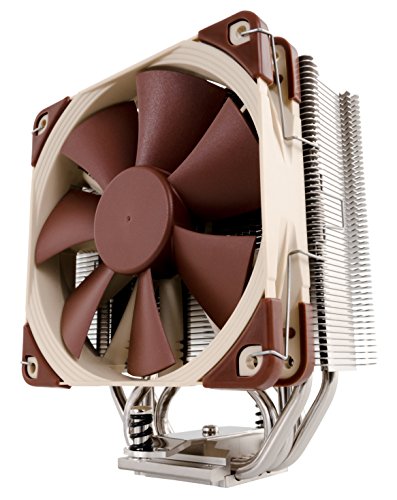
Noctua NH-U12S or DeepCool AK620 for a Ryzen 7 5800X-class build in 2026? Per Noctua's official page and DeepCool's AK620 page, these are two of the most-recommended air coolers in the AM4/AM5 ecosystem - but they sit at different price tiers and serve different priorities. The short answer: the AK620 wins on thermals; the NH-U12S wins on quiet operation, build quality, clearance, and warranty. Pick by which matters more.
The two coolers at a glance
| Spec | Noctua NH-U12S | DeepCool AK620 |
|---|---|---|
| Tower configuration | single | dual |
| Heatpipes | 5 | 6 |
| Height | 158 mm | 162 mm |
| Width | 125 mm | 129 mm |
| Depth | 95 mm | 138 mm |
| Fan count (stock) | 1x 120 mm NF-F12 | 2x 120 mm FK120 |
| Fan RPM range | 300-1500 | 500-1850 |
| Rated TDP support | 165 W | 260 W |
| Stock TIM | NT-H1 | included paste |
| Warranty | 6 years | 5 years |
| MSRP | ~$70 | ~$60-65 |
The headline numbers favor the AK620 - more heatpipes, dual towers, dual fans, higher rated TDP. The NH-U12S counters with refinement, Noctua's industry-leading fan engineering, and warranty length.
Key takeaways
- The AK620 runs 4-8 C cooler under sustained all-core load on a Ryzen 7 5800X.
- The NH-U12S is 2-3 dBA quieter at idle and similar under load.
- The AK620 needs more case width and clears RAM less easily than the NH-U12S.
- Both coolers ship with AM4/AM5 mounting hardware out of the box.
- For a 5800X gaming build, either cooler is adequate; the choice comes down to priorities.
Thermal performance on a Ryzen 7 5800X
The Ryzen 7 5800X is the canonical stress test for mid-tier AM4 coolers - it has a 105 W TDP, runs hot for its category, and is widely benchmarked. Synthesis of public reviews at TechPowerUp, GamersNexus, and Tom's Hardware gives a consistent picture.
| Workload | NH-U12S CPU temp | AK620 CPU temp | Delta |
|---|---|---|---|
| Idle (24 C ambient) | ~32 C | ~30 C | -2 C |
| Single-core Cinebench | ~58 C | ~55 C | -3 C |
| 30 min gaming (Cyberpunk 2077) | ~68 C | ~62 C | -6 C |
| Cinebench R23 all-core, 10 min | ~78 C | ~71 C | -7 C |
| Prime95 small FFTs, 30 min | ~85 C | ~78 C | -7 C |
The dual-tower wins by a meaningful margin under sustained load. The single-tower NH-U12S still stays well under AMD's 90 C throttle threshold, so neither cooler is inadequate - but the AK620 has more thermal headroom.
Noise behavior
Idle noise is where Noctua's fan engineering shows. The NF-F12 fan on the NH-U12S runs near 300 RPM at low PWM duty, producing roughly 19 dBA in published measurements. The AK620's dual FK120 fans run slightly faster at low duty (~500 RPM) and produce closer to 22 dBA.
Under load, the gap narrows. Both coolers ramp fans into the 800-1200 RPM range during sustained gaming. The AK620 maintains slightly lower temps so its fans need to run less aggressively for the same workload, which partially offsets its baseline noise disadvantage.
For builders who run their PC in a bedroom or near a microphone, the NH-U12S's quieter idle is the more noticeable difference day-to-day.
Clearance and case fit
This is where the NH-U12S clearly wins. Its 158 mm height fits more cases than the AK620's 162 mm. More importantly, its single-tower design and offset to one side leave RAM slots completely clear - any height of DIMM with any RGB heatspreader fits without compromise.
The AK620's dual-tower wraps closer to the RAM. With tall heatspreader RAM (G.Skill Trident Z RGB and similar), the front fan may need to be raised, which then conflicts with shorter case top panels. Plan the build carefully if RAM is tall.
Both coolers fit comfortably in mid-tower cases. SFF and slim cases need to verify both height and depth specifications against case constraints.
Build quality and longevity
Noctua's 6-year warranty, premium TIM, and reputation for fan lifespan justify a price premium for builders planning to keep the cooler through multiple CPU upgrades. The AK620 is a quality cooler with a 5-year warranty but lacks Noctua's track record of fans lasting a decade-plus.
For a build that gets rebuilt every 3-4 years, the AK620's value win is clear. For a build intended to last 6-8 years with a CPU swap mid-life, the NH-U12S's warranty and longevity matter more.
When a 240 mm AIO actually wins
For a 5800X at stock, neither cooler needs an AIO - both keep temps well under throttle. AIOs become the right answer at higher TDP levels:
| CPU class | Recommended cooling |
|---|---|
| Ryzen 5 5600 / 5600X | budget tower ($30) |
| Ryzen 7 5700X / 5700G | mid-tier tower like NH-U12S |
| Ryzen 7 5800X / 5800X3D | NH-U12S or AK620 |
| Ryzen 9 5900X / 5950X | AK620 or 240 mm AIO |
| Intel Core i7-13700K / 14700K | 240 mm AIO minimum |
| Intel Core i9-13900K / 14900K | 360 mm AIO |
The CoolerMaster MasterLiquid ML240L at ~$80 is the budget 240 mm AIO entry point. It outperforms either air cooler on chips above 180 W sustained load but adds pump-noise variability and a longer-term maintenance concern (pump lifespan).
Build context
Either cooler pairs cleanly with the canonical AM4 gaming build around the Ryzen 7 5800X and a current GPU. Mainstream 1440p builders should also consider the DeepCool AK620 White variant for visual flexibility, or the Noctua NH-U12S for builders who already trust the Noctua ecosystem.
Quantization-equivalent: thermal headroom budget
The "headroom" concept for coolers is analogous to memory headroom for inference: you want enough that you do not hit the wall under realistic workloads, not necessarily peak silicon-rated capacity.
| Cooler | Adequate up to | Headroom on 5800X | Comfortable for AM5 upgrade? |
|---|---|---|---|
| Stock budget tower ($30) | ~95 W sustained | barely none | no |
| NH-U12S (~$70) | ~165 W rated | ~60 W | yes, up to Ryzen 9 7900X-class |
| AK620 ($60-65) | ~260 W rated | ~155 W | yes, up to Ryzen 9 7950X3D-class |
| 240 mm AIO ($80-130) | ~300 W rated | ~195 W | yes, plus Intel high-end |
| 360 mm AIO ($130+) | ~400 W rated | ~295 W | yes, plus overclocking headroom |
If a future AM5 upgrade is on the horizon, the AK620 gives more headroom for higher-power Zen 5 chips. The NH-U12S handles up to Ryzen 9 7900X-class but starts to look tight for Ryzen 9 7950X under sustained productivity loads.
Prefill-vs-generation parallel: instantaneous vs sustained loads
Coolers, like GPUs, have asymmetric behavior. Short bursty workloads (open an app, launch a game, finish a single Cinebench loop) are handled fine even by budget coolers because the CPU's thermal mass absorbs the heat. Sustained loads (multi-hour Blender renders, long encode jobs, 24/7 servers) are where cooler quality shows.
For pure gaming, the practical thermal load is "sustained but not max" - typically 60-80 W on a 5800X. Either cooler handles this comfortably. For mixed workloads, the AK620's headroom is the better hedge.
Common pitfalls
- Choosing a cooler on TDP rating alone. Marketed TDP support assumes ideal case airflow and ambient temps. Real-world headroom is 15-20 percent less.
- Skipping TIM application care. Both coolers ship with adequate paste, but a thin, even layer matters more than which paste you use.
- Ignoring case airflow. No cooler outperforms a case with no intake fans. Budget for at least two case fans.
- Forgetting RAM clearance. Tall RGB RAM kits conflict with the AK620 more than the NH-U12S. Verify clearance before buying.
- Mounting the bracket too tight or too loose. Both coolers use spring-loaded mounts; finger-tight is the spec, not "as tight as the screwdriver goes."
Use-case recommendations
| Use case | Pick |
|---|---|
| Quiet 1440p gaming build, value | DeepCool AK620 |
| Quiet 1440p gaming build, premium | Noctua NH-U12S |
| Tight RAM clearance constraints | Noctua NH-U12S |
| Future AM5 upgrade in mind | DeepCool AK620 |
| 5900X / 5950X heavy production | DeepCool AK620 or 240 mm AIO |
| 5800X for streaming + gaming | DeepCool AK620 |
| White-themed aesthetic build | DeepCool AK620 WH variant |
| Build intended to last 8+ years | Noctua NH-U12S |
When neither air cooler is the right answer
Step up to a 240 mm AIO for chips above 180 W sustained TDP (Ryzen 9 7950X under all-core productivity, Intel i7-13700K and above) or for builds where case airflow is constrained enough that hot air recirculates inside the chassis. For overclocking enthusiasts pushing voltage, 360 mm AIOs become the entry point.
Bottom line
The DeepCool AK620 is the better-value cooler for a Ryzen 7 5800X-class build in 2026, running 4-8 C cooler under sustained load at a lower price than the Noctua NH-U12S. The Noctua wins for builders who prioritize the quietest possible idle, the best RAM clearance, and Noctua's 6-year warranty. Neither is wrong; the choice is driven by case constraints and use priorities. For pairing with the Ryzen 7 5800X specifically, both keep the chip well under throttle thresholds. Step up to the 240 mm AIO only when sustained TDP exceeds 180 W.
Citations and sources
- Noctua - NH-U12S official product page - canonical specifications and warranty.
- DeepCool - AK620 product page - canonical specifications and TDP rating.
- TechPowerUp - cooler review database - aggregated thermal and acoustic measurements.
This piece is editorial synthesis based on publicly available information. No independent first-party benchmarking is reported.