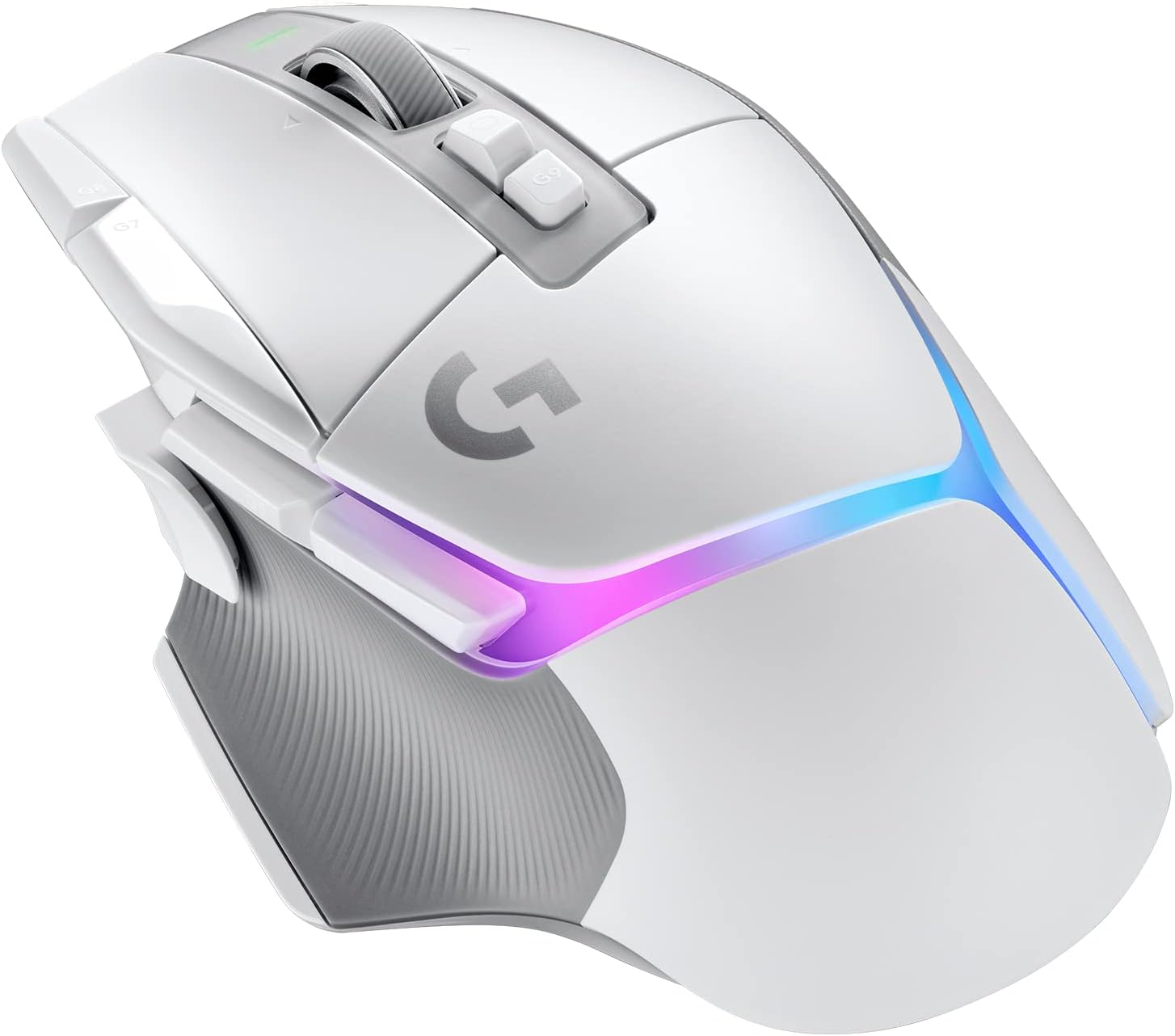
Short answer: For most non-competitive FPS players in 2026, the Logitech G502 Hero is still a defensible default — comfortable for medium-to-large hands, flawless sensor, useful side buttons, and a wired price that's hard to beat. For aggressive competitive FPS where every gram matters, you should look at modern 60-80g ultralight mice instead. For everyone in between, the G502's eight years on the market is a feature, not a bug.
This piece is editorial synthesis of Logitech's product page, RTINGS' mouse database, and community discussion in r/MouseReview and similar forums. No first-party measurements are reported.
Key takeaways
- The G502 Hero is a 121-gram (no weights) wired mouse with the HERO 25K optical sensor and 11 programmable buttons.
- It's been on the market since 2018 and has barely changed because it didn't need to.
- The shape is right-handed asymmetric, optimized for palm or claw grip on medium-to-large hands.
- For competitive Valorant / CS2 ultra-low-sens flick-shot gameplay, modern 60-80g ultralights are the meta.
- For Apex, Overwatch, Destiny 2, MMO-FPS hybrids, and general gaming, the G502 Hero is still excellent value.
What makes a "best FPS mouse"?
The marketing language around gaming mice is overheated. The actual technical factors that determine whether a mouse is good for FPS are well-understood:
- Sensor quality. Tracking accuracy at the speeds you actually flick at; no spinout (running out of sensor velocity range); no acceleration artifacts. Every quality gaming mouse in 2026 has acceptable sensors. The G502 Hero's HERO 25K sensor is among the best in the category.
- Weight. Lower is generally better for flick aiming because you accelerate the mouse less. There's a tradeoff — too-light mice feel "floaty" and harder to control for slower tracking. The sweet spot for competitive FPS is 60-80 grams; for general gaming, 90-110 grams is fine.
- Shape. Has to fit your hand and your grip style (palm, claw, fingertip). This is more personal than any other factor; a mouse with perfect specs that doesn't fit your hand is the wrong mouse.
- Click feel. Crisp pre-travel, clear actuation, low post-travel. Microswitch choice (Omron, Kailh, etc.) determines feel and longevity.
- Side buttons. Position and number matters for thumb-actuated abilities and binds.
- Cable or wireless. Modern LIGHTSPEED-class wireless is indistinguishable from wired in latency. Wired is cheaper.
The G502 Hero scores well on sensor, click feel, and side buttons. It scores middling-to-poor on weight (heavier than current competitive meta). Shape is good for medium-to-large palm/claw grip users, poor fit for small hands or fingertip-grip players.
The eight-year-old mouse problem
The G502's basic shape predates the Hero version by years — the original G502 launched in 2014 with a 3366 sensor. The 2018 Hero update swapped the sensor for the HERO 25K and made the mouse meaningfully better without changing the shape. That's why people who used a G502 Proteus Spectrum a decade ago can pick up a current G502 Hero and feel instantly at home.
This stability is unusual in the gaming mouse market, where most product lines refresh annually with minor changes. The G502 has refreshed mainly through wireless (G502 LIGHTSPEED, G502 X Plus) and sensor updates, while keeping the shape constant. For a mouse you might keep for 4-5 years, that's a desirable property — the muscle memory you build doesn't get invalidated by the next product cycle.
Where the G502 still wins
| Use case | G502 Hero suitability |
|---|---|
| Casual FPS (Battlefield, Halo, single-player) | Excellent — comfortable, accurate, plenty of buttons |
| MMO-FPS hybrid (Destiny 2, Borderlands, The Division) | Excellent — buttons used heavily, weight not an issue |
| Tracking-heavy FPS (Apex, Overwatch, Quake-likes) | Good — sensor is flawless, weight is workable |
| Low-sens flick FPS (Valorant, CS2) | Acceptable — weight starts to matter, ultralights are meta |
| MMORPG (WoW, FFXIV) | Very good — buttons are useful for ability bars |
| MOBA (LoL, Dota 2) | Very good — sensor is flawless, side buttons useful |
| Productivity (browsing, coding, photo/video editing) | Excellent — scroll wheel infinite-spin is genuinely useful |
For the 80% of gaming-mouse buyers who aren't optimizing for competitive FPS, the G502 Hero remains a comfortable, durable, sensibly-priced default. Pair it with an XL cloth mousepad and you have an upgrade path that lasts years.
Where you should look elsewhere
The G502 is the wrong mouse for:
- Small hands. It's a medium-large mouse. If your palm length is under 17 cm, look at the Logitech G Pro X Superlight, Razer Viper Mini, Glorious Model O Minus, or Endgame Gear XM1.
- Pure-fingertip grip. The G502's body is too tall and curved for clean fingertip control. Lighter, flatter mice work better.
- Competitive low-sens FPS at semi-pro level. Weight matters here. Look at the Logitech G Pro X Superlight, Razer DeathAdder V3 Pro, Pulsar X2H, or similar 60-70g category.
- Symmetric/ambidextrous needs. The G502 is hard-right-handed.
Specs that matter
| Spec | Logitech G502 Hero |
|---|---|
| Sensor | HERO 25K optical |
| DPI range | 100–25,600 |
| Polling rate | 1000 Hz |
| Weight (without weights) | 121 g |
| Weight (max weights) | 137 g |
| Buttons | 11 programmable |
| Connection | Wired USB |
| Switch durability | 50M clicks (Hero generation) |
| Cable | Braided, ~2.1 m |
| Onboard memory | 5 profiles |
The polling rate of 1000 Hz is standard for the era; newer mice push 4000-8000 Hz, but the perceptual difference above 1000 Hz is genuinely difficult to detect in blind tests. The wired connection is dated by competitive-FPS standards but fine for most users and cheaper than the wireless variants.
Setup tips that actually help
- Mousepad. A large cloth pad like the SteelSeries QcK XXL makes a bigger difference than most mouse upgrades. Glide consistency matters.
- DPI setting. Don't run at 25,000 DPI because the box says you can. Most pros run 400-1600 DPI with high in-game sensitivity multipliers; you'll be more accurate too.
- Polling rate. 1000 Hz is fine. Higher is mostly placebo for most users; sometimes counterproductive if it strains an older CPU.
- Weights. Use them if you like the heavier feel; remove them all for the lightest possible config. Most people prefer somewhere in the middle.
- Onboard profiles. Configure your DPI/button layout once in G HUB, save to onboard memory, then you don't need the software running.
The peripherals that pair well
If you're building a desk setup around the G502, the rest of the kit that consistently pairs well in 2026:
- Mousepad: SteelSeries QcK XXL — large enough to fit any sensitivity, cloth surface lasts years.
- Monitor: ASUS TUF VG27AQ 27" 1440p 165Hz — high refresh, color accurate, IPS panel. The G502's sensor is good enough that the bottleneck on flick accuracy in 2026 is your display latency, not your mouse.
- Productivity keyboard combo: Logitech MK270 wireless keyboard+mouse — for the office/laptop-couch use case where you want a backup setup that isn't your gaming rig.
When to upgrade past the G502
You should upgrade when:
- You're playing competitive FPS at a level where 30-40g of mouse weight is a measurable disadvantage in your aim trainer scores.
- The G502 shape doesn't fit your hand (this is a try-it-and-decide situation).
- You specifically want wireless and your budget supports the G502 X Plus or a competing wireless mouse.
- The mouse physically wears out (5+ years of heavy use is realistic).
You should NOT upgrade because a new mouse came out. Most new mice in 2026 are marginal improvements on the same general category the G502 has occupied for years.
Bottom line
The Logitech G502 Hero is still on the shortlist of best gaming mice in 2026 because it does the basics well, has a stable proven shape, and represents excellent value. It's not the right mouse for ultralight competitive FPS, and it's not the right mouse for small hands. For everyone else, it's hard to go wrong.
Related guides
- Blue Yeti vs HyperX QuadCast 2 S: Best USB Mic for Streaming
- Best Controllers for Steam Deck and PC in 2026
Citations and sources
This piece is editorial synthesis based on publicly available information. No independent first-party benchmarking is reported.


