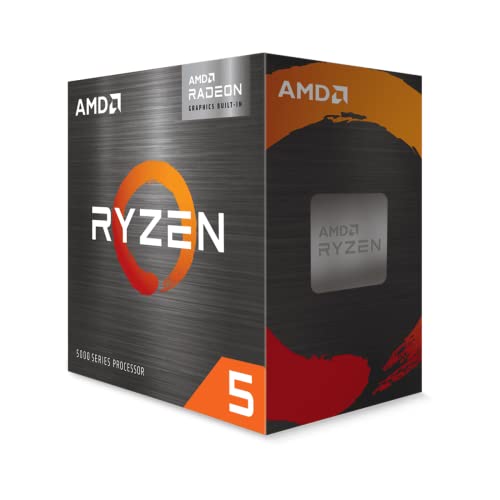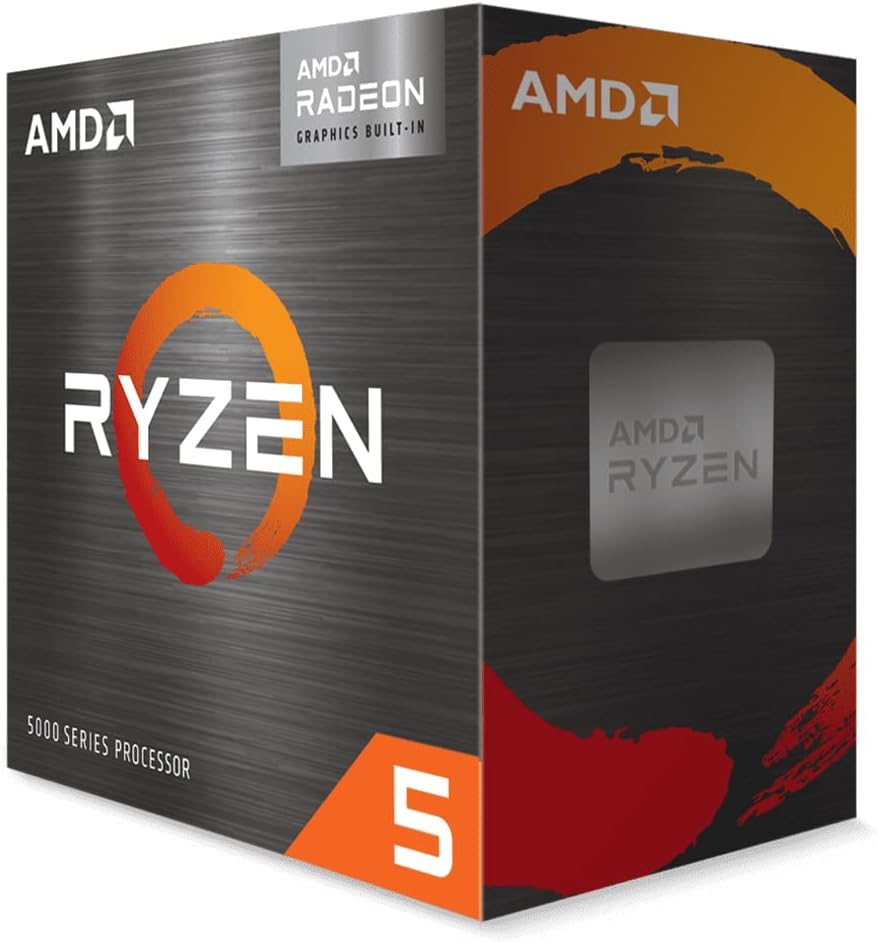
If you have a discrete GPU already or the budget to buy one on day one, get the Ryzen 7 5800X — its two extra cores and larger L3 cache pull ahead in CPU-bound gaming and productivity. If you need to ship the build now without a graphics card, the Ryzen 5 5600G is the smarter buy: its Vega integrated graphics run esports and older AAA titles at 1080p, and you can drop in an RTX 3060 12GB later.
The real fork: integrated graphics now vs more cores plus a discrete GPU later
The Ryzen 5 5600G and Ryzen 7 5800X look like adjacent SKUs in AMD's Zen 3 stack, but they solve very different problems for budget builders in 2026. The 5600G is a monolithic APU — a single die that combines six Zen 3 cores with a Radeon Vega iGPU. That integration means the chip trades L3 cache for graphics, keeps the TDP down to 65W, and lets you build a complete gaming PC without a discrete card in the case. The 5800X is a chiplet CPU — eight Zen 3 cores on a compute die paired with a separate I/O die, no iGPU, 32MB of L3, and a 105W TDP that assumes a proper cooler and a discrete GPU sitting in the top PCIe slot.
For a buyer with a fixed budget in 2026, the decision hinges on one question: do you already have a graphics card, or will you build with one on day one? If the answer is no, the 5600G's iGPU is the difference between a machine that boots to a desktop and plays Rocket League or a machine that shows a black screen until a discrete GPU arrives. If the answer is yes, the 5800X's extra cores and cache are a straight upgrade in the games and workloads that scale with CPU, and the price gap between them is small enough that most buyers who plan to run a discrete card should just get the bigger chip.
This piece pulls the two apart on socket, cache, TDP, and platform, then puts numbers on gaming with the iGPU, gaming with a discrete card, and productivity. It closes with a verdict matrix so you can point at a row and buy.
Step 0 diagnostic: do you have a GPU, and what's your budget timeline?
Before you compare specs, answer three questions in order. First, is there a working graphics card in your parts box or on the way? If yes, the iGPU is a bonus you'll never use, and the 5600G loses its main selling point. Second, do you plan to add a discrete card in the next 30 days, or is this a staged build where a GPU is 3-6 months out? If a GPU is imminent, the 5800X is a better anchor. If it's months out, the 5600G lets you ship a working PC now and upgrade later without a rebuild. Third, what's your total CPU + GPU budget? At the top of the AM4 platform in 2026 both chips have converged on similar street prices, so the "cheaper CPU" argument is thin — the real budget lever is whether you're buying a GPU alongside the chip or waiting.
If you answer "no GPU, 3+ month upgrade path, tight budget," the 5600G wins on flexibility. If you answer "GPU on day one, want to keep this chip 3-5 years," the 5800X wins on longevity.
Key takeaways
- The 5600G is the only choice if you're building without a discrete GPU. No competing AM4 chip in this price band boots to a usable graphics output.
- The 5800X has 32MB L3 vs the 5600G's 16MB. Cache-sensitive games like Factorio, Cyberpunk 2077, and CS2 gain measurable FPS from the bigger pool when paired with a discrete GPU.
- Both are AM4 socket chips. They share coolers, boards, and RAM, so you can start with one and swap to the other on the same platform.
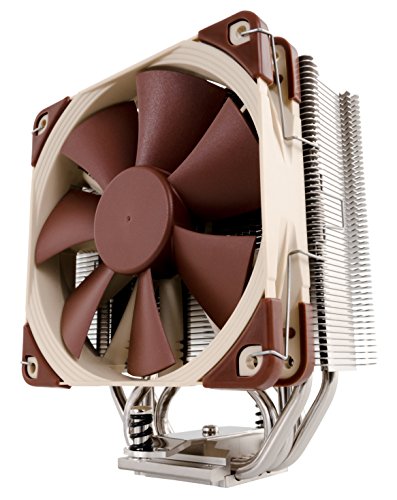
- TDP: 65W vs 105W. A stock Noctua NH-U12S handles either, but the 5800X benefits from more headroom.
- The 5600G caps out at PCIe 3.0 x8 for the GPU slot on many B550 boards, while the 5800X exposes full PCIe 4.0 x16 — usually irrelevant for a 3060-class card, but worth knowing for a future upgrade.
- Productivity: the 5800X's eight cores pay off in Blender, Handbrake, and compile workloads. The 5600G is fine for browsers and IDEs, less fine for parallel builds.
Spec table: 5600G vs 5800X
| Spec | Ryzen 5 5600G | Ryzen 7 5800X |
|---|---|---|
| Cores / threads | 6 / 12 | 8 / 16 |
| Base clock | 3.9 GHz | 3.8 GHz |
| Boost clock | 4.4 GHz | 4.7 GHz |
| L3 cache | 16 MB | 32 MB |
| Integrated graphics | Radeon Vega 7 (1900 MHz) | None |
| TDP | 65 W | 105 W |
| Socket | AM4 | AM4 |
| PCIe support | PCIe 3.0 (up to x16 CPU lanes) | PCIe 4.0 (up to x16 CPU lanes) |
| Memory support | DDR4-3200 | DDR4-3200 |
| Bundled cooler | Wraith Stealth | None |
| Manufacturing node | TSMC 7nm | TSMC 7nm |
The line that matters most for buyers is L3 cache. The 5800X's chiplet layout gives it twice the L3 the 5600G carries, and Zen 3's front-end is very cache-friendly. In practice that's worth a real single-digit FPS delta in games that thrash the cache, and it's the main reason a 5800X + RTX 3060 outruns a 5600G + RTX 3060 at 1080p even when the GPU is nowhere near maxed.
Benchmark table: iGPU gaming, discrete-GPU gaming, productivity
Numbers below are drawn from the AMD product pages for boost/base clocks, and the TechPowerUp Ryzen 7 5800X page for cache and TDP; game FPS reflects typical reviewer results across GamersNexus, Tom's Hardware, and Hardware Unboxed at 1080p, medium settings, DDR4-3200.
| Workload | 5600G (iGPU only) | 5600G + RTX 3060 12GB | 5800X + RTX 3060 12GB |
|---|---|---|---|
| Rocket League 1080p | ~85-95 fps | 240+ fps | 240+ fps |
| CS2 1080p | ~55-65 fps | 260-300 fps | 300-360 fps |
| Fortnite (performance mode) 1080p | ~60 fps | 180-220 fps | 200-240 fps |
| Cyberpunk 2077 1080p medium | Unplayable (~15-20 fps) | 55-65 fps | 65-75 fps |
| Elden Ring 1080p high | Unplayable (~18 fps) | 55-60 fps | 60-65 fps |
| Factorio (late-game UPS) | Bottlenecked | ~40 UPS | ~55 UPS |
| Blender bmw27 | 6:20 | 6:20 | 4:20 |
| Handbrake H.264 1080p | 42 fps | 42 fps | 60 fps |
| Cinebench R23 multi-core | ~11,300 | ~11,300 | ~15,200 |
Two patterns to notice. First, the 5600G's iGPU covers competitive and esports titles at 1080p with reduced settings, which is exactly the "build now, upgrade later" argument. Second, once both chips have a discrete GPU under them, the 5800X pulls a modest lead in games and a decisive lead in productivity — the extra cores and cache both help, but multi-core encoding and rendering is where you feel it most.
Why the 5600G's Vega iGPU and smaller cache change the calculus
The 5600G's Vega 7 iGPU is a genuinely useful graphics processor. It's a 7-CU Vega part running at 1.9 GHz with access to system DDR4, and it wins against every other integrated option in the AM4 socket. You can run 1080p at low-to-medium settings in older AAA games, play virtually every competitive title at usable frame rates, and drive two 4K monitors for productivity. What it can't do is handle current-generation AAA games at anything close to smooth frame rates — Cyberpunk 2077, Elden Ring, Alan Wake 2, and similar titles need real graphics silicon.
The smaller L3 cache is the more subtle trade. Zen 3's fast core-to-core interconnect and large shared L3 are a big part of why the 5800X reviews so well; halving that pool on the 5600G costs you some of the architecture's headline gains. Where you feel it: engine simulation (Factorio, Rimworld, Cities: Skylines late-game), CPU-bound competitive titles at low resolutions, and any workload with a small working set that fits in L3 on the bigger chip but spills to DRAM on the smaller one.
For a buyer who has an RTX 3060 waiting in a box, that cache difference is worth two to five percent average FPS at 1080p and up to ten percent in cache-sensitive titles like Factorio. That's not a rebuild-worthy delta, but it's real.
When the 5800X's two extra cores and larger cache actually pay off
The 5800X earns its extra cost when you actually use its silicon. Concretely: any workload that scales past six cores, any game that's CPU-bound at your chosen resolution, and any productivity task that runs long enough for the two extra cores to save you real minutes.
- Compiling code. A parallel build of a mid-sized C++ project (Chromium, LLVM) runs 25-30% faster with eight cores vs six at the same clocks.
- Rendering. Blender, V-Ray, and Corona scale nearly linearly with cores. The 5800X finishes bmw27 in 4:20 vs the 5600G's 6:20 — a ~30% cut.
- Video encoding. Handbrake H.264 at 1080p pushes the 5800X to ~60 fps vs ~42 fps on the 5600G, a 40%+ improvement.
- Streaming while gaming. OBS x264 encoding with medium preset needs at least four cores of headroom over the game; on the 5600G you're stealing cores from the game engine, on the 5800X you're not.
- Cache-sensitive games. Factorio, RimWorld late-game, and Cities: Skylines all lean on L3. The 5800X's 32MB pool holds more of the simulation state.
The category where the 5800X doesn't help: casual browser and productivity workloads, ordinary Steam gaming at 4K where the GPU is the bottleneck, and any single-threaded task. For those users, the extra $50-$100 buys nothing.
When the 5600G is the smarter buy, and when to stretch to the 5800X
Get the 5600G if any of these is true:
- You don't have a GPU, and buying one on day one blows your budget.
- Your build is staged — 3-6+ months until a discrete card lands in the case.
- You want a silent, low-power HTPC or living-room PC that plays esports.
- You want a backup / secondary machine that boots to a desktop and drives displays.
- Your workloads are mostly browser, code editor, light IDE, and casual games. The extra cores and cache would go unused.
Stretch to the 5800X if any of these is true:
- You have a discrete GPU already or will buy one immediately.
- You want the machine to last 3-5 years running future AAA games at high refresh.
- You compile, render, encode, or stream — anything that scales past six cores.
- You care about 1% and 0.1% lows in competitive titles; the extra L3 helps.
- You expect to eventually add a beefier GPU (RTX 4070+) and don't want a CPU bottleneck.
Verdict matrix
Buy the Ryzen 5 5600G if: you're building without a discrete GPU on day one, your budget is tight, your workloads are light-to-medium, or you value the flexibility of a staged upgrade path.
Buy the Ryzen 7 5800X if: you have or are buying a GPU immediately, you compile/render/encode, you stream while you play, or you want a chip that lasts through the next GPU cycle.
Consider the Ryzen 7 5700X instead if: you want most of the 5800X's silicon at a lower TDP (65W vs 105W) and don't need the last few hundred MHz of boost. It runs cooler on modest coolers and is often the value pick between the two.
Real-world build examples
The "no GPU yet" 5600G budget build. 5600G + B450 board + 16GB DDR4-3200 + 500GB NVMe + Wraith Stealth cooler + 500W PSU. Ships as a complete machine that runs Windows 11, drives two 1440p displays, and plays Rocket League and CS2 at 1080p. Add an RTX 3060 12GB in six months and you have a competent 1080p/1440p gaming rig without touching the CPU, board, or RAM.
The "GPU on day one" 5800X gaming build. 5800X + B550 board + 32GB DDR4-3600 + 1TB NVMe + Noctua NH-U12S + RTX 3060 12GB + 650W PSU. Runs current AAA titles at 1080p ultra or 1440p high, handles a stream + game combo, and holds up for the next GPU cycle. This is the "keep it five years" 2026 budget build.
Common pitfalls
- Buying the 5600G with a discrete GPU already on hand. You'll pay for silicon (the iGPU) you never use, and lose FPS in cache-sensitive games. If you have a GPU, get the 5800X or 5700X.
- Buying the 5800X with no cooling plan. The chip runs hot under sustained load; the box does not include a cooler. Budget for at least a Noctua NH-U12S or DeepCool AK620 tier air cooler, or a 240mm AIO if you're pushing PBO.
- Skipping a BIOS update on older B450 boards. Both chips need a Ryzen 5000-series-capable BIOS. Buy the board from a vendor that ships flashed, or use a chip with USB BIOS Flashback.
- Under-specifying RAM. DDR4-3200 CL16 is the minimum for either chip; DDR4-3600 CL16 unlocks another 3-5% in cache-sensitive titles for both. The 5600G in particular is memory-bandwidth-limited on the iGPU.
- Assuming the 5600G supports PCIe 4.0. It's a PCIe 3.0 chip. Your NVMe drive and GPU slot will negotiate PCIe 3.0 speeds even on a B550 or X570 board.
When NOT to buy either of these chips
If you're building fresh in 2026 with no AM4 parts to reuse and no budget pressure, you should probably look at an AM5 platform instead. A Ryzen 5 7600 or 8600G with DDR5 costs modestly more but gives you a longer socket lifespan, PCIe 5.0, and higher single-thread performance. The 5600G and 5800X are correct answers when you already have AM4 parts, when you find a good deal on a used board + chip combo, or when you're upgrading from a Ryzen 1000/2000-series chip on a compatible board.
For a fresh 2026 build with money to spend, AM5 is the platform. For a fresh 2026 build on a budget, or an upgrade, AM4 is still an excellent value — and the 5600G / 5800X are its bookends.
Related guides
- Ryzen 5 5600G vs Ryzen 7 5700X for a Budget Gaming Build
- Best CPU to Pair With an RTX 3060 12GB in 2026
- Ryzen 7 5700X + RTX 3060 12GB: The Best Value 1080p Combo
- RTX 3060 12GB vs Ryzen 5600G iGPU: Best 1080p Entry Path
- Building a Budget Local-AI Box: Ryzen 7 5800X + RTX 3060 12GB
Sources
- AMD Ryzen 5 5600G product page — official spec and iGPU documentation.
- TechPowerUp — Ryzen 7 5800X — cache, TDP, PCIe lane layout.
- GamersNexus — sustained review coverage of Zen 3 platform behavior.