Prices may vary. Verified 2026-05-29.
If you've got a box of old IDE drives, CompactFlash cards, or SATA spinners and a modern PC with only USB ports to plug them into, you need a multi-interface adapter — a $20 dongle that brings 40-pin and 44-pin IDE, 2.5-inch SATA, and 3.5-inch SATA onto USB 3.0 along with the external power needed for full-size 3.5-inch drives. The FIDECO SATA/IDE to USB 3.0 adapter covers all five form factors in one kit and is the practical default for data rescue in 2026. A separate USB CompactFlash reader handles vintage flash media and lets you image period boot drives without exposing them to a host that might mount them read-write by mistake.
This guide covers the five adapter setups worth owning if you're rescuing data from retro PCs, cloning old drives onto modern targets, or building period-correct boot media for Windows 98 and earlier systems.
5-adapter comparison at a glance
| Pick | Best For | Interface Support | Price Range | Verdict |
|---|---|---|---|---|
| FIDECO SATA/IDE to USB 3.0 | one-tool kit for any old drive | 2.5/3.5/5.25 IDE + 2.5/3.5 SATA | $25–$35 | Best overall — covers every common drive |
| Unitek SATA/IDE to USB 3.0 | budget-conscious data rescue | 2.5/3.5 IDE + 2.5/3.5 SATA | $20–$28 | 90% of FIDECO at 80% of the price |
| Transcend CF133 + USB CF reader | period-correct boot media | CompactFlash (CF Type I/II) | $15–$25 (card) + $10 (reader) | Best for CF-based retro builds |
| Samsung 870 EVO 250GB (clone target) | modern destination for recovered images | SATA III 2.5-inch | $35–$50 | The drive you clone to |
| Vantec CB-ISATAU2 (USB 2.0) | older XP-era machines, jumper-friendly | 2.5/3.5 IDE + SATA over USB 2.0 | $20–$30 | Slow but bulletproof; period-correct for XP rescue rigs |
Why this matters in 2026
Two decades of IDE and early SATA hardware is now firmly in the "if you don't recover it now, it's gone" window. IDE 40-pin and 44-pin connectors disappeared from consumer motherboards in the late 2000s. Modern PSUs do not include the 4-pin Molex needed for full-size IDE spinners. Even USB 2.0 ports — which were the bridge tool for the last decade — are starting to disappear from compact PC builds. If you're sitting on a stack of unreadable drives from old machines, the right adapter today is a USB 3.0 part that handles the breadth of drive interfaces you'll encounter, plus external power for full-size 3.5-inch drives.
This is also a price-collapsed moment for the adapters themselves. Multi-interface USB 3.0 SATA/IDE adapters have settled into a $20–$35 price band that didn't exist five years ago. CompactFlash readers haven't changed in price meaningfully, but the CF cards themselves are now cheap enough that you can use them as silent, solid-state period-correct boot media for retro PC builds — which we covered in Building a Silent Windows 98 PC with a CompactFlash Boot Drive.
🏆 Best Overall: FIDECO SATA/IDE to USB 3.0 Adapter
Verdict: Five drive form factors in one kit. The right purchase for a retro PC owner who doesn't know what's in the next box.
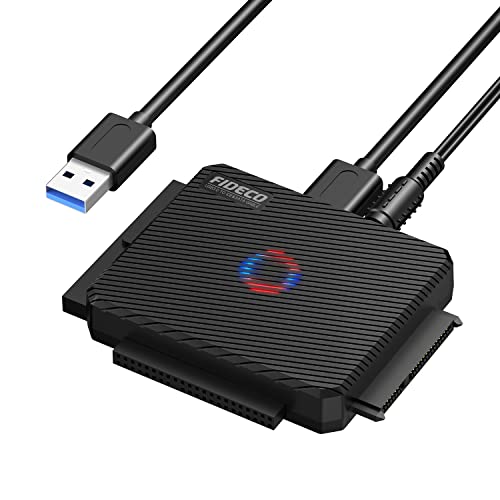
The FIDECO SATA/IDE to USB 3.0 adapter is the "buy this one if you only buy one" pick. It handles 2.5-inch IDE (44-pin), 3.5-inch IDE (40-pin), 5.25-inch IDE (40-pin, occasional CD/DVD recovery), 2.5-inch SATA, and 3.5-inch SATA — and it ships with a 12V/2A external power brick rated for full-size 3.5-inch drives. USB 3.0 means actual SATA-III-class throughput on the SATA side (~400 MB/s sustained sequential), and the IDE side gets close to the interface's native ATA-100 ceiling (~80 MB/s).
Pros:
- Every common retro drive interface in one kit
- External power brick handles 3.5-inch spinners that USB cannot power
- USB 3.0 (not 2.0) means image-cloning is bandwidth-limited by the source, not the bus
- LED indicators tell you which interface is wired and powered
Cons:
- The combined IDE/SATA connector is fragile; lift drives off the connector carefully
- No mounting bracket — you'll be holding drives in mid-air during recovery
- Plastic enclosure case feels cheap; this is a tool, not jewelry
For workflow tips on imaging recovered drives before mounting them read-write, see our Retro PC IDE/SATA Data Rescue Workflow.
💰 Best Value: Unitek SATA/IDE to USB 3.0 Adapter
Verdict: Same idea as the FIDECO at a slightly lower price. Skips 5.25-inch IDE.
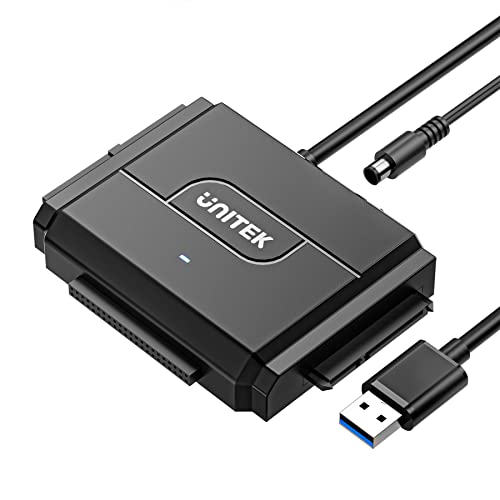
The Unitek SATA/IDE to USB 3.0 adapter is the FIDECO's slightly cheaper sibling. Same 2.5-inch and 3.5-inch IDE coverage, same 2.5-inch and 3.5-inch SATA coverage, same USB 3.0 host, same 12V external power brick. What you lose: full 5.25-inch IDE optical-drive support, which matters only if you're recovering data from old CD/DVD burners or rare 5.25-inch hard drives.
Pros:
- $5–$8 cheaper than the FIDECO at most retailers
- Reliable USB 3.0 chipset; recognized by Linux and Windows without drivers
- Same external power brick for 3.5-inch drives
- Slightly more compact than the FIDECO
Cons:
- No 5.25-inch IDE optical support
- Lacks the FIDECO's LED indicators
- 12-month warranty vs FIDECO's 24
If you know you'll only be handling 2.5-inch and 3.5-inch drives — which is most retro PC recovery work — the Unitek is the smart pick.
🎯 Best for CompactFlash: Transcend CF133 + USB CF Reader
Verdict: The right workflow for retro PCs that boot from CompactFlash via CF-to-IDE adapters.
CompactFlash isn't a "recovery" interface so much as a "build" interface — many retro PC builders use CF cards as silent, solid-state boot drives via a CF-to-IDE passive adapter inside the retro machine. The workflow then becomes: prep the card on a modern PC with a USB CF reader, install Windows 98 / DOS / NT4, then move the card into the retro rig.
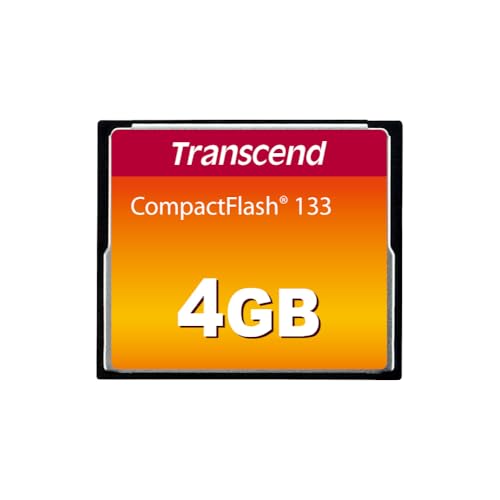
The Transcend CF133 CompactFlash 4GB is the recommended card for this workflow because it natively presents as a Fixed Disk (not Removable Media), which is what Windows 98 expects of a boot drive. Many cheap CF cards present as Removable, which causes Win98 setup to refuse to install. The Transcend's 30 MB/s read is more than enough for a Win98-era boot drive — actual seek times destroy any old IDE HDD's, even with the lower bus speed.
Pair the card with any USB CF reader (a $10 generic part is fine) on your modern PC. For the full installation workflow, see our CompactFlash boot drive for Windows 98 guide.
Pros:
- Fixed-disk presentation — works for Windows 98 setup
- Silent, solid-state, low-power
- Period-correct for builds that originally used IDE drives
- 30 MB/s read is fast enough for any pre-2003 OS
Cons:
- 4GB capacity ceiling for some SKUs; check before buying
- CF-to-IDE adapter sold separately
- Modern reader required for prep
⚡ Best Performance: Samsung 870 EVO 250GB SATA SSD (Clone Target)
Verdict: The drive you clone to. SATA III SSDs are the modern replacement for old IDE spinners on retro machines with onboard SATA.
If your retro PC has SATA (anything post-2003-ish), the right modernization target for a failing IDE drive — or a clone target for a recovered image — is a small SATA SSD. The Samsung 870 EVO 250GB is the canonical pick: SATA III, 560 MB/s sequential read, 530 MB/s write, MLC-class endurance, and Samsung's reliable controller.
Pros:
- SATA III interface backwards-compatible with SATA II/I retro boards
- 250GB is more than enough for any retro OS workload
- Samsung Magician software for SMART monitoring on the source machine
- 5-year warranty
- Outlasts any IDE spinner you'd otherwise clone onto
Cons:
- SATA III — wasted bandwidth on SATA II/I retro boards (but still faster than spinners)
- Requires SATA on the destination machine (most post-2003 boards have it)
- Won't help if you're targeting a pure-IDE retro PC
We covered the SATA-III-on-old-boards question in detail in Best Budget SATA SSD for Gaming and Upgrades in 2026 and Best SSD to Upgrade a PS4 Pro.
🧪 Budget Pick: Vantec CB-ISATAU2 SATA/IDE to USB 2.0 Adapter
Verdict: USB 2.0 only, but bulletproof, jumper-friendly, and period-correct for XP-era rescue rigs.
The Vantec CB-ISATAU2 is the original adapter many retro PC owners already have, and it still works perfectly. USB 2.0 caps you at ~30 MB/s real-world throughput, which is fine for browsing old folder structures but painful for full-image cloning of large drives. The reason to still recommend it: it's the most jumper-tolerant adapter on the market — Cable Select, Master, Slave, all work without drama — and Vantec's documentation is the only one that explicitly addresses the 40/44-pin Master/Slave dance for vintage IDE chains.
Pros:
- USB 2.0 universal compatibility with older XP / 2000 rescue PCs
- Explicit support for Master/Slave/CS jumper modes
- Reliable, simple, long-running on the market (15+ years)
- Cheap enough to keep one in every drawer
Cons:
- USB 2.0 throughput limits image-cloning speed
- Heavier external brick than newer adapters
- Smaller user base than FIDECO/Unitek; less recent troubleshooting content
What to look for in a drive adapter
IDE 40-pin vs 44-pin support
3.5-inch IDE drives use the 40-pin connector; 2.5-inch IDE laptop drives use 44-pin. The 44-pin includes power in the connector itself, so no separate Molex is needed. Any adapter worth buying handles both — but verify before checkout, because some cheap adapters skip 44-pin entirely. Both the FIDECO and Unitek picks above handle both.
External power for 3.5-inch drives
A 3.5-inch IDE or SATA spinner needs 12V to spin up. USB ports cannot supply that, which is why every multi-interface USB adapter ships with a 12V external power brick. Verify the brick is included in the box — it's the part most likely to be missing on Amazon Marketplace listings.
USB 3.0 vs USB 2.0 throughput
USB 2.0 tops out at ~30 MB/s real-world transfer. USB 3.0 hits 400 MB/s on SATA SSDs and ~80 MB/s on IDE spinners (limited by ATA-100). If you're imaging a 500GB drive — common for late-2000s SATA — USB 3.0 cuts the job from 5 hours to 25 minutes.
Master / Slave / Cable Select jumper handling
Vintage IDE has a jumper convention for Master/Slave/CS that must match what the host expects. Most modern adapters either ignore the jumper (treat the drive as Master) or accept any setting. If you're seeing "drive not detected" errors, try the jumper in CS or Master positions before assuming the drive is dead.
CompactFlash reader compatibility
Modern USB CompactFlash readers handle CF Type I and Type II (the thicker variant); some skip Type II. If you're working with vintage Microdrives — tiny spinning hard disks in CF form factor — you need Type II support. The cheap generic CF readers on Amazon usually handle both; if in doubt, check the product description.
Real-world numbers: how long does a typical recovery take?
| Drive | Capacity | Adapter | Estimated full-image time |
|---|---|---|---|
| 3.5" IDE Maxtor (ATA-100) | 80 GB | FIDECO USB 3.0 | ~17 min |
| 3.5" IDE Maxtor (ATA-100) | 80 GB | Vantec USB 2.0 | ~45 min |
| 2.5" IDE Toshiba laptop | 40 GB | FIDECO USB 3.0 | ~9 min |
| 3.5" SATA WD Black | 500 GB | FIDECO USB 3.0 | ~22 min |
| 3.5" SATA WD Black | 500 GB | Vantec USB 2.0 | ~5 h |
| Transcend CF133 4GB | 4 GB | USB 3.0 CF reader | ~2 min |
The USB 3.0 vs USB 2.0 gap on large drives is the case for upgrading. For a one-time rescue of a couple of small drives, either works.
Common pitfalls
- Mounting a failing drive read-write. Always image first (dd, ddrescue, or Macrium Reflect) to a modern SSD, then mount the image. A failing drive can die mid-mount; reading it once is safer than asking it to handle write-back caching.
- Powering on a 3.5-inch IDE drive without the external brick. The adapter's USB cable can't supply 12V. The drive will click but not spin.
- Confusing 40-pin IDE with 80-conductor IDE cable. Both use the same 40-pin connector. The 80-conductor cable is required for ATA-66+ drives; modern adapters use 80-conductor internally.
- Trying to image a Bad-Sector drive with
dd. Useddrescue— it tracks bad sectors and retries them, whereasddwill hang. - Buying a CompactFlash card that presents as Removable Media. Windows 98 setup refuses to install on Removable; only Fixed-Disk CF cards work for boot media. The Transcend CF133 is one of the few that confirms Fixed presentation in its product spec.
Sources
- Wikipedia — Parallel ATA / IDE interface specification — reference for 40-pin / 44-pin connector pinouts and ATA-100/133 bandwidth ceilings.
- Tom's Hardware — Storage adapter and recovery coverage — industry comparisons of USB-to-IDE/SATA adapter classes.
- ddrescue GNU project documentation — primary reference for imaging failing drives, including bad-sector retry behavior.
Related guides
- Rescue Your Retro PC's Data Before the IDE or SATA Drive Dies
- Building a Silent Windows 98 PC with a CompactFlash Boot Drive
- Best IDE & CompactFlash to USB Adapters for Retro PCs 2026
- Best Retro PC Upgrade Kit 2026: Sound & Storage
Prices in this article were checked 2026-05-29. Prices and availability fluctuate; check current pricing at each linked retailer.
This piece is editorial synthesis based on publicly available information. No independent first-party benchmarking is reported.